
Introduction: Why Glucagon Generic Characterization Is Technically Demanding
Glucagon Generic Characterization is demanding because glucagon is one of the least stable therapeutic peptides in routine clinical use. The 29-residue hormone, used for severe hypoglycaemia and as a diagnostic aid, degrades quickly once reconstituted, forming chemical degradants and physical aggregates within hours. A generic developer therefore has to prove not only that the molecule is the same, but that it behaves the same under stress.
At ResolveMass Laboratories Inc., a Canadian analytical CRO/CDMO specializing in mass spectrometry, biosimilar and peptide characterization, we design these studies so that each claim of sameness is backed by at least two independent analytical techniques. This case study walks through how that works for deamidation, fibrillation and impurity profiling.
Summary:
- Glucagon Generic Characterization is the orthogonal analytical comparison of a generic glucagon product against its reference listed drug (RLD) to show the same peptide sequence, comparable impurity profile and equivalent stability behaviour.
- Glucagon is a 29-amino-acid peptide hormone that can undergo chemical degradation, including deamidation, oxidation and isomerization.
- Physical instability, particularly self-association, oligomer formation and fibrillation, can affect product quality and biological performance.
- LC-MS/MS and high-resolution mass spectrometry (HRMS) identify and characterize peptide-related impurities and degradation products.
- Size-exclusion chromatography (SEC), SEC-MALS, dynamic light scattering (DLS) and field-flow fractionation (FFF-MALS) give complementary information about aggregation.
- Peptide mapping, circular dichroism (CD), FTIR and biological activity assays establish structural and functional comparability.
- A complete strategy evaluates primary sequence, physicochemical properties, higher-order structure, aggregation states, impurity profiles and biological activity.
- FDA’s revised draft product-specific guidances, announced in July 2026, reinforce the importance of advanced characterization for generic peptide development.
Scope note: This article describes a representative case-study workflow based on ResolveMass’s analytical approach to glucagon. It is not a report of a specific client programme, and no client data are disclosed.
1: What Is Glucagon Generic Characterization and Why Does It Matter?
Glucagon Generic Characterization is the structured analytical evidence showing that a generic glucagon matches the RLD in identity, purity, impurity profile and degradation behaviour. It matters because regulators expect an ANDA applicant to demonstrate sameness and to show that any differences in impurities do not affect safety or immunogenicity risk.
For synthetic peptides referencing an rDNA-origin RLD, FDA guidance expects the applicant to identify and characterize peptide-related impurities and compare them with the RLD. Glucagon is a clear example, as the commercial reference product is recombinant while a generic may be produced by chemical synthesis.
| Characterization Pillar | Question Answered | Typical Techniques |
|---|---|---|
| Identity and sequence | Is the primary structure the same? | LC-HRMS, peptide mapping, MS/MS sequencing |
| Chemical degradation | Which modifications form, and how fast? | RP-HPLC/UPLC, LC-HRMS |
| Physical stability | Does the peptide aggregate or fibrillate? | ThT assay, SEC, DLS, microscopy |
| Impurity profile | Are impurities at or above 0.10% identified? | LC-HRMS, MS/MS, orthogonal LC |
| Higher-order structure | Is the secondary structure comparable? | Circular dichroism, FTIR |
Why Is Glucagon Generic Characterization Challenging?
It is challenging because matching the amino acid sequence alone does not establish analytical similarity. Chemical modifications, conformation, aggregation, peptide-related impurities and biological activity must also be compared, and degradation can arise during synthesis, purification, formulation, storage or even sample handling.
| Challenge | Potential Impact | Recommended Approach |
|---|---|---|
| Deamidation | Modified peptide species and possible potency change | LC-MS/MS, UHPLC-HRMS |
| Oxidation | Modification of susceptible residues | LC-MS/MS, peptide mapping |
| Isomerization | Change in amino acid configuration | LC-MS/MS, advanced peptide mapping |
| Oligomer formation | Shift in molecular-size distribution | SEC, SEC-MALS, DLS |
| Fibrillation | Ordered insoluble or soluble aggregates | ThT assay, FTIR, TEM |
| Process-related impurities | Differences between synthetic and recombinant manufacture | UHPLC-HRMS, LC-MS/MS |
| Structural differences | Altered secondary structure or association | CD, FTIR, NMR |
| Activity differences | Possible change in pharmacological performance | Comparative functional bioassay |
Because no single result is conclusive, different techniques should provide complementary evidence rather than relying on one chromatographic purity value.
2: How Do You Characterize Deamidation in Glucagon?
Deamidation in glucagon is characterized by separating the modified species with a stability-indicating chromatographic method, then locating the modification on the sequence with high-resolution mass spectrometry and peptide mapping. Deamidation converts asparagine or glutamine to a carboxylic acid residue and adds roughly 0.984 Da, a small mass shift that needs accurate-mass instrumentation to detect reliably.
Deamidation Analysis in Glucagon Generic Characterization
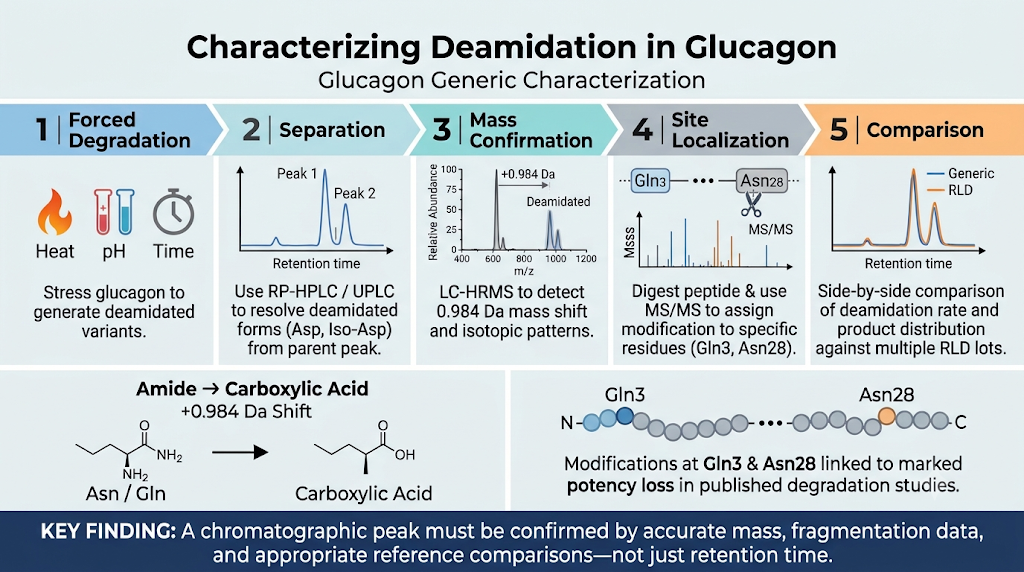
In this workflow, deamidation is treated as a critical quality attribute. The steps are:
- Forced degradation: Stress glucagon across pH, temperature and time to generate the full range of deamidated variants.
- Separation: Use RP-HPLC/UPLC to resolve deamidated forms, including aspartate and isoaspartate products, from the parent peak.
- Mass confirmation: Use LC-HRMS to confirm the +0.984 Da shift and the isotopic pattern.
- Site localization: Digest the peptide and apply MS/MS to assign the modification to a specific residue, such as Asn28 or the glutamine residues.
- Side-by-side comparison: Compare the deamidation rate and product distribution of the generic against multiple RLD lots.
Why this matters: a generic that deamidates at a different site or rate than the RLD may carry a different impurity risk, even when the starting purity looks identical.
Which Residues Deamidate, and What Else Degrades?
Published research on glucagon degradation reports deamidation and isomerization under alkaline conditions, with modifications at Gln3 and Asn28 linked to marked potency loss in the degradation products studied. This is why impurity identification should be tied to functional evaluation rather than chemical purity alone.
Deamidation is not examined in isolation. The study also covers:
| Degradation Pathway | Analytical Concern | Suitable Technique |
|---|---|---|
| Methionine oxidation | Oxidized glucagon species | LC-MS/MS |
| Aspartic acid isomerization | Structurally modified peptide | Peptide mapping, LC-MS/MS |
| Deamidation | Acidic peptide derivatives | UHPLC-HRMS |
| Peptide fragmentation | Shorter peptide sequences | LC-MS/MS |
| Sequence-related impurities | Deletion or insertion products | HRMS/MS |
Key finding: a chromatographic peak should not be called an impurity just because its retention time differs from the main glucagon peak. Accurate mass, fragmentation data and appropriate reference comparisons are needed to establish identity.
3: Why Does Glucagon Form Fibrils and How Is Fibrillation Measured?
Glucagon forms fibrils because the peptide is highly prone to self-association in solution, especially at acidic or alkaline pH and at higher concentrations. Fibrillation is measured by combining a fluorescence assay for amyloid-like structure with orthogonal methods that sense size, shape and secondary structure.
This is a physical stability issue as much as a chemical one. Fibrils can cause gelation, turbidity or particulates, and they may alter immunogenicity risk, so comparability to the RLD is essential.
| Method | What It Detects | Role in the Study |
|---|---|---|
| Thioflavin T (ThT) fluorescence | Amyloid-like beta-sheet structure | Kinetic fibrillation profile and lag time |
| Size-exclusion chromatography | Soluble oligomers and aggregates | Quantifies aggregate levels over time |
| Dynamic light scattering | Hydrodynamic size distribution | Early detection of particle growth |
| Circular dichroism / FTIR | Secondary structure shift | Alpha-helix or random coil to beta-sheet transition |
| TEM or AFM | Fibril morphology | Visual confirmation of fibril form |
Interpreting Fibrillation Data for Glucagon Generic Characterization
For a defensible comparison, the generic and RLD should be tested under identical concentration, pH, temperature and agitation conditions, with several RLD lots to capture natural variability. Comparable lag times, growth rates and fibril morphology support the conclusion that the two products share physical stability behaviour.
Distinguishing Oligomers, Aggregates and Fibrils
A larger molecular size does not automatically mean fibril formation, so the study separates three physical states: soluble oligomers, non-fibrillar aggregates and ordered fibrillar structures. Each technique contributes a different piece of evidence:
- SEC: separates monomer, soluble oligomers and higher-molecular-weight species, and tracks size distribution over time.
- SEC-MALS: adds molar mass for each separated species, subject to suitable separation and detector sensitivity.
- DLS: reports hydrodynamic size and flags large particle populations early, though large particles can dominate its signal.
- ThT fluorescence: indicates amyloid-like structure, but results depend on fibril structure and assay conditions, so they should not be read alone.
- TEM: visualizes fibrillar nanostructures directly, confirming whether signals reflect fibrils or simply oligomers.
The matched-condition design covers freshly prepared samples, controlled temperature exposure, agitation stress, extended solution holding and fibrillation-promoting conditions. Sample preparation (reconstitution, pH, temperature, concentration and holding time) is standardized so that handling differences are not mistaken for product differences.
A published study of glucagon aggregation combined SEC and field-flow fractionation with multi-angle light scattering (FFF-MALS) to compare generic and reference products, illustrating the value of examining both soluble species and broader particle populations.
4: How Do You Build an Impurity Profile for a Generic Glucagon?
An impurity profile for generic glucagon is built by detecting every related substance above the reporting threshold, identifying those at or above 0.10%, and comparing the full profile to the RLD. Impurities can originate from synthesis, from degradation, or from the formulation.
Common impurity categories include:
- Process-related: deletion and truncation sequences, insertion variants, incompletely removed protecting groups and racemized residues from synthesis.
- Degradation-related: deamidated forms, oxidized methionine (Met27), and hydrolytic cleavage products, particularly under acidic conditions.
- Physical variants: soluble oligomers, aggregates and fibrils.
- Formulation-related: excipient interactions and potential extractables or leachables from the container closure.
Our approach is to run an orthogonal LC method alongside the primary RP-HPLC to reveal co-eluting species, then use LC-HRMS and MS/MS to assign structures. Any impurity found in the generic but absent in the RLD, or present at a clearly higher level, is flagged early so that process or formulation adjustments can be made before submission.
UHPLC-HRMS and Peptide Mapping for Impurity Identification
UHPLC-HRMS resolves complex peptide impurity profiles by combining chromatographic separation with accurate-mass detection. The workflow covers separation, accurate mass, isotopic pattern evaluation, MS/MS fragmentation, structural assignment and a comparison of generic and reference profiles, which shows whether an impurity already exists in the RLD or is new to the generic process.
Peptide mapping adds evidence of sequence integrity and locates deletion or insertion variants, oxidation sites and deamidation sites. Combined with intact-mass analysis, it gives stronger structural evidence than either technique alone. Acylation of the peptide is another modification to rule out, particularly in formulations that can react with the peptide; see our guide to peptide acylation impurity analysis.
| Impurity Category | Examples | Techniques |
|---|---|---|
| Peptide-related | Deamidated or oxidized glucagon, deletion and insertion sequences | UHPLC-HRMS, LC-MS/MS |
| Process-related | Residual reagents, solvents, synthesis residues | GC-MS, LC-MS, ICP-MS as appropriate |
| Product-related degradation | Fragments, modified peptides, aggregation-associated species | LC-MS/MS, SEC, DLS |
The manufacturing route decides what else needs investigation: recombinant production may add host-cell-related impurities, while chemical synthesis may add synthesis residues and sequence variants.
5: How Are Higher-Order Structure and Biological Activity Assessed in Glucagon Generic Characterization?
Higher-order structure is compared with spectroscopic methods, and biological activity with a receptor-based comparative bioassay, because two samples with the same sequence can still differ in molecular organization or function.
| Technique | Objective |
|---|---|
| Circular dichroism (CD) | Compare secondary structure |
| FTIR | Detect structural change and beta-sheet-associated features |
| NMR | Detailed conformation, where concentration and physical state allow |
| Intrinsic fluorescence | Changes in the local molecular environment |
A suitable bioassay evaluates glucagon-receptor-mediated response, for example receptor activation, intracellular cAMP generation, concentration-response curves, relative potency and assay precision.
Important: a similar LC-MS profile or purity value does not on its own establish equivalent biological activity. Functional data must be read alongside structural and physicochemical results.
6: Case-Study Workflow: From Method Development to Submission Data
The representative workflow runs in six stages:
- Reference product assessment: Characterize several RLD lots to define the target quality range.
- Method development: Develop stability-indicating methods and confirm specificity through forced degradation.
- Method validation: Validate against ICH Q2(R2) expectations, including specificity, accuracy, precision, linearity, range and robustness.
- Comparative testing: Test the generic and RLD side by side for identity, impurities, deamidation and fibrillation.
- Stability study: Track degradation and aggregation over time under defined storage and in-use conditions.
- Data package assembly: Compile results, raw data and justifications for the CTD Module 3 quality section.
What Did the Case-Study Data Show?
In a representative outcome, the generic and RLD showed matching intact mass and peptide-map coverage, comparable deamidation profiles at the same sites, and overlapping fibrillation kinetics. A small number of low-level process-related impurities were identified and characterized below the qualification concern level, which supported the sameness argument without a need for additional clinical data.
What Are the Regulatory Expectations for Generic Glucagon?
Regulators expect a generic glucagon application to show sameness of the active ingredient and a justified comparison of impurities, supported by validated methods. FDA’s guidance on synthetic peptides referencing rDNA-origin products is the central reference, alongside ICH Q2(R2) for method validation and ICH Q1 for stability. Health Canada applies comparable expectations for ANDS filings, which is relevant for sponsors targeting both markets.
Because requirements evolve, sponsors should confirm the current guidance with their regulatory team before locking a study design.
What Does FDA’s Synthetic Peptide Guidance Say?
FDA’s May 2021 guidance, ANDAs for Certain Highly Purified Synthetic Peptide Drug Products That Refer to Listed Drugs of rDNA Origin, specifically includes glucagon. It recommends orthogonal evaluation of:
- Primary sequence and physicochemical properties.
- Secondary structure.
- Oligomer and aggregation states.
- Biological activity and function.
It also sets out a framework for comparing peptide-related impurities between a synthetic generic and a recombinant RLD: comparing common impurities, characterizing new specified impurities, assessing their effect on physicochemical properties and activity, and considering immunogenicity risk. For the peptides covered, FDA generally recommends identifying impurities at or above 0.10% of the drug substance. That is a recommendation within this context, not a universal specification for every glucagon product.
2026 update: FDA announced revised draft product-specific guidances for generic peptide products, including glucagon, on July 28, 2026. They address synthetic, recombinant and semi-synthetic manufacturing approaches, impurity thresholds, higher-order structure, biological activity and innate immune response assessment. Sponsors should consult the current draft or final guidance for their own reference product and pathway.
7: Can Glucagon Generic Characterization Extend to Long-Acting Peptide Formulations?
Yes, the same orthogonal logic carries over when a peptide is delivered from a polymer-based long-acting system, although the added polymer introduces its own variables. Sponsors exploring this route can use these related ResolveMass resources:
- Peptide behaviour in depots: characterizing peptides in PLGA microsphere and depot formulations.
- Polymer fundamentals: PLGA in drug delivery.
- Polymer properties and release: PLGA molecular weight and end-group chemistry and PLGA molecular weight and drug release.
- Veterinary use: PLGA and PLA veterinary long-acting injectables.
- Clinical supply: GMP-grade PLGA for Phase II/III clinical supply.
Why Work with ResolveMass Laboratories Inc.?
Sponsors choose ResolveMass because our work is built on hands-on peptide and biologic characterization rather than generic templates:
- Experience: routine work on peptide characterization, biosimilar comparability, forced degradation and impurity profiling.
- Expertise: high-resolution mass spectrometry, peptide mapping and orthogonal chromatography run by trained analytical scientists.
- Authoritativeness: data packages written around FDA, Health Canada, ICH and pharmacopoeial expectations.
- Trustworthiness: transparent reporting, documented methods and data-integrity controls, with clear statements of what a study does and does not demonstrate.
Conclusion:
A convincing Glucagon Generic Characterization package rests on three things: validated stability-indicating methods, orthogonal evidence for deamidation, fibrillation and impurities, and a side-by-side comparison against several RLD lots. Treating glucagon’s instability as a design input rather than a late surprise is what separates a smooth submission from a costly delay.
Frequently Asked Questions:
Glucagon deamidation is a chemical degradation process in which susceptible amino acid residues, particularly asparagine and glutamine, undergo conversion into acidic derivatives. This modification can alter peptide structure, chromatographic behaviour and potentially biological activity.
Deamidation can be detected using UHPLC-HRMS and LC-MS/MS. Deamidation generally produces a mass increase of approximately 0.984 Da per modified residue. Tandem mass spectrometry and peptide mapping help identify the modification site.
Glucagon fibrillation can occur due to peptide self-association under certain environmental conditions. Factors such as pH, temperature, peptide concentration, agitation, ionic strength and formulation composition can influence fibril formation.
LC-MS/MS helps identify and characterize glucagon-related impurities, including deamidated species, oxidized peptides, sequence variants and degradation products. It provides molecular mass and fragmentation information that supports structural identification.
SEC-MALS combines size-exclusion chromatography with multi-angle light scattering to provide information about the molar mass of separated molecular species. It helps investigate monomeric glucagon, soluble oligomers and higher-molecular-weight assemblies.
Reference
- D’Addio SM, Bothe JR, Walsh E, Gindy ME. Assessing the Impact of Functional Excipients on Peptide Drug Product Attributes During Pharmaceutical Development.https://books.rsc.org/books/edited-volume/801/chapter/540878
- Wolf AJ, Ricci A. Oligopeptide Regulatory Affairs and Challenges.https://books.rsc.org/books/edited-volume/2237/chapter/8149841
- Bao Z, Cheng YC, Luo MZ, Zhang JY. Comparison of the purity and impurity of glucagon-for-injection products under various stability conditions. Scientia Pharmaceutica. 2022 May 17;90(2):32.https://www.mdpi.com/2218-0532/90/2/32
- Kodidasu A, Acharyya K, Ramu VG. Absolute quantitation of coeluting impurities in peptide drugs using high resolution mass spectrometry: Glucagon a case study in pharmaceutical development. Journal of the American Society for Mass Spectrometry. 2025 Aug 26;36(10):2072-8.https://pubs.acs.org/doi/abs/10.1021/jasms.5c00105
About the Author