

Introduction:
Glycopeptide Characterization is a critical analytical process used to identify, quantify, and structurally analyze glycosylated therapeutic peptides. Glycosylation is one of the most important post-translational modifications (PTMs) influencing peptide therapeutics, directly impacting biological activity, serum half-life, stability, and immunogenicity.
As peptide therapeutics become increasingly sophisticated, regulatory agencies now expect detailed glycosylation analysis during drug development and commercialization. Pharmaceutical and biotechnology companies must therefore implement robust analytical strategies capable of accurately characterizing glycopeptide heterogeneity.
At ResolveMass Laboratories Inc., advanced mass spectrometry-based workflows are routinely applied to support glycopeptide analysis for innovator biologics, biosimilars, peptide-drug conjugates, and complex therapeutic peptides.
Summary:
- Glycopeptide Characterization is essential for understanding glycosylation patterns in therapeutic peptides and ensuring product safety, efficacy, and regulatory compliance.
- Glycosylation can significantly affect peptide stability, bioavailability, immunogenicity, and pharmacokinetics.
- Advanced analytical platforms such as LC-MS/MS, HRMS, HILIC, CE, MALDI-MS, and glycopeptide mapping are widely used for characterization.
- Accurate glycopeptide analysis supports:
- Biosimilar comparability studies
- Batch-to-batch consistency
- Stability assessment
- Process development
- Regulatory submissions
- Modern workflows combine enzymatic digestion, chromatographic separation, and high-resolution mass spectrometry for site-specific glycan analysis.
- ResolveMass Laboratories Inc. provides comprehensive analytical support for glycopeptide profiling and therapeutic peptide characterization.
1: What Is Glycopeptide Characterization?
Glycopeptide Characterization refers to the analytical evaluation of peptides containing covalently attached carbohydrate structures (glycans). The objective is to determine:
- Glycosylation sites
- Glycan composition
- Glycan heterogeneity
- Glycoform distribution
- Site occupancy
- Structural integrity
This characterization helps establish product quality attributes and ensures therapeutic consistency.
Why Glycopeptide Analysis Matters
Glycosylation can alter several critical properties of therapeutic peptides:
| Property | Impact of Glycosylation |
|---|---|
| Stability | Enhances resistance to enzymatic degradation |
| Solubility | Improves aqueous solubility |
| Pharmacokinetics | Extends circulation half-life |
| Immunogenicity | Can increase or reduce immune response |
| Biological Activity | Influences receptor binding |
| Manufacturing Consistency | Affects batch reproducibility |
Because glycosylation is highly sensitive to manufacturing conditions, even small process changes can alter glycan profiles.
2: Types of Glycosylation in Therapeutic Peptides
The first step in Glycopeptide Characterization is identifying the type of glycosylation present.
1. N-Linked Glycosylation
N-linked glycans are attached to the amide nitrogen of asparagine residues.
Common Features
- Consensus sequence: Asn-X-Ser/Thr
- Complex glycan branching
- Frequently observed in recombinant therapeutics
Analytical Importance
N-linked glycans significantly influence:
- Protein folding
- Stability
- Serum half-life
2. O-Linked Glycosylation
O-linked glycans attach to serine or threonine residues.
Characteristics
- No strict consensus sequence
- Highly heterogeneous
- Often difficult to characterize
Analytical Challenges
- Variable occupancy
- Diverse glycan structures
- Lack of universal enzymatic cleavage tools
3: Major Analytical Challenges in Glycopeptide Characterization
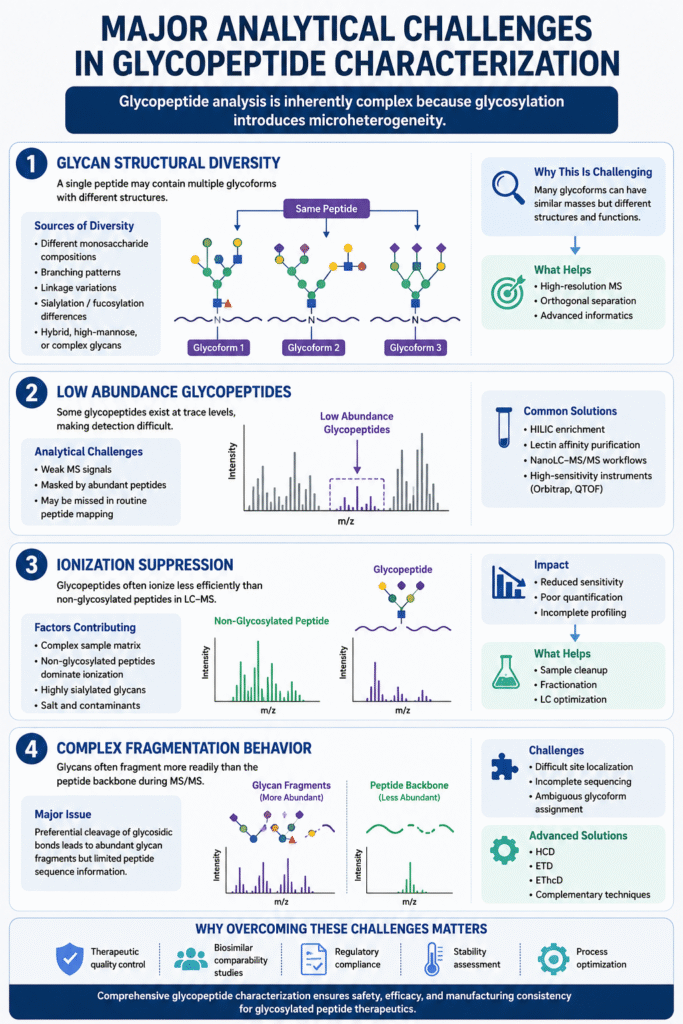
Glycopeptide analysis is inherently challenging because glycosylation creates extensive molecular heterogeneity. Even a single therapeutic peptide can exist in multiple glycosylated forms, making accurate identification and quantification difficult. Advanced analytical workflows are therefore required to achieve reliable Glycopeptide Characterization.
Key Challenges Include:
1. Glycan Structural Diversity
One of the biggest challenges in Glycopeptide Characterization is the enormous structural diversity of glycans. A single glycosylation site may contain numerous glycoforms that differ in composition and structure.
Common Sources of Diversity
- Different monosaccharide compositions
- Variable branching structures
- Linkage isomerism
- Differences in sialylation or fucosylation
- Presence of hybrid, high-mannose, or complex glycans
Why This Matters
This heterogeneity significantly increases analytical complexity because many glycoforms can possess similar molecular masses while exhibiting different biological properties. Accurate differentiation often requires:
- High-resolution mass spectrometry (HRMS)
- Orthogonal chromatographic separation
- Advanced bioinformatics tools
2. Low Abundance Glycopeptides
Certain glycopeptides may be present at extremely low concentrations compared to non-glycosylated peptides. Detecting these trace-level species can be particularly difficult in complex biological samples.
Analytical Challenges
Low-abundance glycopeptides may:
- Produce weak MS signals
- Be masked by highly abundant peptides
- Escape detection during routine peptide mapping
Common Solutions
To improve sensitivity, laboratories often use:
- Hydrophilic Interaction Liquid Chromatography (HILIC) enrichment
- Lectin affinity purification
- NanoLC-MS/MS workflows
- High-sensitivity Orbitrap or QTOF instruments
These approaches help enrich glycopeptides prior to mass spectrometric analysis.
3. Ionization Suppression
Glycopeptides frequently exhibit lower ionization efficiency during electrospray ionization (ESI)-based LC-MS analysis. The hydrophilic nature of glycans can reduce ion formation compared to standard peptides.
Consequences of Ionization Suppression
- Reduced detection sensitivity
- Poor quantitative reproducibility
- Incomplete glycopeptide profiling
Factors Contributing to Suppression
| Factor | Impact |
|---|---|
| Complex sample matrix | Competes for ionization |
| Non-glycosylated peptides | Dominant MS signals |
| Highly sialylated glycans | Reduced ionization efficiency |
| Salt contamination | Signal interference |
Careful sample cleanup and chromatographic optimization are essential to minimize suppression effects.
4. Complex Fragmentation Behavior
Fragmentation behavior in glycopeptide MS/MS analysis is highly complex. During collision-induced fragmentation, glycans often fragment more readily than peptide backbones.
Major Analytical Issue
This preferential cleavage can generate abundant glycan fragment ions while providing insufficient peptide sequence information.
Resulting Challenges
- Difficult glycosylation site localization
- Incomplete peptide sequencing
- Ambiguous glycoform assignment
Advanced Fragmentation Techniques
To overcome these issues, analysts commonly use:
- Higher-Energy Collisional Dissociation (HCD)
- Electron Transfer Dissociation (ETD)
- Electron-Transfer/Higher-Energy Collision Dissociation (EThcD)
These fragmentation approaches improve both glycan and peptide backbone characterization, enabling more confident glycopeptide identification.
4: Analytical Workflow for Glycopeptide Characterization
A robust Glycopeptide Characterization workflow generally combines multiple orthogonal analytical techniques.
| Workflow Step | Purpose |
|---|---|
| Sample Preparation | Protein extraction and cleanup |
| Enzymatic Digestion | Generate glycopeptides |
| Enrichment | Isolate glycopeptides |
| Chromatographic Separation | Reduce complexity |
| Mass Spectrometry | Structural identification |
| Data Analysis | Glycoform assignment |
5: Sample Preparation Strategies
Reliable sample preparation is essential for accurate characterization.
Common Preparation Steps:
Reduction and Alkylation
Used to:
- Break disulfide bonds
- Prevent reformation
- Improve digestion efficiency
Enzymatic Digestion
Proteases commonly used include:
| Enzyme | Application |
|---|---|
| Trypsin | Standard peptide mapping |
| Chymotrypsin | Complementary digestion |
| Glu-C | Improved sequence coverage |
Different enzymes help improve glycosylation site localization.
6: Glycopeptide Enrichment Techniques
Enrichment improves detection sensitivity for low-abundance glycopeptides.
1. HILIC Enrichment
Hydrophilic Interaction Liquid Chromatography (HILIC) preferentially retains glycopeptides due to their hydrophilic glycans.
Advantages
- High enrichment efficiency
- MS compatible
- Widely adopted
2. Lectin Affinity Chromatography
Lectins selectively bind specific glycan motifs.
Common Lectins
| Lectin | Glycan Specificity |
|---|---|
| ConA | Mannose-rich glycans |
| WGA | Sialic acid and GlcNAc |
| RCA120 | Galactose-containing glycans |
LC-MS/MS in Glycopeptide Characterization
Liquid Chromatography coupled with Tandem Mass Spectrometry (LC-MS/MS) is the gold standard for Glycopeptide Characterization.
Why LC-MS/MS Is Preferred
It enables simultaneous analysis of:
- Peptide backbone
- Glycosylation site
- Glycan composition
Common LC Techniques:
Reverse-Phase LC (RPLC)
Separates peptides based on hydrophobicity.
HILIC-LC
Enhances glycopeptide separation through glycan interactions.
High-Resolution Mass Spectrometry (HRMS)
High-resolution instruments provide accurate mass determination necessary for complex glycoform identification.
Common HRMS Platforms
| Instrument | Advantages |
|---|---|
| Orbitrap MS | High mass accuracy |
| QTOF-MS | Fast acquisition |
| FTICR-MS | Ultra-high resolution |
7: Fragmentation Techniques for Glycopeptide Analysis
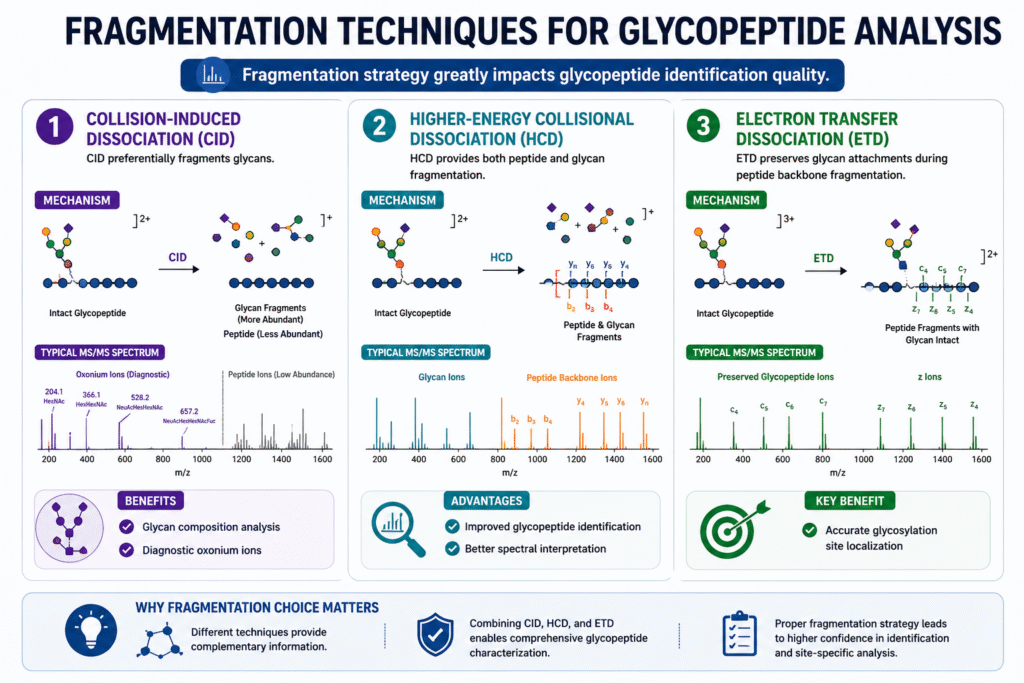
Fragmentation strategy is one of the most important factors in successful glycopeptide characterization. During tandem mass spectrometry (MS/MS), fragmentation methods determine how glycopeptides break apart, directly influencing the quality of peptide sequencing, glycan identification, and glycosylation site localization.
Because glycopeptides contain both peptide backbones and attached glycans, selecting the appropriate fragmentation technique is critical for obtaining complete structural information.
1. Collision-Induced Dissociation (CID)
Collision-Induced Dissociation (CID) is a traditional MS/MS fragmentation technique widely used in glycopeptide analysis. In CID, ions collide with inert gas molecules, causing fragmentation through vibrational energy transfer.
How CID Works:
CID preferentially breaks weaker glycosidic bonds before peptide backbone bonds. As a result, glycan fragments are often generated more abundantly than peptide sequence ions.
Benefits of CID:
Glycan Composition Analysis
CID is highly useful for determining:
- Monosaccharide composition
- Glycan branching patterns
- Presence of sialic acids or fucose residues
Diagnostic Oxonium Ions:
CID generates characteristic oxonium ions that serve as markers for glycopeptide detection.
Common Oxonium Ions:
| Oxonium Ion | Interpretation |
|---|---|
| m/z 204 | N-acetylhexosamine (HexNAc) |
| m/z 366 | Hex-HexNAc structure |
| m/z 274/292 | Sialic acid residues |
These ions help rapidly confirm glycosylated species during LC-MS/MS analysis.
Limitations of CID:
Although CID provides excellent glycan information, it may produce limited peptide backbone fragmentation, making glycosylation site localization difficult in some cases.
2. Higher-Energy Collisional Dissociation (HCD)
Higher-Energy Collisional Dissociation (HCD) is an advanced fragmentation technique commonly used in Orbitrap-based mass spectrometry systems.
Unlike traditional CID, HCD generates both glycan and peptide backbone fragments simultaneously.
Advantages of HCD:
Improved Glycopeptide Identification
HCD provides richer fragmentation spectra that contain:
- Oxonium ions
- Glycan fragment ions
- Peptide sequence ions
This improves confidence in glycopeptide assignments.
Better Spectral Interpretation:
The balanced fragmentation pattern allows researchers to analyze:
- Glycan composition
- Peptide sequence
- Glycosylation modifications
within a single MS/MS spectrum.
Why HCD Is Widely Used:
HCD has become one of the most preferred methods for glycopeptide characterization because it offers:
- High sensitivity
- Fast acquisition speed
- Compatibility with high-resolution MS
- Better automated database searching
3. Electron Transfer Dissociation (ETD)
Electron Transfer Dissociation (ETD) is particularly valuable for site-specific glycosylation analysis.
In ETD, electrons are transferred to peptide ions, causing peptide backbone cleavage while preserving fragile glycan attachments.
Key Benefit of ETD:
Accurate Glycosylation Site Localization
Because glycans remain attached to peptide fragments, ETD enables precise determination of:
- Glycosylation sites
- Site occupancy
- Glycoform positioning
This is especially important for complex therapeutic peptides and biologics.
Advantages of ETD:
| Advantage | Analytical Impact |
|---|---|
| Preserves glycans | Enables site localization |
| Extensive backbone fragmentation | Improves peptide sequencing |
| Ideal for labile PTMs | Maintains structural integrity |
Limitations of ETD:
ETD generally works best with:
- Higher charge-state ions
- Larger peptides
- High-resolution MS systems
It may be less effective for small or poorly ionizing glycopeptides.
8: Emerging Trends in Glycopeptide Characterization
Analytical technologies for glycopeptide characterization are evolving rapidly to address the increasing complexity of therapeutic peptides and biologics. Modern workflows now integrate advanced mass spectrometry, artificial intelligence, and high-throughput data analysis to improve accuracy, sensitivity, and efficiency.
These emerging technologies are helping researchers better understand glycosylation patterns, monitor critical quality attributes (CQAs), and accelerate therapeutic development.
1. Multi-Attribute Method (MAM)
MAM combines targeted and untargeted analysis using high-resolution MS.
Benefits
- Simultaneous monitoring of multiple CQAs
- Improved efficiency
- Enhanced product understanding
2. Artificial Intelligence and Machine Learning
AI-driven software now assists with:
- Automated spectral interpretation
- Glycan prediction
- Peak annotation
3. Native Mass Spectrometry
Native MS enables characterization under near-physiological conditions.
Advantages
- Preserves non-covalent interactions
- Provides conformational information
9: Importance of Glycopeptide Characterization in Therapeutic Development
Comprehensive Glycopeptide Characterization supports every phase of drug development.
Key Development Applications
| Development Stage | Analytical Objective |
|---|---|
| Discovery | Candidate screening |
| Process Development | Glycosylation optimization |
| Preclinical Studies | Structural verification |
| Clinical Manufacturing | Batch consistency |
| Commercial Release | Quality control |
10: Why Choose ResolveMass Laboratories Inc.
ResolveMass Laboratories Inc. provides advanced analytical services for complex therapeutic peptides and glycosylated biomolecules.
Analytical Capabilities Include
- Glycopeptide mapping
- High-resolution LC-MS/MS
- Intact mass analysis
- PTM characterization
- Stability studies
- Biosimilar comparability assessment
- Method development and validation
Scientific Expertise
ResolveMass scientists utilize industry-standard workflows and advanced instrumentation to support:
- Pharmaceutical companies
- Biotechnology organizations
- CDMOs
- Research institutions
The laboratory focuses on generating accurate, reproducible, and regulatory-aligned analytical data for complex biotherapeutics.
Conclusion:
Glycopeptide Characterization is essential for understanding the structural complexity and functional performance of glycosylated therapeutic peptides. Detailed characterization helps ensure product quality, regulatory compliance, biosimilarity, and patient safety.
Modern analytical workflows combining LC-MS/MS, HRMS, glycopeptide mapping, enrichment techniques, and advanced bioinformatics provide comprehensive insights into glycosylation heterogeneity and site-specific modifications.
As therapeutic peptides continue evolving in complexity, robust Glycopeptide Characterization strategies will remain fundamental to successful drug development and commercialization. ResolveMass Laboratories Inc. continues to support the pharmaceutical and biotechnology industries with advanced analytical expertise tailored for complex glycosylated therapeutics.
Frequently Asked Questions:
Glycosylation can significantly influence the biological activity, pharmacokinetics, immunogenicity, and stability of therapeutic peptides. Even small changes in glycan structures may impact product performance and patient safety. Glycopeptide Characterization ensures batch consistency, supports biosimilar comparability studies, and helps meet regulatory expectations. It is considered a critical quality assessment step during drug development and manufacturing.
Glycopeptide mapping is a site-specific analytical technique used to identify glycosylation sites and characterize attached glycans on peptides or proteins. It combines enzymatic digestion, chromatographic separation, and mass spectrometry analysis. Glycopeptide mapping is widely used in therapeutic peptide characterization, biosimilar studies, and stability testing to ensure product consistency and structural integrity.
Fragmentation techniques are essential for obtaining structural information during glycopeptide analysis. CID mainly fragments glycans and generates diagnostic oxonium ions, while HCD provides both glycan and peptide fragmentation. ETD preserves glycan attachments during peptide backbone fragmentation, enabling accurate glycosylation site localization. Combining these methods improves analytical confidence and structural characterization.
High-resolution mass spectrometry instruments such as Orbitrap and QTOF systems provide accurate mass measurements necessary for distinguishing closely related glycoforms. These instruments improve sensitivity, mass accuracy, and structural interpretation. HRMS is especially important when analyzing complex glycan heterogeneity in therapeutic peptides and biologics.
Regulatory agencies require detailed characterization of glycosylation because it directly impacts therapeutic safety and efficacy. Glycopeptide Characterization helps demonstrate product consistency, stability, and biosimilarity. Comprehensive analytical data generated through LC-MS/MS and glycopeptide mapping supports regulatory filings and ensures compliance with quality guidelines for therapeutic peptides and biologics
Reference
- Desaire H. Glycopeptide analysis, recent developments and applications. Molecular & Cellular Proteomics. 2013 Apr 1;12(4):893-901.https://www.sciencedirect.com/science/article/pii/S1535947620311348
- Piovesana S, Cavaliere C, Cerrato A, Laganà A, Montone CM, Capriotti AL. Recent trends in glycoproteomics by characterization of intact glycopeptides. Analytical and Bioanalytical Chemistry. 2023 Jul;415(18):3727-38.https://link.springer.com/article/10.1007/s00216-023-04592-z
- Li J, Zhang J, Xu M, Yang Z, Yue S, Zhou W, Gui C, Zhang H, Li S, Wang PG, Yang S. Advances in glycopeptide enrichment methods for the analysis of protein glycosylation over the past decade. Journal of Separation Science. 2022 Aug;45(16):3169-86.https://analyticalsciencejournals.onlinelibrary.wiley.com/doi/abs/10.1002/jssc.202200292
- Oh MJ, Hua S, Kim U, Kim HJ, Lee J, Kim JH, An HJ. Analytical detection and characterization of biopharmaceutical glycosylation by MS. Bioanalysis. 2016 Apr 1;8(7):711-27.https://www.tandfonline.com/doi/abs/10.4155/bio.16.20
About the Author


