

Introduction
Designing a GMP-Compliant Extractables and Leachables (E&L) Study requires a structured, risk-based approach that brings together advanced analytical chemistry, toxicological risk assessment, and cGMP quality systems. The objective is to demonstrate that container closure systems (CCS) do not negatively affect the safety, quality, or efficacy of pharmaceutical products. Container closure systems—including elastomeric stoppers, pre-filled syringes, intravenous bags, high-density polyethylene (HDPE) bottles, and drug delivery devices—are manufactured from complex polymeric, glass, or metallic materials. These materials may release chemical substances into pharmaceutical formulations through leaching during the intended commercial shelf-life of the product. Regulatory agencies across major markets, including the US Food and Drug Administration (FDA), the European Medicines Agency (EMA), and Health Canada, expect comprehensive E&L characterization as part of Module 3.2.P.7 of the Common Technical Document (CTD). Compliance with United States Pharmacopeia (USP) Chapters and , Product Quality Research Institute (PQRI) recommendations, ISO 10993-18, and emerging ICH Q3E guidelines enables analytical laboratories to establish scientifically justified safety profiles that align with international regulatory expectations.
| Regulatory Domain | Core Standard / Guidance | Primary Focus Area | Key Analytical Deliverable |
|---|---|---|---|
| USP Compendial | USP <1217> / USP <1663> | Controlled Extractables Studies | Extractables Profile & Identification |
| USP Compendial | USP <1664> | Drug Product Leachables Studies | Quantified Leachables & Shelf-Life Profiling |
| International Standards | ISO 10993-18 | Chemical Characterization of Medical Devices | Biocompatibility & Chemical Risk Assessment |
| Global Harmonization | ICH Q3E (Draft) | Global E&L Risk Management Framework | Integrated Life-Cycle E&L Control Strategy |
| Regulatory Submissions | FDA CTD Module 3.2.P.7 | Container Closure System Qualification | Qualification Data for Marketing Authorization |
Share via:
Quick Summary:
- GMP-compliant E&L studies ensure packaging materials do not compromise pharmaceutical product safety, quality, or efficacy.
- Regulatory compliance integrates USP <1663>/<1664>, ISO 10993-18, PQRI recommendations, ICH Q3E, and FDA CTD Module 3.2.P.7 requirements.
- Risk-based assessment classifies products by route of administration, packaging type, and interaction potential, with inhalation, injectable, and ophthalmic products generally requiring the most extensive E&L evaluation.
- Advanced analytical techniques such as HS-GC-MS, GC-MS/FID, LC-HRMS, and ICP-MS provide broad coverage of volatile, semi-volatile, non-volatile, and elemental compounds.
- AET calculation converts health-based Safety Concern Thresholds into practical analytical limits; for the example parenteral product, the leachables AET is 0.50 µg/mL (500 ng/mL).
- Leachables stability studies and toxicological assessment use validated methods, real-time/accelerated storage, and PDE evaluation to determine whether detected compounds are within acceptable safety limits.
- The five-phase lifecycle workflow—material risk profiling, controlled extractables testing, AET/method development, cGMP validation, and leachables stability monitoring—supports a complete, audit-ready CTD Module 3.2.P.7 package.
Regulatory Architecture of a GMP-Compliant Extractables and Leachables (E&L) Study
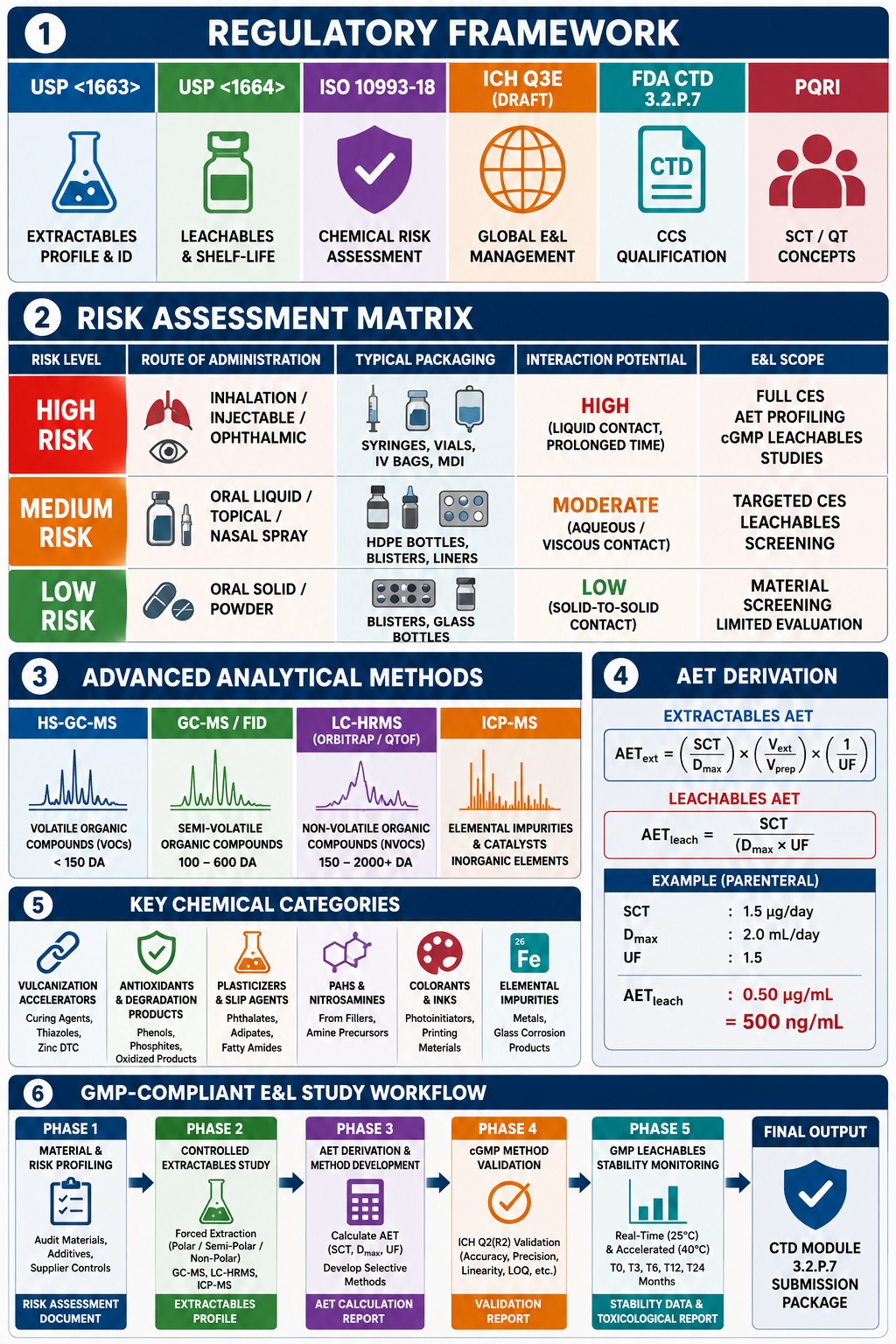
A GMP-Compliant Extractables and Leachables (E&L) Study is conducted within a connected global regulatory framework intended to prevent pharmaceutical products from being compromised by chemicals originating from packaging materials. This regulatory structure incorporates compendial standards, regulatory guidance documents, and internationally recognized quality risk management principles. Together, these elements establish expectations for material characterization, extractables assessment, leachables monitoring, analytical testing, and toxicological evaluation.
Compendial Guidelines: USP , USP , and ICH Q3E
Compendial compliance starts with USP (“Assessment of Extractables Associated with Pharmaceutical Packaging/Delivery Systems”) and USP (“Assessment of Drug Product Leachables Associated with Pharmaceutical Packaging/Delivery Systems”). USP provides the scientific framework for developing an extractables profile through forced extraction studies, allowing laboratories to generate a comprehensive inventory of chemical substances that could potentially migrate from packaging components. In comparison, USP addresses the development and execution of real-time and accelerated leachables studies using actual drug product formulations, thereby establishing a scientific relationship between extractables findings and drug product stability.
The International Council for Harmonisation (ICH) draft Q3E guideline provides a broader global framework intended to harmonize E&L assessment throughout the pharmaceutical product lifecycle. The guideline addresses pharmaceuticals, biologics, and combination drug-device products and establishes consistent expectations for toxicological thresholds, risk assessment, and analytical method development. Such harmonization is intended to minimize differences in E&L evaluation requirements among regulatory agencies, including the FDA, EMA, and PMDA.
Explore strategies to avoid root causes of failed E&L studies.
Integration of PQRI Recommendations and ISO 10993-18
The Product Quality Research Institute (PQRI) working groups developed important safety threshold concepts for Orally Inhaled and Nasal Drug Products (OINDP) and Parenteral and Ophthalmic Drug Products (PODP). These frameworks introduce critical safety concepts such as the Safety Concern Threshold (SCT) and Qualification Threshold (QT). These values provide an important scientific basis for determining the Analytical Evaluation Threshold (AET) used during E&L analytical assessments.
When container closure systems contain drug delivery components or function as drug-device combination products, such as auto-injectors and transdermal patches, ISO 10993-18 (“Chemical Characterization of Medical Device Materials Within a Risk Management Process”) should be considered alongside applicable USP guidelines. ISO 10993-18 requires comprehensive chemical characterization and toxicological assessment using extraction conditions that are appropriately selected according to the duration of patient contact and the intended route of administration.
Learn more about extractables and leachables testing for auto-injectors.
Risk Assessment Matrix and Packaging Material Profiling for a GMP-Compliant Extractables and Leachables (E&L) Study
Risk assessment within a GMP-Compliant Extractables and Leachables (E&L) Study involves classifying container closure systems according to their route of administration and the potential for chemical interactions between the pharmaceutical formulation and packaging materials. This systematic assessment determines the appropriate analytical testing scope, applicable threshold limits, and required stability study durations needed to support patient safety and product quality.
Route of Administration and Formulation Risk
The US FDA Container Closure Guidance provides a framework for evaluating risk according to the probability of interaction between packaging materials and pharmaceutical products, as well as the physiological consequences associated with the route of administration. Inhalation aerosols, injectable solutions, and ophthalmic suspensions generally fall within the highest-risk category because they may involve direct systemic exposure or contact with particularly sensitive tissues. Oral solids and topical products generally have a lower risk profile because of physiological barriers and comparatively limited chemical migration potential.
| Risk Level | Route of Administration | Typical Packaging Systems | Interaction Potential | Mandatory E&L Scope |
|---|---|---|---|---|
| High Risk | Inhalation (OINDP), Injectable (Parenteral), Ophthalmic | Pre-filled syringes, elastomeric vials, IV bags, MDI actuators | High (Liquid contact, prolonged contact time) | Full CES, Analytical Evaluation Threshold (AET) profiling, validated cGMP leachables stability studies |
| Medium Risk | Oral Liquid, Topical Transdermal, Nasal Spray | HDPE bottles with closure liners, squeeze bottles, blister packs | Moderate (Aqueous/viscous contact) | Targeted CES, leachables screening, toxicological assessment |
| Low Risk | Oral Powder, Oral Solid Tablet/Capsule | Blister packaging, glass bottles with desiccant stoppers | Low (Solid-to-solid contact) | Material compliance screening, limited extractables evaluation |
Discover specialized E&L testing for ophthalmic drug products.
Polymeric and Elastomeric Chemical Profiles
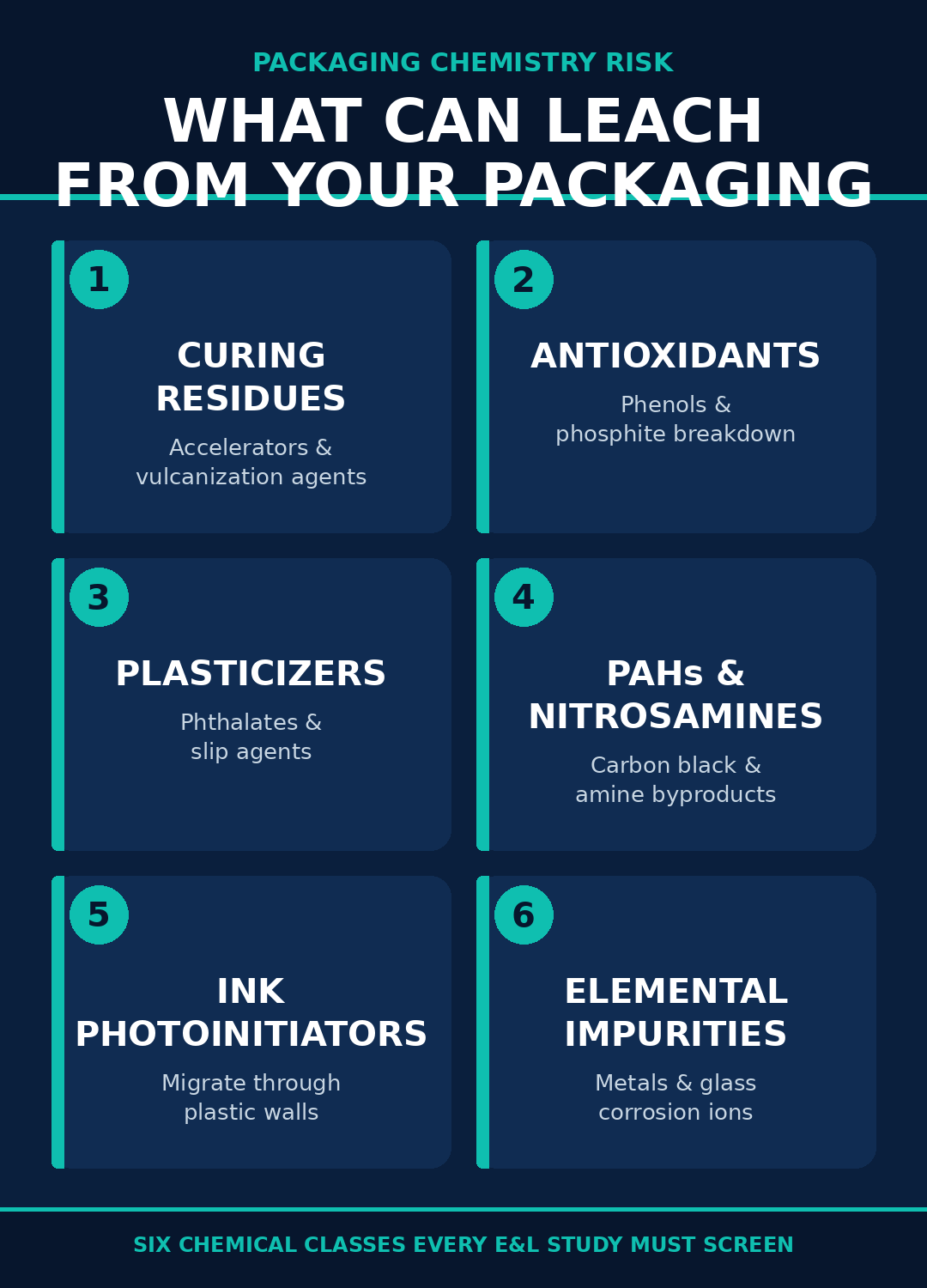
Container closure systems are not necessarily chemically inert and may contain substances capable of migrating into pharmaceutical products. Synthetic elastomers, vulcanized rubbers, polyolefins such as polypropylene and polyethylene, and sophisticated multi-layer laminates can contain intentionally added substances as well as unintended process-related impurities. Important chemical categories that may require evaluation include:
- Vulcanization Accelerators and Curing Agents: Zinc dithiocarbamates, thiazoles, diphenylguanidine, and sulfur compounds may migrate from elastomeric stoppers as a consequence of rubber curing and vulcanization processes.
- Antioxidants and Degradation Products: Hindered phenols, including Irganox 1010 and Irganox 1076, and phosphites such as Irgafos 168 may be present together with their corresponding oxidized transformation products.
- Plasticizers and Slip Agents: Phthalate esters, adipates, and fatty acid amides such as erucamide and oleamide may be incorporated to improve polymer processing characteristics and may subsequently become potential extractables or leachables.
- Polycyclic Aromatic Hydrocarbons (PAHs) and Nitrosamines: These potentially hazardous contaminants may originate from carbon black fillers or develop through reactions involving amine precursors during rubber curing.
- Colorants and Printing Inks: Photoinitiators, including benzophenone and ITX, may migrate through the walls of primary plastic packaging from external labels, printing systems, or associated materials.
- Elemental Impurities: Catalytic metals, including catalyst residues such as organotin or platinum, as well as glass corrosion products such as silicon, aluminum, barium, and borate, may require characterization and assessment.
Explore selection guidance for low-leachables packaging materials.
Advanced Analytical Methodologies for a GMP-Compliant Extractables and Leachables (E&L) Study
Advanced analytical methodologies used in a GMP-Compliant Extractables and Leachables (E&L) Study combine controlled extraction procedures with orthogonal mass spectrometry techniques to provide broad coverage of volatile, semi-volatile, non-volatile, and inorganic extractables. These analytical strategies are designed to generate a comprehensive chemical inventory of substances that could potentially migrate from packaging materials under intentionally exaggerated extraction conditions.
Extraction Conditions, Solvents, and Stoichiometry
Controlled Extractables Studies (CES) employ deliberately exaggerated environmental conditions, including increased temperatures, extended extraction periods, and solvents representing different polarity ranges. The purpose is to maximize the recovery of chemical species from packaging materials without causing inappropriate degradation of the primary matrix polymer.
Solvent selection should reflect the physicochemical characteristics of the drug product formulation and the types of compounds expected to migrate from the packaging material:
- Polar Solvents: Purified water or buffered aqueous solutions, including solutions adjusted to match the drug formulation pH, can be used to extract inorganic salts, polar organic acids, and hydrophilic compounds.
- Semi-Polar Solvents: Ethanol/water mixtures, isopropyl alcohol (IPA), or propyl alcohol may be selected to represent drug formulations containing organic co-solvents, surfactants, or complexing agents.
- Non-Polar Solvents: Hexane, cyclohexane, or dichloromethane (DCM) can be used to recover low-polarity polymer additives, oligomers, and lipophilic processing aids.
Extraction approaches may include reflux, Soxhlet extraction, sealed vessel incubation at elevated temperatures, such as 50°C to 70°C for 24–72 hours, and sonication. The surface area-to-solvent volume ratio is commonly standardized to 6 cm²/mL according to ISO 10993-12/18 guidance, supporting consistency and analytical comparability among extraction studies.
Read our complete guide on selecting solvents for extractables studies.
Multi-Instrument Analytical Profiling Architecture
E&L compounds can differ substantially in molecular weight, polarity, volatility, chemical structure, and ionization efficiency. Consequently, a single analytical platform cannot adequately characterize the complete extract profile. Comprehensive E&L analytical testing therefore uses complementary chromatographic and spectroscopic techniques to provide coverage across multiple chemical classes.
| Analytical Technique | Target Compound Class | Molecular Weight Range | Key Application in E&L |
|---|---|---|---|
| Headspace Gas Chromatography-Mass Spectrometry (HS-GC-MS) | Volatile Organic Compounds (VOCs) | < 150 Da (Boiling point < 150°C) | Residual monomers, solvents, blowing agents, low-MW fragrances |
| Direct Injection Gas Chromatography-Mass Spectrometry / FID (GC-MS/FID) | Semi-Volatile Organic Compounds (SVOCs) | 100–600 Da (Boiling point 150–500°C) | Plasticizers, fatty acids, low-MW antioxidants, curing accelerators |
| Liquid Chromatography High-Resolution Mass Spectrometry (LC-HRMS / Orbitrap / QTOF) | Non-Volatile Organic Compounds (NVOCs) | 150–2000+ Da | High-MW antioxidants, UV stabilizers, polymer oligomers, surfactants |
| Inductively Coupled Plasma-Mass Spectrometry (ICP-MS) | Elemental Impurities & Catalysts | Inorganic elements | Heavy metals (As, Cd, Pb, Hg), catalyst residues, glass delamination ions |
To pick the correct instrument strategy between gas and liquid chromatography techniques, laboratories evaluate target volatility and thermal stability. Compare GC-MS vs LC-MS in extractables and leachables testing.
For identifying inorganic elements and trace heavy metals, specialized mass spectrometry is required. Learn how ICP-MS is utilized in E&L testing.
Mathematical Derivation of the Analytical Evaluation Threshold (AET)
The Analytical Evaluation Threshold (AET) is a mathematically derived reporting limit used to determine when unknown extractables or leachables require structural identification and toxicological evaluation. It translates health-based Safety Concern Thresholds (SCT) into practical analytical concentration limits by taking into consideration patient daily dosing requirements and analytical method uncertainty.
Safety Concern Thresholds (SCT) and Uncertainty Factors
AET determination is based on the Safety Concern Threshold (SCT), which represents an absolute daily exposure level below which a chemical leachable is considered to present negligible carcinogenic or non-carcinogenic risk under the applicable framework. According to PQRI and USP guidelines:
- Orally Inhaled and Nasal Drug Products (OINDP): SCT = 0.15 μg/day.
- Parenteral and Ophthalmic Drug Products (PODP): SCT = 1.5 μg/day.
- Other Oral/Topical Products: Higher thresholds, ranging from 5.0 μg/day to 10.0 μg/day, may be applicable depending on the availability and adequacy of qualified toxicological data.
Because detector response can vary considerably among different chemical structures during screening, particularly when authentic reference standards are unavailable, an Uncertainty Factor (UF) is incorporated into the AET calculation. The UF generally ranges from 1.3 to 2.0 depending on detector characteristics and analytical specificity. For example, a UF of 1.3 may be used for GC-FID, whereas a UF of 1.5 to 2.0 may be appropriate for LC-MS ESI.
Establishing correct AET values ensures low-level contaminants are identified before causing safety concerns. Calculate and understand AET for E&L studies.
Formal Mathematical Equations for AET Derivation
The general equation used to calculate the Analytical Evaluation Threshold (AET) for extractables studies, expressed as a concentration in μg/mL, is:
AEText = (SCT / Dmax) × (Vext / Vprep) × (1 / UF)
Where:
- SCT = Safety Concern Threshold (µg/day)
- Dmax = Maximum daily dose of the drug product (mL/day or doses/day)
- Vext = Total volume of solvent used in the extraction (mL)
- Vprep = Total volume or mass equivalent of the extracted packaging component (mL equivalent)
- UF = Analytical response factor Uncertainty Factor (dimensionless)
For a direct drug product leachables evaluation, in which the drug product is analyzed directly without concentration adjustments, the leachables AET (AETleach) can be expressed as:
AETleach = SCT / (Dmax × UF)
Practical Worked Numerical Example
Consider a high-risk parenteral drug product packaged in a glass vial containing an elastomeric stopper:
- Maximum Daily Dose (Dmax): 2.0 mL/day
- Applicable Safety Concern Threshold (SCT): 1.5 µg/day
Analytical Method: LC-HRMS with an Uncertainty Factor (UF) of 1.5, accounting for a 33% variation in relative response factors across unknown NVOCs.
Using the leachables AET equation:
AETleach = (1.5 µg/day) / (2.0 mL/day × 1.5) = 1.5 / 3.0 = 0.50 µg/mL = 500 ng/mL
Analytical methods used for leachables quantification should be validated to achieve a Limit of Quantitation (LOQ) at or below the calculated threshold (LOQ ≤ 0.50 µg/mL) to support regulatory compliance. Specialized contract research facilities such as ResolveMass Laboratories Inc. can configure analytical instrumentation to achieve sub-part-per-billion LOQs, providing extensive analytical sensitivity and regulatory coverage for E&L assessments.
Design of GMP Leachables Stability Studies and Toxicological Risk Assessment
A GMP leachables stability study is designed to measure the migration of target chemical substances from packaging materials into the actual drug product formulation under both real-time and accelerated storage conditions throughout the intended commercial shelf-life. Any leachable detected at or above the Analytical Evaluation Threshold must undergo appropriate toxicological evaluation to determine whether the observed exposure is within acceptable safety limits and to establish applicable Permissible Daily Exposure (PDE) limits.
Monitoring compounds over extended storage periods validates real-time shelf-life safety. Explore leachables monitoring during stability studies.
Method Validation under cGMP (ICH Q2(R2))
Targeted leachables analytical methods should be validated in accordance with ICH Q2(R2) before samples from formal stability studies are tested. The principal validation characteristics include:
- Specificity/Selectivity: Demonstrating that active pharmaceutical ingredients (APIs), excipients, degradation products, and other formulation components do not interfere with or co-elute with the target leachables.
- Linearity and Range: Demonstrating an appropriate linear detector response across a concentration range extending from below the AET, such as 50% AET, through 150% of the maximum expected leachable concentration.
- Accuracy and Precision: Establishing acceptable recovery, typically within the range of 80%–120%, and repeatability, such as %RSD < 10%, using spiked formulation matrices at the AET level.
- Limit of Quantitation (LOQ): Demonstrating and validating that the lower limit of reliable quantification is below the calculated AET.
Rigorous method validation guarantees the reproducibility and accuracy required for cGMP regulatory filings. Review standards for method validation in leachables testing.
Toxicological Qualification and Permissible Daily Exposure (PDE)
Any leachable detected at or above the AET during real-time stability monitoring at 25°C/60% RH or accelerated stability testing at 40°C/75% RH requires appropriate toxicological qualification. Board-certified toxicologists may calculate a Permissible Daily Exposure (PDE) using principles derived from ICH Q3D and ICH M7:
PDE = (NOAEL × Body Weight Adjustment) / (F1 × F2 × F3 × F4 × F5)
In this equation, NOAEL represents the No Observed Adverse Effect Level obtained from relevant animal toxicity literature. Factors F1 through F5 account for considerations such as interspecies variability, study duration, extrapolation from human clinical data, and toxicity severity. When the calculated daily human exposure resulting from the measured leachables concentration remains below the established PDE, the container closure system can be considered toxicologically qualified for its intended commercial use, provided all other applicable requirements are satisfied.
Evaluating the biological safety impact of identified leachables is critical for clinical clearance. Understand the toxicological qualification of leachables.
Lifecycle Workflow Matrix for a GMP-Compliant Extractables and Leachables (E&L) Study
The complete workflow for a GMP-Compliant Extractables and Leachables (E&L) Study consists of five interconnected analytical and regulatory phases. The process begins with material and risk assessment and progresses through controlled extractables characterization, AET determination, analytical method validation, and long-term leachables stability monitoring. Following this structured sequence helps ensure that relevant extractables are comprehensively characterized before formal leachables monitoring is performed under cGMP conditions.
| Study Phase | Primary Objective | Key Methodological Steps | Required Regulatory Output |
|---|---|---|---|
| Phase 1: Material & Risk Profiling | Characterize packaging materials and establish study boundaries | Audit component formulations (polymers, additives, curing agents); review supply chain controls. | Categorized E&L Risk Assessment Document (CTD 3.2.P.7) |
| Phase 2: Controlled Extractables Study (CES) | Identify potential migratables under worst-case conditions | Perform forced extractions using polar, semi-polar, and non-polar solvents; profile via GC-MS, LC-HRMS, and ICP-MS. | Comprehensive Extractables Profile & Target Compound Database |
| Phase 3: AET Derivation & Method Development | Establish quantifiable reporting limits and target methods | Calculate AET based on SCT, daily dose, and UF; develop selective leachables testing methods. | Technical Method Protocols & AET Calculation Report |
| Phase 4: cGMP Method Validation | Validate analytical performance per ICH Q2(R2) | Assess accuracy, precision, linearity, specificity, and LOQ in the target formulation matrix. | ICH Q2(R2) Validation Report |
| Phase 5: GMP Leachables Stability Monitoring | Quantify long-term migration under storage conditions | Test real-time (25°C) and accelerated (40°C) stability samples at T0, T3, T6, T12, and T24 months. | cGMP Stability Leachables Data & Final Toxicological Qualification Report |
Conclusion
Executing a GMP-Compliant Extractables and Leachables (E&L) Study is a critical component of obtaining market authorization while protecting patient safety and maintaining pharmaceutical product quality across a wide range of dosage forms. By integrating systematic material risk profiling, scientifically controlled extraction studies, appropriate mathematical derivation of Analytical Evaluation Thresholds (AET), and validated cGMP stability testing, pharmaceutical sponsors can develop comprehensive CTD Module 3.2.P.7 regulatory dossiers. Managing the complex combination of multi-instrument analytical testing, toxicological assessment, and evolving international standards requires substantial analytical expertise and access to high-resolution mass spectrometry capabilities.
Learn more about outsourcing extractables and leachables E&L testing services.
To learn how ResolveMass Laboratories Inc. supports container closure system qualification through advanced E&L study design, analytical method validation, and toxicological evaluation, connect directly with technical experts through the ResolveMass Contact Portal.
Frequently Asked Questions (FAQs)
USP and USP provide standardized scientific approaches for assessing chemical substances associated with pharmaceutical packaging and delivery systems. USP focuses on generating and evaluating extractables under controlled conditions, while USP addresses leachables that migrate into drug products. Following these frameworks supports consistent E&L evaluation and helps meet regulatory expectations for packaging safety.
A comprehensive E&L study uses multiple complementary analytical platforms because extractables and leachables vary considerably in volatility, polarity, molecular weight, and chemical structure. HS-GC-MS is commonly used for volatile organic compounds (VOCs), while GC-MS/FID addresses semi-volatile organic compounds (SVOCs). LC-HRMS supports non-volatile organic compounds (NVOCs), and ICP-MS is used for elemental impurities.
The emerging ICH Q3E guideline is intended to establish a harmonized approach for managing extractables and leachables throughout the pharmaceutical product lifecycle. It addresses scientific principles for thresholds, analytical assessment, toxicological evaluation, and risk management. This framework can help align E&L strategies across pharmaceuticals, biologics, and drug-device combination products in different regulatory regions.
ISO 10993-18 establishes principles for the chemical characterization of materials used in medical devices within a broader risk management process. For drug-device combination products, including pre-filled autoinjectors and transdermal delivery systems, its principles can complement applicable USP E&L approaches. This integrated assessment helps evaluate chemical substances originating from device materials and their potential patient exposure.
An Uncertainty Factor (UF) accounts for differences in analytical response among chemically diverse compounds, particularly when authentic reference standards are not available. Unknown substances may produce substantially different detector responses depending on their chemical characteristics and ionization behavior. Incorporating a UF provides an additional level of conservatism when establishing the Analytical Evaluation Threshold.
Container closure systems used with parenteral, orally inhaled and nasal drug products (OINDP), and ophthalmic products generally require greater E&L scrutiny because of their potential for direct and significant patient exposure. Examples include elastomeric vial stoppers, liquid-filled IV bags, pre-filled syringes, and MDI actuators. The extent of testing should ultimately be determined through a scientifically justified risk assessment.
E&L planning should begin early during development, particularly when packaging materials and container closure systems are being selected. Controlled Extractables Studies (CES) can identify potential chemical migrants early enough to support analytical method development and risk assessment. Leachables testing should then be incorporated into appropriate cGMP stability programs before commercialization and throughout the product lifecycle.
Permissible Daily Exposure (PDE) limits are established through toxicological evaluation of identified chemical substances using available experimental, clinical, and published safety information. Toxicologists may consider data such as the No Observed Adverse Effect Level (NOAEL) and apply appropriate adjustment factors for interspecies differences, exposure duration, and toxicity. The resulting assessment establishes a scientifically justified daily exposure level for the identified leachable.
Reference:
- Siew, A. (2018, August 1). E&L risk assessment for biologic drug products. BioPharm International, 31(8), 30, 32–34. https://www.biopharminternational.com/view/el-risk-assessment-biologic-drug-products-0
- United States Pharmacopeia. (n.d.). <1127> application of ion chromatography for pharmaceutical analysis. United States Pharmacopeia–National Formulary. https://doi.usp.org/USPNF/USPNF_M7127_03_01.html
- International Journal of Pharmaceutical and Phytopharmacological Research. (n.d.). [Article title unavailable from the provided PDF link]. https://ijpp.edwiserinternational.com/admin/uploads/hgDWGc.pdf
- International Council for Harmonisation of Technical Requirements for Pharmaceuticals for Human Use. (2025, August 1). Q3E guideline for extractables and leachables (Draft version). U.S. Food and Drug Administration. https://www.fda.gov/media/189890/download
- U.S. Food and Drug Administration. (1999, May). Container closure systems for packaging human drugs and biologics: Chemistry, manufacturing, and controls documentation. https://www.fda.gov/media/70788/download
- United States Pharmacopeia. (n.d.). Extractables and leachables. U.S. Pharmacopeia. https://www.usp.org/impurities/extractables-and-leachables
- Patkar, K., & Xu, J. (2024, April 11). ANDA submission: Risk-based extractable and leachable quality information [Presentation]. U.S. Food and Drug Administration. https://www.fda.gov/media/183127/download
Get In Touch With Us
About The Author


