

Introduction
The GMP Manufacturing of Peptide-Oligonucleotide Conjugates requires a Contract Research Organization (CRO) or Contract Development and Manufacturing Organization (CDMO) with the ability to integrate solid-phase peptide synthesis, phosphoramidite nucleic acid chemistry, advanced downstream purification, and high-resolution analytical characterization within a stringent Current Good Manufacturing Practice (cGMP) framework. Qualified contract manufacturing partners contribute validated facilities, specialized process chemistry expertise, scale-up engineering capabilities, and regulatory documentation required to advance exploratory hybrid molecules into clinical-grade active pharmaceutical ingredients (APIs).
Peptide-oligonucleotide conjugates (POCs) constitute an increasingly sophisticated therapeutic modality within the TIDES (peptides and oligonucleotides) drug development field. Through covalent attachment of sequence-specific genetic modalities, including small interfering RNAs (siRNAs), antisense oligonucleotides (ASOs), microRNA inhibitors, or phosphorodiamidate morpholino oligomers (PMOs), to bio-functional peptides, drug developers can address several longstanding delivery limitations. The peptide component can function as a targeted delivery vector by promoting cell-surface receptor interactions, supporting tissue-specific accumulation, and improving intracellular endosomal escape. At the same time, the nucleic acid payload provides the desired biological activity through mechanisms such as precise pre-mRNA splicing modulation or target gene silencing.
Discover how conjugated peptides enhance targeted delivery systems in our guide on Peptide-Oligonucleotide Conjugates Drug Delivery.
Although POCs provide important therapeutic opportunities, their manufacture introduces substantial chemical and operational complexities. These hybrid molecules bring together two fundamentally different synthesis disciplines: solid-phase peptide synthesis (SPPS), which commonly depends on acid-labile protection chemistries, and solid-phase oligonucleotide synthesis (SPOS), which incorporates acid-sensitive linkages together with base-labile nucleobase protection strategies.
Compare the differences, advantages, and trade-offs of peptide versus antibody systems in Peptide vs. Antibody-Oligonucleotide Conjugates.
As a candidate advances from preclinical investigation into clinical trials, the manufacturing process must operate within applicable global regulatory frameworks. Compliance with cGMP requires stringent environmental controls, fully validated bioanalytical methodologies, comprehensive qualification of raw materials, and complete traceability of every manufacturing batch. Determining what a qualified CRO should provide for the GMP Manufacturing of Peptide-Oligonucleotide Conjugates therefore requires a detailed assessment of available process chemistry approaches, downstream purification technologies, mass spectrometry-based characterization procedures, and regulatory quality standards.
Share via:
Quick Summary:
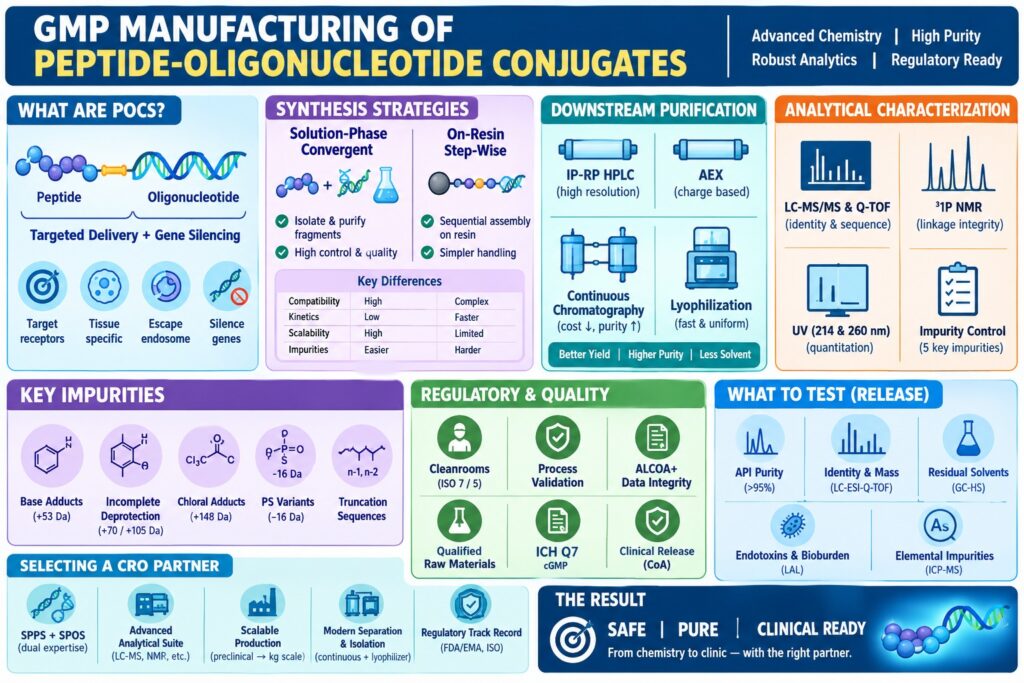
- GMP manufacturing of POCs requires integrated expertise in peptide synthesis, oligonucleotide chemistry, purification, analytical characterization, and cGMP quality systems.
- Two main synthesis strategies are used: solution-phase convergent conjugation, which offers strong intermediate quality control and scalability, and on-resin assembly, which reduces handling but creates greater chemical compatibility challenges.
- Downstream purification relies on high-resolution IP-RP-HPLC and AEX chromatography, with continuous chromatography offering potential improvements in yield, solvent use, cost, and processing efficiency.
- Advanced isolation using TFF/diafiltration and modern lyophilization can remove salts and solvents while producing stable, free-flowing POC API powders.
- Analytical characterization combines LC-MS/MS, Q-TOF-MS, ^31P NMR, UV detection, and validated chromatographic methods to confirm identity, sequence, structural integrity, purity, and impurities.
- Critical impurities include base adducts, incomplete deprotection products, chloral adducts, phosphorothioate variants, and n-1/n-2 truncation sequences, requiring sensitive impurity-control strategies.
- A suitable GMP CRO partner should demonstrate dual SPPS/SPOS expertise, scalable manufacturing, advanced analytics, qualified raw materials, ALCOA+ data integrity, ICH Q7/cGMP compliance, and reliable clinical batch-release capabilities.
Synthetic Strategies for GMP Manufacturing of Peptide-Oligonucleotide Conjugates
Synthetic approaches used for the GMP Manufacturing of Peptide-Oligonucleotide Conjugates generally follow one of two pathways: solution-phase convergent conjugation using separately synthesized and purified intermediates or on-resin step-wise linear assembly. Solution-phase conjugation provides greater control over the quality and release of individual fragments and offers a predictable framework for clinical-scale manufacturing. In contrast, on-resin assembly can simplify processing by allowing sequential construction of the complete conjugate while the intermediates remain attached to a common solid support.
Learn about different structural classifications and target applications in Types of Peptide-Oligonucleotide Conjugates.
Solution-Phase Convergent Conjugation in GMP Production
Solution-phase convergent conjugation consists of independently synthesizing, purifying, and analytically releasing the peptide and oligonucleotide components before bringing them together in a liquid-phase coupling reaction. This strategy is widely used for cGMP manufacturing because it enables detailed analytical quality assessment and specification verification of each biopolymer before the individual high-value components are combined.
In a typical solution-phase workflow, the oligonucleotide fragment is synthesized with a functionalized reactive handle, including a primary amine, thiol, or alkyne modification, positioned at either its 5′ or 3′ terminus. In parallel, the peptide sequence is generated through standard Fluorenylmethyloxycarbonyl (Fmoc)/t-butyl (tBu) solid-phase chemistry and incorporates a compatible reactive functionality, such as a free cysteine residue, maleimide group, or azide moiety.
Heterobifunctional crosslinking reagents, including succinimidyl 4-(N-maleimidomethyl)cyclohexane-1-carboxylate (SMCC), are commonly applied to connect primary amine modifications on oligonucleotides with sulfhydryl groups present on peptides. The primary amine of the purified oligonucleotide reacts with the N-hydroxysuccinimide (NHS) ester of SMCC in a buffered aqueous environment, such as 100 mM KH2PO4 at pH 7.2. After intermediate ethanol precipitation or desalting is performed to eliminate excess and unreacted crosslinker, the resulting maleimide-activated oligonucleotide is reacted with the thiol-containing peptide to generate a stable thioether bond. Other solution-phase conjugation options include strain-promoted azide-alkyne cycloaddition (SPAAC) “click” reactions and bio-cleavable disulfide linkages that are designed to undergo cleavage within reducing cytosolic environments.
Dive deeper into chemical coupling methods and strategies in Peptide-Oligonucleotide Conjugate Synthesis Methods.
On-Resin Step-Wise Linear Assembly Considerations
On-resin step-wise linear assembly involves sequentially constructing the peptide and oligonucleotide components on a common solid support matrix, followed by final cleavage and global deprotection. This strategy can reduce downstream handling requirements because it avoids the need to isolate intermediates between synthesis stages. However, it also creates significant chemical compatibility concerns because oligonucleotide backbones may be sensitive to conditions commonly used during peptide deprotection and cleavage.
Conventional SPPS uses basic conditions, such as 20% piperidine in N,N-dimethylformamide [DMF], to remove Fmoc protecting groups, followed by concentrated trifluoroacetic acid (TFA, ≥90%) cleavage cocktails for removal of amino acid side-chain protecting groups. In contrast, phosphoramidite SPOS depends on acid-sensitive 5′-dimethoxytrityl (DMT) protecting groups that are removed using mild dichloroacetic acid (DCA), together with basic aqueous ammonium hydroxide or methylamine for nucleobase deprotection. If a pre-assembled oligonucleotide is exposed to concentrated TFA cleavage conditions, substantial purine depurination and degradation of internucleotide chains can occur. Therefore, CROs developing on-resin POC assembly processes must incorporate specialized orthogonal protecting group strategies, including ultra-mild base-labile nucleobase protection or acid-resistant phosphoramidite modifications, along with custom polymer supports that can tolerate transitions between organic and aqueous solvent systems.
Review chemical coupling, cleavage sensitivities, and spacer selection in Peptide-Oligonucleotide Conjugate Linker Chemistry.
| Synthetic Parameter | Solution-Phase Convergent Conjugation | On-Resin Step-Wise Assembly |
|---|---|---|
| Intermediate Quality Control | High; peptide and oligonucleotide components are isolated and released independently | None; synthesis proceeds continuously on a single solid support resin |
| Chemical Compatibility | High; individual fragments can be synthesized using standard optimized conditions | Complex; requires orthogonal protecting groups and mild cleavage cocktails |
| Conjugation Kinetics | Rate-limited by biomolecular concentration during solution-phase reactions | Facilitated by the high local concentration generated on the solid support matrix |
| Scalability & Yield | Highly scalable; provides predictable kinetics for multi-kilogram API production | Typically limited to early preclinical development or low gram-scale production |
| Impurity Profile | Unreacted fragments have distinct chemical characteristics, simplifying downstream separation | Peptide and oligonucleotide truncation failure sequences can accumulate simultaneously |
Downstream Purification and Isolation Technologies for GMP Manufacturing of Peptide-Oligonucleotide Conjugates
Downstream purification during the GMP Manufacturing of Peptide-Oligonucleotide Conjugates depends on high-resolution Ion-Pair Reversed-Phase (IP-RP) and Anion-Exchange (AEX) liquid chromatography, together with continuous processing technologies or specialized lyophilization systems. These purification and isolation approaches are designed to recover active conjugate APIs at high purity while eliminating structural failure sequences, unreacted starting materials, and residual toxic organic solvents.
Address common synthesis and purification bottlenecks in Challenges in Peptide-Oligonucleotide Conjugates.
Preparative Chromatographic Separation Regimens
Preparative chromatographic separation is used to distinguish the desired conjugate from unreacted precursors, truncated sequences, and diastereomers through bioinert stationary phases and volatile ion-pairing reagents. The amphiphilic nature of peptide-oligonucleotide conjugates creates distinctive chromatographic challenges because these molecules combine a hydrophobic or positively charged peptide domain with a negatively charged and hydrophilic nucleic acid backbone. Conventional reversed-phase HPLC methods developed for peptides may provide inadequate retention of hydrophilic nucleic acids, whereas conventional anion-exchange chromatography may produce irreversible binding when used with hydrophobic peptide-linked species.
For improved chromatographic resolution, CROs may use Ion-Pair Reversed-Phase High-Performance Liquid Chromatography (IP-RP-HPLC) with wide-pore (300 Å to 1000 Å) bioinert silica or hybrid column hardware. Volatile alkylamine ion-pairing agents, including triethylammonium acetate (TEAA) or triethylamine/hexafluoroisopropanol (TEA/HFIP), temporarily reduce the effective negative charge of the phosphate backbone. This enables controlled chromatographic retention and high-resolution separation according to hydrophobic interactions.
For cGMP clinical manufacturing at larger scales, advanced continuous purification technologies, including twin-column continuous chromatography, are increasingly being considered as alternatives to conventional batch HPLC systems. Continuous chromatographic processing allows partially resolved side-cuts to undergo center-cut recycling, producing several operational benefits:
- 30% to 50% Reduction in Total Manufacturing Costs: Improved recovery of raw materials and substantially lower consumption of organic solvents can reduce overall manufacturing expenditure.
- Superior Purity and Yield Balances: Closely eluting impurities, including n-1 oligonucleotide failure sequences, can be separated while maintaining recovery of the conjugate API.
- Decreased Operational Footprint: Smaller column diameters can be operated continuously, allowing kilogram-scale batches to be processed over shorter manufacturing periods.
Advanced Isolation and Lyophilization Processing
Advanced isolation processes convert purified conjugate liquid pools into stable, dry active pharmaceutical ingredient powders through sequential ultrafiltration, desalting, and controlled freeze-drying operations. After chromatographic purification, the POC pool can undergo membrane tangential flow filtration (TFF) or diafiltration to eliminate excess salts and volatile ion-pairing components.
Lyophilization is commonly used to isolate the conjugate as a solid API. Conventional shelf freeze-drying of biopolymers may involve prolonged processing periods, often ranging from 7 to 14 days, and can experience localized thermal gradients that contribute to cake collapse or aggregate formation. Modern CRO facilities may employ advanced isolation technologies, including mixer-type lyophilization systems. These systems gently agitate the frozen product bed under controlled vacuum conditions and can achieve over an 80\% reduction in total drying duration while generating consistent, free-flowing granular powders with rapid dissolution characteristics.
Understand thermal degradation and proper handling guidelines in Handling and Storage for Peptide-Oligonucleotide Conjugates.
| Process Parameter | Standard Batch RP/AEX HPLC | Continuous Twin-Column Chromatography |
|---|---|---|
| Separation Efficiency | Moderate; compromises may be necessary between fraction purity and overall recovery | High; continuous recycling of mixed fractions improves overall yield |
| Solvent Consumption | High; substantial quantities of acetonitrile and aqueous buffers are required | Low; can achieve up to $50\%$ reduction in eluent solvent consumption |
| Drying Methodology | Conventional Shelf Lyophilization | Advanced Mixer-Type Lyophilization |
| Cycle Duration | Extended processing periods of approximately 100 to 200+ hours | Accelerated processing with >80% reduction in drying duration |
| Product Powder Quality | Variable cake density with potential for localized non-uniformity | Homogeneous, highly soluble, free-flowing granular powder |
Analytical Characterization and In-Process Controls in GMP Manufacturing of Peptide-Oligonucleotide Conjugates
Analytical characterization and in-process controls associated with the GMP Manufacturing of Peptide-Oligonucleotide Conjugates incorporate high-resolution LC-MS/MS, Q-TOF spectrometry, nuclear magnetic resonance, and validated chromatographic assays to establish the identity, structural integrity, and impurity profile of these complex molecules. These integrated analytical workflows provide evidence of manufacturing consistency, support regulatory quality requirements, and contribute to the documentation required for clinical batch release.
High-Resolution Mass Spectrometry and Hyphenated Analytical Platforms
High-resolution mass spectrometry combined with liquid chromatography provides direct evidence for structural identity, sequence mapping, and accurate mass determination of complex bioconjugates. Because these hybrid molecules generally exhibit high molecular weights and multiple charge states, liquid chromatography-quadrupole time-of-flight mass spectrometry (LC-Q-TOF-MS) is an important primary platform for detailed characterization.
When operated in negative electrospray ionization mode (ESI−) with volatile ion-pairing mobile phases, the analytical system can provide mass accuracy within 0.1 to 3.0 Da for multi-kilodalton molecules. Top-down and tandem MS/MS fragmentation approaches can establish both the amino acid sequence of the targeting peptide and the nucleotide sequence of the nucleic acid payload. These analyses can also be used to confirm the specific location of covalent linker attachment.
Read our detailed analytical guide on Structural Characterization of Peptide-Oligonucleotide Conjugates.
Phosphorus nuclear magnetic resonance (31P NMR) spectroscopy provides additional information regarding the chemical integrity and stereopurity of internucleotide linkages. It can distinguish native phosphodiester bonds from modified phosphorothioate backbones and associated oxidized side-products. Simultaneous dual-wavelength UV detection at λ = 214 nm, corresponding primarily to peptide backbone absorption, and λ = 260 nm, associated with nucleobase ring absorption, supports quantitative monitoring of concentration and mass balance during downstream processing.
Identification and Control of Critical Product-Related Impurities
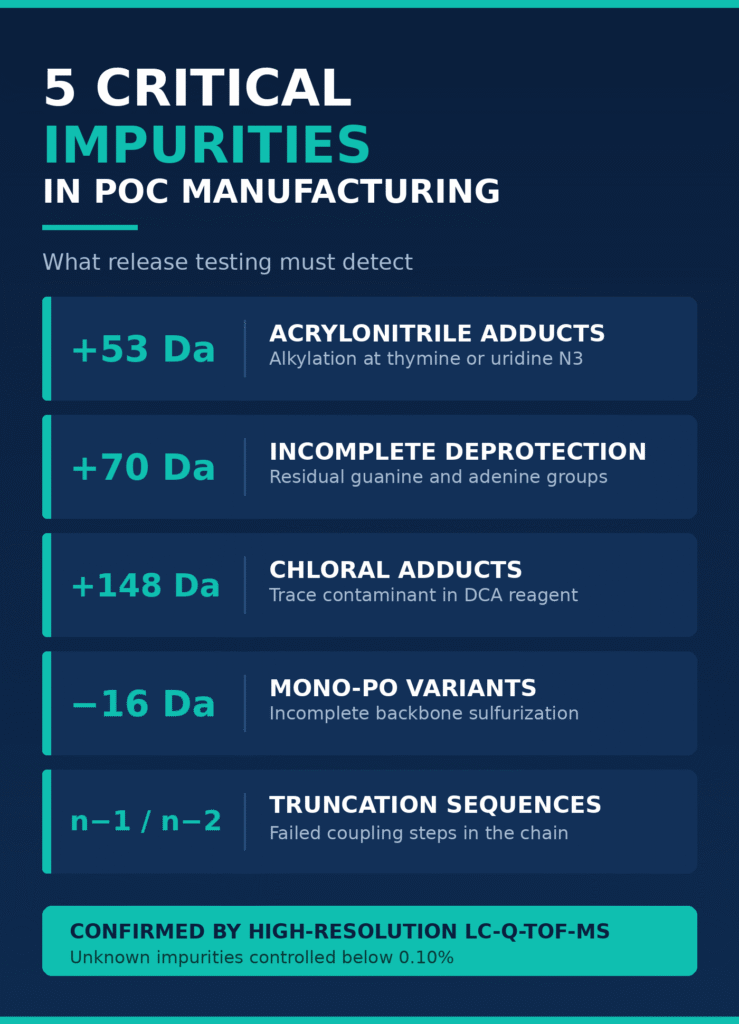
Manufacturing of peptide-oligonucleotide conjugates can generate several important product-related impurities, including base modification adducts, incomplete deprotection products, phosphorothioate oxidation variants, and truncated failure sequences. A qualified CRO should therefore maintain validated high-resolution analytical methods that can detect, distinguish, and quantify impurities at trace levels:
- Acrylonitrile Base Adducts (+53 Da): These impurities can arise during basic deprotection of cyanoethyl-protected phosphate groups in SPOS. Under these conditions, liberated acrylonitrile may undergo alkylation at the N3-position of thymine or uridine bases.
- Incomplete Deprotection Variants (+70 Da / +105 Da): These products may result from residual N2-isobutyryl groups associated with guanine (+70 Da) or N6-benzoyl groups associated with adenine residues. Remaining isobutyryl groups may also undergo conversion into acetylated diaminopurine adducts during capping operations.
- Trichloroacetaldehyde (Chloral) Adducts (+148 Da): These adducts may form because of trace chloral contaminants in dichloroacetic acid (DCA) detritylation reagents used during solid-phase extension reactions.
- Phosphorothioate Mono-Phosphodiester Variants (mono-PO, −16 Da): These variants can be generated when sulfurization or desulfurization reactions remain incomplete during deprotection, producing oxygen-for-sulfur substitutions within the phosphorothioate backbone.
- Truncation Failure Sequences (n−1, n−2): These include shortened peptide products missing particular amino acids because of incomplete coupling kinetics, as well as truncated oligonucleotide failure sequences generated when phosphoramidite additions do not proceed efficiently.
Learn how to define release criteria and impurity limits in Peptide-Oligonucleotide Conjugates Specification Setting.
Regulatory Frameworks and Quality Assurance Standards for CRO Partnership
Regulatory requirements for cGMP conjugate manufacturing involve strict compliance with ICH Q7 API standards, controlled cleanroom environments, qualified raw materials, and ALCOA+ data integrity principles. Because POCs combine characteristics associated with small-molecule synthetic drugs and complex biologics, regulatory submissions, including Investigational New Drug (IND) applications and Chemistry, Manufacturing, and Controls (CMC) packages, require evidence of process reproducibility, effective impurity control, and comprehensive quality assurance.
Process Validation, Cleanroom Standards, and Data Integrity
Facility management and process validation require appropriately classified cleanroom environments, validated cleaning processes, and controlled electronic data management systems designed to minimize cross-contamination and prevent inappropriate data alteration. CGMP API manufacturing areas must operate within isolated and environmentally controlled cleanroom facilities, typically incorporating ISO Class 7 (Grade C) suites for synthesis and purification and ISO Class 5 (Grade A) laminar flow cabinets for aseptic handling and sampling activities.
Manufacturing and release-testing data must be managed according to ALCOA+ data integrity principles. Contract facilities should be able to demonstrate that electronic records generated by automated synthesizers, preparative chromatography systems, and mass spectrometers meet the following requirements:
- Attributable: Each record can be linked to the specific technician or authorized individual who performed the activity.
- Legible: Records remain readable, accessible, and durable throughout the required retention period.
- Contemporaneous: Information is documented at the time the activity is performed.
- Original: Primary raw data files are retained, or validated true copies are maintained where applicable.
- Accurate: Results are verified and protected from unexplained alterations or unauthorized changes to analytical parameters.
Raw Material Qualification and Clinical Release Protocols
Raw material qualification and release procedures require comprehensive evaluation of phosphoramidites, amino acid monomers, resins, and crosslinking reagents before these materials are introduced into cGMP manufacturing operations. The performance and quality of the final peptide-oligonucleotide conjugate are directly influenced by the consistency and quality of the materials used during synthesis. High-purity phosphoramidites, protected amino acids, solid supports, and bifunctional linkers therefore require appropriate identity, purity, and trace impurity testing before being approved for manufacturing use.
Before a Certificate of Analysis (CoA) is issued for clinical batch release, the final active conjugate API must undergo comprehensive specification testing, including:
- Conjugate API Purity: Orthogonal IP-RP-HPLC and AEX-HPLC assays are used to establish overall API purity and confirm that it meets the applicable release criteria, typically >95%, while individual unknown impurities are maintained below 0.10% or 0.15%.
- Identity and Mass Verification: High-resolution LC-ESI-Q-TOF mass spectrometry is used to verify molecular identity and measured mass.
- Residual Solvent Quantitation: Headspace Gas Chromatography (GC-HS) is applied to determine residual process solvents, including DMF, acetonitrile, piperidine, TEA, and HFIP, and verify compliance with ICH Q3C safety limits.
- Bacterial Endotoxins & Bioburden: Limulus Amebocyte Lysate (LAL) testing is used to evaluate bacterial endotoxins and support product safety requirements for parenteral administration, with endotoxins controlled below 0.5 EU/mg.
- Elemental Impurities: Inductively Coupled Plasma Mass Spectrometry (ICP-MS) is used in accordance with ICH Q3D guidelines to quantify elemental impurities and confirm removal of heavy metal catalysts, including residual copper potentially introduced through click reactions.
Prepare your regulatory strategy with insights from Peptide-Oligonucleotide Conjugates in IND Submissions.
Selecting a CRO Partner for GMP Manufacturing of Peptide-Oligonucleotide Conjugates
Selecting a CRO for the GMP Manufacturing of Peptide-Oligonucleotide Conjugates requires a detailed evaluation of capabilities spanning peptide and oligonucleotide synthesis, advanced continuous purification, high-resolution analytical characterization, and documented regulatory inspection performance. Assessing these competencies before entering a partnership can help reduce development and manufacturing risks while establishing a pathway for scalable clinical supply.
Important technical and quality parameters to examine when auditing prospective CRO partners include:
- Dual Expertise in SPPS and SPOS: The CRO should demonstrate established in-house capabilities for both peptide and oligonucleotide synthesis. Maintaining both disciplines internally can reduce dependencies and risks associated with obtaining counterpart intermediates from third-party suppliers.
- Advanced Analytical Suite: The facility should provide access to high-resolution mass spectrometry (LC-Q-TOF), high-field $^{31}\text{P}$ NMR, bioinert HPLC/UHPLC platforms, and dedicated bioanalytical laboratories capable of supporting release testing.
- Scalable Production Capacities: The manufacturing organization should demonstrate a defined scale-up pathway that can transition from early preclinical quantities toward multi-kilogram cGMP clinical trial supplies.
- Modern Separation and Isolation Infrastructure: Technologies such as continuous twin-column chromatography and mixer-type lyophilization can support solvent reduction, shorter processing timelines, and improved consistency between manufacturing batches.
- Regulatory Compliance and Inspection History: A documented record of successful inspections by applicable global regulatory authorities, including the FDA or EMA, together with relevant quality certifications such as ISO 9001 and ISO 13485, can provide evidence of an established quality management framework and support regulatory submission activities.
Understand systemic stability, degradation pathways, and half-life considerations in Peptide-Oligonucleotide Conjugates Pharmacokinetics.
Conclusion
Successfully managing the GMP Manufacturing of Peptide-Oligonucleotide Conjugates requires coordinated control across synthetic chemistry, high-resolution purification, analytical characterization, and regulatory quality systems. As targeted TIDES therapeutics continue to expand within drug development, biopharmaceutical companies require contract organizations with the specialized capabilities necessary to address the distinct chemical and manufacturing requirements associated with both peptide and oligonucleotide components. Establishing robust analytical release strategies and involving experienced process chemistry teams early in development can facilitate scale-up planning, strengthen manufacturing control, support global regulatory requirements, and advance novel conjugated candidates toward clinical development.
To discuss specialized analytical characterization, process chemistry development, or custom manufacturing options for complex bioconjugates, contact the technical team at ResolveMass Laboratories Inc..
Frequently Asked Questions
GMP manufacturing establishes the controlled production conditions required for materials intended for clinical development and potential commercial use. CGMP systems help ensure that each batch consistently meets predefined requirements for identity, purity, strength, quality, and safety. They also provide documented controls for manufacturing operations, testing, traceability, and batch release.
POC production generally follows either solution-phase convergent conjugation or step-wise on-resin linear assembly. In the convergent approach, peptide and oligonucleotide fragments are separately synthesized, purified, and characterized before they are chemically linked. On-resin assembly instead constructs the components sequentially on a common solid support before cleavage and final deprotection.
Characterization of POC APIs typically requires complementary analytical techniques capable of evaluating molecular mass, sequence integrity, linkage chemistry, and impurity content. High-resolution LC-Q-TOF mass spectrometry, tandem MS/MS, phosphorus nuclear magnetic resonance (31P NMR), and dual-wavelength UV HPLC provide orthogonal information. Together, these methods help confirm molecular identity, conjugation, and critical product-related impurities.
POC manufacturing may generate several impurity classes, including n−1 and n−2 failure sequences, acrylonitrile base adducts (+53 Da), residual isobutyryl protecting groups (+70 Da), chloral adducts (+148 Da), and phosphorothioate mono-phosphodiester (mono-PO, −16 Da) variants. These impurities can originate from incomplete coupling, deprotection, sulfurization, or side reactions during synthesis. Sensitive analytical methods are therefore required for their detection and control.
CROs can address the amphiphilic nature of POCs by combining Ion-Pair Reversed-Phase (IP-RP) HPLC and Anion-Exchange (AEX) chromatography. Bioinert columns and volatile ion-pairing systems such as TEA/HFIP can improve separation of the conjugate from structurally related impurities. Continuous twin-column chromatography may additionally improve fraction recovery, resolution, and solvent utilization during larger-scale processing.
POC manufacturing must be conducted according to the regulatory requirements applicable to the intended development stage and product type. Relevant frameworks include ICH Q7 for API manufacturing, applicable requirements under 21 CFR Part 211/312, ICH Q3C for residual solvents, and ICH Q3D for elemental impurities. ALCOA+ principles also support the integrity, traceability, and reliability of manufacturing and analytical records.
A major benefit of convergent solution-phase conjugation is the ability to synthesize and evaluate the peptide and oligonucleotide components independently before coupling. Each intermediate can undergo separate purification, analytical characterization, and quality assessment before valuable materials are combined. This approach also minimizes the need to expose an assembled oligonucleotide to the highly acidic conditions associated with conventional peptide cleavage.
Continuous twin-column chromatography can improve process efficiency by allowing partially resolved fractions to be recycled rather than discarded. This approach can increase recovery of the desired conjugate while reducing the amount of fresh mobile phase and organic solvent required for purification. At manufacturing scale, these improvements can contribute to lower material consumption, reduced processing time, and improved overall process economics.
Clinical batch release generally requires a comprehensive documentation package demonstrating that manufacturing and testing were performed according to approved procedures. Typical records include the Certificate of Analysis (CoA), executed Batch Manufacturing Records (BMR), validated analytical method reports, raw material certificates of analysis, residual solvent results, and applicable stability data. Additional documentation may be required based on the product specifications, manufacturing process, and regulatory submission requirements.
Reference:
- U.S. Food and Drug Administration. (2023, December 6–7). Chemistry, manufacturing, and controls: Regulatory considerations through clinical development [Presentation]. FDA PDF
- Tengvall, U., Auriola, S., & Antopolsky, M. (2003). Characterization of antisense oligonucleotide–peptide conjugates with negative ionization electrospray mass spectrometry and liquid chromatography–mass spectrometry. Journal of Pharmaceutical and Biomedical Analysis, 32(4–5), 581–590. https://doi.org/10.1016/S0731-7085(03)00165-1
- Williams, B. A. R., & Chaput, J. C. (2010). Synthesis of peptide-oligonucleotide conjugates using a heterobifunctional crosslinker. Current Protocols in Nucleic Acid Chemistry, 4, Unit 4.41. https://doi.org/10.1002/0471142700.nc0441s42
- Gilar, M., Fountain, K. J., Budman, Y., Holyoke, J. L., Davoudi, H., & Gebler, J. C. (2003). Characterization of therapeutic oligonucleotides using liquid chromatography with on-line mass spectrometry detection. Oligonucleotides, 13(4), 229–243. https://doi.org/10.1089/154545703322460612
- Elsayed, Y. Y., Kühl, T., & Imhof, D. (2025). Regulatory guidelines for the analysis of therapeutic peptides and proteins. Journal of Peptide Science, 31(3), e70001. https://doi.org/10.1002/psc.70001
- European Medicines Agency. (2025). Guideline on the development and manufacture of synthetic peptides (EMA/CHMP/CVMP/QWP/367182/2025). https://www.ema.europa.eu/en/documents/scientific-guideline/guideline-development-manufacture-synthetic-peptides_en.pdf
Get In Touch With Us
About The Author


