

Introduction:
GMP Manufacturing of Peptide-Oligonucleotide Conjugates requires a manufacturing strategy that accounts for the distinct chemical and analytical characteristics of both the peptide and oligonucleotide components while still maintaining control over the final conjugated drug substance. These hybrid molecules combine the targeting or membrane-penetration properties of peptides with the biological activity of oligonucleotides, which is why sponsors pursue conjugation in the first place — a peptide segment can meaningfully improve a molecule’s pharmacokinetics and biodistribution, helping the payload reach tissues that free oligonucleotides struggle to penetrate. But that same hybrid structure means the manufacturing process is considerably more complex than producing either component on its own.
For sponsors moving from discovery or laboratory-scale work toward clinical manufacturing, working with a specialized contract research organization (CRO) can provide access to process-development expertise, analytical capability, GMP infrastructure, and the quality systems needed to generate regulator-ready data. There is no single manufacturing checklist that fits every conjugate — the right control strategy depends on molecular architecture, conjugation chemistry, sequence, backbone chemistry, intended dosage form, and clinical stage. For a deeper technical breakdown of the manufacturing considerations discussed here, see our related article on GMP Manufacturing of Peptide-Oligonucleotide Conjugates.
Summary:
- GMP Manufacturing of Peptide-Oligonucleotide Conjugates requires coordinated control of peptide synthesis, oligonucleotide synthesis, conjugation, purification, analytical testing, and pharmaceutical quality systems working together as one process, not five separate ones.
- Conjugation adds a layer of complexity beyond either parent molecule: it can generate new impurities, alter purification behavior, and change how the final drug substance behaves in the body.
- Process development should define critical quality attributes (CQAs), critical process parameters (CPPs), impurity risks, and in-process controls specific to the conjugate — not just to the peptide or oligonucleotide alone.
- Analytical characterization typically combines chromatographic, spectrometric, and biochemical techniques because no single method fully confirms identity, purity, and integrity across both molecule types.
- A qualified CRO should bring documented GMP quality systems (deviation management, CAPA, change control, data integrity), transparent technology transfer, and regulatory-ready CMC documentation.
- ResolveMass Laboratories Inc. supports POC programs with analytical method development, LC-MS/HPLC characterization, impurity profiling, and CMC-focused documentation from its ISO 9001:2015-certified facility in Laval, Quebec.
1: What Are Peptide-Oligonucleotide Conjugates?
Peptide-oligonucleotide conjugates (POCs) are hybrid therapeutic molecules that covalently link a peptide — often a cell-penetrating or targeting sequence — to an oligonucleotide such as an antisense oligo, siRNA strand, or peptide nucleic acid, in order to improve delivery, stability, or tissue targeting.
A typical conjugate can include:
- A peptide component
- An oligonucleotide component, which may use a phosphorothioate, phosphodiester, or other backbone chemistry (see our comparison of phosphorothioate vs. phosphodiester backbone chemistries and how each affects stability and manufacturing)
- A linker or spacer joining the two components
- A defined conjugation site
- Chemical modifications to the oligonucleotide
- Counterions or other associated components, depending on molecular design
The manufacturing challenge isn’t just producing each component independently — the CRO also has to demonstrate control of the conjugation step itself and of the resulting molecular entity as a whole.
2: Why Is GMP Manufacturing of Peptide-Oligonucleotide Conjugates More Complex Than Single-Modality Manufacturing?
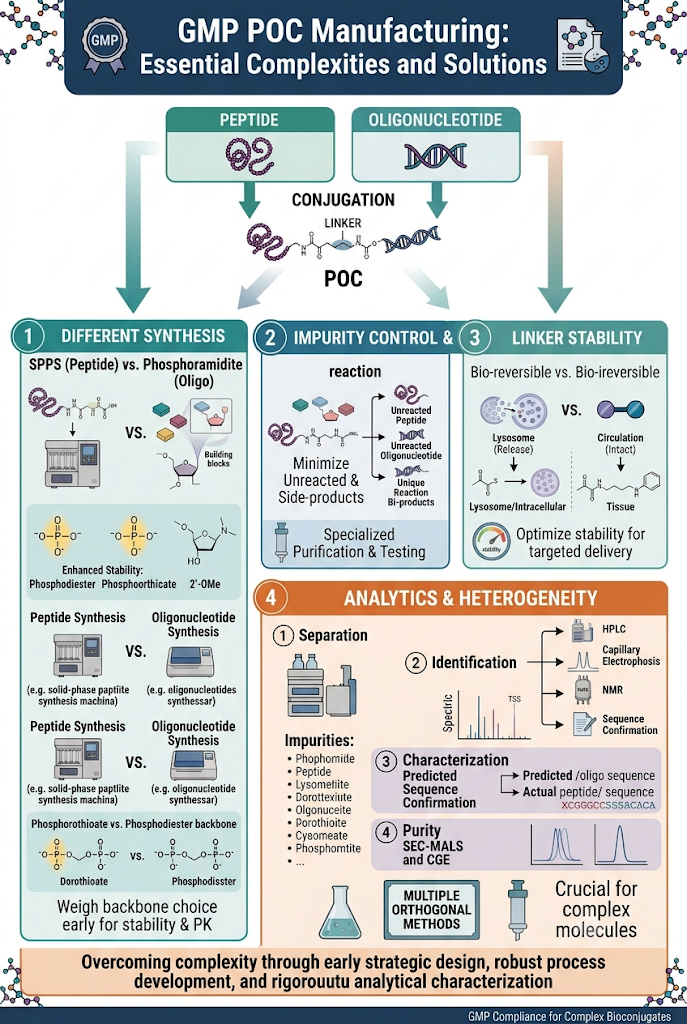
GMP Manufacturing of Peptide-Oligonucleotide Conjugates is more complex than manufacturing a peptide or an oligonucleotide alone because the conjugation reaction can introduce impurities and heterogeneity that don’t exist in either starting material, and because the two components often require different synthesis, purification, and analytical strategies entirely.
Different Synthesis Chemistries and Backbone Modifications
Peptides and oligonucleotides are typically built using different synthesis platforms, and the oligonucleotide’s backbone chemistry choice has downstream consequences for stability and nuclease resistance. Sponsors often need to weigh a phosphorothioate vs. phosphodiester backbone early in design, since this choice affects everything from purification behavior to how the conjugate performs pharmacokinetically.
Conjugation Efficiency and New Impurity Pathways
Incomplete conjugation can leave behind unreacted peptide, unreacted oligonucleotide, or partially conjugated species — and the conjugation reaction itself can generate impurities that were never present in either starting component. This is why process development needs to map impurity risk specifically at the conjugation step, rather than assuming impurity profiles from peptide or oligonucleotide manufacturing will simply carry over.
Linker Chemistry and Hydrolytic Stability
The linker connecting the two components is often the single most important design decision in a POC program. Bio-reversible and bio-irreversible linkages behave very differently in circulation and in tissue, and optimizing linker hydrolytic stability is essential to avoid premature cleavage, unwanted degradation products, or loss of activity before the conjugate reaches its target.
Molecular Heterogeneity and Analytical Complexity
Sequence-related impurities, truncations, deletion products, peptide-related impurities, oxidation, deamidation, linker-related species, and conjugation-related variants may all need to be evaluated — and no single analytical technique typically characterizes the entire molecule. Confirming the final sequence accurately requires dedicated sequence confirmation strategies that combine multiple orthogonal methods rather than relying on one default technique.
3: What Should a CRO Provide for GMP Manufacturing of Peptide-Oligonucleotide Conjugates?
A capable CRO should provide an integrated development and manufacturing pathway rather than treating synthesis, purification, testing, and documentation as disconnected activities.
| Area | What to Expect from the CRO |
|---|---|
| Process development | Scalable and reproducible manufacturing process |
| Peptide synthesis | Controlled peptide production and purification |
| Oligonucleotide synthesis | Controlled sequence synthesis and purification |
| Conjugation | Defined reaction conditions and process controls |
| Purification | Removal of process- and product-related impurities |
| Analytical development | Identity, purity, potency, and characterization methods |
| GMP manufacturing | Controlled production under approved procedures |
| Quality assurance | Deviations, CAPA, change control, and batch review |
| Documentation | Batch records, specifications, analytical reports, certificates |
| Stability | Protocol development and stability monitoring |
| Regulatory support | CMC data and documentation suitable for regulatory submissions |
4: How Does the GMP Manufacturing Process Work?
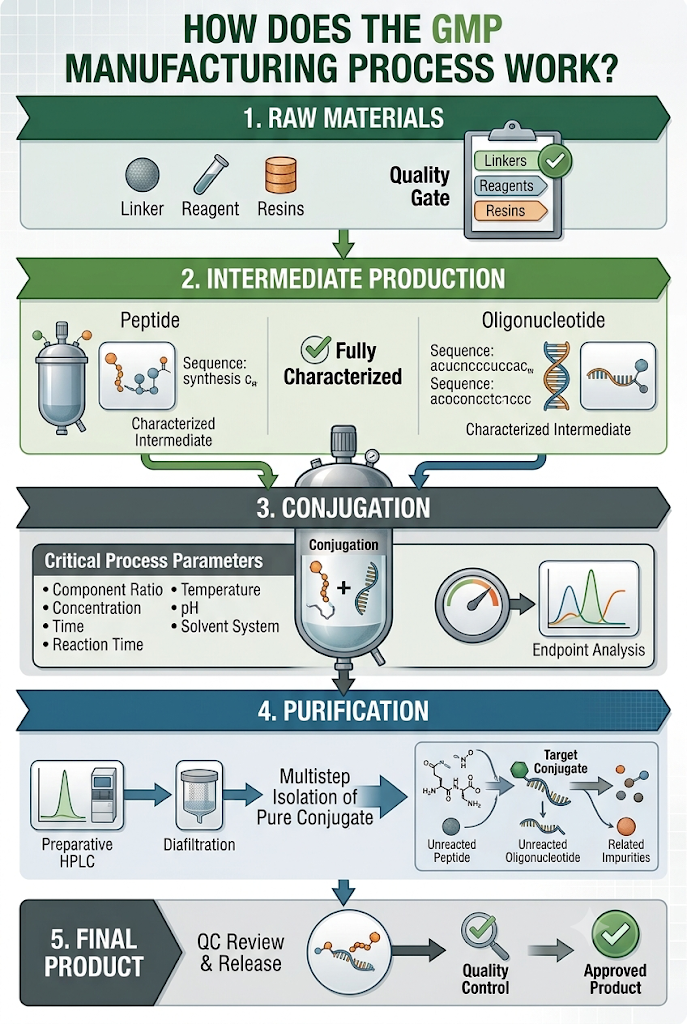
The manufacturing workflow generally progresses from raw-material qualification through component synthesis, conjugation, purification, analytical characterization, GMP batch processing, release testing, and stability monitoring: raw-material qualification → peptide synthesis → oligonucleotide synthesis → component purification → conjugation → purification → concentration/formulation → analytical testing → GMP batch review → release/stability. The exact sequence can vary depending on whether the CRO manufactures both components internally or receives one component directly from the sponsor.
Raw-Material and Starting-Material Control
The CRO first establishes specifications and controls for every material entering the process — peptide starting materials, nucleotide phosphoramidites, linkers, activating agents, solvents, reagents, resins, and purification materials. Supplier qualification, incoming testing, and traceability all need to be built into the quality system from the outset.
Peptide Manufacturing
The peptide is typically produced using solid-phase peptide synthesis, with attention to sequence accuracy, coupling efficiency, deprotection, cleavage, and peptide-related impurities. The resulting peptide intermediate should be fully characterized before it enters conjugation.
Oligonucleotide Manufacturing
The oligonucleotide component involves controlled synthesis followed by cleavage, deprotection, purification, and characterization. Depending on the molecule, the CRO may need to evaluate full-length product, shortmers, truncated sequences, modified nucleotides, and backbone-related attributes — which is where decisions like phosphorothioate vs. phosphodiester backbone chemistry become directly relevant to analytical strategy.
Conjugation
Conjugation is usually the single most important process-development stage, because it determines whether the peptide and oligonucleotide are consistently converted into the intended conjugate. Parameters worth tight control include component ratio, concentration, reaction time, temperature, pH, solvent system, and reaction endpoint — all tied back to defined CQAs.
Purification
After conjugation, the reaction mixture typically contains the desired conjugate alongside unreacted starting materials and conjugation-related impurities. Depending on the molecule’s properties, purification may use preparative HPLC, ion-exchange chromatography, reverse-phase chromatography, size-based separation, or ultrafiltration/diafiltration.
5: What Analytical Testing Should You Expect from a CRO?
Analytical testing for peptide-oligonucleotide conjugates should use orthogonal methods, because identity, purity, and molecular integrity are rarely demonstrated adequately by a single technique.
| Analytical Technique | Typical Purpose |
|---|---|
| HPLC/UPLC | Purity and related substances |
| LC-MS | Molecular mass and identity |
| MS/MS | Structural characterization |
| UV spectroscopy | Concentration/quantification |
| Peptide mapping | Peptide-related characterization |
| Oligonucleotide-specific chromatography | Sequence-related purity assessment |
| Capillary electrophoresis | Size/charge-related characterization |
| NMR (where appropriate) | Structural characterization |
| Karl Fischer | Water content |
| Residual solvent testing | Process-related impurity control |
The right analytical panel should be scientifically justified for the specific molecule and development stage — not chosen simply because a test is commonly used elsewhere. This is also where robust sequence confirmation strategies matter most, since sequence-level confidence underpins every downstream specification.
6: How Are Critical Quality Attributes (CQAs) Defined?
Critical quality attributes are the measurable physical, chemical, biological, or microbiological characteristics that must be controlled to ensure the product consistently meets its intended quality profile.
For a peptide-oligonucleotide conjugate, potential CQAs can include:
- Molecular identity and conjugation state
- Purity and related substances
- Sequence integrity (peptide and oligonucleotide)
- Residual solvents and water content
- Counterion content
- Aggregation, where relevant
- Potency or biological activity
- Microbiological quality and endotoxin, where applicable
The final CQA list needs to be molecule-specific and supported by actual development data — not copied from a generic template.
7: What GMP Quality Systems Should a CRO Have?
A GMP CRO should operate a documented pharmaceutical quality system capable of controlling manufacturing activities, investigating failures, managing changes, and maintaining complete, traceable records.
- Standard operating procedures (SOPs) and training/competency management
- Equipment qualification, calibration, and cleaning procedures
- Supplier qualification and material management
- Deviation management, CAPA, and OOS/OOT investigation
- Change control and batch record review
- Data integrity controls and document control
- Internal audits and formal quality agreements
8: How Does Technology Transfer Work?
A successful technology transfer converts the sponsor’s laboratory-scale process and product knowledge into a reproducible process the CRO can execute under GMP conditions. A typical package includes molecular structure and sequence information, synthesis procedures, starting-material specifications, critical process parameters, existing analytical methods, known impurities, and prior batch and stability data.
A structured transfer generally follows: document review → gap assessment → laboratory confirmation → process adaptation → engineering/development batch → GMP readiness → GMP batch. This staged approach helps distinguish a genuine process problem from an issue caused by differences in equipment, scale, materials, or analytical methods between the sponsor’s lab and the CRO’s facility.
9: In-House vs. CRO: A Quick Comparison
| Factor | In-House Development | CRO Partnership |
|---|---|---|
| Upfront capital investment | High (specialized synthesis + analytical equipment) | Low to moderate (pay-per-project) |
| Access to hybrid-molecule expertise | Limited unless already built | Available immediately if CRO has POC experience |
| Timeline flexibility | Constrained by internal resourcing | Scalable based on project scope |
| Regulatory documentation support | Must be built internally | Typically included as a core service |
How ResolveMass Laboratories Supports POC Programs
ResolveMass Laboratories Inc. is a Canadian Contract Research Organization based in Laval, Quebec, built around the kind of advanced analytical characterization that peptide-oligonucleotide conjugate programs require. Our team works across LC-MS, GC-MS, NMR, HPLC, and spectroscopic techniques to support clients from early research through regulatory submission, with direct experience in peptide-oligonucleotide conjugate analysis, sequence confirmation, impurity profiling, and custom organic and polymer synthesis. Operating under an ISO 9001:2015-certified quality management system, we connect analytical results to manufacturing decisions — impurity-control strategy, specifications, and CMC documentation — rather than simply generating chromatograms in isolation. For a closer look at how these pieces fit together, our detailed resource on GMP Manufacturing of Peptide-Oligonucleotide Conjugates walks through the process stage by stage.
Key Takeaways
- Establish a well-defined, molecule-specific manufacturing process rather than reusing a generic peptide or oligonucleotide template.
- Control peptide and oligonucleotide starting materials, including backbone chemistry choices.
- Understand conjugation chemistry, linker hydrolytic stability, and the impurity risks unique to the conjugation step.
- Define CQAs and CPPs specific to the conjugate, supported by real development data.
- Develop orthogonal analytical and sequence confirmation methods rather than relying on a single technique.
- Maintain GMP documentation, data integrity, and change-control systems throughout.
- Plan technology transfer and quality risk management proactively, not reactively.
- Align CMC data generation with regulatory expectations from the start of development.
Conclusion:
GMP Manufacturing of Peptide-Oligonucleotide Conjugates is a multidisciplinary process that requires coordinated expertise in peptide chemistry, oligonucleotide synthesis, conjugation, purification, analytical characterization, GMP operations, and pharmaceutical quality systems. For sponsors progressing toward clinical development, selecting the right CRO partner — one that can demonstrate consistent process control, generate reliable and traceable data, and support both technology transfer and regulatory documentation — can make the difference between a program that stays on track and one that stalls at purification or characterization. Early integration of GMP Manufacturing of Peptide-Oligonucleotide Conjugates planning, analytical strategy, and CMC documentation provides a stronger foundation for every stage that follows.
Frequently Asked Questions:
Stability testing helps evaluate how the conjugate changes under defined storage conditions over time. It can provide information about degradation, impurity formation, potency, physical characteristics, and appropriate storage conditions.
GMP planning should begin before clinical manufacturing rather than after the process has already been finalized. Early planning can help identify scalability, analytical, raw-material, equipment, documentation, and quality-system requirements.
Laboratory-scale manufacturing primarily focuses on developing and understanding the process, whereas GMP manufacturing requires a controlled, documented, and quality-system-based operation designed to consistently produce material meeting predefined requirements.
Yes. Development programs generally need appropriate chemistry, manufacturing, and controls (CMC) information covering manufacturing processes, characterization, specifications, analytical methods, impurities, stability, and other product-specific quality considerations.
Quality risk management helps identify manufacturing steps, materials, process parameters, and analytical attributes that could affect product quality. Tools such as risk assessments and FMEA can help prioritize controls and guide process-development activities.
Reference
- Sinha A. Advanced Technical Strategies in the Contract Manufacturing of Peptide-Oligonucleotide Conjugates.https://resolvemass.ca/peptide-oligonucleotide-conjugate-manufacturing/
- Darji P. Toxicology Study Design for Peptide-Oligonucleotide Conjugate Therapeutics: A CRO Perspective.https://resolvemass.ca/peptide-oligonucleotide-conjugate-toxicology-studies/
- Darji P. Bioequivalence Study Bioanalytical Services: Regulatory Requirements and CRO Selection Criteria.https://resolvemass.ca/bioequivalence-study-bioanalytical-services/
About the Author


