

Introduction:
GMP manufacturing of peptide-oligonucleotide conjugates sits at the intersection of two highly complex chemistries — and getting it right requires far more than simply combining a peptide synthesis platform with an oligonucleotide manufacturing line. These conjugates, which link therapeutic nucleic acids (such as siRNA, antisense oligonucleotides, or aptamers) to peptide moieties for targeted delivery, represent one of the fastest-growing drug modalities in the pharmaceutical pipeline.
As drug developers increasingly turn to peptide-oligonucleotide conjugates (POCs) to overcome delivery barriers and achieve tissue-specific targeting, the demand for experienced contract research organizations (CROs) in this space has grown sharply. The challenge is that not all CROs are equally equipped. Manufacturing these molecules under Good Manufacturing Practice (GMP) conditions requires a rare combination of synthesis expertise, analytical depth, and regulatory fluency.
At ResolveMass Laboratories Inc., we have built our capabilities specifically around the structural and analytical complexity of bioconjugates — giving our pharmaceutical partners a reliable, science-driven path from early-stage synthesis through GMP production and regulatory submission.
This article outlines what you should expect — and what you should demand — from a CRO offering GMP manufacturing of peptide-oligonucleotide conjugates.
Summary:
- Peptide-oligonucleotide conjugates (POCs) are complex hybrid molecules requiring specialized GMP manufacturing expertise that few CROs possess.
- GMP manufacturing of these conjugates demands orthogonal analytical control, multi-step synthesis coordination, and rigorous quality systems.
- A capable CRO must demonstrate end-to-end capabilities: from solid-phase synthesis and conjugation chemistry to mass spectrometry-based characterization and ICH-compliant release testing.
- ResolveMass Laboratories Inc. brings deep structural biology and mass spectrometry expertise that directly addresses the most common challenges in POC development.
- Choosing the right CRO partner determines not just manufacturing success, but the speed and confidence of your IND/NDA filing.
- Key deliverables from a quality CRO include: defined CoA, method validation packages, batch records, and regulatory-ready documentation.
1: What Are Peptide-Oligonucleotide Conjugates and Why Are They Difficult to Manufacture?
Peptide-oligonucleotide conjugates are hybrid biomolecules where a peptide — often a cell-penetrating peptide (CPP), receptor-targeting ligand, or endosomal escape motif — is covalently linked to a therapeutic oligonucleotide. The goal is typically to enhance cellular uptake, improve organ targeting, or overcome endosomal entrapment that limits naked oligonucleotide efficacy.
Manufacturing difficulty stems from several intrinsic molecular characteristics:
- Dual chemical identity: Peptides and oligonucleotides are synthesized using different solid-phase chemistries (Fmoc/SPPS for peptides; phosphoramidite chemistry for oligonucleotides), and their conjugation requires precision chemistry under carefully controlled conditions.
- Orthogonal protecting group strategy: Both moieties carry protecting groups that must be selectively removed without damaging the other component.
- Sequence-specific structural sensitivity: Small errors in synthesis — a single missed coupling or truncation — produce impurities that are biologically inactive or potentially immunogenic.
- Conjugation site fidelity: Whether using thioether, oxime, maleimide, or click chemistry-based linkages, the conjugation site must be verified to be correct, complete, and homogeneous.
- Analytical complexity: Characterizing a POC requires simultaneous coverage of both the peptide and nucleic acid portions — neither a peptide-centric HPLC method nor a standard oligonucleotide gel assay alone is sufficient.
Each of these challenges is compounded when moving from research-grade synthesis into GMP-compliant production, where every step must be documented, validated, and reproducible.
2: GMP vs. Research-Grade POC Manufacturing: Understanding the Critical Difference
A GMP-manufactured peptide-oligonucleotide conjugate is not simply a scaled-up version of a research batch. The regulatory and quality expectations are fundamentally different.
| Feature | Research Grade | GMP Grade |
|---|---|---|
| Batch documentation | Informal lab notebook | Formal Batch Manufacturing Records (BMRs) |
| Starting material qualification | Vendor CoA sufficient | Full vendor qualification + identity/purity testing |
| In-process controls | Optional | Defined, tested, and documented at each step |
| Analytical methods | Fit-for-purpose | Validated per ICH Q2(R1)/Q2(R2) |
| Impurity characterization | Targeted | Comprehensive (process, degradation, elemental) |
| Storage and stability | Short-term | ICH-compliant stability programs |
| Change control | Informal | Formal SOP-driven process |
| Final release | Informal check | Defined specification, authorized QP/QC sign-off |
The shift to GMP also introduces comprehensive quality management system (QMS) requirements: deviation management, CAPA (corrective and preventive action) processes, environmental monitoring, equipment qualification (IQ/OQ/PQ), and personnel training documentation. A competent CRO must have all of these in place before your molecule ever enters their facility.
3: Key Technical Capabilities to Expect from a GMP POC CRO
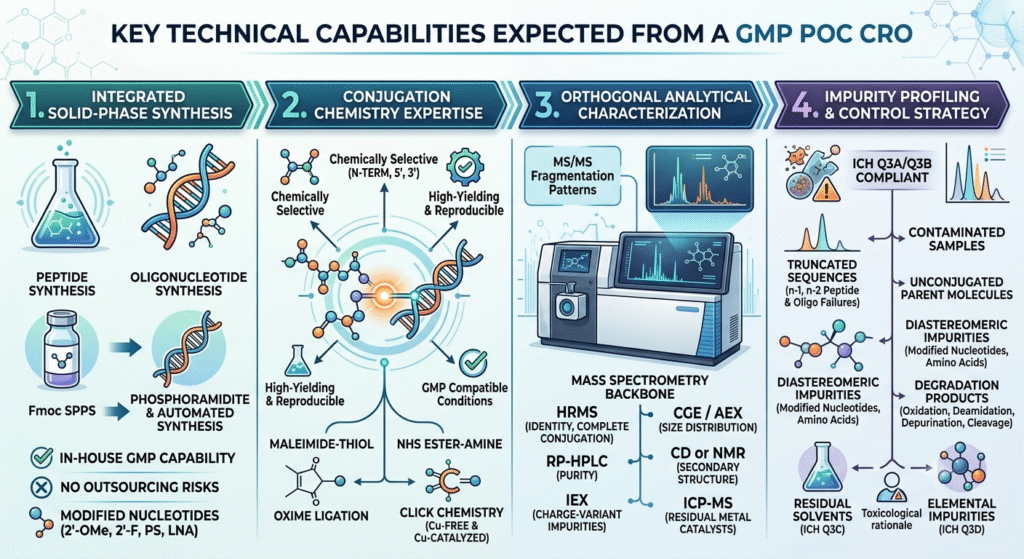
1. Integrated Solid-Phase Synthesis for Both Peptide and Oligonucleotide Components
The CRO should have in-house, GMP-compliant solid-phase synthesis capabilities for both components. Outsourcing one component to a sub-vendor while manufacturing the other in-house creates chain-of-custody complexity, quality oversight gaps, and potential timeline risks.
What to look for:
- Fmoc-based SPPS for peptide synthesis with appropriate resin and coupling reagent selection
- Phosphoramidite-based automated oligonucleotide synthesis with capping and oxidation control
- Capability to incorporate modified nucleotides (2′-OMe, 2′-F, phosphorothioate, LNA) commonly required for therapeutic oligonucleotides
2. Conjugation Chemistry Expertise
The conjugation step — linking the peptide to the oligonucleotide — is where many CROs fall short. This step must be:
- Chemically selective: Reacting at the intended site only (e.g., N-terminus, C-terminus, or specific lysine/cysteine residue on the peptide; 5′ or 3′ end of the oligonucleotide)
- High-yielding and reproducible: Incomplete conjugation creates process-related impurities that are structurally similar to the product and difficult to remove
- Compatible with GMP conditions: Reagents, solvents, and reaction parameters must be qualified and controlled
Common chemistries used in GMP POC manufacturing include maleimide-thiol, NHS ester-amine, oxime ligation, strain-promoted azide-alkyne (SPAAC), and copper-catalyzed CuAAC click chemistry. Each has its own regulatory and stability profile, and your CRO should be able to advise on the optimal approach based on your molecule’s intended use.
3. Orthogonal Analytical Characterization — Including Mass Spectrometry
This is where ResolveMass Laboratories Inc. distinguishes itself. Comprehensive analytical characterization of a POC cannot rely on any single technique. A rigorous analytical package includes:
- High-Resolution Mass Spectrometry (HRMS): Confirmation of molecular weight, conjugation completeness, and detection of truncated sequences or unconjugated byproducts. At ResolveMass, our advanced mass spectrometry platforms are central to every characterization workflow.
- Reversed-Phase HPLC (RP-HPLC): Purity assessment and quantification under both peptide-optimized and oligonucleotide-optimized conditions
- Ion-Exchange Chromatography (IEX): Resolution of charge-variant impurities, particularly relevant for phosphorothioate-modified oligonucleotides
- CGE or AEX with UV/fluorescence detection: Oligonucleotide size distribution and sequence confirmation
- Circular Dichroism (CD) or NMR: Secondary structure confirmation for larger or conformationally defined conjugates
- Elemental analysis / ICP-MS: Residual metal catalyst quantification (essential for click chemistry-derived products)
Mass spectrometry is not just a characterization tool at ResolveMass — it is the backbone of our structural understanding. Our team’s expertise in interpreting complex MS/MS fragmentation patterns for hybrid molecules gives our clients unparalleled confidence in structural identity and purity.
4. Impurity Profiling and Control Strategy
ICH Q3A/Q3B guidelines require that impurities above identification thresholds be characterized and, where necessary, qualified. For GMP POC manufacturing, the impurity landscape includes:
- Truncated sequences (n-1, n-2 peptide or oligonucleotide failures)
- Unconjugated parent molecules (free peptide and free oligonucleotide)
- Diastereomeric impurities from chiral centers in non-natural amino acids or modified nucleotides
- Oxidation and deamidation products from the peptide portion
- Depurination or strand cleavage products from the oligonucleotide portion
- Residual solvents and reagents (ICH Q3C)
- Elemental impurities (ICH Q3D)
Your CRO must not only detect these impurities but define specification limits supported by toxicological rationale or pharmacopoeial precedent.
4: Regulatory Expectations for GMP POC Drug Substances
Regulatory agencies — including FDA, EMA, and Health Canada — do not have a single unified guideline specifically for peptide-oligonucleotide conjugates. These molecules may be regulated under the frameworks for oligonucleotides (FDA’s 2020 Guidance on Clinical Pharmacology), peptide APIs, or novel bioconjugates depending on their structural classification.
Your CRO must be familiar with:
- ICH Q7: Good Manufacturing Practice Guide for Active Pharmaceutical Ingredients
- ICH Q6B (and Q6A where applicable): Specifications for biotechnology-derived proteins and chemical APIs
- FDA’s Oligonucleotide Guidance (2020): Clinical pharmacology guidance for oligonucleotide-based drugs
- ICH Q8/Q9/Q10: Quality by Design, risk management, and pharmaceutical quality systems
A CRO that has experience preparing IND-enabling regulatory packages for oligonucleotide or peptide-based drugs — and ideally for conjugates — will save you significant time during pre-IND meetings and CMC review.
5: What a GMP Batch Package Should Include
When your CRO delivers a GMP batch of peptide-oligonucleotide conjugate, you should receive a complete, audit-ready documentation package. This typically includes:
- Certificate of Analysis (CoA): All release specifications and results
- Batch Manufacturing Record (BMR): Step-by-step executed synthesis and processing record
- Analytical Method Reports: Method validation summaries (if validated) or qualification data
- Impurity Profile Report: Structural characterization of above-threshold impurities
- Residual Solvent Testing Report (ICH Q3C)
- Elemental Impurity Report (ICH Q3D, where applicable)
- Stability Data (real-time and accelerated, per agreed stability protocol)
- Vendor CoAs for critical starting materials and reagents
- Deviation Reports (if any deviations occurred, with investigation and disposition)
Anything less than this is incomplete for regulatory submission purposes.
6: Red Flags When Evaluating a CRO for GMP POC Manufacturing
Not every CRO that claims POC manufacturing capability is truly equipped for GMP-grade work on these complex molecules. Watch for:
- No in-house mass spectrometry: If your CRO outsources MS characterization, they cannot provide rapid, iterative analytical feedback during synthesis troubleshooting.
- Inability to describe their conjugation chemistry rationale: A strong CRO should be able to explain why they recommend a specific conjugation strategy for your molecule.
- Lack of oligonucleotide-specific analytical methods: Gel electrophoresis alone is insufficient for GMP release of therapeutic oligonucleotides.
- No track record with regulatory agencies: Ask directly whether they have supported IND, IMPD, or CTA filings for oligonucleotide or peptide conjugate drug substances.
- Vague quality systems: GMP compliance requires specific, auditable procedures — not general assurances.
7: Why ResolveMass Laboratories Inc. Is Your Trusted Partner for GMP POC Manufacturing
ResolveMass Laboratories Inc. was built around one foundational insight: that advanced mass spectrometry and deep structural analytical expertise are the difference between a CRO that ships material and one that truly understands it.
Our team brings together decades of combined experience in:
- Peptide and oligonucleotide synthesis chemistry with the versatility to handle modified, non-natural, and dual-functionality building blocks
- High-resolution mass spectrometry — including native MS, LC-MS/MS, and top-down structural workflows — as a core platform for POC characterization
- GMP quality systems designed for complex hybrid molecules, not just small molecules or single-modality biologics
- Regulatory strategy support for CMC documentation, method validation packages, and pre-IND meeting preparation
We work collaboratively with our partners from early development stages — helping to select optimal conjugation chemistry, establish early analytical benchmarks, and design the synthesis route before GMP activities begin — so there are no surprises when it matters most.
Conclusion:
GMP manufacturing of peptide-oligonucleotide conjugates is not a commodity service. It requires a CRO with genuine dual-modality expertise, a validated analytical infrastructure built for hybrid molecules, and a quality system that will stand up to regulatory scrutiny.
When evaluating a CRO partner, hold them to a high standard: demand to see their analytical workflows, their conjugation chemistry rationale, their GMP documentation systems, and — most importantly — evidence of prior success with similar molecules. The right CRO will welcome these questions because they reflect exactly how they think about the work.
At ResolveMass Laboratories Inc., GMP manufacturing of peptide-oligonucleotide conjugates is a core competency, not an extension of an existing platform. Our combination of synthesis precision, mass spectrometry-anchored characterization, and regulatory experience makes us a trusted partner for pharmaceutical teams developing the next generation of targeted nucleic acid therapeutics.
Frequenty Asked Questions:
GMP manufacturing ensures that peptide-oligonucleotide conjugates are produced consistently, safely, and according to regulatory requirements. Compliance with Good Manufacturing Practices helps maintain product quality, traceability, and reproducibility while reducing risks during clinical development and commercialization. Regulatory agencies require GMP-produced materials for human clinical studies.
A qualified CRO should offer end-to-end support, including process development, peptide synthesis, oligonucleotide synthesis, conjugation optimization, purification, analytical testing, stability studies, GMP manufacturing, and regulatory documentation. Having all services under one provider can improve efficiency and reduce technology transfer risks.
Peptides are typically produced using solid-phase peptide synthesis (SPPS), while oligonucleotides are synthesized using phosphoramidite chemistry. Both components undergo purification and quality testing before conjugation. Ensuring the quality of these starting materials is essential for achieving successful conjugation and final product consistency.
Common analytical methods include LC-MS, high-resolution mass spectrometry, HPLC, capillary electrophoresis, and sequence verification techniques. These methods help confirm molecular identity, purity, conjugation efficiency, linker integrity, and impurity profiles. Comprehensive characterization is essential for regulatory submissions and product quality assurance.
Regulatory documentation typically includes manufacturing process descriptions, specifications, analytical methods, validation reports, stability data, batch records, and Chemistry, Manufacturing, and Controls (CMC) information. These documents support IND, CTA, and other regulatory submissions required for clinical development.
Reference
- Sinha A. Advanced Technical Strategies in the Contract Manufacturing of Peptide-Oligonucleotide Conjugates.https://resolvemass.ca/peptide-oligonucleotide-conjugate-manufacturing/
- Venkatesan N, Kim BH. Peptide conjugates of oligonucleotides: synthesis and applications. Chemical reviews. 2006 Sep 13;106(9):3712-61.https://pubs.acs.org/doi/full/10.1021/cr0502448
- Srivastava V, editor. Peptide therapeutics: strategy and tactics for chemistry, manufacturing, and controls. Royal Society of Chemistry; 2019 Aug 16.https://books.google.com/books?hl=en&lr=&id=Cw6xDwAAQBAJ&oi=fnd&pg=PT20&dq=GMP+Manufacturing+of+Peptide-Oligonucleotide+Conjugates:+What+to+Expect+from+a+CRO&ots=BTD9asUaOX&sig=Miw5UHEesmHE3Sf_834Ck9mstHU
- Darji P. PLGA Implant Characterization Case Study: Goserelin Implant Polymer Degradation and Release Correlation.https://resolvemass.ca/goserelin-plga-implant-characterization/
About the Author


