
Introduction
Health Canada’s 2026 Biosimilar Guidance establishes a modernized regulatory framework that formally removes the routine requirement for comparative Phase III clinical efficacy trials for biosimilar candidates. Under this updated framework, market authorization in Canada is based primarily on demonstrating a high degree of analytical similarity, supported by comparative clinical pharmacokinetic (PK) and pharmacodynamic (PD) data. Published in May 2026 following comprehensive stakeholder consultations, the finalized guidance, titled Information and Submission Requirements for Biosimilar Biologic Drugs, reflects a fundamental evolution in biopharmaceutical science.
Historically, regulatory frameworks required large-scale Phase III comparative efficacy and safety trials to exclude clinically meaningful differences between a biosimilar and its reference drug. However, continuous advances in high-resolution analytical technologies, particularly state-of-the-art mass spectrometry platforms and functional bioassays, have demonstrated that structural and physicochemical characterization can be significantly more sensitive than clinical endpoints in detecting minor molecular variations. By aligning Canadian regulatory policy with international benchmarks established by the UK Medicines and Healthcare products Regulatory Agency (MHRA) and European authorities, Health Canada’s 2026 Biosimilar Guidance has the potential to substantially shorten drug development timelines, reduce R&D expenditures, and accelerate patient access to essential biotherapeutics.
For an overview of the analytical evidence used to demonstrate biosimilarity, explore comprehensive biosimilar characterization services.
Share via:
Quick Summary:
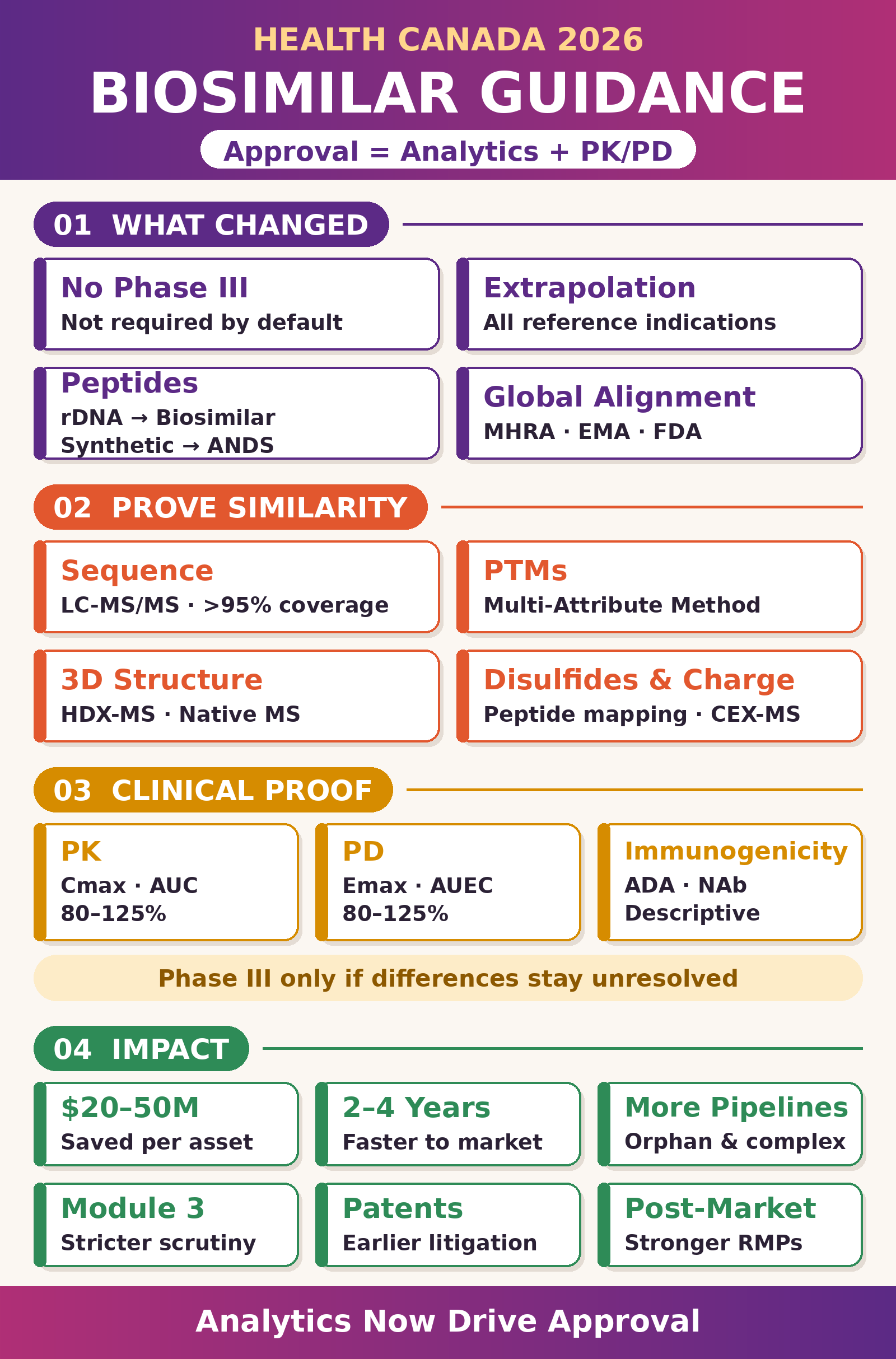
- Phase III no longer routine: Health Canada’s May 2026 guidance says comparative Phase III efficacy trials are “not typically required.” Approval now rests mainly on analytical similarity, backed by comparative PK/PD data.
- Indication extrapolation: Once a biosimilar shows a high degree of similarity and an equivalent dosage, it can take on all the reference product’s (CRBD’s) authorized indications without separate efficacy trials for each one.
- Peptide classification and global alignment: Recombinant DNA polypeptides follow the biosimilar pathway, while chemically synthesized ones may qualify through the generic ANDS pathway. The framework also aligns Canada with the MHRA, EMA and FDA.
- Advanced analytics are the core evidence: The burden of proof shifts to Module 3 (Quality). Sponsors must show side-by-side similarity across key quality attributes:
- sequence, using LC-MS/MS peptide mapping with more than 95% coverage
- post-translational modifications, using the Multi-Attribute Method
- higher-order structure, using HDX-MS and native MS
- disulfide bonds and charge variants, using non-reducing mapping and CEX-MS
- Clinical pharmacology confirms similarity: PK studies must show Cmax and AUC ratios within the 80–125% range (90% CI). PD markers such as Emax and AUEC are added where feasible, and immunogenicity (ADA and NAb) is assessed descriptively. Phase III may still be needed if differences remain unresolved.
- Major cost and time savings: Sponsors could save an estimated $20–50M per asset and reach market 2–4 years sooner. This makes biosimilars viable for orphan, lower-volume and complex biologics.
- New strategic pressures: Sponsors face stricter scrutiny of quality data, earlier patent litigation under the PM(NOC) Regulations, and a greater need for strong post-market risk management plans. Strong analytical capability becomes key to regulatory success.
Key Provisions of Health Canada’s 2026 Biosimilar Guidance
The primary provisions of Health Canada’s 2026 Biosimilar Guidance replace the traditional expectation of comparative Phase III efficacy trials with comprehensive analytical similarity assessments and indication extrapolation across authorized uses of the reference drug. This regulatory evolution is intended to ensure that biosimilar evaluation relies on sensitive analytical methodologies while reducing redundant clinical testing in human subjects.
Under the revised guidance, comparative clinical efficacy and safety studies are formally categorized as “not typically required” for establishing biosimilarity. Instead, sponsors must demonstrate a “high degree of similarity” between the biosimilar candidate and the Canadian Reference Biologic Drug (CRBD) through extensive quality, non-clinical, and clinical pharmacology comparisons.
The finalized policy outlines several core updates:
- Suppression of Comparative Clinical Efficacy Studies: Phase III clinical trials are no longer expected by default, shifting the primary clinical submission requirements toward comparative clinical pharmacology studies.
- Automatic Indication Extrapolation: Once a high degree of analytical similarity has been established and the biosimilar demonstrates an equivalent dosage, indications authorized for the CRBD may be extrapolated to the biosimilar without separate clinical efficacy trials for each indication, provided the scientific requirements for extrapolation are satisfied.
- Updated Classification for Polypeptides: Short polypeptide therapeutics manufactured through recombinant DNA procedures are classified as biologics under the biosimilar pathway, whereas chemically synthesized polypeptides may qualify for approval through the generic drug Abbreviated New Drug Submission (ANDS) pathway, depending on the applicable regulatory requirements.
- Alignment with International Authorities: The guidance reflects regulatory modernization frameworks adopted by the UK MHRA, the European Medicines Agency (EMA), and the US FDA, supporting greater consistency across global biosimilar development programs.
| Regulatory Dimension | Pre-2026 Regulatory Framework | Health Canada’s 2026 Biosimilar Guidance Framework |
|---|---|---|
| Phase III Efficacy Trials | Comparative Phase III clinical trials routinely required | Not typically required; reserved for exceptional cases |
| Primary Basis of Approval | Clinical efficacy equivalence supported by baseline quality data | High degree of analytical similarity combined with comparative PK/PD |
| Indication Extrapolation | Scientific rationale required for each claimed indication | Indication extrapolation across authorized CRBD indications when regulatory criteria are met |
| Clinical Pharmacology | Stepwise PK/PD evaluation followed by pivotal clinical trials | Standalone comparative PK studies, PD assessments where feasible, and immunogenicity evaluation |
| Quality Data Focus | Basic characterization testing | Multi-attribute, high-resolution analytical concordance |
Redefining “High Degree of Similarity”: Advanced Analytical Characterization Requirements
Establishing a “high degree of similarity” under Health Canada’s 2026 Biosimilar Guidance requires rigorous biophysical and functional concordance across structural, post-translational, and stability profiles using state-of-the-art mass spectrometry and orthogonal bioassays. As the routine expectation for comparative Phase III clinical trials is removed, the burden of proof shifts substantially toward Module 3 (Quality) of the Common Technical Document (CTD).
Health Canada expects analytical similarity to be established primarily through robust, prospective, side-by-side comparative studies. Critical Quality Attributes (CQAs), defined as physical, chemical, biological, or microbiological properties that must remain within acceptable limits to ensure the desired product quality, must be comprehensively characterized.
Learn how intact mass analysis for biosimilars helps assess molecular identity and detect mass differences that may warrant further investigation.
To meet Health Canada’s analytical expectations, biopharmaceutical sponsors must implement advanced testing workflows:
- Primary Structure and Sequence Fidelity: Liquid Chromatography-Mass Spectrometry (LC-MS/MS) peptide mapping with greater than 95% sequence coverage supports confirmation of primary amino acid sequence identity and the detection of unexpected sequence variants or amino acid misincorporations.
- Post-Translational Modification (PTM) Profiling: High-resolution accurate mass (HRAM) LC-MS using the Multi-Attribute Method (MAM) enables sponsors to quantify site-specific post-translational modifications, including N-glycosylation, C-terminal lysine truncation, N-terminal pyroglutamate formation, deamidation, and methionine oxidation, within a single automated workflow.
- Higher-Order Structure (HOS): Assessing secondary and tertiary conformational integrity requires advanced biophysical techniques, such as Hydrogen-Deuterium Exchange Mass Spectrometry (HDX-MS) and native mass spectrometry. HDX-MS provides residue-level insights into protein dynamics and solvent accessibility, helping confirm whether protein folding and domain assembly are comparable to those of the reference standard.
- Charge Heterogeneity and Disulfide Architecture: Non-reducing LC-MS peptide mapping confirms appropriate intra-chain and inter-chain disulfide pairing while identifying low-level disulfide scrambling. Cation exchange chromatography coupled with mass spectrometry (CEX-MS) characterizes acidic and basic charge variants that may influence systemic clearance.
Explore peptide mapping in biosimilars to understand how LC-MS/MS supports sequence confirmation and structural comparison.
| Critical Quality Attribute (CQA) | Mass Spectrometry and Bioanalytical Approach | Impact on Safety, Efficacy, and Clearance |
|---|---|---|
| Primary Sequence Integrity | LC-MS/MS Peptide Mapping (greater than 95% coverage) | Confirms molecular identity and detects low-level amino acid substitutions |
| Glycosylation Profile | Released Glycan HILIC-LC-MS / Intact Mass MS | Influences ADCC effector function, FcγRIIIa binding, and half-life |
| Higher-Order Structure (HOS) | HDX-MS and Native Mass Spectrometry | Evaluates tertiary folding, subunit assembly, and conformational stability |
| Post-Translational Variants | LC-MS Multi-Attribute Method (MAM) | Monitors deamidation, oxidation, and pyroglutamate formation across stability lots |
| Disulfide Bond Architecture | Non-reducing Peptide Mapping LC-MS/MS | Detects misfolding, free cysteines, and scrambled disulfide bridges |
Contract analytical laboratories with specialized mass spectrometry infrastructure, such as ResolveMass Laboratories Inc., can provide the analytical rigor and multi-attribute characterization datasets needed to support the assessment of analytical concordance. These capabilities help biopharmaceutical sponsors generate comprehensive evidence for regulatory submissions and evaluate relevant Critical Quality Attributes throughout biosimilar development.
Read about Critical Quality Attributes in biosimilars and their importance in analytical similarity assessments.
Clinical Pharmacology Strategy Under Health Canada’s 2026 Biosimilar Guidance
Under Health Canada’s 2026 Biosimilar Guidance, clinical evaluation focuses on comparative pharmacokinetic (PK) studies and descriptive immunogenicity profiling to establish comparable drug disposition in humans without routinely requiring large-scale Phase III efficacy studies. Comparative clinical pharmacology serves as a confirmatory component of the biosimilarity assessment, helping demonstrate that analytical similarity translates into comparable clinical exposure.
Pharmacokinetic (PK) Equivalence Standards
Comparative human PK studies must demonstrate equivalent systemic exposure between the biosimilar candidate and the CRBD within predefined statistical limits. Evaluation parameters include maximum concentration (\(C_{\max}\)) and the total area under the concentration-time curve (\(AUC\)). Health Canada’s stated equivalence approach requires the 90% confidence interval (CI) for the relative geometric mean ratio of the biosimilar candidate to the CRBD to fall within the standard equivalence range of 80.0% to 125.0%, where applicable to the study design and assessment.
Pharmacodynamic (PD) Biomarker Integration
Where sensitive and measurable PD endpoints are available, sponsors should integrate comparative PD biomarker assessments into single-dose or repeat-dose clinical pharmacology studies, as appropriate. Relevant PD markers should reflect the primary mechanism of action and demonstrate a clear dose-response relationship. The primary comparative PD endpoints, including the area under the effect-time curve (\(AUEC_T\)) and maximum effect (\(E_{\max}\)), should also be assessed against the applicable equivalence criteria. Where the 80.0% to 125.0% equivalence interval is appropriate, the corresponding geometric mean ratios and confidence intervals must be evaluated accordingly.
Immunogenicity Assessment Strategy
Immunogenicity testing under the 2026 guidance relies on multi-tiered, drug-tolerant assays conducted during PK studies to determine whether anti-drug antibody profiles affect product safety or systemic exposure. Anti-drug antibodies (ADAs) and neutralizing antibodies (NAbs) are evaluated at baseline and at appropriate post-dose sampling intervals, including trough concentrations where relevant. The findings are interpreted descriptively to determine whether the biosimilar candidate produces unexpected immune responses compared with the CRBD.
Comparative Phase III clinical trials may still be considered in exceptional circumstances, such as when unresolved analytical differences remain, functional assays do not adequately reflect the mechanism of action, or PK/PD outcomes reveal unexplained disparities. The need for additional clinical studies depends on the nature of the remaining uncertainty and the evidence required to resolve it.
Strategic and Economic Implications for Biopharmaceutical Sponsors
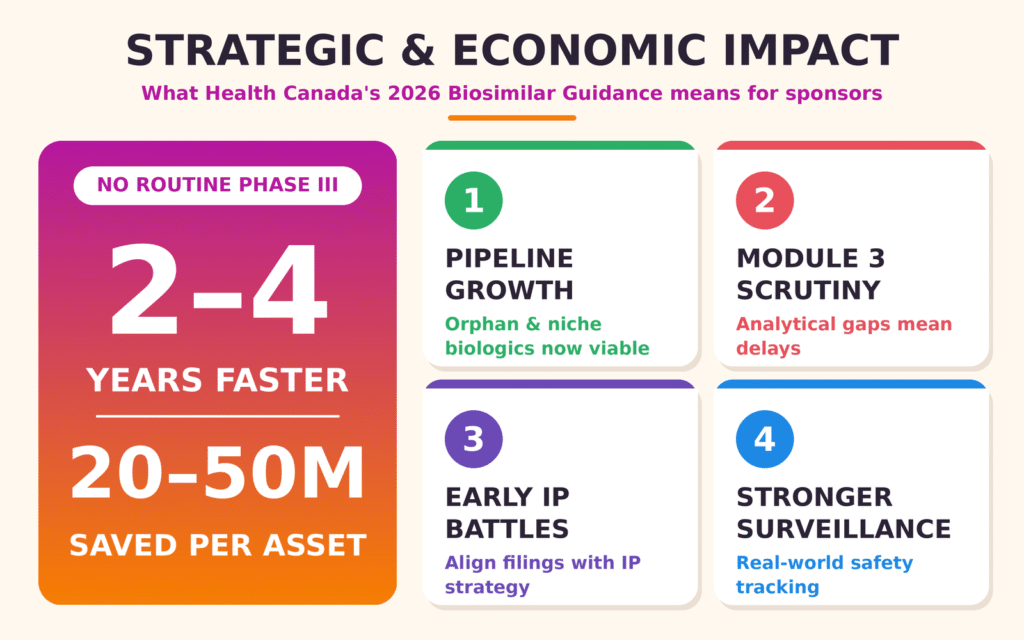
Health Canada’s 2026 Biosimilar Guidance has the potential to reduce R&D expenditures and accelerate time to market by approximately 2 to 4 years in applicable development programs, while placing greater emphasis on bioanalytical validation and early patent litigation strategy. Removing the routine expectation for Phase III clinical trials fundamentally changes the commercial and regulatory dynamics for biopharmaceutical companies developing biosimilars for the Canadian market.
The removal of routine Phase III trials introduces several important commercial and operational considerations:
- R&D Cost and Timeline Savings: Eliminating Phase III trials can reduce overall biosimilar development budgets by an estimated 20 million to 50 million per asset and shorten clinical development timelines by approximately 24 to 48 months, depending on the product, development strategy, and remaining regulatory requirements.
- Pipeline Diversification: Lower financial barriers may enable sponsors to develop biosimilars for lower-volume biologics, orphan disease indications, and complex multispecific modalities that were previously cost-prohibitive.
- Elevated Module 3 Regulatory Scrutiny: Because approval depends heavily on analytical similarity, Health Canada reviewers are expected to examine Quality Module 3 data rigorously. Uncharacterized post-translational modifications or subtle batch-to-batch inconsistencies may trigger regulatory delays, requests for additional information, or deficiency letters.
- Earlier Intellectual Property Enforcement: Faster regulatory development and review pathways may shift patent litigation under the Patented Medicines (Notice of Compliance) Regulations to earlier stages of development. Originators and biosimilar sponsors must coordinate regulatory submission timelines with their patent landscape assessments and intellectual property strategies.
- Enhanced Post-Market Surveillance: Given the reduced exposure to large clinical trial populations before approval, sponsors must implement comprehensive post-market Risk Management Plans (RMPs) to monitor real-world safety and immunogenicity continuously.
Explore the end-to-end biosimilar analytical package for regulatory submissions to understand how complementary analytical datasets can support a comprehensive submission.
Conclusion
Health Canada’s 2026 Biosimilar Guidance represents a potentially transformative shift in biopharmaceutical regulation by moving away from routine Phase III clinical efficacy trials and placing greater emphasis on analytical characterization and comparative clinical pharmacology. This regulatory modernization aims to accelerate market access for biosimilar sponsors while maintaining rigorous standards for evaluating product quality, safety, and efficacy.
By establishing multi-attribute analytical concordance as a central component of biosimilar authorization, Health Canada recognizes the importance of modern biophysical tools in identifying molecular differences that may not be detected reliably through clinical endpoints alone. Biopharmaceutical sponsors that invest in robust bioanalytical strategies, incorporating advanced mass spectrometry, Multi-Attribute Method workflows, and higher-order structural profiling, will be better positioned to generate comprehensive evidence for regulatory review. As the development process places greater emphasis on detailed analytical characterization, partnering with experienced bioanalytical specialists remains an important factor in supporting regulatory success.
To learn how ResolveMass Laboratories Inc. supports biopharmaceutical sponsors with high-resolution mass spectrometry and analytical similarity testing for Canadian drug submissions, visit the contact page.
Frequently Asked Questions (FAQs)
Sponsors must submit comprehensive, side-by-side comparative data demonstrating similarities in the structural, functional, physicochemical, and stability characteristics of the biosimilar candidate and the Canadian Reference Biologic Drug (CRBD). Critical Quality Attributes (CQAs) must be assessed using validated analytical methods and predefined, scientifically justified acceptance criteria. Any identified differences must be evaluated to determine their potential impact on product quality, safety, and efficacy.
Indication extrapolation allows a biosimilar to receive authorization for additional indications approved for its reference biologic without conducting separate clinical efficacy trials for every indication. Sponsors must establish sufficient analytical and functional similarity and provide supporting scientific evidence addressing the relevant mechanisms of action, safety, and immunogenicity. Extrapolation depends on satisfying the applicable regulatory criteria rather than occurring unconditionally.
Comparative human PK studies remain an important component of biosimilar evaluation, helping establish whether the candidate and reference biologic produce comparable systemic exposure. Parameters commonly assessed include maximum concentration (\(C_{\max}\)) and the area under the concentration-time curve (\(AUC\)). The 90% confidence interval for the relative geometric mean ratio is generally assessed against the 80.0% to 125.0% equivalence range, where applicable under the study design and regulatory requirements.
Additional comparative clinical efficacy studies may be considered when analytical or functional differences cannot be adequately explained through existing evidence. Such studies may also be warranted when available bioassays do not sufficiently reflect the product’s mechanism of action or comparative PK/PD results leave important questions unresolved. The need for further clinical investigation depends on the specific uncertainties identified during the biosimilarity assessment.
Immunogenicity is assessed through appropriately designed comparative clinical pharmacology studies using validated, sensitive assays. Sponsors evaluate anti-drug antibodies (ADAs) and neutralizing antibodies (NAbs) to determine whether immune responses differ between the biosimilar candidate and the reference biologic. The results help establish whether observed immune responses could affect product safety, pharmacokinetics, or overall clinical performance.
Biosimilar development relies on advanced analytical technologies capable of detecting subtle molecular differences between the candidate and reference products. Common approaches include LC-MS/MS peptide mapping, high-resolution accurate mass Multi-Attribute Method (MAM) workflows, Hydrogen-Deuterium Exchange Mass Spectrometry (HDX-MS), native mass spectrometry, and cell-based bioassays. Together, these methods support the evaluation of primary structure, post-translational modifications, higher-order structure, and biological activity.
Health Canada’s updated approach reflects broader international efforts to modernize biosimilar development by placing greater emphasis on analytical evidence and comparative clinical pharmacology. Regulatory frameworks developed by the UK Medicines and Healthcare products Regulatory Agency (MHRA), the European Medicines Agency (EMA), and the US FDA provide important points of comparison. However, sponsors must still follow the specific submission requirements and scientific standards applicable in each jurisdiction.
Reducing the need for large comparative efficacy trials may shorten biosimilar development timelines and bring regulatory submissions forward. Consequently, patent disputes governed by the Patented Medicines (Notice of Compliance) Regulations may need to be addressed earlier in the development process. Sponsors should coordinate regulatory planning, patent assessments, and commercialization strategies to identify potential intellectual property barriers before submission.
The regulatory classification of short polypeptide therapeutics depends on factors such as their manufacturing process, molecular characteristics, and applicable Canadian regulatory requirements. Polypeptides produced using recombinant DNA technology may be regulated as biologic drugs and assessed under the relevant biosimilar framework. Chemically synthesized polypeptides may qualify for the pharmaceutical pathway, including an Abbreviated New Drug Submission (ANDS), when they meet the applicable eligibility criteria.
Reference:
- Health Canada. (2026, May 19). Guidance on information and submission requirements for biosimilar biologic drugs: Non-clinical and clinical information requirements. Government of Canada. https://www.canada.ca/en/health-canada/services/drugs-health-products/biologics-radiopharmaceuticals-genetic-therapies/applications-submissions/guidance-documents/information-submission-requirements-biosimilar-biologic-drugs/non-clinical-and-clinical.html
- Health Canada. (2026, May 21). Summary of changes: Guidance on information and submission requirements for biosimilar biologic drugs. Government of Canada. https://www.canada.ca/en/health-canada/services/drugs-health-products/biologics-radiopharmaceuticals-genetic-therapies/applications-submissions/guidance-documents/information-submission-requirements-biosimilar-biologic-drugs/summary-changes.html
- Health Canada. (n.d.). Biosimilar biologic drugs in Canada: Fact sheet. Government of Canada. https://www.canada.ca/en/health-canada/services/drugs-health-products/biologics-radiopharmaceuticals-genetic-therapies/applications-submissions/guidance-documents/fact-sheet-biosimilars.html
- Health Canada. (n.d.). Handbook for health care professionals on biosimilar biologic drugs: Data requirements, labelling and indications. Government of Canada. https://www.canada.ca/en/health-canada/services/drugs-health-products/biologics-radiopharmaceuticals-genetic-therapies/biosimilar-biologic-drugs/handbook-healthcare-professionals/data-requirements-labelling-indications.html
- Health Canada. (2026, May 19). Guidance on information and submission requirements for biosimilar biologic drugs: Post-market information requirements. Government of Canada. https://www.canada.ca/en/health-canada/services/drugs-health-products/biologics-radiopharmaceuticals-genetic-therapies/applications-submissions/guidance-documents/information-submission-requirements-biosimilar-biologic-drugs/post-market.html
Get In Touch With Us
About The Author