

Introduction:
Higher-order structure characterization of therapeutic peptides is no longer optional science — it is a regulatory and scientific imperative. As the global pipeline for peptide-based drugs expands rapidly, regulators and manufacturers alike have come to recognize that a peptide’s primary sequence alone cannot predict or guarantee its therapeutic performance. The way a peptide folds, how it interacts with solvent, and what conformational states it adopts under physiological or manufacturing stress conditions are equally determinative of its safety and efficacy.
Unlike small molecules, therapeutic peptides occupy a unique structural middle ground: they are large enough to exhibit meaningful higher-order structure (secondary and, in some cases, tertiary arrangements), yet small enough that HOS can shift dynamically with formulation, temperature, or pH changes. This structural lability makes rigorous HOS characterization critical at every stage of the development lifecycle — from lead optimization and process development to regulatory filing and post-approval comparability studies.
At ResolveMass Laboratories Inc., our analytical scientists work at the intersection of structural biology and regulatory science to provide peptide developers with the HOS data needed to de-risk their programs and satisfy agency expectations. This article walks through the scientific rationale, key analytical methods, and current regulatory expectations for HOS characterization of therapeutic peptides.
Summary:
- Higher-order structure (HOS) characterization of therapeutic peptides refers to the analysis of secondary, tertiary, and quaternary structural features that determine a peptide’s biological activity, safety, and stability.
- Regulatory bodies including the FDA, EMA, and ICH require robust HOS data as part of the critical quality attribute (CQA) framework for peptide therapeutics and biosimilars.
- Key analytical methods include Circular Dichroism (CD), Nuclear Magnetic Resonance (NMR), Hydrogen-Deuterium Exchange Mass Spectrometry (HDX-MS), X-ray crystallography, and Fourier-Transform Infrared Spectroscopy (FTIR).
- Incomplete HOS characterization is one of the leading causes of regulatory delays in IND, NDA, and BLA submissions.
- ResolveMass Laboratories Inc. provides end-to-end HOS characterization services tailored to peptide complexity, regulatory stage, and submission requirements.
1: What Is Higher-Order Structure in Therapeutic Peptides?
Higher-order structure refers to all structural levels beyond the primary amino acid sequence — including secondary structure (alpha-helices, beta-sheets, turns), tertiary folding, and any supramolecular assemblies. Understanding these levels is critical because they govern receptor binding, immunogenicity, and physical stability.
Protein and peptide structure is traditionally described in four hierarchical levels:
| Structural Level | Description | Analytical Relevance |
|---|---|---|
| Primary | Amino acid sequence | Confirmed by MS, Edman degradation |
| Secondary | Local folding patterns (α-helices, β-sheets, turns, random coil) | CD, FTIR, NMR |
| Tertiary | Three-dimensional arrangement of the full peptide chain | NMR, X-ray, cryo-EM, HDX-MS |
| Quaternary | Oligomeric assemblies or peptide-peptide interactions | SEC-MALS, AUC, HDX-MS |
While most small therapeutic peptides (< 30 amino acids) do not form highly ordered tertiary structures in the classical protein sense, they can still exhibit:
- Defined helical conformations in hydrophobic environments or membrane-mimicking systems
- Aggregation-prone beta-sheet architectures that affect safety and immunogenicity
- Cyclization-dependent structural rigidity (cyclic peptides)
- Disulfide-bridged constrained conformations (e.g., somatostatin analogues, conotoxins)
All of these features fall within the scope of HOS characterization and are of direct regulatory relevance.
2: Why Regulators Require HOS Data for Peptide Therapeutics
Regulatory agencies require HOS characterization because changes in peptide conformation directly impact critical quality attributes (CQAs) such as biological activity, aggregation propensity, and immunogenicity. Without HOS data, a manufacturer cannot demonstrate structural comparability across batches, manufacturing changes, or biosimilar development.
The regulatory framework for HOS characterization draws from multiple guidance documents:
- ICH Q6B — Specifications: Test Procedures and Acceptance Criteria for Biotechnological/Biological Products; calls for characterization of higher-order structure using appropriate physicochemical methods.
- FDA Guidance for Industry: Development of New Stereoisomeric Drugs — Relevant for cyclic or constrained peptides with defined chiral centers.
- FDA Biosimilar Guidance (2015, updated 2021) — Requires stepwise analytical similarity assessment, with HOS data as a core component of structural characterization.
- EMA Guideline on development, production, characterization and specification for monoclonal antibodies and related products (EMA/CHMP/BWP/532517/2008) — Broadly applied to complex peptides and fusion proteins.
- USP <1058> Analytical Instrument Qualification and USP <1065> Ion Chromatography — Referenced for method qualification and instrument suitability.
The FDA has increasingly scrutinized HOS data in BLA and NDA submissions for complex peptides. In several Complete Response Letters (CRLs), insufficient structural characterization — particularly for aggregation-prone sequences and post-translational modification mapping — has been cited as a deficiency.
3: Core Analytical Methods for HOS Characterization of Therapeutic Peptides
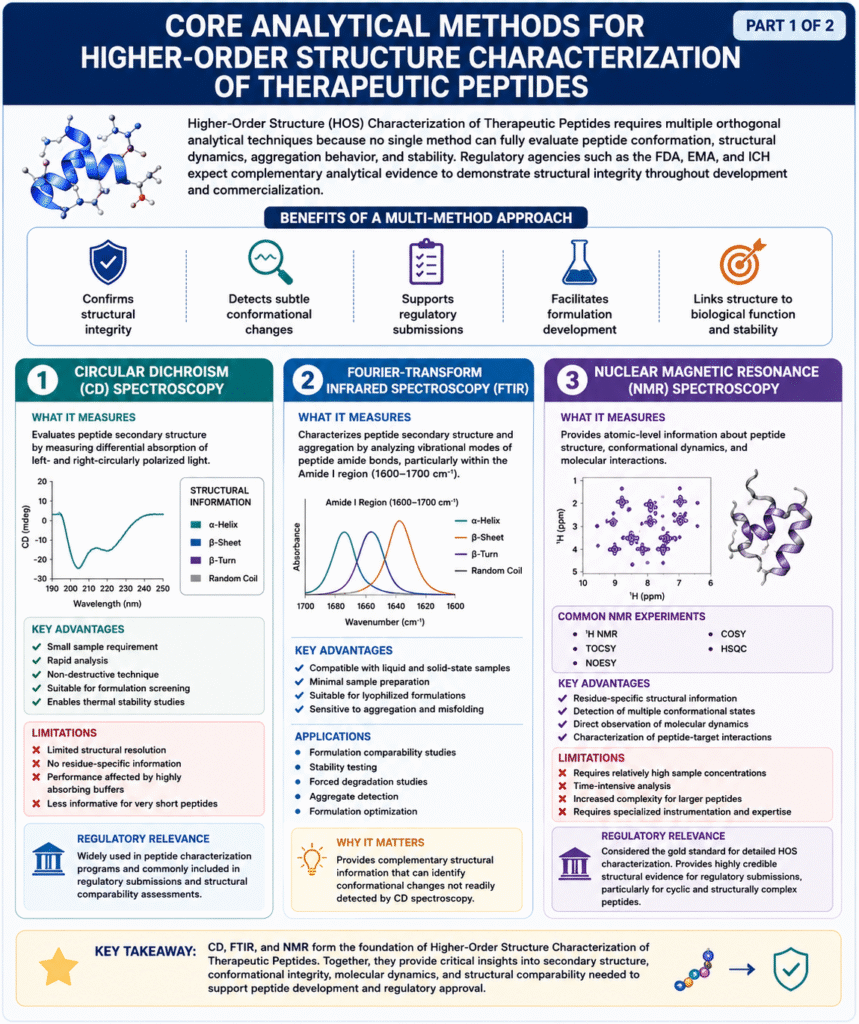
Higher-Order Structure Characterization of Therapeutic Peptides requires multiple orthogonal analytical techniques because no single method can fully define peptide conformation, dynamics, aggregation behavior, and structural stability. Regulatory agencies such as the FDA, EMA, and ICH expect developers to use complementary methods that collectively demonstrate structural integrity throughout development, manufacturing, and commercialization.
The optimal analytical strategy depends on several factors, including peptide size and complexity, the presence of disulfide bonds or cyclic structures, formulation composition, sample availability, development stage, and regulatory requirements.
1. Circular Dichroism (CD) Spectroscopy
Circular Dichroism (CD) is the most widely used first-line technique for Higher-Order Structure Characterization of Therapeutic Peptides because it rapidly evaluates secondary structural elements such as alpha-helices, beta-sheets, beta-turns, and random coils.
CD measures the differential absorption of left- and right-circularly polarized light by optically active chromophores. In peptide analysis, measurements are typically performed in the far-UV region (190–250 nm), where peptide bonds contribute most strongly to the signal.
Key Advantages:
- Requires relatively small sample quantities
- Rapid analytical turnaround
- Suitable for formulation screening studies
- Enables thermal unfolding analysis
- Non-destructive measurement
Advanced deconvolution software such as CDSSTR, CONTIN-LL, and SELCON3 can estimate secondary structure percentages, making CD an effective tool for routine structural assessment.
Limitations:
- Limited structural resolution
- Cannot assign structural elements to specific amino acid residues
- Performance decreases in highly absorbing buffer systems
- Less informative for very short peptides
Regulatory Perspective:
CD spectroscopy is commonly included in peptide regulatory submissions and structural comparability packages. Thermal denaturation studies derived from CD measurements are frequently used as stability-indicating parameters.
2. Fourier-Transform Infrared Spectroscopy (FTIR)
FTIR provides complementary secondary structure information and is particularly valuable for detecting aggregation, misfolding, and formulation-induced conformational changes.
FTIR analyzes vibrational modes of peptide amide bonds, with the Amide I region (approximately 1600–1700 cm⁻¹) serving as the primary source of structural information. Because FTIR can analyze peptides in liquid, solid, and lyophilized forms, it is widely used throughout pharmaceutical development.
Key Advantages:
- Compatible with liquid and solid-state samples
- Minimal sample preparation
- Effective for lyophilized formulations
- Sensitive to aggregate formation
Applications in Therapeutic Peptide Development:
- Pre- and post-lyophilization comparability studies
- Stability testing programs
- Forced degradation studies
- Detection of beta-sheet-rich aggregates
- Formulation optimization
FTIR is especially useful for identifying structural changes that may not be readily apparent through CD spectroscopy alone.
3. Nuclear Magnetic Resonance (NMR) Spectroscopy
NMR spectroscopy provides atomic-resolution structural information and is widely regarded as the gold standard for detailed Higher-Order Structure Characterization of Therapeutic Peptides.
Solution-state NMR can reveal conformational preferences, molecular dynamics, residue interactions, and structural heterogeneity at the amino acid level. Common experiments include 1D ¹H NMR, TOCSY, NOESY, COSY, and HSQC.
Key Advantages:
- Residue-specific structural information
- Detection of multiple conformational states
- Direct observation of molecular dynamics
- Characterization of peptide-target interactions
Limitations:
- Requires relatively high sample concentrations
- Time-intensive analysis
- Increased complexity for larger peptides
- Requires specialized instrumentation and expertise
Regulatory Perspective:
For cyclic peptides, constrained peptides, and structurally complex therapeutics, NMR often provides critical evidence supporting regulatory submissions and structural comparability assessments. Because it offers atomic-level resolution, NMR data carries significant weight in regulatory reviews.
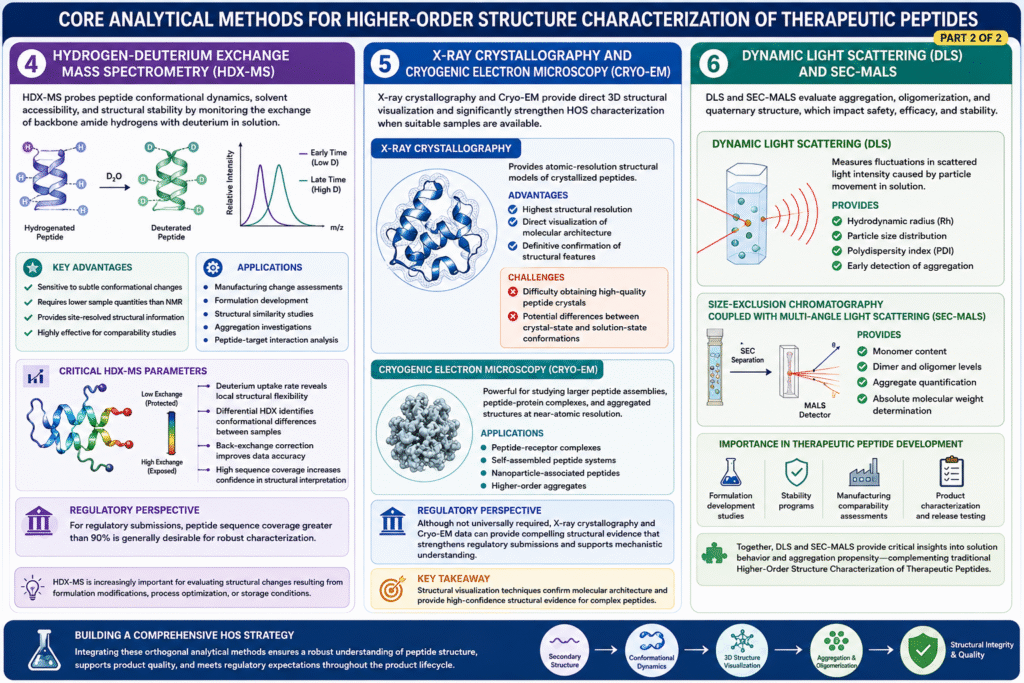
4. Hydrogen-Deuterium Exchange Mass Spectrometry (HDX-MS)
HDX-MS is one of the most powerful modern tools for probing peptide conformational dynamics, solvent accessibility, and structural stability.
The technique monitors the exchange of backbone amide hydrogens with deuterium in solution. Regions stabilized by hydrogen bonding exchange more slowly than flexible or solvent-exposed regions, providing valuable information about peptide folding and dynamics.
Key Advantages:
- Sensitive to subtle conformational changes
- Requires lower sample quantities than NMR
- Provides site-resolved structural information
- Highly effective for comparability studies
Applications:
- Manufacturing change assessments
- Formulation development
- Structural similarity studies
- Aggregation investigations
- Peptide-target interaction analysis
HDX-MS has become increasingly important for evaluating structural changes resulting from formulation modifications, process optimization, or storage conditions.
Critical HDX-MS Parameters:
- Deuterium uptake rate reveals local structural flexibility
- Differential HDX identifies conformational differences between samples
- Back-exchange correction improves data accuracy
- High sequence coverage increases confidence in structural interpretation
For regulatory submissions, peptide sequence coverage greater than 90% is generally desirable for robust characterization.
| HDX-MS Parameter | What It Reveals |
|---|---|
| Deuterium uptake rate | Local structural flexibility |
| Differential HDX | Conformational changes between two states/batches |
| Back-exchange correction | Ensures data accuracy and reproducibility |
| Peptide map coverage | Must be > 90% for regulatory submissions |
5. X-ray Crystallography and Cryo-Electron Microscopy (Cryo-EM)
X-ray crystallography and Cryo-EM provide direct three-dimensional structural visualization and can significantly strengthen Higher-Order Structure Characterization of Therapeutic Peptides when suitable samples are available.
X-ray Crystallography
X-ray crystallography provides atomic-resolution structural models of crystallized peptides and remains one of the most definitive structural characterization techniques available.
Advantages include:
- Highest structural resolution
- Direct visualization of molecular architecture
- Definitive confirmation of structural features
Challenges include:
- Difficulty obtaining high-quality peptide crystals
- Potential differences between crystal-state and solution-state conformations
Cryogenic Electron Microscopy (Cryo-EM):
Cryo-EM has emerged as a powerful technique for studying larger peptide assemblies, peptide-protein complexes, and aggregated structures at near-atomic resolution.
Applications include:
- Peptide-receptor complexes
- Self-assembled peptide systems
- Nanoparticle-associated peptides
- Higher-order aggregates
Regulatory Perspective:
Although not universally required for peptide therapeutics, X-ray crystallography and Cryo-EM data can provide compelling structural evidence that strengthens regulatory submissions and supports mechanistic understanding.
6. Dynamic Light Scattering (DLS) and Size-Exclusion Chromatography Multi-Angle Light Scattering (SEC-MALS)
DLS and SEC-MALS are essential techniques for evaluating peptide aggregation, oligomerization, and quaternary structural behavior, all of which can influence product safety, efficacy, and stability.
Dynamic Light Scattering (DLS):
DLS measures fluctuations in scattered light intensity caused by particle movement in solution.
The technique provides:
- Hydrodynamic radius (Rh)
- Particle size distribution
- Polydispersity index (PDI)
- Early detection of aggregation
Because aggregation is a common challenge in peptide formulation development, DLS is frequently used as a rapid screening tool.
Size-Exclusion Chromatography Coupled with Multi-Angle Light Scattering (SEC-MALS):
SEC-MALS determines absolute molecular weight independently of retention time calibration standards.
The technique provides:
- Monomer content
- Dimer and oligomer levels
- Aggregate quantification
- Absolute molecular weight determination
Importance in Therapeutic Peptide Development:
DLS and SEC-MALS are commonly incorporated into:
- Formulation development studies
- Stability programs
- Manufacturing comparability assessments
- Product characterization and release testing
Together, these techniques provide critical information about solution behavior and aggregation propensity that complements traditional Higher-Order Structure Characterization of Therapeutic Peptides.
4: Selecting the Right Method Panel: A Practical Framework
The choice of HOS methods should be driven by the peptide’s structural complexity, development stage, and regulatory context. Below is a stage-appropriate method selection guide used by ResolveMass Laboratories Inc.:
| Development Stage | Recommended HOS Methods |
|---|---|
| Discovery / Lead Optimization | CD, FTIR, DLS |
| Preclinical IND-Enabling | CD, FTIR, NMR (if < 50 aa), HDX-MS, SEC-MALS |
| Clinical Phase I/II | CD, NMR, HDX-MS, DLS, SEC-MALS |
| BLA/NDA Filing | Full panel: CD, FTIR, NMR, HDX-MS, X-ray/Cryo-EM (where applicable), SEC-MALS, AUC |
| Biosimilar Structural Similarity | Comparative CD, HDX-MS, NMR, SEC-MALS, AUC |
| Post-Approval Comparability | CD, FTIR, HDX-MS, DLS |
5: Regulatory Expectations: What FDA, EMA, and ICH Require
Regulators expect HOS characterization data to be generated using validated, orthogonal methods that together provide a comprehensive structural fingerprint of the therapeutic peptide. The key regulatory expectations are:
ICH Q6B Expectations
- Full physicochemical characterization including higher-order structure
- Methods should be appropriate to the molecular complexity
- Structural data should be correlated to biological activity
FDA Expectations for Peptide NDA/BLA
- HOS data must cover the drug substance as manufactured (not just reference standard)
- Changes to HOS following process changes must be assessed via comparability protocols
- Aggregation characterization (size, morphology, quantity) is required for immunogenicity risk assessment
Biosimilar Structural Similarity (FDA and EMA)
- Comparative HOS data between proposed biosimilar and reference product is a prerequisite for a totality-of-the-evidence approach
- HDX-MS and NMR are specifically highlighted in FDA guidance as tools for higher-order structural comparability
- A tiered analytical similarity approach (Tier 1 = equivalence testing; Tier 2 = quality range; Tier 3 = raw data) applies
Common Regulatory Deficiencies to Avoid
- Relying on a single HOS method without orthogonal confirmation
- Failure to characterize HOS under stressed conditions (thermal, oxidative, pH extremes)
- Insufficient peptide map coverage in HDX-MS (< 90% coverage is a common deficiency flag)
- Missing or incomplete NMR data for constrained or cyclic peptides
- Inadequate comparability study design for post-approval manufacturing changes
6: HOS and Immunogenicity: A Critical Regulatory Link
Aberrant higher-order structure — particularly beta-sheet aggregation — is a primary driver of unwanted immunogenicity in peptide therapeutics. Regulators expect developers to characterize and control aggregation as part of the immunogenicity risk management strategy.
Peptide aggregates, especially sub-visible particles (2–10 µm range), are highly immunogenic because they:
- Present repetitive epitopes that activate B-cells without T-cell help
- Activate innate immune pathways via pattern recognition receptors
- Can co-immunize with the monomeric peptide, boosting anti-drug antibody (ADA) responses
For this reason, HOS characterization is directly linked to the immunogenicity risk framework outlined in FDA’s 2013 guidance Immunogenicity Assessment for Therapeutic Protein Products. HOS data for aggregation must be paired with:
- Subvisible particle analysis (MFI, RMM)
- Visible particle inspection
- Potency assays to confirm loss-of-function in aggregated fractions
7: ResolveMass Laboratories Inc.: Your Partner for HOS Characterization
ResolveMass Laboratories Inc. is a Canadian contract analytical laboratory specializing in the structural and physicochemical characterization of biopharmaceuticals, including complex therapeutic peptides. Our scientists bring deep expertise in both the technical execution and regulatory interpretation of HOS data.
Our HOS characterization capabilities include:
- Far-UV and near-UV Circular Dichroism (CD) with thermal ramp profiling
- FTIR spectroscopy with Amide I band deconvolution
- Solution-state NMR (1D ¹H, 2D NOESY/TOCSY) for peptides up to 50 amino acids
- HDX-MS with > 95% peptide map coverage and rigorous back-exchange controls
- SEC-MALS for absolute molecular weight and oligomeric state determination
- DLS for hydrodynamic size and aggregation screening
- Sub-visible particle analysis by MFI (Micro-Flow Imaging)
- Regulatory writing support for ICH Q6B, FDA, and EMA structural characterization sections
Every analytical program at ResolveMass is designed with the regulatory endpoint in mind. We do not just generate data — we build structured, defensible characterization packages that stand up to agency scrutiny.
Conclusion:
Higher-order structure characterization of therapeutic peptides is the structural foundation upon which safety, efficacy, and regulatory approval are built. As peptide therapeutics continue to grow in clinical and commercial significance — from GLP-1 receptor agonists to novel antimicrobial peptides and targeted oncology payloads — the analytical and regulatory bar for HOS characterization will only rise.
Developers who invest in comprehensive, orthogonal HOS characterization early in the development lifecycle gain multiple competitive advantages: cleaner IND packages, more defensible NDA/BLA submissions, lower risk of CRLs related to structural inadequacy, and stronger biosimilar development programs.
ResolveMass Laboratories Inc. stands ready to support your therapeutic peptide program at every stage — from discovery-phase structural screening to regulatory filing packages and post-approval comparability studies. Our team combines hands-on analytical expertise with a deep understanding of the regulatory landscape to help you move faster, with confidence.
Frequently Asked Questions:
Yes, Higher-Order Structure (HOS) characterization is increasingly important for both therapeutic peptides and larger biologics. While regulatory expectations are generally more extensive for complex biologics such as monoclonal antibodies, peptide therapeutics that rely on specific conformations, disulfide bonds, cyclic structures, or higher-order assemblies also require structural characterization. The extent of HOS testing is typically determined using a risk-based approach that considers peptide complexity, mechanism of action, formulation, and potential impact on product quality, safety, and efficacy.
Sample requirements vary depending on the analytical techniques included in the characterization package. As a general guideline:
-CD spectroscopy may require only a few hundred micrograms to a few milligrams.
-FTIR often requires minimal sample quantities.
-HDX-MS typically requires low microgram-to-milligram amounts.
-NMR generally requires the largest quantity, often several milligrams depending on peptide size and experiment design.
-DLS and SEC-MALS requirements vary based on concentration and formulation.
For a comprehensive HOS characterization package, laboratories often recommend providing approximately 10–50 mg of material, although actual requirements depend on the peptide, formulation, and study objectives.
Yes. HOS characterization can be performed on both drug substance and formulated drug product. In fact, evaluating the formulated product is often critical because excipients, buffers, surfactants, lyophilization processes, and container-closure systems can influence peptide conformation and stability.
Common applications include:
-Pre- and post-formulation comparability studies
-Stability testing programs
-Lyophilized versus reconstituted product comparisons
-Manufacturing process change assessments
-Extractables and leachables impact investigations
Some analytical methods may require optimization or additional sample preparation when analyzing complex formulations, but meaningful HOS data can often still be obtained.
Turnaround time depends on the scope of the study, analytical methods selected, sample complexity, and regulatory requirements. Individual techniques such as CD, FTIR, DLS, or SEC-MALS can often be completed relatively quickly, while advanced methods such as HDX-MS and NMR generally require more time for data acquisition, analysis, and interpretation.
A comprehensive HOS characterization program that includes multiple orthogonal techniques, data integration, and reporting typically takes several weeks to complete. Projects involving method development, forced degradation studies, comparability assessments, or regulatory documentation may require additional time. Early consultation with an experienced analytical laboratory can help establish realistic timelines and ensure efficient project execution.
Reference
- Chen G, Tao L, Li Z. Recent advancements in mass spectrometry for higher order structure characterization of protein therapeutics. Drug Discovery Today. 2022 Jan 1;27(1):196-206.https://www.sciencedirect.com/science/article/pii/S1359644621004049
- Kuhne F, Liu RP, Wang L, Wecksler AT, Gaikwad M, Jao CC, Estevez A, Regy RM, Izadi S. Modern Methods for Characterizing the Higher‐Order Structure (HOS) of Biotherapeutics. Characterizing Biotherapeutics: Analytical Methods for Diverse Modalities. 2025 Jun 17:129-60.https://onlinelibrary.wiley.com/doi/abs/10.1002/9781394236145.ch8
- Kaltashov IA, Bobst CE, Pawlowski J, Wang G. Mass spectrometry-based methods in characterization of the higher order structure of protein therapeutics. Journal of pharmaceutical and biomedical analysis. 2020 May 30;184:113169.https://www.sciencedirect.com/science/article/pii/S073170851932792X
- Chen K, Smith CJ. Best practices for submission of NMR data to support higher order structure assessment of generic peptide drugs. The AAPS Journal. 2023 Jan 20;25(1):17.https://link.springer.com/article/10.1208/s12248-023-00782-w
- Orphanou C, Gervais D. Higher‐order structure and conformational change in biopharmaceuticals. Journal of Chemical Technology & Biotechnology. 2018 Sep;93(9):2477-85.https://scijournals.onlinelibrary.wiley.com/doi/abs/10.1002/jctb.5682
- Weiss IV WF, Gabrielson JP, Al-Azzam W, Chen G, Davis DL, Das TK, Hayes DB, Houde D, Singh SK. Technical decision making with higher order structure data: perspectives on higher order structure characterization from the biopharmaceutical industry. Journal of Pharmaceutical Sciences. 2016 Dec 1;105(12):3465-70.https://www.sciencedirect.com/science/article/pii/S0022354916416953
About the Author


