


Introduction:
Cyclodextrin-Based Dendrimers Enhance Drug Solubility by combining two powerful drug-delivery technologies into one advanced molecular system. This approach allows poorly soluble drugs to become more stable, more bioavailable, and easier to formulate.
In modern drug development, poor solubility is one of the most common reasons why promising molecules fail. Many new chemical entities (NCEs) are highly potent but extremely difficult to dissolve in aqueous environments. This is where cyclodextrin-based dendrimers are transforming pharmaceutical formulation strategies.
At ResolveMass Laboratories Inc., advanced analytical expertise is used to evaluate how such innovative excipient systems improve drug solubility, stability, and performance in real-world formulations.
Share via:
Summary:
- Cyclodextrin-Based Dendrimers Enhance Drug Solubility by combining the inclusion ability of cyclodextrins with the multivalent structure of dendrimers.
- These hybrid systems significantly improve the bioavailability of poorly soluble drugs.
- They are especially useful in modern pharmaceutical development, including small molecules, peptides, and complex drug candidates.
- Compared to conventional solubility techniques, cyclodextrin-based dendrimers offer better stability, controlled drug release, and improved formulation efficiency.
- ResolveMass Laboratories Inc. provides advanced analytical support to evaluate solubility enhancement strategies using cutting-edge tools like LC-MS, HRMS, and formulation characterization techniques.
1: What Are Cyclodextrin-Based Dendrimers and How Do They Work?
Cyclodextrin Dendrimers Enhance Drug Solubility because they combine the inclusion capability of cyclodextrins with the highly branched structure of dendrimers.
Understanding Cyclodextrins
Cyclodextrins are cyclic oligosaccharides that form a hollow, hydrophobic cavity. This cavity can trap poorly soluble drug molecules and increase their apparent solubility in water.
Key advantages of cyclodextrins:
- Improve solubility of hydrophobic drugs
- Protect drugs from degradation
- Reduce toxicity of certain APIs
- Improve drug stability during storage
Understanding Dendrimers
Dendrimers are highly branched, tree-like macromolecules with:
- Large surface area
- Multiple functional groups
- High drug-loading capacity
- Controlled molecular architecture
Why Combining Them Works So Well
When cyclodextrins are attached to dendrimers:
- Multiple drug molecules can be encapsulated simultaneously
- Solubility increases significantly
- Drug release becomes more controlled
- Stability improves during storage and formulation
This is exactly why Cyclodextrin-Based Dendrimers Enhance Drug Solubility more effectively than traditional methods.
2: Why Cyclodextrin-Based Dendrimers Enhance Drug Solubility Better Than Traditional Methods
Cyclodextrin Dendrimers Enhance Drug Solubility more efficiently than common techniques such as salt formation, particle size reduction, or simple cyclodextrin complexation.
Comparison Table
| Method | Solubility Improvement | Stability | Drug Loading | Scalability |
|---|---|---|---|---|
| Particle size reduction | Moderate | Low | Low | High |
| Salt formation | Moderate | Moderate | Low | Moderate |
| Simple cyclodextrin complex | Good | Good | Moderate | High |
| Cyclodextrin-based dendrimers | Excellent | Excellent | High | High |
This clearly explains why Cyclodextrin Dendrimers Enhance Drug Solubility in a more reliable and scalable way for modern drug development programs.
3: How Cyclodextrin-Based Dendrimers Enhance Drug Solubility at the Molecular Level
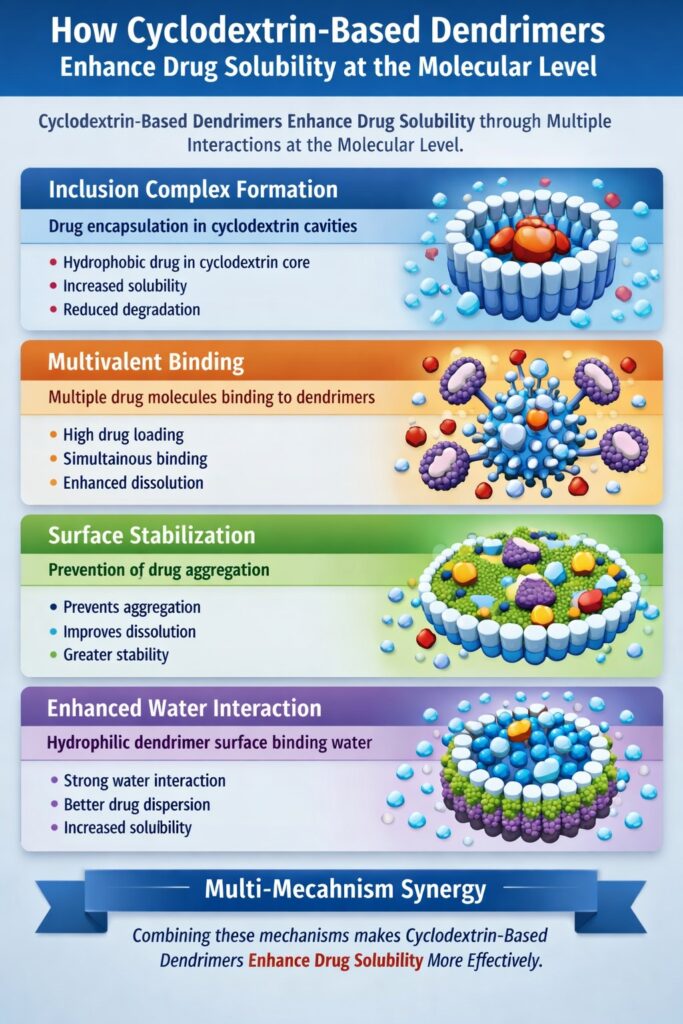
Cyclodextrin-Based Dendrimers Enhance Drug Solubility because they create multiple simultaneous interactions between the drug molecule and the carrier system. Unlike conventional solubility-enhancement techniques that rely on a single mechanism, these hybrid systems work through a combination of inclusion, surface interaction, stabilization, and molecular-level binding.
This multi-mechanism behavior is the primary reason why Cyclodextrin Dendrimers Enhance Drug Solubility more effectively than traditional solubility approaches.
1. Inclusion Complex Formation
The first mechanism through which Cyclodextrin Dendrimers Enhance Drug Solubility is inclusion complex formation. Cyclodextrins have a hydrophobic inner cavity and a hydrophilic outer surface. Poorly soluble drug molecules enter this cavity and become more compatible with aqueous environments.
What happens at the molecular level:
- The hydrophobic portion of the drug is trapped inside the cyclodextrin cavity
- The outer hydrophilic surface interacts with water
- The drug becomes more soluble without changing its chemical structure
- Degradation caused by light, oxygen, or moisture is reduced
This mechanism is particularly effective for lipophilic drug molecules that struggle to dissolve in aqueous media.
2. Multivalent Binding
Another major reason why Cyclodextrin Dendrimers Enhance Drug Solubility is multivalent binding. When multiple cyclodextrin units are attached to a dendrimer, the system can bind several drug molecules at the same time.
Why this improves solubility significantly:
- Multiple drug molecules are stabilized simultaneously
- Drug loading capacity increases
- Solubility improves more than simple cyclodextrin complexes
- Drug aggregation is reduced
- Dissolution becomes faster and more uniform
This multi-binding effect is one of the strongest advantages of cyclodextrin-based dendrimers compared to traditional formulation methods.
3. Surface Stabilization
Cyclodextrin Dendrimers Enhance Drug Solubility not only by binding drug molecules but also by preventing them from aggregating. Many poorly soluble drugs tend to form clusters in aqueous environments, which significantly reduces their dissolution rate.
How surface stabilization works:
- The dendrimer structure surrounds drug molecules
- Drug particles remain separated instead of forming aggregates
- Dissolution rate improves
- Precipitation during formulation is reduced
- Stability during storage improves
This mechanism is particularly useful in formulations where drug precipitation is a major issue.
4. Enhanced Water Interaction
The outer surface of dendrimers is highly hydrophilic, which means it interacts strongly with water molecules. This property plays a critical role in explaining why Cyclodextrin Dendrimers Enhance Drug Solubility more efficiently than many traditional excipients.
At the molecular level, this results in:
- Strong interaction between the carrier and water
- Better dispersion of drug molecules in aqueous media
- Improved dissolution behavior
- Increased apparent solubility
- More stable drug formulations
Why This Multi-Mechanism Approach Matters
The real strength of this technology is that all these mechanisms work together simultaneously. Instead of relying on a single approach such as particle-size reduction or salt formation, cyclodextrin-based dendrimers improve solubility through multiple molecular-level interactions.
This is the core reason why Cyclodextrin Dendrimers Enhance Drug Solubility more effectively, more reliably, and more consistently than traditional solubility-enhancement techniques.
4: Applications Where Cyclodextrin-Based Dendrimers Enhance Drug Solubility the Most
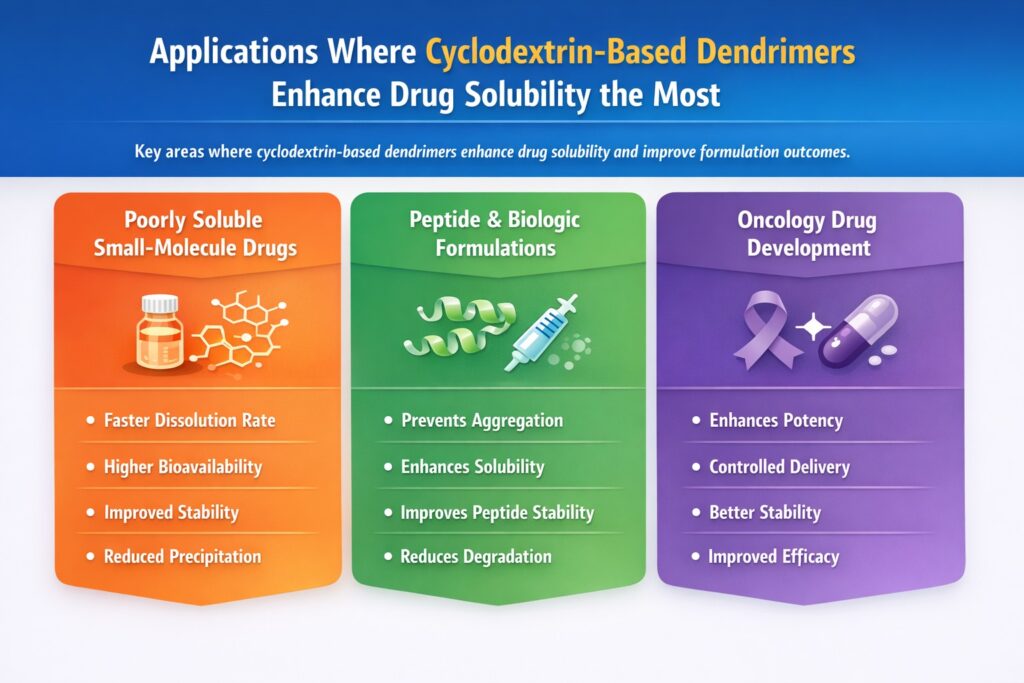
Cyclodextrin-Based Dendrimers Enhance Drug Solubility especially in complex pharmaceutical molecules where conventional formulation approaches such as particle-size reduction, salt formation, or simple complexation fail. Their unique hybrid structure allows them to work effectively across multiple drug categories, including small molecules, peptides, and highly potent oncology drugs.
Below are the areas where Cyclodextrin Dendrimers Enhance Drug Solubility the most and provide the highest impact in modern drug development.
1. Poorly Soluble Small-Molecule Drugs
One of the biggest challenges in pharmaceutical development is that a large percentage of modern APIs are poorly soluble in water. Many new chemical entities (NCEs) are highly lipophilic and show excellent biological activity but extremely low solubility.
In such cases, Cyclodextrin Dendrimers Enhance Drug Solubility by forming multiple inclusion complexes while also preventing drug aggregation.
Key improvements include:
- Faster dissolution rate in aqueous media
- Higher oral bioavailability
- Improved stability during formulation development
- Reduced precipitation during storage
- Better drug performance in final dosage forms
This makes cyclodextrin-based dendrimers especially valuable in early-stage drug development, where solubility issues often delay formulation progress.
2. Peptide and Biologic Formulations
Peptide-based drugs are becoming increasingly important in modern therapeutics, but they often suffer from major formulation challenges. Many peptides are unstable in solution, prone to aggregation, and difficult to dissolve in aqueous environments.
This is where Cyclodextrin Dendrimers Enhance Drug Solubility by providing both structural protection and improved interaction with water.
Common peptide challenges solved:
- Instability in aqueous formulations
- Protein and peptide aggregation
- Low solubility at therapeutic concentrations
- Degradation during storage
- Difficulty in developing injectable formulations
By stabilizing peptide molecules while improving their solubility, cyclodextrin-based dendrimers significantly increase the chances of successful formulation development.
3. Oncology Drug Development
Cancer drugs are among the most complex molecules developed today. Many oncology drugs are highly potent but extremely poorly soluble, which creates serious formulation and bioavailability challenges.
In this area, Cyclodextrin Dendrimers Enhance Drug Solubility while also improving drug stability and delivery efficiency.
Why they are particularly useful in oncology:
- Many anticancer drugs are highly lipophilic
- Very small doses require very high stability
- Controlled drug delivery is critical
- Stability during storage and transport is essential
- Improved solubility directly improves therapeutic performance
Because of these advantages, cyclodextrin-based dendrimers are increasingly being explored as advanced drug-delivery systems for oncology applications.
5: How Analytical Testing Confirms That Cyclodextrin-Based Dendrimers Enhance Drug Solubility
Cyclodextrin-Based Dendrimers Enhance Drug Solubility only when validated using advanced analytical techniques.
At ResolveMass Laboratories Inc., solubility enhancement is confirmed using:
Advanced Analytical Techniques
- LC-MS solubility studies
- HRMS characterization
- Dissolution profiling
- Stability testing
- Impurity profiling
- Drug-excipient interaction studies
Why Analytical Validation Is Important
Without proper testing:
- Solubility improvements may be temporary
- Stability issues may remain undetected
- Drug degradation may occur during formulation
This is why scientific validation plays a major role in proving that Cyclodextrin Dendrimers Enhance Drug Solubility in real pharmaceutical applications.
6: Advantages of Cyclodextrin-Based Dendrimers in Modern Drug Development
Cyclodextrin-Based Dendrimers Enhance Drug Solubility while also offering several additional benefits.
Key Advantages
- Higher drug-loading capacity
- Improved bioavailability
- Better stability under stress conditions
- Reduced formulation failures
- Controlled drug release
- Suitable for both oral and injectable formulations
- Strong compatibility with modern analytical methods
These advantages make cyclodextrin-based dendrimers one of the most promising excipient technologies in pharmaceutical development today.
7: Why the Pharmaceutical Industry Is Focusing on Cyclodextrin-Based Dendrimers
Cyclodextrin-Based Dendrimers Enhance Drug Solubility in a way that aligns perfectly with current pharmaceutical trends.
Industry Trends Supporting Their Use
- Increase in poorly soluble drug candidates
- Growth in peptide-based therapies
- Need for advanced drug-delivery systems
- Demand for improved bioavailability
- Regulatory focus on formulation performance
Companies developing complex drugs increasingly rely on advanced analytical partners such as ResolveMass Laboratories Inc. to evaluate these innovative solubility-enhancement approaches.
8: Real-World Challenges Where Cyclodextrin-Based Dendrimers Enhance Drug Solubility
Cyclodextrin Dendrimers Enhance Drug Solubility especially when traditional formulation approaches fail.
Common Problems Solved
- Low dissolution rate
- Poor bioavailability
- Drug precipitation during formulation
- Stability problems in aqueous systems
- Inconsistent drug performance
- High formulation cost due to multiple trials
Cyclodextrin-based dendrimers reduce formulation risks and significantly shorten development timelines.
Conclusion:
Cyclodextrin-Based Dendrimers Enhance Drug Solubility by combining advanced molecular design with powerful drug-delivery functionality. They improve solubility, stability, bioavailability, and overall formulation performance—making them one of the most promising technologies in modern pharmaceutical development.
With the increasing number of poorly soluble drug candidates entering the market, these hybrid systems will play a critical role in future drug development strategies. Scientific validation, analytical testing, and formulation expertise are essential to successfully implement this technology.
At ResolveMass Laboratories Inc., advanced analytical capabilities help pharmaceutical companies evaluate and confirm solubility-enhancement strategies using modern tools and real-world expertise.
Frequently Asked Questions:
Cyclodextrin-Based Dendrimers Enhance Drug Solubility by combining the inclusion ability of cyclodextrins with the multivalent structure of dendrimers. This allows multiple drug molecules to be encapsulated while improving stability and dissolution in aqueous environments.
Cyclodextrin-Based Dendrimers Enhance Drug Solubility more effectively than techniques like particle-size reduction or salt formation because they work through multiple mechanisms simultaneously, including inclusion complex formation, surface stabilization, and improved water interaction.
Poorly soluble small-molecule drugs, peptide formulations, and oncology drugs benefit the most because Cyclodextrin-Based Dendrimers Enhance Drug Solubility while also improving stability and bioavailability.
Yes. One of the biggest advantages is that Cyclodextrin-Based Dendrimers Enhance Drug Solubility without chemically modifying the drug molecule. Instead, they improve solubility through molecular encapsulation and stabilization.
They increase dissolution rate, prevent drug aggregation, and improve stability in aqueous media. Because Cyclodextrin-Based Dendrimers Enhance Drug Solubility, the drug becomes more available for absorption in the body.
Yes. Many pharmaceutical companies are exploring advanced excipient systems because Cyclodextrin-Based Dendrimers Enhance Drug Solubility in complex drug molecules that fail with traditional formulation approaches.
Reference
- Jain NK, Gupta U. Application of dendrimer–drug complexation in the enhancement of drug solubility and bioavailability. Expert opinion on drug metabolism & toxicology. 2008 Aug 1;4(8):1035-52.https://www.tandfonline.com/doi/abs/10.1517/17425255.4.8.1035
- Topuz F, Uyar T. Recent advances in cyclodextrin‐based nanoscale drug delivery systems. Wiley Interdisciplinary Reviews: Nanomedicine and Nanobiotechnology. 2024 Nov;16(6):e1995.https://wires.onlinelibrary.wiley.com/doi/abs/10.1002/wnan.1995
- Vyas A, Saraf S, Saraf S. Cyclodextrin based novel drug delivery systems. Journal of inclusion phenomena and macrocyclic chemistry. 2008 Oct;62(1):23-42.https://link.springer.com/article/10.1007/s10847-008-9456-y
- Thakur SS, Parekh HS, Schwable CH, Gan Y, Ouyang D. Solubilization of Poorly Soluble Drugs: Cyclodextrin‐Based Formulations. Computational Pharmaceutics. 2015 Jun 29:31-51.https://onlinelibrary.wiley.com/doi/abs/10.1002/9781118573983.ch3
- Gadade DD, Pekamwar SS. Cyclodextrin based nanoparticles for drug delivery and theranostics. Advanced pharmaceutical bulletin. 2020 Feb 18;10(2):166.https://pmc.ncbi.nlm.nih.gov/articles/PMC7191229/
- Simões SM, Rey-Rico A, Concheiro A, Alvarez-Lorenzo C. Supramolecular cyclodextrin-based drug nanocarriers. Chemical Communications. 2015;51(29):6275-89.https://pubs.rsc.org/en/content/articlehtml/2015/cc/c4cc10388b

