

Introduction
Choosing a peptide Contract Development and Manufacturing Organization (CDMO) in the US requires a comprehensive assessment of technical synthesis capabilities, regulatory compliance, process analytical technologies, and supply chain security. Understanding How to Choose a Peptide CDMO in the US allows pharmaceutical sponsors to identify manufacturing partners with the capabilities needed to advance complex synthetic peptides from early-stage development through commercial-scale production while reducing regulatory and supply chain risks.
The rapid worldwide expansion of peptide therapeutics—largely fueled by glucagon-like peptide-1 (GLP-1) receptor agonists such as semaglutide and tirzepatide, together with growing development pipelines in oncology, rare diseases, and targeted delivery systems—has generated substantial demand for specialized peptide manufacturing infrastructure. Contemporary peptide molecules are becoming increasingly sophisticated and often include cyclic structures, non-natural amino acids, stapled peptide backbones, and conjugated functional groups such as fatty acid chains or polyethylene glycol (PEG) polymers. Transferring these advanced compounds from research-grade discovery, which is often supported by Contract Research Organizations (CROs), into cGMP-compliant manufacturing requires a CDMO with demonstrated expertise in solid-phase, liquid-phase, or hybrid synthesis, reliable purification technologies, and comprehensive analytical characterization capabilities.
Learn more about transitioning from early discovery to scale up: Peptide CDMO vs CRO
Meeting regulatory requirements established by the United States Food and Drug Administration (FDA) requires stringent control of organic impurities, residual solvents, elemental contaminants, and peptide aggregation profiles. Independent analytical partners, including ResolveMass Laboratories Inc., contribute to this ecosystem by providing high-resolution mass spectrometry, quantitative nuclear magnetic resonance (qNMR), and orthogonal purity profiling to establish active pharmaceutical ingredient (API) sameness and structural integrity for regulatory submissions. Assessing potential manufacturing partners using standardized technical, quality, and operational criteria enables sponsors to establish compliant, resilient, and cost-effective commercial supply chains.
Share via:
Article Summary:
- Choosing the right peptide CDMO in the US requires evaluating technical expertise, regulatory compliance, analytical capabilities, manufacturing capacity, supply chain reliability, and project governance.
- Sponsors should confirm that the CDMO has proven experience with complex peptide structures, including long sequences, cyclic peptides, lipidated molecules, PEGylated peptides, and other chemical modifications.
- A reliable CDMO should have strong cGMP systems, a positive regulatory track record, effective CAPA and OOS investigation procedures, and robust controls for peptide-related, solvent, and elemental impurities.
- Advanced analytical capabilities and Process Analytical Technology (PAT) are essential for monitoring manufacturing processes and confirming peptide identity, purity, structure, degradation products, and other critical quality attributes.
- Supply chain transparency has become increasingly important due to geopolitical and regulatory considerations, including the need to evaluate raw material sourcing, domestic manufacturing capabilities, and BIOSECURE Act compliance.
- Buyers should assess production capacity, scale-up readiness, technology transfer procedures, quality agreements, communication systems, and Person-in-Plant access before selecting a CDMO partner.
- A structured, risk-based vendor evaluation and technology transfer strategy helps sponsors reduce scale-up challenges, protect development timelines, maintain regulatory compliance, and establish a dependable long-term peptide manufacturing supply chain.
Regulatory and Geopolitical Factors in How to Choose a Peptide CDMO in the US
Determining How to Choose a Peptide CDMO in the US requires careful consideration of how legislative requirements, particularly the US BIOSECURE Act, may influence contractor selection, supply chain continuity, and eligibility for federal funding. Biopharmaceutical sponsors must evaluate a CDMO’s domestic manufacturing presence and raw material supply networks to minimize the risk of regulatory obstacles and legislative non-compliance.
Explore our dedicated Pharmaceutical CDMO US and Canada services to build a resilient regional supply chain.
The enactment of the BIOSECURE Act, codified under Section 851 of the Fiscal Year 2026 National Defense Authorization Act, formally limits US federal agencies from procuring biotechnology equipment or services from designated foreign “Biotechnology Companies of Concern” (BCCs). Importantly, the legislation includes contractor “flow-down” provisions that prevent federal contractors, grant recipients such as National Institutes of Health research programs, and federally funded drug developers from using BCC equipment or services throughout their wider manufacturing supply chains. Because an estimated 79% of global biopharmaceutical organizations have historically maintained manufacturing or analytical contracts with overseas entities, this legislation has accelerated near-shoring and reshoring efforts toward domestic and compliant North American partners.
Implementing a technology transfer for complex peptide active pharmaceutical ingredients generally requires a lead time of 12 to 24 months. Drug developers that postpone these activities until enforcement deadlines are approaching may face significant industry-wide capacity limitations and increased pricing across US-based cGMP facilities. As a result, supply chain resilience, geographical stability, and complete visibility into tier-2 and tier-3 raw material suppliers have become essential evaluation criteria during CDMO selection. Near-shoring manufacturing to North American facilities also helps align production activities with Good Distribution Practice (GDP) guidelines and the FDA’s Drug Supply Chain Security Act (DSCSA), thereby reducing cold-chain vulnerabilities associated with sensitive injectable formulations.
See how our regulatory team assists with FDA and Health Canada compliance: Regulatory Support for Generic Drugs US and Canada CDMO
Technical Evaluation: Synthesis Platforms and Process Scalability
Assessing a peptide CDMO’s technical capabilities requires matching the peptide sequence length, chemical modifications, and intended batch volumes with the most suitable synthesis platform, including Solid-Phase Peptide Synthesis (SPPS), Liquid-Phase Peptide Synthesis (LPPS), or hybrid convergent assembly. Selecting a partner with scalable reactor infrastructure and optimized purification technologies supports a controlled transition from pilot-scale production to multikilogram commercial manufacturing campaigns.
Peptide assembly strategies differ according to sequence length, amino acid characteristics, and projected commercial demand. Solid-Phase Peptide Synthesis (SPPS) remains the principal platform for early-stage development and short-to-medium peptide chains, generally covering sequences ranging from 2 to 50 amino acids. By using solid supports together with Fluorenylmethyloxycarbonyl (Fmoc) or tert-Butyloxycarbonyl (Boc) protecting group strategies, SPPS facilitates high yields and relatively rapid synthesis cycles. However, when peptide length exceeds 50 residues, steric hindrance and incomplete coupling reactions can become increasingly problematic, leading to greater accumulation of deletion sequences and truncated impurities.
For longer peptide sequences or high-volume commercial manufacturing, hybrid convergent synthesis can provide improved overall yield and enhanced control of product purity. In a convergent strategy, shorter protected peptide fragments are synthesized separately using SPPS, purified, and then coupled in the solution phase through Liquid-Phase Peptide Synthesis (LPPS) to assemble the complete full-length molecule.
Discover how to transition efficiently to large-scale production: Peptide API Scale-Up
| Evaluation Criteria | Solid-Phase Peptide Synthesis (SPPS) | Liquid-Phase Peptide Synthesis (LPPS) | Convergent / Hybrid Synthesis |
|---|---|---|---|
| Optimal Sequence Length | 2 to 50 Amino Acids | 2 to 15 Amino Acids (or fragment coupling) | 50+ Amino Acids |
| Scalability Target | High flexibility; batch scales up to multikilogram | Exceptional commercial scale (>100 kg/year) | Moderate to High; requires complex fragment optimization |
| Development Timeline | Short (ideal for rapid early R&D and Phase I) | Extended (requires liquid-phase route scouting) | Moderate (requires fragment synthesis and ligation optimization) |
| Solvent Footprint | High (demands extensive resin washing cycles) | Lower relative to total mass output | Balanced (optimized fragment wash and solution coupling) |
| Dominant Impurity Risks | Deletion sequences, truncated peptides, enantiomers | Residual unreacted starting materials and reagents | Diastereomeric impurities at fragment ligation sites |
In addition to primary sequence assembly, a qualified CDMO must demonstrate technical expertise in performing secondary chemical modifications. Native peptides frequently undergo rapid enzymatic degradation and have short circulating half-lives in vivo, making modifications such as N-terminal acetylation, C-terminal amidation, disulfide bond cyclization, PEGylation, or fatty-acid lipidation necessary in some cases to improve therapeutic efficacy. Sponsors should confirm that prospective CDMOs have access to specialized industrial prep-HPLC purification columns, large-capacity lyophilizers (freeze-dryers), and high-containment suites capable of safely handling hazardous reagents.
Check out our full spectrum of specialized manufacturing solutions: Peptide CDMO Services
Sponsors must also distinguish between total product mass and net peptide content. Lyophilized bulk peptide powder commonly contains 10% to 30% non-peptide mass, which may include bound water and counter-ions such as trifluoroacetate (TFA) or acetate. A CDMO should therefore provide validated quantitative Amino Acid Analysis (AAA) and counter-ion testing to determine net peptide potency and support accurate dosing in clinical formulations.
Review top-tier synthesis and execution criteria: Best Peptide CDMO
Regulatory Compliance, Impurity Profiling, and Quality Systems
Demonstrating compliance with FDA regulations governing peptide drug substances requires adherence to 21 CFR Parts 210/211, strict implementation of relevant ICH guidelines, including Q3A, Q3B, Q3C, and Q3D, and alignment with FDA guidance addressing peptide-related impurities. Selecting a compliant CDMO requires a detailed assessment of its regulatory inspection history, procedures for investigating out-of-specification (OOS) results, and ability to demonstrate active pharmaceutical ingredient (API) sameness for Abbreviated New Drug Application (ANDA) or New Drug Application (NDA) submissions.
Peptide-related impurities may be generated during synthesis as a result of incomplete coupling, racemization, premature deprotection, or chemical degradation pathways such as oxidation and deamidation. Synthetic peptides are excluded by the FDA from the basic qualification thresholds described in ICH Q3A/Q3B, with stricter limits instead applying under regulatory guidance specific to generic synthetic peptides. Drug sponsors submitting Abbreviated New Drug Applications (ANDAs) or New Drug Applications (NDAs) must meet established impurity thresholds:
Reporting Threshold: Any organic peptide-related impurity present at or above 0.05% must be documented in batch analytical records.
Identification Threshold: Impurities present at or above 0.10% require complete structural characterization using validated analytical methods.
Qualification Threshold: Impurities exceeding 0.15% (or a Total Daily Intake of 1.0 mg) require formal toxicological qualification or comparative evaluation against the Reference Listed Drug (RLD).
Generic Synthetic Limits: For synthetic generic peptides referencing rDNA-derived products, such as semaglutide, the generic product must not contain any new peptide-related impurity greater than 0.5%. Any new impurity present between 0.10% and 0.5% requires detailed assessment of both adaptive and innate immunogenicity risks.
Read our real-world analysis on structural sameness and impurity mapping: Generic Peptide Drug Analytical Characterization Case Study
Process-related impurities create additional compliance requirements. Residual organic solvents used during synthesis and purification, including dimethylformamide (DMF), dichloromethane (DCM), and acetonitrile (ACN), are regulated under ICH Q3C guidelines. Elemental impurities, including heavy metal catalysts introduced through reagents or processing equipment, must be quantified using Inductively Coupled Plasma Mass Spectrometry (ICP-MS) in accordance with ICH Q3D and applicable USP requirements.
A CDMO’s Quality Management System (QMS) must include robust Root Cause Analysis (RCA) frameworks for investigating Out-of-Specification (OOS) analytical events, managing Corrective and Preventive Actions (CAPA), and implementing stringent Change Control procedures. Reviewing a manufacturer’s history of FDA Form 483 observations, Warning Letters, and Health Canada inspection reports can provide valuable insight into its overall operational compliance and quality performance.
Advanced Analytical Characterization and Process Analytical Technology (PAT)
Integrating Process Analytical Technology (PAT) into peptide manufacturing enables real-time in-process control, while complementary orthogonal offline testing provides comprehensive confirmation of critical quality attributes (CQAs). Collaborating with CDMOs and specialized analytical laboratories that use advanced mass spectrometry platforms can reduce the risk of batch failures and support more efficient regulatory dossier review.
Modern peptide manufacturing increasingly uses PAT tools to transform conventional batch operations into digitized and tightly controlled processes. Integrating real-time sensors directly into synthesis vessels and purification columns provides immediate, actionable process feedback. This approach can eliminate unnecessary wash cycles, improve process control, and reduce overall solvent consumption.
In-Line UV-Vis Spectroscopy: Measures UV absorbance to monitor the removal of Fmoc protecting groups during deprotection cycles according to the Beer-Lambert law ($A = \varepsilon l c$), helping confirm complete cleavage before the next amino acid is added.
Refractive Index (RI) Sensors: Monitor changes in the refractive index of the liquid, which is governed by Snell’s law, $n = \frac{c}{v}$. These changes can help identify amino acid coupling completion and establish wash endpoints during solid-phase synthesis.
Near-Infrared (NIR) & Raman Spectroscopy: Enables real-time quantitative monitoring of residual piperidine and solvent concentrations during resin washing steps. This helps prevent premature deprotection while also minimizing unnecessary solvent consumption.
In-Line Conductivity Monitoring: Measures conductivity changes to monitor the removal of basic by-products, including dibenzylfulvene (DBF) and piperidine, during washing stages.
Dual-Pressure Freeze-Drying Control: Uses Pirani and Barocel pressure sensors during lyophilization to determine the endpoint of primary drying, helping prevent thermal collapse and peptide aggregation.
Although PAT improves manufacturing execution and process control, regulatory approval requires extensive offline structural characterization. Because no single analytical technique can adequately resolve every potential impurity or conformational variant, regulatory agencies expect orthogonal testing strategies that combine complementary analytical and separation mechanisms.
Explore high-resolution LC-MS/MS and orthogonal testing solutions: Peptide Analytical Characterization Services
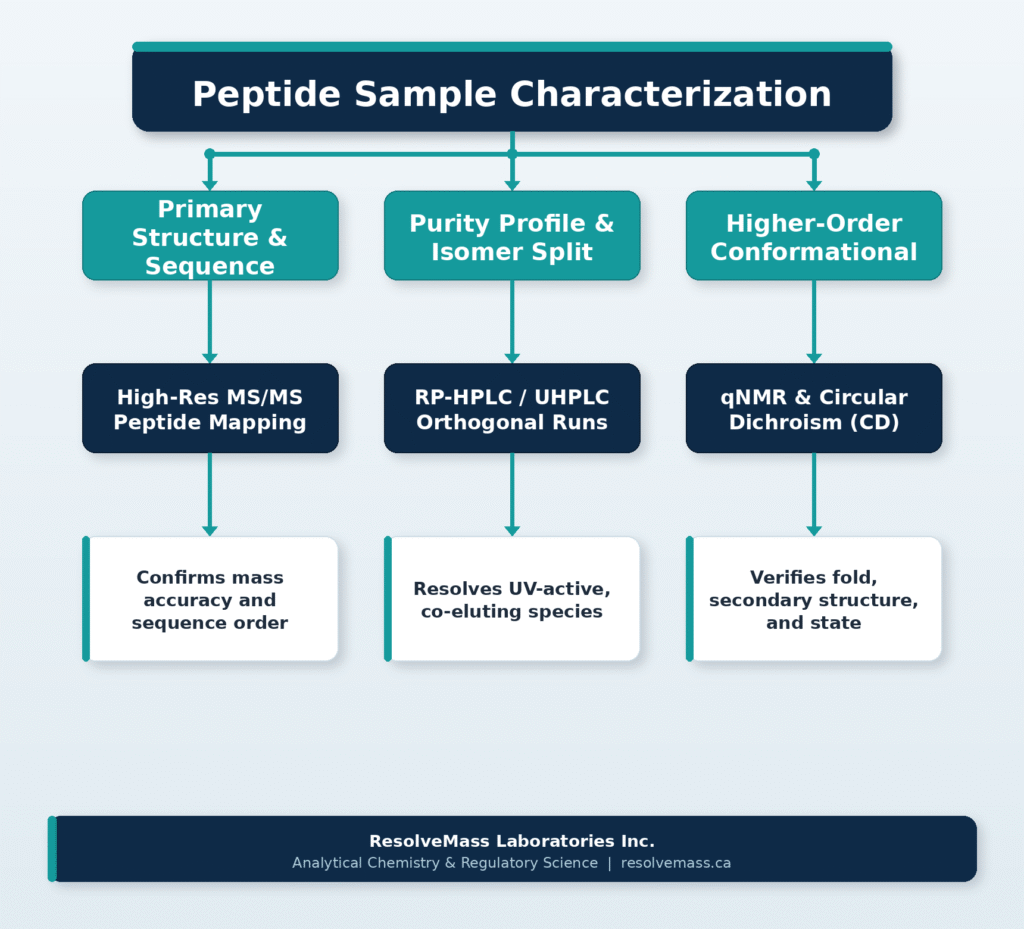
Specialized analytical CROs, such as ResolveMass Laboratories Inc., can support CDMO workflows through Health Canada Licensed (DEL 3-002945-A) and FDA-registered testing facilities. Using high-resolution Orbitrap and QToF Mass Spectrometry (HRMS), LC-MS/MS peptide mapping, quantitative Nuclear Magnetic Resonance (qNMR), and Capillary Electrophoresis (CE), these analytical platforms can structurally characterize degradation products, deamidation variants, and stereoisomers. Comprehensive analytical data packages generated through these techniques can support IND, NDA, and ANDA regulatory filings while maintaining strict compliance with ALCOA+ data integrity principles.
Learn how advanced characterization specifically applies to complex metabolic therapeutics: GLP-1 Peptide Analytical Characterization
Comprehensive Buyer’s Checklist for How to Choose a Peptide CDMO in the USA
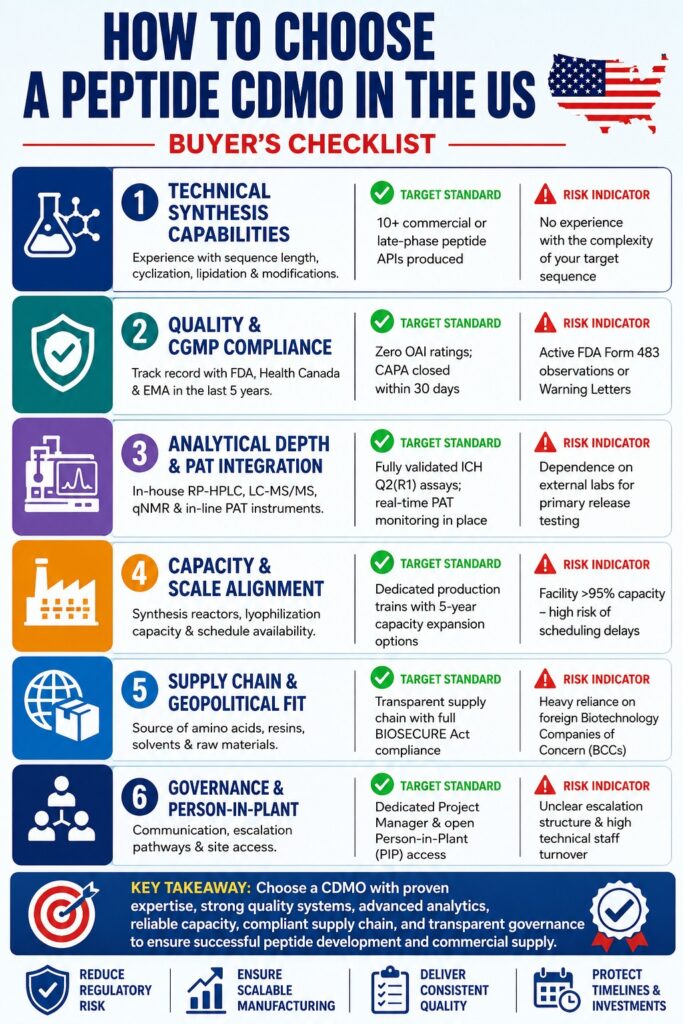
A comprehensive buyer’s checklist for How to Choose a Peptide CDMO in the USA evaluates potential CDMO partners across six fundamental operational areas: technical synthesis expertise, quality compliance, regulatory track record, manufacturing capacity, analytical capabilities, and project governance. Applying a structured decision matrix enables objective comparison between potential vendors and helps reduce process scale-up risks when determining How to Choose a Peptide CDMO in the US.
| Checklist Evaluation Domain | Critical Assessment Parameters | Target Benchmark / Standard | Operational Risk Indicator |
|---|---|---|---|
| 1. Technical Synthesis Capabilities | Experience with sequence length, cyclization, and lipidation. | Demonstrated production history of more than 10 commercial or late-phase peptide APIs. | Lack of previous experience with the complexity of the target sequence. |
| 2. Quality & cGMP Compliance | Inspection record with FDA, Health Canada, and EMA over the past 5 years. | Zero Official Action Indicated (OAI) ratings; rapid CAPA closures within 30 days. | Active FDA Form 483 observations or Warning Letters. |
| 3. Analytical Depth & PAT Integration | In-house RP-HPLC, LC-MS/MS, qNMR, and in-line PAT instrumentation. | Fully validated ICH Q2(R1) release assays; real-time PAT monitoring. | Complete reliance on third-party laboratories for primary release testing. |
| 4. Capacity & Scale Alignment | Synthesis reactor volumes, lyophilization capacity, and available production schedule space. | Dedicated production trains with 5-year capacity expansion options. | Facility operating above 95% capacity, creating a high risk of scheduling delays. |
| 5. Supply Chain & Geopolitical Fit | Sourcing origins for protected amino acids, resins, and solvents. | Transparent supply chain with full BIOSECURE Act compliance. | Heavy reliance on foreign Biotechnology Companies of Concern (BCCs). |
| 6. Governance & Person-in-Plant | Communication protocols, escalation pathways, and site access policies. | Dedicated Project Manager and open Person-in-Plant (PIP) access during cGMP manufacturing runs. | Unclear escalation structures and high technical staff turnover. |
Pharmaceutical procurement teams should implement this checklist through a phased vendor onboarding workflow that allows each prospective CDMO to be evaluated systematically and consistently.
Request for Proposal (RFP) Issuance: Provide candidate CDMOs with detailed technical specifications, including the target sequence, required purity specifications, desired batch scale, and analytical parameters, to obtain standardized and comparable proposals.
Weighted Scorecard Evaluation: Establish cross-functional evaluation teams that include leaders from CMC, Quality Assurance, Regulatory Affairs, and Supply Chain. These teams should assess and score vendor proposals against predefined weighted criteria.
On-Site Facility and Quality Audits: Perform comprehensive on-site technical and quality audits to evaluate cleanrooms, automated synthesizers, preparative HPLC systems, freeze-dryers, and Quality Management System (QMS) documentation.
Person-in-Plant (PIP) Protocol Agreement: Establish formal contractual provisions that grant sponsor technical representatives the right to monitor critical manufacturing activities directly on the production floor.
Streamline your domestic partner evaluation process: Peptide CDMO in United States
Strategic Onboarding, Technology Transfer, and Risk Mitigation
Successful CDMO onboarding depends on establishing a formal Technology Transfer Plan that clearly defines the manufacturing scope, analytical method validation protocols, milestone timelines, and mutually agreed Quality Agreements at the beginning of the engagement. Effective operational risk management also requires clearly defined communication pathways, validation of single-use component trains, and qualification of secondary analytical partners to reduce the risk of project delays or interruptions.
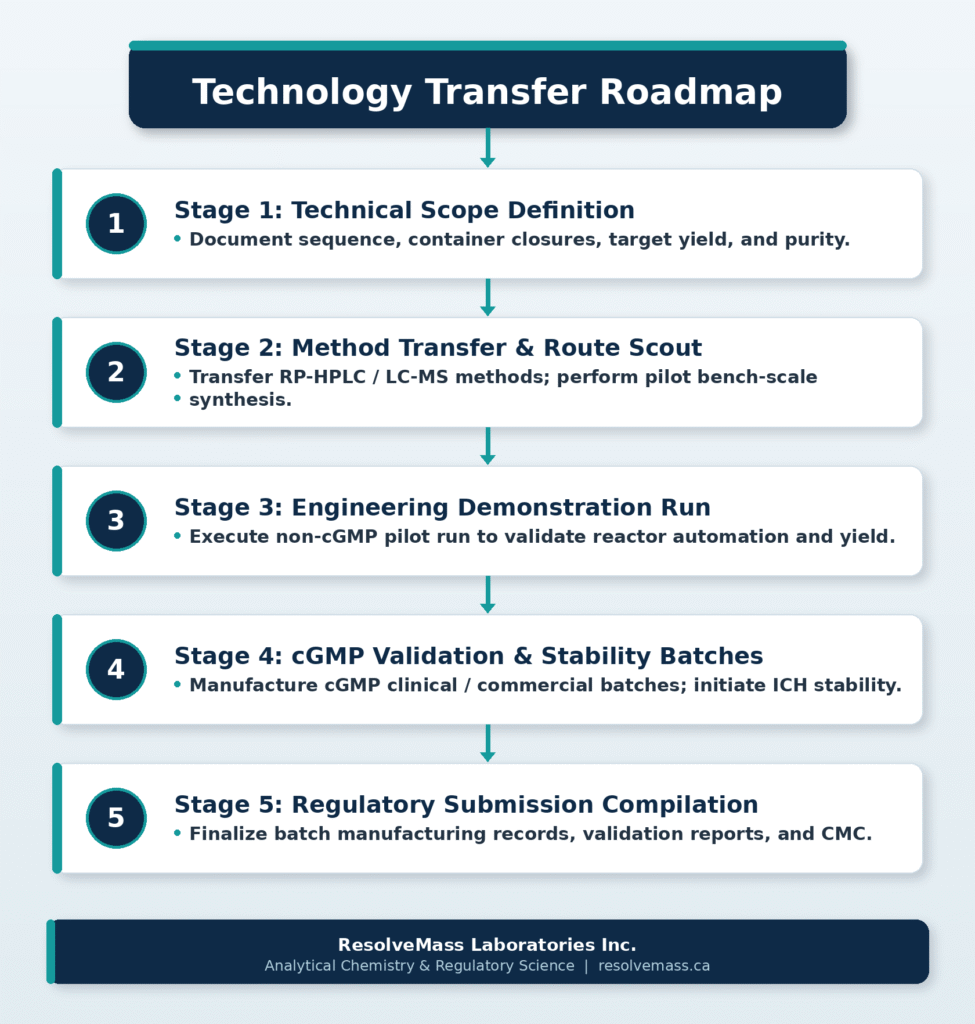
The technology transfer phase represents a critical transition in the contract manufacturing process. A structured, milestone-based tech transfer roadmap helps prevent misunderstandings, minimizes timeline slippage, and ensures that technical responsibilities are clearly defined throughout the transfer process.
To safeguard development programs against operational disruptions, sponsors should incorporate formal risk-mitigation provisions into commercial contracts. A comprehensive Quality Agreement that establishes defined turnaround times for deviation investigations, CAPA closures, and out-of-specification (OOS) root-cause reports helps ensure operational accountability and timely issue resolution. The use of single-use synthesis and fluid-handling components can reduce cross-contamination risks while decreasing the cleaning validation burden between manufacturing campaigns. In addition, qualifying an independent analytical testing laboratory provides dependable third-party verification during process troubleshooting and helps keep regulatory submission timelines on schedule.
Learn more about mitigating risks during tech transfer and commercial handoff: Outsource Peptide Manufacturing to CDMO
Conclusion: Key Takeaways on How to Choose a Peptide CDMO in the US
Selecting a peptide CDMO requires a structured assessment of synthesis technology, regulatory compliance, process analytical automation, and supply chain security. Understanding How to Choose a Peptide CDMO in the US enables biopharmaceutical companies to develop resilient, cGMP-compliant manufacturing partnerships capable of advancing complex peptide molecules from early development through commercial market release.
As peptide development pipelines continue to expand toward longer sequences, increasingly complex modifications, and greater manufacturing volumes under new legislative requirements such as the BIOSECURE Act, choosing the appropriate manufacturing partner has become a critical strategic decision. Systematic assessment using a weighted buyer’s checklist, combined with structured technology transfer procedures and robust Process Analytical Technology (PAT), helps minimize scale-up risks and protect development timelines.
Integrating specialized analytical CRO capabilities can further strengthen CDMO operations. Collaborating with Health Canada Licensed and FDA-registered analytical laboratories, such as ResolveMass Laboratories Inc., provides access to advanced LC-MS/MS mapping, qNMR spectroscopy, and orthogonal impurity profiling. This specialized analytical oversight supports confirmation of peptide identity, structural integrity, and batch-to-batch consistency while generating the data integrity required for successful IND, NDA, and ANDA regulatory submissions.
For specialized peptide characterization, high-resolution mass spectrometry, and regulatory analytical support, contact the experts at ResolveMass Laboratories Inc. through the Contact Us Page.
Frequently Asked Questions (FAQs)
The BIOSECURE Act affects peptide CDMO selection by restricting certain US federal agencies and federally funded biopharmaceutical programs from using designated foreign “Biotechnology Companies of Concern” (BCCs). Pharmaceutical sponsors must therefore evaluate the geographic origin of manufacturing services, equipment, and critical raw materials. Supply chain audits and partnerships with compliant North American CDMOs have become increasingly important for maintaining regulatory and funding eligibility.
Solid-Phase Peptide Synthesis (SPPS) is generally well suited for short-to-medium peptide sequences, typically ranging from 2 to 50 amino acids, and provides flexibility during early development. For longer sequences exceeding 50 amino acids or high-volume manufacturing, Liquid-Phase Peptide Synthesis (LPPS) and hybrid convergent approaches may be more appropriate. These strategies enable protected peptide fragments to be assembled in solution, potentially improving production efficiency, yield, and purity at larger scales.
Under FDA guidance applicable to generic synthetic peptide products submitted through ANDAs, organic peptide-related impurities at or above 0.05% must be reported, while those reaching or exceeding 0.10% generally require structural identification. A generic product should not contain new peptide-related impurities above 0.5% compared with the reference listed drug. New impurities within the 0.10% to 0.5% range require appropriate justification, including evaluation of toxicological and immunogenicity risks.
Process Analytical Technology (PAT) enables continuous monitoring of critical process parameters through real-time analytical tools such as UV-Vis, Refractive Index, and NIR spectroscopy. These systems can help identify reaction endpoints, monitor Fmoc protecting group removal, and optimize resin washing operations during peptide synthesis. By providing immediate process feedback, PAT can reduce unnecessary solvent use, improve consistency, and help prevent manufacturing failures.
Complete peptide characterization generally requires an orthogonal analytical strategy because individual techniques cannot adequately evaluate every structural and impurity attribute. Reverse-Phase High-Performance Liquid Chromatography (RP-HPLC) supports purity and impurity profiling, while Liquid Chromatography–Tandem Mass Spectrometry (LC-MS/MS) confirms peptide mass and primary sequence. Quantitative Nuclear Magnetic Resonance (qNMR) and Capillary Electrophoresis (CE) provide complementary information regarding peptide content, structural characteristics, and charge-related variants.
Technology transfer for a peptide active pharmaceutical ingredient commonly requires approximately 12 to 24 months, depending on molecular complexity and process maturity. The process may include route scouting, analytical method transfer and validation, engineering demonstration batches, and cGMP manufacturing. It may also include the production of validation or clinical/commercial batches and the initiation of formal ICH stability studies.
Research-grade peptides are generally produced for laboratory investigations, target screening, and non-clinical research and may not require the extensive documentation and quality controls associated with regulated manufacturing. cGMP-grade peptides are manufactured under controlled Quality Management Systems in accordance with 21 CFR Parts 210/211. They require traceable raw materials, validated analytical release methods, documented batch execution, and regulatory controls appropriate for clinical or commercial use.
Independent analytical CROs provide specialized testing that can complement the release and characterization activities performed by a CDMO. Their capabilities may include qNMR structural verification, Orbitrap HRMS impurity identification, forced degradation studies, and extractables/leachables testing. By generating validated analytical data under ALCOA+ data integrity principles, these laboratories can provide independent confirmation and support analytical packages for IND, NDA, and ANDA regulatory submissions.
Reference:
- Li, Y. (2022, September 20). Common deficiencies associated with comparative peptide impurity profile studies and qualification of impurity levels and proposed limits [Conference presentation]. U.S. Food and Drug Administration. FDA presentation
- U.S. Food and Drug Administration. (2008, June). Q3A impurities in new drug substances: Guidance for industry (Revision 2). FDA guidance document
- U.S. Food and Drug Administration. (2021, May). ANDAs for certain highly purified synthetic peptide drug products that refer to listed drugs of rDNA origin: Guidance for industry. FDA guidance document
- Carvalho, M., Cruz, A., Haringa, C., Ottens, M., & Klijn, M. (2026). A review on quantitative process analytical technology for continuous downstream processing of monoclonal antibodies. Biotechnology and Bioengineering, 123(3), 564–581. https://doi.org/10.1002/bit.70139
Get In Touch With Us
About The Author


