

Introduction
How to Choose a Peptide CDMO? Sponsoring organizations must perform a comprehensive technical audit that assesses chemical synthesis platforms, scale-up physics, impurity profiling, and global regulatory compliance. Choosing the appropriate Contract Development and Manufacturing Organization (CDMO) can determine whether a complex peptide candidate progresses successfully from preclinical discovery through clinical development and ultimately into commercial supply.
The global therapeutic peptide market is experiencing rapid growth, supported by metabolic therapies such as GLP-1 receptor agonists, peptide-drug conjugates (PDCs), radiolabeled peptides, and cyclic antimicrobial sequences. Synthetic peptides occupy a distinctive regulatory and chemical position between conventional small-molecule drugs and complex biological proteins. According to the U.S. Food and Drug Administration (FDA), synthetic polymers containing 40 or fewer amino acids are regulated as small-molecule drug substances, whereas sequences exceeding 40 amino acids are regulated within the biological products framework.
This regulatory distinction creates several unique development challenges. Unlike small molecules, which may be manufactured through a limited number of convergent organic reactions, synthetic peptides are constructed through repeated, iterative cycles. As the peptide chain becomes longer, sequence-dependent secondary structure formation, aggregation, steric hindrance, and side reactions can generate highly complex impurity profiles. These profiles may include deletion sequences, truncated fragments, regioisomers, and racemate byproducts. In addition, global regulatory expectations—including the European Medicines Agency (EMA) 2024 synthetic peptide guidelines and United States Pharmacopeia (USP) chapters and —require comprehensive control strategies for process-related impurities, residual solvents, counter-ions, and elemental contaminants.
To evaluate key strategic factors when partnering with North American CDMOs, read How to Choose a Peptide CDMO in the US.
Share via:
Article Summary:
- Choosing the right peptide CDMO requires a complete technical assessment covering synthesis chemistry, scale-up capability, analytical characterization, quality systems, and regulatory readiness—not just manufacturing capacity.
- Synthesis platform selection should match the peptide’s complexity and production goals. SPPS is well suited to rapid development and many short-to-medium sequences, while LPPS can support efficient high-volume production of shorter peptides. Hybrid approaches are useful for longer and more complex sequences, whereas recombinant methods may be considered for very long peptides and protein-like molecules.
- Successful scale-up depends on controlling manufacturing physics. Resin integrity, mixing, mass transfer, solvent consumption, aggregation, and reactor performance can significantly affect yield and product quality when moving from laboratory batches to commercial production.
- Downstream processing is a major CDMO evaluation criterion. Sponsors should assess preparative RP-HPLC capacity, impurity separation capabilities, counter-ion exchange systems, and large-scale lyophilization infrastructure to ensure consistent production of high-purity peptide API.
- A strong quality and regulatory framework is essential for development success. The CDMO should demonstrate robust QMS, starting-material qualification, deviation and CAPA management, change control, data integrity, and experience supporting global regulatory submissions.
- Advanced analytical capabilities are critical for peptide characterization and impurity control. Techniques such as high-resolution LC-MS/MS, 1D/2D NMR, CE, amino acid analysis, and forced degradation studies provide complementary information about sequence integrity, structure, impurities, and stability.
- Sponsors should use a structured four-pillar checklist before selecting a peptide CDMO: synthetic chemistry expertise, scale-up and downstream infrastructure, advanced analytical capabilities, and quality/regulatory readiness. Evaluating all four areas helps reduce development risks and supports a smoother transition from early research to clinical and commercial manufacturing.
Synthesis Platform Alignment: How to Choose a Peptide CDMO? Platform Strategy
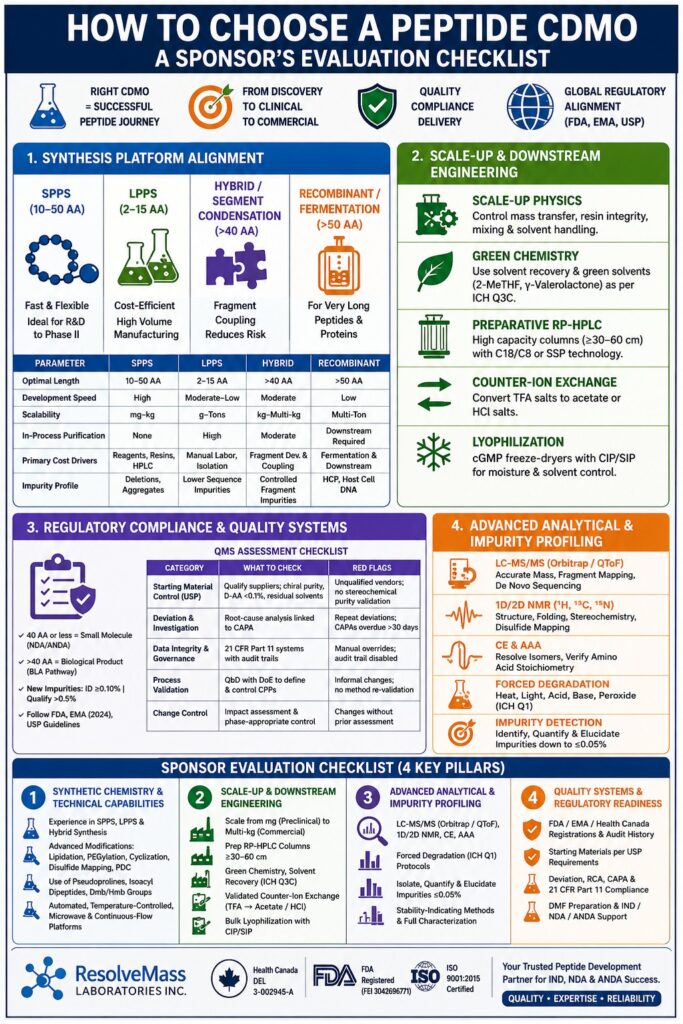
Selecting the most suitable peptide synthesis platform requires careful alignment of the peptide sequence length, intended manufacturing scale, and impurity control requirements. The principal options include Solid-Phase Peptide Synthesis (SPPS), Liquid-Phase Peptide Synthesis (LPPS), and hybrid fragment condensation. SPPS offers rapid development and considerable flexibility for sequences containing approximately 10 to 50 amino acids. In contrast, LPPS and hybrid approaches may provide improved cost efficiency and enhanced intermediate quality control for high-volume manufacturing or long-chain commercial targets.
Compare specialized operational models and platform options via Peptide CDMO Services.
Solid-Phase Peptide Synthesis (SPPS)
Solid-Phase Peptide Synthesis (SPPS) involves anchoring the C-terminal amino acid to a polymeric resin, thereby enabling automated and repetitive coupling and washing cycles. This approach is particularly suitable for peptides containing up to approximately 50 amino acids. The target sequence is constructed from the C-terminus toward the N-terminus on insoluble polymeric supports, including polystyrene cross-linked with divinylbenzene and polyethyleneglycol (PEG)-based resins. When evaluating a CDMO, sponsors should specifically assess its expertise in orthogonal protection strategies, particularly Fluorenylmethyloxycarbonyl (Fmoc) and Tert-butyloxycarbonyl (Boc) chemistries.
To minimize secondary structure formation during synthesis, advanced peptide manufacturing partners may use backbone-protecting groups such as N-(2-hydroxy-4-methoxybenzyl) (Hmb) or N-(2,4-dimethoxybenzyl) (Dmb). The use of pseudoproline dipeptides and isoacyl dipeptides can also help disrupt problematic secondary structures. In addition, expertise with automated, temperature-controlled, microwave-assisted, and continuous-flow SPPS reactors is important for reducing cycle times, improving process consistency, and minimizing racemization.
Liquid-Phase Peptide Synthesis (LPPS)
Liquid-Phase Peptide Synthesis (LPPS) carries out coupling reactions entirely in solution, allowing intermediate peptide fragments to be isolated and purified before final product assembly. Because individual intermediates can be characterized and purified through techniques such as crystallization or liquid-liquid extraction, LPPS can prevent the progressive accumulation of truncated and deletion impurities commonly associated with extended SPPS processes. Although LPPS generally requires a longer initial development period for route scouting and optimization, it can provide excellent raw material efficiency and a lower cost-per-gram for short sequences containing approximately 2 to 15 amino acids that are manufactured at high commercial volumes.
Understand key structural and operational differences in Peptide CDMO vs CMO.
Hybrid Fragment Condensation and Recombinant Synthesis
Hybrid synthesis combines SPPS for the preparation of short, protected peptide fragments with solution-phase segment condensation. This strategy helps reduce the exponential yield losses and aggregation risks that can occur when attempting to synthesize sequences longer than 40 amino acids as a single continuous chain. In this approach, fragments containing approximately 10 to 20 amino acids may be synthesized on specialized cleavage resins, purified individually, and subsequently coupled in solution through native chemical ligation or segment condensation. By enabling independent purification and characterization of intermediate fragments, CDMOs can improve the feasibility of commercial-scale production for complex target molecules.
Recombinant fermentation remains an alternative for very long peptides or small proteins exceeding 50 residues. However, synthetic hybrid chemistry can avoid biological contaminants associated with host-cell systems, including host-cell proteins (HCP) and host-cell DNA.
| Selection Parameter | Solid-Phase Peptide Synthesis (SPPS) | Liquid-Phase Peptide Synthesis (LPPS) | Hybrid / Segment Condensation | Recombinant / Fermentation |
|---|---|---|---|---|
| Optimal Sequence Length | 10 – 50 amino acids | 2 – 15 amino acids | > 40 amino acids | Long peptides & proteins (>50 AA) |
| Development Speed | High (ideal for research to Phase II) | Moderate to Low (requires route scouting) | Moderate (requires fragment design) | Low (requires cell-line engineering) |
| Scalability Limit | Milligrams to Kilograms | Grams to Multi-Kilograms / Tons | Kilograms to Multi-Kilograms | Commercial Multi-Ton volumes |
| In-Process Purification | None (end-stage purification only) | High (intermediate crystallization/extraction) | Moderate (fragment-level purification) | Downstream recovery & refolding required |
| Primary Cost Drivers | Reagents, resins, excess solvents, prep HPLC | Manual labor, stepwise isolation development | Fragment development & coupling optimization | Fermentation media, downstream processing |
| Impurity Profile | Deletion sequences, aggregation, truncations | Lower sequence impurities, residual reagents | Controlled fragment-level impurities | Host cell proteins (HCP), host cell DNA |
Scaling Up Synthetic Peptides: Managing Scale-Up Physics and Downstream Purification
Scaling synthetic peptide manufacturing from gram-level clinical batches to multi-kilogram commercial production requires careful management of physical challenges associated with resin bead mechanical integrity, mass transfer kinetics, solvent handling, and chromatographic purification capacity. Engineering teams must carefully control the relevant physical chemistry parameters to increase manufacturing scale while maintaining batch yield, process consistency, and molecular purity.
Read more about scaling up processes and parameter optimization in Peptide API Scale Up.
Mass Transfer, Aggregation, and Green Solvent Dynamics
Increasing reactor size changes fluid dynamics and mixing efficiency, potentially resulting in resin degradation, increased mass transfer resistance, and substantial solvent consumption governed by ICH Q3C guidelines. In large industrial SPPS reactors, mechanical agitation can generate shear forces that damage fragile resin beads. The resulting fine particles may obstruct discharge frits and create localized concentration gradients within the reactor.
In addition, SPPS commonly requires large quantities of hazardous solvents, including N,N-Dimethylformamide (DMF), Dichloromethane (DCM), and N-Methyl-2-pyrrolidone (NMP). Capable CDMOs may implement continuous-flow synthesis platforms, solvent recovery systems, or alternative green solvents, including 2-Methyltetrahydrofuran and γ-Valerolactone. These approaches can help support regulatory compliance, manage Cost of Goods Sold (COGS), reduce environmental impact, and improve overall process sustainability.
Downstream Purification: Preparative HPLC, Counter-Ion Exchange, and Lyophilization
Downstream purification requires high-capacity preparative Reverse-Phase HPLC (RP-HPLC), reliable counter-ion exchange, and large-scale lyophilization capabilities to isolate a high-purity API free from co-eluting sequence deletion variants. Crude peptide mixtures may contain impurities with chemical structures that are highly similar to the parent API, including (n-1) deletion sequences, truncated fragments, and enantiomeric racemates.
To process large batch volumes efficiently, a CDMO should have access to commercial-scale RP-HPLC columns with diameters ranging from approximately 30 cm to more than 60 cm. These columns are typically packed with silica-based C18 or C8 stationary phases. Advanced manufacturing facilities may also use Surrogate Stationary Phase (SSP) HPLC technology, which modifies the surface chemistry of the chromatographic column to increase loading capacity by approximately 7 to 10 times compared with conventional silica. This can reduce solvent consumption and shorten overall purification timelines.
Following chromatographic purification, peptides isolated using trifluoroacetic acid (TFA) mobile phases generally require counter-ion exchange to convert TFA salts into pharmaceutically suitable salt forms, such as acetate or hydrochloride. This step can help prevent potential toxicity and stability concerns associated with the final salt form. The purified product is subsequently isolated through bulk lyophilization in cGMP freeze-dryers equipped with Clean-In-Place (CIP) and Sterilization-In-Place (SIP) systems. These systems enable precise control of residual moisture, solvent limits, and cake structure.
Discover key advantages of external manufacturing in Outsource Peptide Manufacturing to CDMO.
Regulatory Compliance, Quality Systems, and Impurity Control Frameworks
Assessing the quality architecture of a peptide CDMO requires a detailed review of its cGMP compliance history, Drug Master File (DMF) filing experience, and adherence to FDA, EMA, and USP regulatory expectations. Sponsoring organizations must confirm that external manufacturing facilities maintain robust Quality Management Systems (QMS) capable of supporting Investigational New Drug (IND), New Drug Application (NDA), and Abbreviated New Drug Application (ANDA) submissions.
Evaluate regional regulatory and manufacturing advantages in Canadian vs US Peptide CDMOs.
Regulatory Classifications and Impurity Thresholds
Regulatory classification requires synthetic peptides containing 40 or fewer amino acids to follow small-molecule drug development pathways, including NDA/ANDA pathways, while also requiring the identification of new impurities above 0.10% and safety qualification above 0.5%. Sequences containing more than 40 amino acids are regulated under the biological products framework and may follow the BLA pathway.
For generic synthetic peptide drug products that reference established originator products, such as Liraglutide, Glucagon, or Teriparatide, FDA guidance requires the structural identification of any new peptide-related impurity present at or above 0.10%. New impurities present between 0.10% and 0.5% require a comparative immunogenicity risk assessment, while impurities exceeding 0.5% require safety qualification.
At the same time, the European Medicines Agency (EMA) 2024 synthetic peptide guidelines and USP chapters and establish specific reporting, identification, and qualification expectations for process-related impurities, counter-ions, and starting materials.
Review real-world impurity mapping and structural evaluation in Peptide Characterization Case Study of Semaglutide.
Quality Management Systems (QMS) and Starting Material Qualification
A mature Quality Management System provides strict supply chain traceability for protected amino acid starting materials (AADs) and maintains structured systems for root-cause investigations. Under USP , protected amino acids used in synthetic manufacturing must comply with specifications covering chemical purity, enantiomeric purity, D-amino acid content, residual solvents, and organic impurities. D-amino acid content is typically controlled at less than 0.1%.
CDMOs must also maintain rigorous deviation management systems based on established root-cause methodologies, including Fishbone analysis and 5-Whys analysis. These investigations should be linked to actionable Corrective and Preventive Actions (CAPA) that can be tracked through completion and effectiveness verification. Fully compliant electronic data systems governed by 21 CFR Part 11 support continuous audit trails and data integrity across synthesis and analytical platforms.
| QMS Assessment Category | Mandatory Evaluation Criteria | Risk Factors & Red Flags |
|---|---|---|
| Starting Material Control (USP ) | Qualification of protected amino acid suppliers; testing for chiral purity, D-amino acid limits (<0.1%), residual solvents, and other relevant quality attributes. | Unqualified starting material vendors; absence of stereochemical purity validation for non-canonical amino acids. |
| Deviation & Investigation Systems | Standardized root-cause analysis procedures directly connected to trackable CAPA implementation plans. | Frequent repeat deviations; overdue CAPAs exceeding 30 days; root-cause determinations that have not been adequately verified. |
| Data Integrity & Governance | 21 CFR Part 11 compliant automated data acquisition systems with restricted administrator access and secure audit trails. | Manual integration overrides without quality approval; disabled audit trail functions on analytical systems. |
| Process Validation & Change Control | Quality-by-Design (QbD) execution using Design of Experiments (DoE) to establish Critical Process Parameters (CPPs). | Informal process changes without prior impact assessments; absence of phase-appropriate analytical method re-validation. |
Advanced Analytical Characterization and Impurity Profiling
Definitive analytical characterization of therapeutic peptides requires the use of orthogonal testing methodologies capable of distinguishing co-eluting variants, sequence mutations, and micro-heterogeneity at sub-percent concentrations. The combined application of High-Resolution LC-MS/MS, quantitative NMR, and RP-HPLC supports comprehensive characterization and helps ensure compliance with global regulatory expectations for investigational and commercial submissions.
Discover advanced analytical solutions via Peptide Analytical Characterization Services.
Structural verification of complex synthetic peptides requires multiple complementary analytical techniques that provide different and non-overlapping types of information. High-Resolution Liquid Chromatography-Mass Spectrometry (LC-MS/MS), performed using Orbitrap or Quadrupole Time-of-Flight (QToF) analyzers, enables accurate mass determination, structural fragment mapping, and de novo sequence validation. Tandem MS/MS fragmentation can help identify the precise locations of deamidation, oxidation, aggregation, and amino acid deletion events.
Multi-dimensional Nuclear Magnetic Resonance (NMR) spectroscopy, including ¹H, ¹³C, and ¹⁵N analysis, provides information regarding primary structure, higher-order secondary folding, stereochemical purity, and disulfide bond configurations in cyclic sequences. Complementary analytical techniques, such as Capillary Electrophoresis (CE) and Amino Acid Analysis (AAA), can help resolve hydrophilic regioisomers and verify the precise amino acid stoichiometry. Forced degradation studies performed under stress conditions, including heat, light, acid, base, and peroxide exposure, are used to demonstrate that analytical methods are stability-indicating and capable of monitoring API degradation throughout shelf-life storage.
Learn about specialized testing methods for metabolic drugs in GLP-1 Peptide Analytical Characterization.
Sponsoring organizations frequently collaborate with specialized analytical testing laboratories to verify sequence integrity and develop regulatory-ready characterization packages. Within North America, ResolveMass Laboratories Inc. operates as a specialized CRO and CDMO partner with a Health Canada Drug Establishment Licence (3-002945-A), FDA Registration (FEI 3042696771), and ISO 9001:2015 certification. With capabilities in high-resolution mass spectrometry (LC-MS/MS), 1D/2D quantitative NMR, and validated chromatographic platforms, ResolveMass provides advanced peptide characterization, forced degradation profiling, and cGMP release testing suitable for IND, NDA, and ANDA filings.
Compare discovery research vs development models in Peptide CDMO vs CRO.
Sponsor Evaluation Checklist: How to Choose a Peptide CDMO?
Sponsoring organizations should assess potential CDMO partners using a structured four-part evaluation checklist that covers synthetic chemistry expertise, physical scale-up infrastructure, orthogonal analytical technologies, and quality systems.
1. Synthetic Chemistry & Technical Capabilities
- Demonstrated operational experience with SPPS, LPPS, and hybrid segment condensation synthesis routes.
- Proven expertise in advanced peptide modifications, including lipidation, PEGylation, head-to-tail cyclization, disulfide mapping, and peptide-drug conjugation (PDC).
- Routine use of secondary structure disruptors, including pseudoprolines, isoacyl dipeptides, and Dmb/Hmb protecting groups, for challenging or hydrophobic peptide sequences.
- Availability of temperature-controlled, automated, microwave-assisted, and continuous-flow SPPS synthesis platforms.
2. Scale-Up, Downstream Engineering, and Infrastructure
- A demonstrated history of successfully scaling manufacturing processes from preclinical milligram quantities to multi-kilogram cGMP commercial batches.
- Preparative RP-HPLC column capacity with diameters of ≥ 30–60 cm and bulk lyophilization infrastructure equipped with CIP/SIP systems.
- Implementation of green chemistry initiatives, solvent recovery loops, or alternative green solvents that are consistent with ICH Q3C residual solvent limits.
- Validated counter-ion exchange processes capable of reliably converting TFA salts into acetate or hydrochloride salt forms.
3. Advanced Analytical Capabilities & Impurity Profiling
- On-site access to high-resolution analytical platforms, including LC-MS/MS using Orbitrap or QToF systems, 1D/2D NMR spectroscopy, Capillary Electrophoresis, and Amino Acid Analysis.
- Established forced degradation study protocols designed to develop and verify stability-indicating methods in accordance with ICH Q1 guidelines.
- The ability to isolate, quantify, and structurally elucidate sequence-related impurities at levels down to ≤ 0.05%.
4. Quality Management Systems & Regulatory Readiness
- Active facility registrations and documented audit histories with global health authorities, including the FDA, EMA, and Health Canada.
- Established vendor qualification programs confirming that protected amino acid starting materials comply with USP guidelines.
- Robust systems for deviation management, root-cause investigations, CAPA tracking, and 21 CFR Part 11 compliant data governance.
- Comprehensive CMC regulatory submission support, including Drug Master File (DMF) preparation and IND/NDA/ANDA filing documentation.
Review leading service capabilities in Best Peptide CDMO.
Conclusion: Final Considerations on How to Choose a Peptide CDMO?
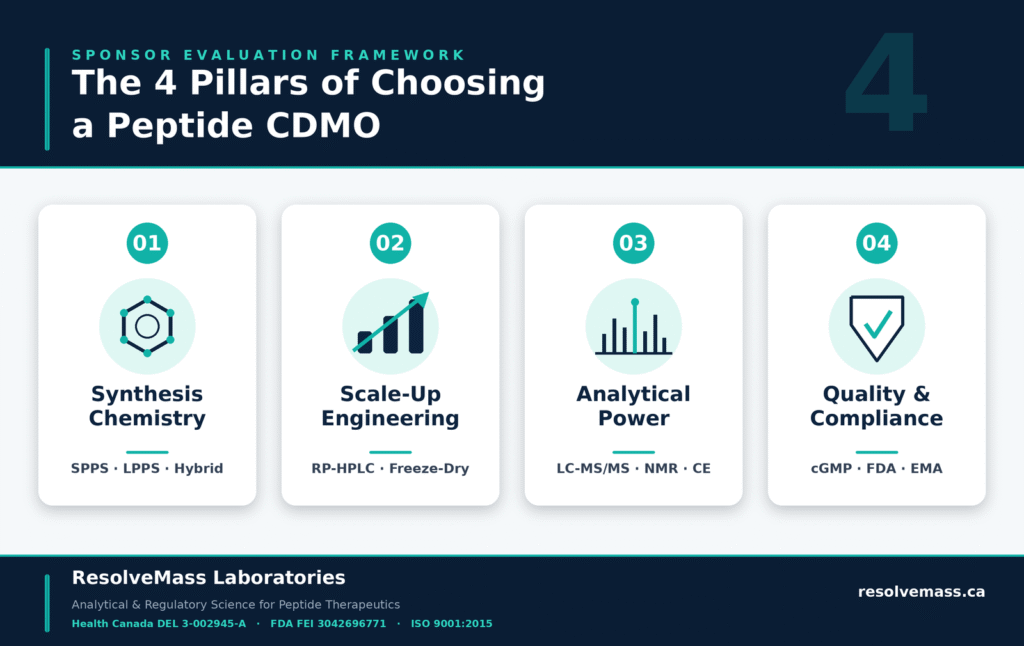
Successfully selecting a peptide CDMO requires sponsors to balance expertise in platform chemistry with scale-up engineering capabilities, advanced analytical characterization, and regulatory readiness. This integrated approach helps ensure that peptide development programs can transition smoothly through clinical trials and into commercial manufacturing. By applying a structured evaluation checklist, sponsors can establish strategic external partnerships capable of controlling synthesis-related risks, meeting international regulatory expectations, and providing consistent clinical and commercial API supplies.
Learn how end-to-end development strategies accelerate market entry in Peptide Drug Development CDMO.
To discuss specialized analytical characterization, impurity profiling, or regulatory testing strategies for your peptide candidate, visit ResolveMass Laboratories Inc. to connect directly with scientific experts- Contact Us.
Frequently Asked Questions (FAQs)
The FDA generally classifies synthetic amino acid polymers containing 40 or fewer amino acids as small-molecule peptide drug substances regulated under Section 505 of the FD&C Act. Synthetic polymers exceeding 40 amino acids are generally regulated as biological protein products under the Public Health Service Act. These products may therefore require development and regulatory submission through the biologics framework, including a Biologics License Application (BLA).
For generic synthetic peptide products, any newly observed peptide-related impurity present at or above 0.10% must be structurally identified according to applicable FDA expectations. Impurities detected between 0.10% and 0.5% may require a comparative immunogenicity risk assessment. New impurities present above 0.5% generally require formal safety qualification to demonstrate that the impurity does not introduce an unacceptable risk.
Peptides purified using conventional reverse-phase HPLC methods that use trifluoroacetic acid (TFA) may be isolated as TFA salts. Excessive TFA content can create concerns related to toxicity, product stability, and suitability for pharmaceutical use. Counter-ion exchange replaces TFA with a more appropriate pharmaceutical counter-ion, such as acetate or hydrochloride, helping improve the final product’s safety, stability, and suitability for development.
Comprehensive peptide characterization requires several orthogonal analytical techniques because no single method can evaluate every critical quality attribute. High-Resolution LC-MS/MS supports intact mass determination and sequence confirmation, while 1D/2D qNMR provides information on structure and stereochemistry. RP-HPLC evaluates chromatographic purity, Capillary Electrophoresis can assess charge-related variants, and Amino Acid Analysis helps confirm absolute amino acid stoichiometry.
Secondary structure disruptors, such as pseudoprolines, isoacyl dipeptides, and backbone-protecting groups including Dmb/Hmb, help interfere with unwanted intramolecular and intermolecular interactions during peptide assembly. By reducing hydrogen bonding and β-sheet aggregation, these strategies can improve resin swelling and increase reagent access to the growing peptide chain. This can reduce incomplete coupling and improve synthesis performance for difficult or aggregation-prone sequences.
USP establishes quality and analytical expectations for protected amino acid derivatives used as starting materials in synthetic peptide manufacturing. The relevant quality attributes may include chemical purity, enantiomeric purity, D-amino acid content, residual solvents, and related organic impurities. Appropriate control of these starting materials helps prevent the introduction of impurities that may accumulate during synthesis and contribute to downstream batch failures.
Commercial peptide scale-up can be limited by several interconnected engineering challenges. Mechanical agitation may damage resin beads, while long-chain synthesis can increase aggregation and mass transfer resistance. Large-scale operations may also involve substantial solvent consumption subject to ICH Q3C requirements, while limited preparative HPLC loading capacity can create significant downstream purification bottlenecks.
Orthogonal analytical testing uses independent analytical principles to evaluate the same product attribute from different perspectives. This approach can reveal co-eluting sequence variants, isomers, and impurities that may not be resolved or detected by a single analytical method. A comprehensive orthogonal data package therefore provides stronger evidence of peptide identity, purity, and quality during regulatory review by agencies such as the FDA, EMA, and Health Canada.
Reference:
- U.S. Food and Drug Administration. (2017, December). Chemistry, manufacturing, and controls changes to an approved application: Certain biological products: Draft guidance for industry. https://www.fda.gov/media/134050/download
- Kekessie, I., Wegner, K., Martinez, I., Kopach, M. E., White, T. D., Tom, J. K., Kenworthy, M. N., Gallou, F., Lopez, J., Koenig, S. G., Payne, P. R., Eissler, S., Arumugam, B., Li, C., Mukherjee, S., Isidro-Llobet, A., Ludemann-Hombourger, O., Richardson, P., Kittelmann, J., Pedersen, D. S., & van den Bos, L. J. (2024). Process mass intensity (PMI): A holistic analysis of current peptide manufacturing processes informs sustainability in peptide synthesis. The Journal of Organic Chemistry, 89(7), 4261–4282. https://doi.org/10.1021/acs.joc.3c01494
- U.S. Food and Drug Administration. (2024, March). Q14 analytical procedure development: Guidance for industry. U.S. Department of Health and Human Services. https://www.fda.gov/media/161202/download
- U.S. Food and Drug Administration. (2021, May). ANDAs for certain highly purified synthetic peptide drug products that refer to listed drugs of rDNA origin: Guidance for industry. U.S. Department of Health and Human Services. FDA guidance document
Get In Touch With Us
About The Author


