

Introduction:
HPLC Testing (High-Performance Liquid Chromatography Testing) is an advanced analytical method used to separate and quantify components in complex mixtures with high accuracy. It plays a crucial role in ensuring product quality, safety, and compliance across multiple industries.
In modern analytical science, HPLC Testing is considered a gold standard technique due to its ability to handle diverse sample types, detect trace impurities, and deliver reproducible results under stringent regulatory conditions.
Share via:
Summary:
- HPLC Testing is a highly precise analytical technique used to separate, identify, and quantify compounds in a sample.
- It is widely used in pharmaceuticals, biotechnology, food safety, and environmental analysis.
- The method offers high sensitivity, reproducibility, and regulatory compliance.
- Proper method development, validation, and instrumentation are critical for reliable results.
- Partnering with experienced laboratories like ResolveMass Laboratories Inc. ensures high-quality, regulatory-ready testing outcomes.
Watch the Detailed Video: 5 HPLC Purity Testing Mistakes That Could Delay FDA Approval
1: What is HPLC Testing?
HPLC Testing (High-Performance Liquid Chromatography Testing) is an advanced analytical technique used to separate, identify, and quantify compounds in a mixture based on their interactions with a stationary phase and a liquid mobile phase. It is widely used for accurate and reliable chemical analysis across industries.
Key Principle of HPLC Testing
- Components in a sample travel through a column at different speeds
- Separation occurs based on:
- Polarity
- Molecular size
- Chemical interactions with the stationary phase
- As compounds exit the column, detectors measure and quantify each component
Core Components of an HPLC System
- Pump: Moves the mobile phase through the system at controlled pressure
- Injector: Introduces the sample into the mobile phase stream
- Column: The heart of the system where separation occurs
- Detector: Identifies and quantifies separated compounds (e.g., UV, PDA, MS)
- Data System: Processes chromatographic data and generates analytical reports
2: Why is HPLC Testing Important?
HPLC Testing is important because it ensures product safety, quality, and regulatory compliance by accurately identifying and quantifying compounds in complex mixtures. It plays a critical role in preventing contamination, verifying composition, and maintaining consistency across batches.
Key Benefits:
- High Sensitivity: Detects impurities at trace levels, even in complex samples
- Accuracy & Precision: Delivers reliable and reproducible quantitative results
- Versatility: Suitable for a wide range of compounds and sample types
- Regulatory Compliance: Supports adherence to global standards such as FDA, ICH, and GMP guidelines
Industries That Rely on HPLC Testing:
- Pharmaceuticals: Drug development, quality control, and stability testing
- Biotechnology: Protein, peptide, and biomolecule analysis
- Food & Beverage: Detection of additives, contaminants, and nutrients
- Environmental Monitoring: Analysis of pollutants in water, air, and soil
- Chemical Manufacturing: Purity assessment and process validation
By ensuring accuracy, safety, and compliance, HPLC Testing remains an indispensable analytical technique across critical industries.
3: Applications of HPLC Testing
HPLC Testing is widely used to analyze complex mixtures with high accuracy across multiple critical industries. Its ability to separate and quantify compounds makes it essential for quality control, safety assessment, and regulatory compliance.
1. Pharmaceutical Analysis
HPLC Testing is crucial in pharmaceuticals for ensuring drug safety, efficacy, and quality.
- Drug Purity Testing: Confirms active pharmaceutical ingredient (API) purity
- Impurity Profiling: Detects and quantifies degradation products and contaminants
- Stability Studies: Monitors how drugs behave over time under various conditions
- Dissolution Testing: Evaluates how a drug releases in the body
2. Biopharmaceuticals
HPLC Testing plays a key role in the characterization and quality control of biologics.
- Peptide and Protein Analysis: Separates and identifies complex biomolecules
- Biomolecule Characterization: Confirms structure and composition
- Quality Control of Biologics: Ensures batch consistency and regulatory compliance
3. Food Safety
HPLC Testing helps ensure food quality and consumer safety by detecting harmful substances.
- Detection of Additives and Contaminants: Identifies preservatives, toxins, and adulterants
- Nutritional Analysis: Quantifies vitamins, amino acids, and other nutrients
- Pesticide Residue Testing: Detects trace levels of harmful chemicals
4. Environmental Testing
HPLC Testing is essential for monitoring environmental health and pollution levels.
- Water Quality Analysis: Detects contaminants in drinking and wastewater
- Detection of Pollutants: Identifies industrial chemicals and hazardous substances
- Soil Contamination Studies: Assesses environmental impact and safety
With its high sensitivity, versatility, and precision, HPLC Testing continues to be a cornerstone analytical tool across industries that demand accurate and reliable results.
4: Types of HPLC Testing
Different types of HPLC Testing are used based on the chemical nature of the analyte and the desired separation mechanism. Selecting the right method ensures optimal resolution, sensitivity, and accuracy.
Common Types of HPLC Testing
| Type of HPLC | Principle | Common Applications |
|---|---|---|
| Reverse Phase HPLC (RP-HPLC) | Uses a non-polar stationary phase and polar mobile phase | Pharmaceuticals, peptides, small molecules |
| Normal Phase HPLC (NP-HPLC) | Uses a polar stationary phase and non-polar mobile phase | Lipids, isomers, organic compounds |
| Ion Exchange HPLC | Separates compounds based on charge interactions | Proteins, amino acids, ionic compounds |
| Size Exclusion HPLC (SEC-HPLC) | Separates molecules based on molecular size | Polymers, proteins, biomolecules |
How to Choose the Right Type
- RP-HPLC: Best for non-polar to moderately polar compounds
- NP-HPLC: Ideal for highly polar substances
- Ion Exchange: Suitable for charged biomolecules
- Size Exclusion: Used when molecular size differences are critical
5: How Does HPLC Testing Work?
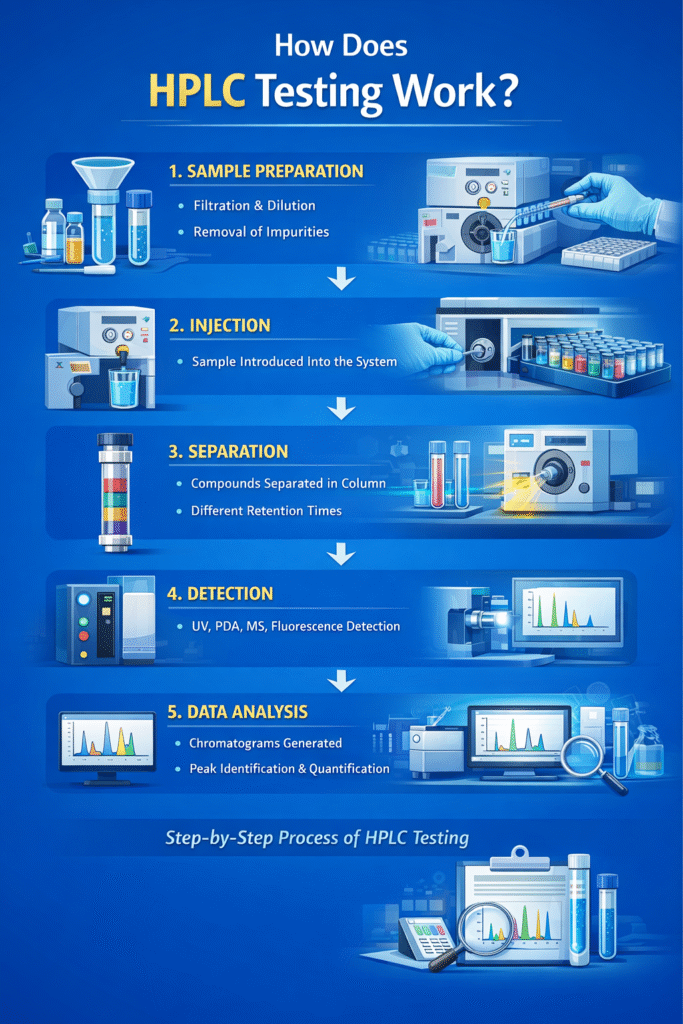
HPLC Testing works by passing a liquid sample through a column, where compounds are separated based on their interactions with the stationary phase and then detected for analysis. This process enables precise identification and quantification of each component in the mixture.
Step-by-Step Workflow:
1. Sample Preparation
Proper sample preparation ensures accurate and reliable results.
- Filtration to remove particulates
- Dilution to achieve optimal concentration
- Removal of impurities that may interfere with analysis
2. Injection
The prepared sample is introduced into the HPLC system.
- Sample is injected into the flowing mobile phase
- Carried into the column under high pressure
3. Separation
Compounds are separated inside the column based on their chemical properties.
- Interaction with stationary phase determines movement
- Different compounds exhibit different retention times
- Effective separation ensures clear identification
4. Detection
Separated compounds are detected and measured as they exit the column.
- Common detectors include:
- UV (Ultraviolet)
- PDA (Photodiode Array)
- MS (Mass Spectrometry)
- Fluorescence detectors
- Signals are recorded for each compound
5. Data Analysis
The system processes the detected signals into meaningful analytical results.
- Chromatograms are generated
- Peaks correspond to individual compounds
- Peak area and height are used for identification and quantification
This structured workflow makes HPLC Testing a highly accurate, reproducible, and industry-standard technique for analyzing complex chemical and biological samples.
6: Method Development in HPLC Testing
HPLC Testing method development is the process of optimizing analytical conditions to achieve accurate separation, high sensitivity, and reproducible results. It is a critical step to ensure the method is reliable, efficient, and suitable for its intended purpose.
Key Factors in HPLC Method Development
- Selection of Mobile Phase:
Choosing the right solvent composition (e.g., water, acetonitrile, methanol) to achieve optimal separation - Column Type and Dimensions:
Selecting appropriate stationary phase, particle size, and column length for better resolution - Flow Rate Optimization:
Adjusting flow rate to balance separation efficiency and analysis time - Detection Wavelength:
Setting the correct wavelength (for UV/PDA detectors) to ensure accurate detection of analytes
Why Method Development Matters
- Improves Resolution Between Compounds:
Ensures clear separation of closely related substances - Reduces Analysis Time:
Optimized methods lead to faster and more efficient workflows - Ensures Consistent Results:
Provides reproducible and reliable data across multiple runs and batches
7: Method Validation in HPLC Testing
HPLC Testing must be validated to ensure the method consistently produces accurate, precise, and reliable results suitable for its intended use. Validation confirms that the analytical procedure meets regulatory and scientific standards.
Key Validation Parameters
- Accuracy:
Measures how close the test results are to the true or accepted value - Precision:
Evaluates the reproducibility of results under the same conditions (repeatability and intermediate precision) - Specificity:
Ensures the method can accurately measure the analyte without interference from impurities, excipients, or matrix components - Linearity:
Demonstrates that the detector response is directly proportional to analyte concentration over a defined range - Limit of Detection (LOD):
The lowest concentration of an analyte that can be detected but not necessarily quantified - Limit of Quantification (LOQ):
The lowest concentration that can be quantitatively measured with acceptable accuracy and precision
Regulatory Guidelines for Validation
- ICH Q2(R1):
International guideline outlining validation requirements for analytical procedures - FDA Guidelines:
Provide regulatory expectations for method validation in pharmaceutical analysis - GMP Compliance:
Ensures methods are validated in accordance with Good Manufacturing Practices for quality and consistency
8: Challenges in HPLC Testing
HPLC Testing can face several challenges due to complex sample matrices, instrument limitations, and method variability. Addressing these issues is essential to maintain accuracy, reproducibility, and data reliability.
Common Issues in HPLC Testing
- Peak Overlapping:
Occurs when compounds are not well separated, making identification and quantification difficult - Column Degradation:
Over time, column performance declines, leading to poor resolution and inconsistent results - Inconsistent Retention Times:
Variability in retention times can affect reproducibility and method reliability - Matrix Interference:
Components in the sample matrix may interfere with analyte detection and accuracy
Effective Solutions
- Robust Method Development:
Optimize mobile phase, column selection, and conditions to improve separation - Regular Instrument Calibration:
Ensures consistent system performance and reliable results - Use of High-Quality Reagents:
Minimizes contamination and improves analytical accuracy - Expert Data Interpretation:
Skilled analysts can identify issues and apply corrective strategies effectively
By proactively addressing these challenges, HPLC Testing can deliver high-quality, precise, and reproducible analytical results, even for complex samples.
9: Why Choose Expert HPLC Testing Services?
Choosing expert HPLC Testing services ensures accurate, reliable, and regulatory-compliant analytical results, especially for complex and high-stakes applications. Experienced laboratories bring the technical expertise and infrastructure required to deliver consistent, high-quality outcomes.
Key Advantages
- Access to Advanced Instrumentation:
State-of-the-art HPLC and LC-MS systems enable high sensitivity, resolution, and precision - Experienced Scientists and Analysts:
Skilled professionals ensure proper method development, validation, and data interpretation - Regulatory-Compliant Workflows:
Adherence to global standards such as FDA, ICH, and GMP ensures audit-ready results - Faster Turnaround Times:
Optimized workflows and expertise reduce delays while maintaining quality
Why Choose ResolveMass Laboratories Inc.?
ResolveMass Laboratories Inc. specializes in delivering high-precision HPLC Testing services tailored to the needs of pharmaceutical and biotechnology industries.
- Proven expertise in complex analytical challenges
- Focus on data integrity and reproducibility
- Customized solutions for research, development, and quality control
- Commitment to regulatory readiness and client success
By partnering with a trusted laboratory like ResolveMass Laboratories Inc., organizations can ensure their HPLC Testing meets the highest standards of accuracy, compliance, and scientific excellence.
10: Future Trends in HPLC Testing
HPLC Testing is rapidly evolving with advancements in technology, automation, and data analytics, enabling faster, more sensitive, and environmentally sustainable analysis. These innovations are transforming how laboratories achieve accuracy, efficiency, and compliance.
Emerging Trends in HPLC Testing
1. Ultra-High Performance Liquid Chromatography (UHPLC)
UHPLC enhances HPLC Testing by providing higher resolution, faster analysis, and improved sensitivity.
- Uses smaller particle size columns
- Delivers sharper peaks and better separation
- Reduces solvent consumption and run time
2. Integration with Mass Spectrometry (LC-MS)
Combining HPLC with mass spectrometry enables highly precise identification and structural analysis of compounds.
- Improves detection of trace-level impurities
- Provides molecular weight and structural information
- Essential for pharmaceuticals and proteomics
3. AI-Driven Data Analysis
Artificial intelligence is revolutionizing HPLC Testing by automating data processing and improving accuracy.
- Automated peak detection and integration
- Predictive analytics for method optimization
- Reduced human error and faster decision-making
4. Green Chromatography Techniques
Sustainable practices are being adopted to make HPLC Testing more environmentally friendly.
- Use of eco-friendly solvents
- Reduced solvent consumption
- Energy-efficient instrumentation
As these innovations continue to evolve, HPLC Testing will become even more efficient, precise, and sustainable, supporting the growing demands of pharmaceutical, biotech, and analytical industries.
Conclusion:
HPLC Testing remains a cornerstone analytical technique for accurate, reliable, and regulatory-compliant analysis across industries. Its ability to deliver precise separation and quantification makes it indispensable in pharmaceuticals, biotechnology, and beyond.
By leveraging expert-driven methodologies and advanced instrumentation, laboratories like ResolveMass Laboratories Inc. ensure that HPLC Testing meets the highest standards of quality, accuracy, and compliance.
Frequently Asked Questions:
HPLC Testing is primarily used to separate, identify, and quantify compounds in complex mixtures with high precision. It plays a vital role in pharmaceutical quality control, ensuring drug purity and safety. In biotechnology, it helps analyze proteins and peptides. It is also widely used in food testing for detecting contaminants and additives. Environmental labs rely on it for pollutant analysis in water and soil. Overall, it ensures product quality, safety, and regulatory compliance.
HPLC Testing uses various detectors depending on the application and analyte properties. UV detectors are commonly used for compounds that absorb ultraviolet light. PDA detectors provide spectral information across multiple wavelengths. Mass spectrometry (MS) offers high sensitivity and structural insights. Fluorescence detectors are used for highly sensitive detection of specific compounds. The choice of detector depends on sensitivity, selectivity, and analytical requirements.
HPLC and UHPLC are both chromatographic techniques, but UHPLC operates at much higher pressure. UHPLC uses smaller particle size columns, which improves resolution and sensitivity. It also significantly reduces analysis time compared to traditional HPLC Testing. The peaks obtained in UHPLC are sharper and more defined. However, UHPLC systems are more advanced and require specialized equipment. Both techniques are widely used depending on analytical needs.
Method validation ensures that HPLC Testing produces accurate, consistent, and reliable results. It verifies parameters such as accuracy, precision, specificity, and linearity. Validation is essential to meet regulatory requirements like ICH and FDA guidelines. It helps build confidence in analytical data for decision-making. Without validation, results may be unreliable or non-compliant. Therefore, it is a critical step in any analytical workflow.
The duration of HPLC Testing depends on the complexity of the sample and method conditions. Simple analyses may take only a few minutes per run. More complex separations can take up to an hour or longer. Advanced techniques like UHPLC can significantly reduce run time. Sample preparation and data analysis also contribute to the total time. Overall, optimized methods help achieve faster and efficient analysis.
Accurate HPLC Testing results require proper sample preparation and handling. Using validated methods ensures reliability and compliance. Regular instrument calibration and maintenance are essential for consistent performance. High-quality reagents and columns improve accuracy and reduce errors. Skilled analysts play a key role in method execution and data interpretation. Partnering with experienced laboratories further enhances result quality and confidence.
Reference
- Bose A. HPLC calibration process parameters in terms of system suitability test. Austin Chromatogr. 2014;1(2):1-4.https://www.researchgate.net/profile/Poonam-Kharangarh/post/What-is-System-suitability-test/attachment/614d8376d248c650eda65322/AS%3A1071470482575360%401632469878740/download/System+Suitability+test.pdf
- Colah RB, Surve R, Sawant P, D’souza E, Italia K, Phanasgaonkar S, Nadkarni AH, Gorakshakar AC. HPLC studies in hemoglobinopathies. The Indian Journal of Pediatrics. 2007 Jul;74(7):657-62.https://link.springer.com/article/10.1007/s12098-007-0117-8
- Zheng Z, Humphrey CW, King RS, Richard JL. Validation of an ELISA test kit for the detection of total aflatoxins in grain and grain products by comparison with HPLC. Mycopathologia. 2005 Feb;159(2):255-63.https://link.springer.com/article/10.1007/s11046-004-8666-0
- Dong MW. Perspectives in modern HPLC. Lc Gc North Am.. 2020;31:472.https://www.researchgate.net/profile/Michael-Dong-3/publication/292397909_Separation_Science_in_Drug_Development_Part_III_Analytical_Development/links/64610910fbaf5b27a4c66c4c/Separation-Science-in-Drug-Development-Part-III-Analytical-Development.pdf

