Summary — Key Takeaways
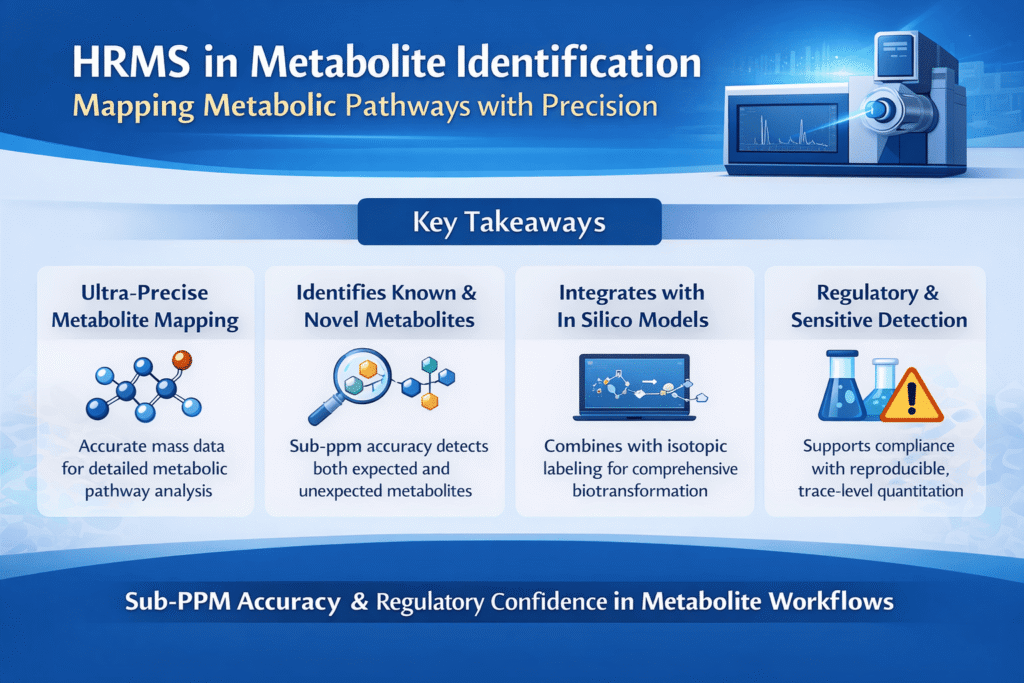
- HRMS in Metabolite Identification enables ultra-precise mapping of metabolic pathways by providing accurate mass data and high-resolution fragmentation spectra.
- It uncovers both expected and unexpected metabolites with sub-ppm accuracy, critical for drug safety, environmental, and biological studies.
- The approach integrates with in silico prediction models and isotopic labeling experiments for a complete understanding of biotransformation.
- HRMS-driven workflows reduce false positives, enhance reproducibility, and provide quantitative trace-level detection of metabolites.
- Adoption of HRMS technology ensures regulatory compliance and scientific reliability in metabolite identification workflows.
Introduction: Why HRMS in Metabolite Identification Is Essential for Modern Biotransformation Research
HRMS in Metabolite Identification has completely changed how scientists study and understand metabolic pathways. By delivering both high mass accuracy and excellent resolution, HRMS allows researchers to move away from assumptions and rely on solid molecular evidence.
Unlike traditional mass spectrometry methods, HRMS provides exact mass values that help determine the elemental composition of metabolites with high confidence. This is critical in complex biological systems where many compounds may share similar nominal masses. For a deeper understanding of how advanced instrumentation supports these capabilities, exploring the principles behind high-resolution mass spectrometry HRMS analysis provides valuable insight into modern analytical workflows.
In pharmaceutical research, toxicology, and environmental fate studies, HRMS ensures that all relevant metabolites are detected. Even low-level, unstable, or previously unknown metabolites can be identified, giving a true and complete view of metabolic processes.
1. The Core Role of HRMS in Metabolite Identification
At its foundation, HRMS transforms metabolite identification from an assumption-based process into a data-supported scientific approach. The high precision offered by HRMS delivers confidence that lower-resolution techniques often cannot achieve.
By measuring ions with sub-ppm mass error, HRMS can easily differentiate compounds with very small mass differences. This accuracy directly improves the reliability of metabolite identification results. Organizations seeking reliable analytical support often rely on specialized high-resolution mass spectrometry services to ensure consistent and defensible metabolite identification outcomes.
In addition, HRMS supports elemental composition assignment and advanced structural analysis using MS/MS and MSⁿ fragmentation. These combined features help create a clear and traceable map of metabolic pathways from parent compounds to final metabolites.
2. Mapping Metabolic Pathways Using HRMS in Metabolite Identification
The workflow for HRMS in Metabolite Identification follows a structured and careful process to ensure data quality at every stage. Each step builds upon the previous one to confirm true metabolic transformations.
| Step | Description | Purpose |
|---|---|---|
| 1. Sample Preparation | Biological matrices (plasma, urine, tissue extracts) are processed using SPE or protein precipitation | Removes interferences and enriches metabolites |
| 2. HRMS Data Acquisition | Data-dependent acquisition captures full-scan and MS/MS data with accurate mass | Detects known and unknown metabolites |
| 3. Data Processing | Advanced algorithms deconvolute spectra and predict molecular formulae | Identifies metabolite candidates |
| 4. Biotransformation Mapping | Correlates metabolites with parent structures | Reconstructs metabolic pathways |
| 5. Confirmation & Quantitation | MS/MS spectra verified against databases or standards | Validates identity and abundance |
Final confirmation is achieved by comparing results with reference standards or trusted databases, ensuring reproducible and regulatory-ready outcomes. A clear understanding of the working principle of HRMS is essential for designing robust metabolite workflows and interpreting high-resolution data correctly.
3. Structural Elucidation with HRMS in Metabolite Identification
One major advantage of HRMS is its ability to separate isobaric and structurally similar compounds that appear identical with low-resolution methods. Accurate mass data and isotope pattern analysis provide clear differentiation.
Fragmentation data from HRMS helps pinpoint structural features and modification sites within metabolites. This is particularly useful when studying metabolic reactions such as oxidation, reduction, or conjugation. The analytical benefits gained from such workflows are well documented among the recognized advantages of HRMS in complex metabolite characterization.
Additional techniques like neutral loss analysis and isotopic fine structure evaluation further strengthen structural interpretation. These tools are especially valuable for identifying complex phase I and phase II metabolites.
4. Combining HRMS in Metabolite Identification with In Silico Prediction
Modern workflows often combine HRMS in Metabolite Identification with in silico biotransformation prediction tools. These tools simulate enzymatic reactions and generate lists of possible metabolites.
When experimental HRMS data matches predicted metabolites, analysts can confirm pathways more quickly and with greater confidence. Understanding how HRMS capabilities have matured over time, as outlined in the evolution of HRMS technology, helps explain why such integrations are now routine in advanced metabolite studies. This reduces uncertainty and speeds up data interpretation.
HRMS also detects unexpected metabolites that prediction models may miss. This ensures that all biologically relevant transformation products are identified, even those outside known pathways.
5. Untargeted Metabolite Discovery Using HRMS
Traditional targeted methods focus only on known metabolites, which can limit discovery. HRMS enables fully untargeted analysis by capturing complete spectral data.
This approach allows detection of unknown or previously unreported metabolites. It is especially useful in early research stages or exploratory metabolism studies. The same approach underpins advanced applications such as impurity profiling using LC-MS, where unknown species must be characterized without prior assumptions.
Another benefit is retrospective analysis. Stored HRMS data can be reanalyzed later as new questions arise, eliminating the need to repeat experiments and maximizing data value.
6. Quantitative Accuracy and Pathway Modeling with HRMS
Quantitative HRMS in Metabolite Identification supports detailed kinetic studies by accurately measuring metabolite levels over time. When used with isotopically labeled standards, results are both precise and reproducible.
HRMS offers a wide dynamic range, allowing simultaneous measurement of high- and low-abundance metabolites. This sensitivity is essential for comprehensive pathway modeling and enzyme activity assessment. In many cases, laboratories evaluate HRMS performance relative to other platforms, such as in comparisons of HRMS vs triple quadrupole (QQQ) for quantification.
These quantitative insights help calculate enzyme activity and reaction rates, linking analytical data to biological meaning.
7. HRMS in Regulatory and Safety Evaluation of Metabolites
Regulatory agencies require clear identification and quantification of metabolites that may pose safety concerns. HRMS meets these expectations by providing unambiguous molecular data.
It enables comparison of metabolites across different species, supporting human relevance assessments during drug development. Such regulatory-focused applications are a key reason HRMS is widely adopted in high-resolution mass spectrometry in drug discovery. This is crucial for compliance with safety testing guidelines.
High-quality HRMS data are widely accepted by authorities such as the FDA and EMA, making HRMS the preferred tool for regulatory metabolite studies.
8. Environmental and Endogenous Applications of HRMS in Metabolite Identification
Beyond pharmaceuticals, HRMS in Metabolite Identification is widely used in environmental research. It helps identify degradation products of chemicals in water, soil, and air samples.
In microbial and ecological studies, HRMS maps complex metabolic networks, offering insight into pollutant breakdown and ecosystem health.
HRMS is also essential in endogenous metabolomics, where it supports biomarker discovery and disease-related metabolic profiling across diverse biological matrices.
9. Addressing Analytical Challenges with HRMS Technology
Although HRMS is powerful, complex biological samples can introduce analytical challenges. Matrix interferences may affect data interpretation if not managed properly.
| Analytical Challenge | HRMS-Enabled Solution |
|---|---|
| Matrix complexity | High-resolution separation + MS/MS validation |
| Isobaric interference | Accurate mass and isotopic discrimination |
| Data overload | AI-driven data processing software |
| Identification confidence | Automated library matching + spectral validation |
Innovations such as AI-driven data processing in HRMS analysis significantly improve data handling efficiency and confidence in metabolite identification.
10. The Future of HRMS in Metabolite Identification
Continuous innovation is expanding the potential of HRMS in Metabolite Identification. Technologies like ion mobility spectrometry and machine learning are improving separation and annotation accuracy.
Future HRMS systems may support real-time metabolic monitoring and integrated multi-omics analysis. This will allow deeper insight into biological systems.
Automation and intelligent data processing will further shorten analysis time, ensuring HRMS remains a leading tool in metabolite research.
Conclusion
HRMS in Metabolite Identification has set new standards for accuracy, reliability, and depth in metabolic pathway analysis. Its ability to deliver precise mass data and confident structural insights makes it essential for modern research.
By combining quantitative analysis, structural elucidation, and predictive modeling, HRMS turns complex data into meaningful biological knowledge.
For organizations seeking accurate, compliant, and future-ready metabolite identification, HRMS represents the gold standard in analytical excellence.
📞 For advanced metabolite identification solutions, reach out to:
➡️ Contact ResolveMass Laboratories Inc.
FAQs on HRMS in Metabolite Identification
HRMS is highly valued because it provides extremely accurate mass measurements along with high-resolution fragmentation data. This combination allows scientists to confidently determine molecular formulas and structures. It also helps separate compounds that look similar but are chemically different, reducing the risk of misidentification.
HRMS links parent compounds to their metabolites using exact mass data and retention time information. This makes it easier to track how a molecule changes during metabolism. As a result, researchers can clearly understand each step of the biotransformation process.
Yes, HRMS supports untargeted analysis, which means it can detect metabolites that were not predicted in advance. Full-scan data capture allows researchers to find new or rare metabolites. These datasets can also be reanalyzed later as new questions arise.
HRMS data are widely accepted by regulatory authorities such as the FDA and EMA. The high accuracy and clear structural evidence support reliable metabolite qualification. This makes HRMS suitable for safety assessments and regulatory submissions.
HRMS offers excellent sensitivity and signal clarity, even at very low concentration levels. It can detect trace metabolites that are often missed by traditional methods. This is especially important for toxicology and pharmacokinetic studies.
In silico tools predict possible metabolites based on known metabolic reactions. HRMS then confirms these predictions using experimental mass and fragmentation data. This combined approach improves confidence and speeds up metabolite identification.
Reference
- Ladumor, M. K., Tiwari, S., Patil, A., Bhavsar, K., & others. (2016). High-resolution mass spectrometry in metabolite identification. Comprehensive Analytical Chemistry, 71, 111–138. https://doi.org/10.1016/bs.coac.2016.01.004
- Rochat, B., Mohamed, R., & Sottas, P.-E. (2018). LC-HRMS metabolomics for untargeted diagnostic screening in clinical laboratories: A feasibility study. Metabolites, 8(2), 39. https://doi.org/10.3390/metabo8020039
- WuXi AppTec. (2020, April 27). Practical derivatization approaches for LC-HRMS metabolite profiling. WuXi AppTec DMPK Service. Retrieved January 5, 2026, from https://dmpkservice.wuxiapptec.com/articles/491-practical-derivatization-approaches-for-lc-hrms-metabolite-profiling/
- Metabolite identification by mass spectrometry. (2024). International Journal of Pharmaceutical Research & Allied Sciences (IJPRA&S). https://ijpras.com/storage/models/article/tI8hrTrTVfZ1ywXUdSiEA1OxVwBf1uyYusSkiPna9t9nifCREBdqZX2egEKn/metabolite-identification-by-mass-spectrometry.pdf
Get In Touch With Us
About The Author