

Introduction
Hydrogen-Deuterium Exchange Mass Spectrometry (HDX-MS) serves as a label-free biophysical approach for investigating peptide conformational dynamics, solvent accessibility, and intramolecular hydrogen-bonding networks over timescales extending from sub-seconds to multiple days. By detecting mass changes produced when backbone amide hydrogens exchange with deuterium, this analytical technique can identify subtle thermodynamic changes and structural ensembles that conventional crystallography or cryo-EM may not adequately resolve in flexible peptide systems. Unlike classical structural biology techniques that depend on long-range crystalline order or high molecular weight targets, short linear peptides, constrained macrocycles, and peptidomimetics continuously fluctuate between different conformational states in solution. Characterizing these energetic landscapes therefore requires analytical methods capable of detecting localized structural changes while preserving the native conformational equilibrium.
Peptide therapeutics represent an important chemical space positioned between small molecules and large biologics and frequently exhibit flexible, multi-state conformational ensembles. Characterizing these ensembles is essential for developing structure-activity relationships (SAR), improving membrane permeability, confirming higher-order structural comparability, and identifying molecular interactions at target-binding interfaces. Through carefully controlled isotopic exchange reactions combined with liquid chromatography and high-resolution mass spectrometry, researchers can monitor localized structural alterations involving peptide backbone amides with high analytical sensitivity.
Learn how advanced analytical strategies ensure regulatory compliance with our specialized peptide sameness study for ANDA submissions.
Share via:
Quick Summary:
- HDX-MS is a label-free technique that reveals peptide conformational dynamics, solvent accessibility, and hydrogen-bonding patterns by tracking hydrogen-to-deuterium mass shifts.
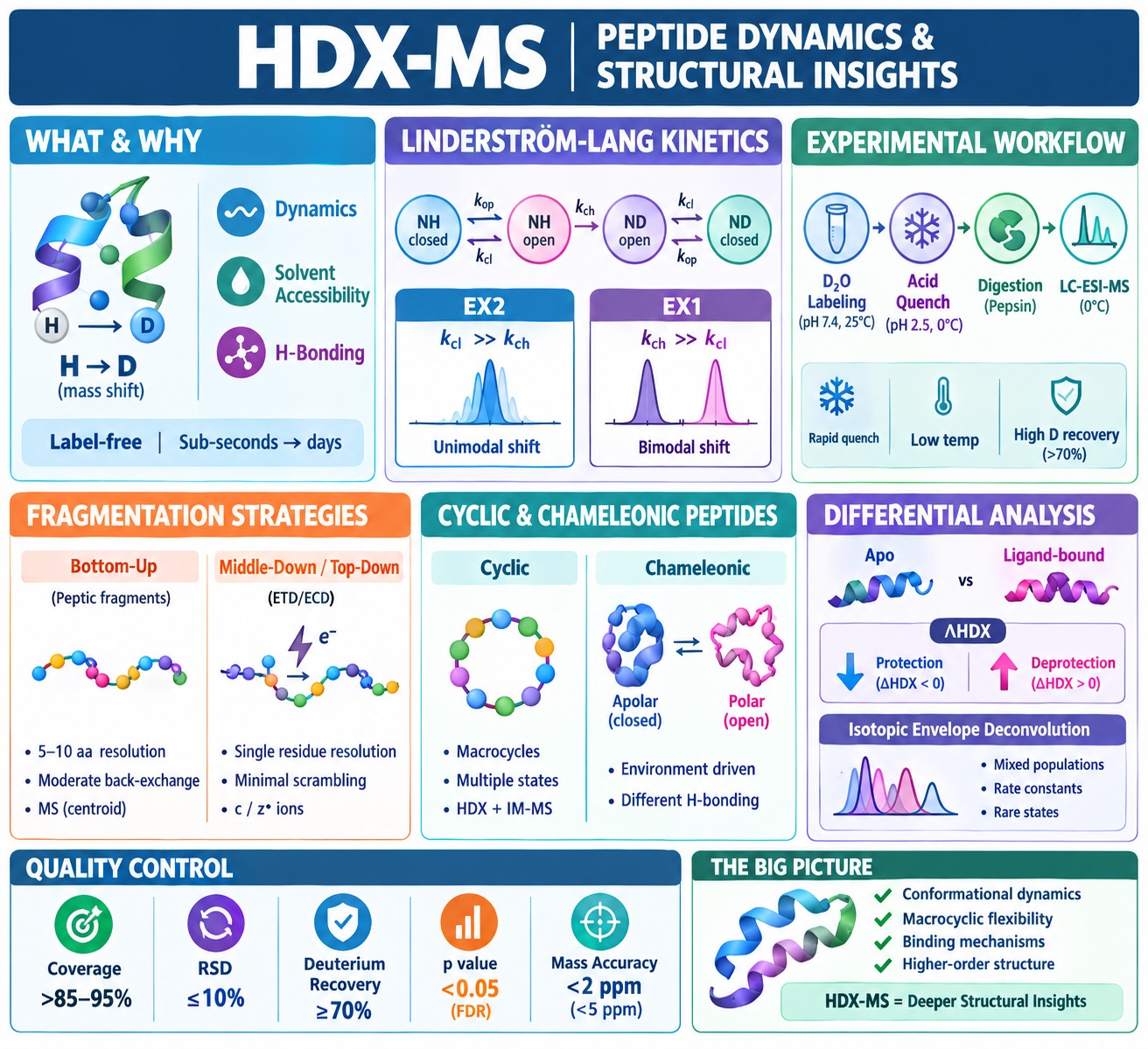
- Linderstrøm–Lang kinetics explains how structural opening and chemical exchange occur, producing EX2 unimodal shifts or EX1 bimodal populations.
- Optimized workflows use D₂O labeling, rapid acid quenching, cold LC separation, and online digestion to minimize back-exchange and preserve structural information.
- Bottom-up HDX-MS provides peptide-level resolution, while ETD/ECD fragmentation enables near-residue-level mapping with minimal hydrogen scrambling.
- Cyclic and chameleonic peptides can be studied across different environments to understand flexibility, intramolecular hydrogen bonding, and membrane-permeability-related conformational changes.
- Differential HDX-MS and isotopic envelope deconvolution identify binding interfaces, protection/deprotection, mixed structural populations, and unfolding kinetics.
- Quality control supports reliable results through high sequence coverage, RSD ≤10%, deuterium recovery ≥70%, FDR-adjusted significance, and accurate mass measurements—making HDX-MS valuable for peptide stability, binding, and higher-order structure characterization.
Linderstrøm-Lang Kinetics in Hydrogen-Deuterium Exchange Mass Spectrometry (HDX-MS)
The kinetics underlying Hydrogen-Deuterium Exchange Mass Spectrometry (HDX-MS) are described by the Linderstrøm-Lang model, which characterizes amide exchange as a sequential two-step mechanism in which structural opening must occur before chemical transfer of deuterium can take place. Depending on the relative rates of structural closing and chemical exchange, peptide dynamics can exhibit either EX2 kinetics, characterized by monomodal mass shifts, or EX1 kinetics, characterized by bimodal population shifts.
Within a polypeptide backbone, each amino acid residue, with the exception of proline, which does not contain a primary backbone amide proton, contains an exchangeable amide hydrogen. According to the Linderstrøm-Lang model, an amide site continuously transitions between a closed state that is hydrogen-bonded or shielded from solvent (NHclosed) and an open state that is accessible to the surrounding solvent (NHopen):
NHclosed kop ⇌ kcl NHopen kch → NDopen kcl ⇌ kop NDclosed
In this mechanism, kop denotes the rate constant associated with structural opening, whereas kcl represents the rate constant for structural closing. The term kch refers to the intrinsic chemical exchange rate constant for an amide located in an unprotected and completely solvent-exposed random-coil environment. Under isotopic dilution conditions, where the concentration of deuterium-containing solvent is substantially higher than that of hydrogen-containing solvent, the observed overall exchange rate constant (kex) can be represented as:
kex = kopkch /kcl + kch
The intrinsic chemical exchange rate constant, kch, is strongly influenced by chemical catalysis involving hydronium (H3O+), hydroxide (OH−), and water (H2O), together with local steric and inductive effects originating from amino acid side chains:
kch = kint, acid[H3O+] + kint, base[OH−] + kint, water[H2O]
At physiological pH, base-catalyzed exchange is the predominant pathway, causing kch to increase by approximately one order of magnitude for every one-unit increase in pH. The minimum value of kch is observed at approximately pH 2.50 at 0 °C. During preparation of deuterated labeling buffers, researchers commonly use the operational relationship pD = pHread + 0.4 to compensate for differences in electrode glass potentials and achieve comparable hydrogen ion activity between H2O- and D2O-based solutions.
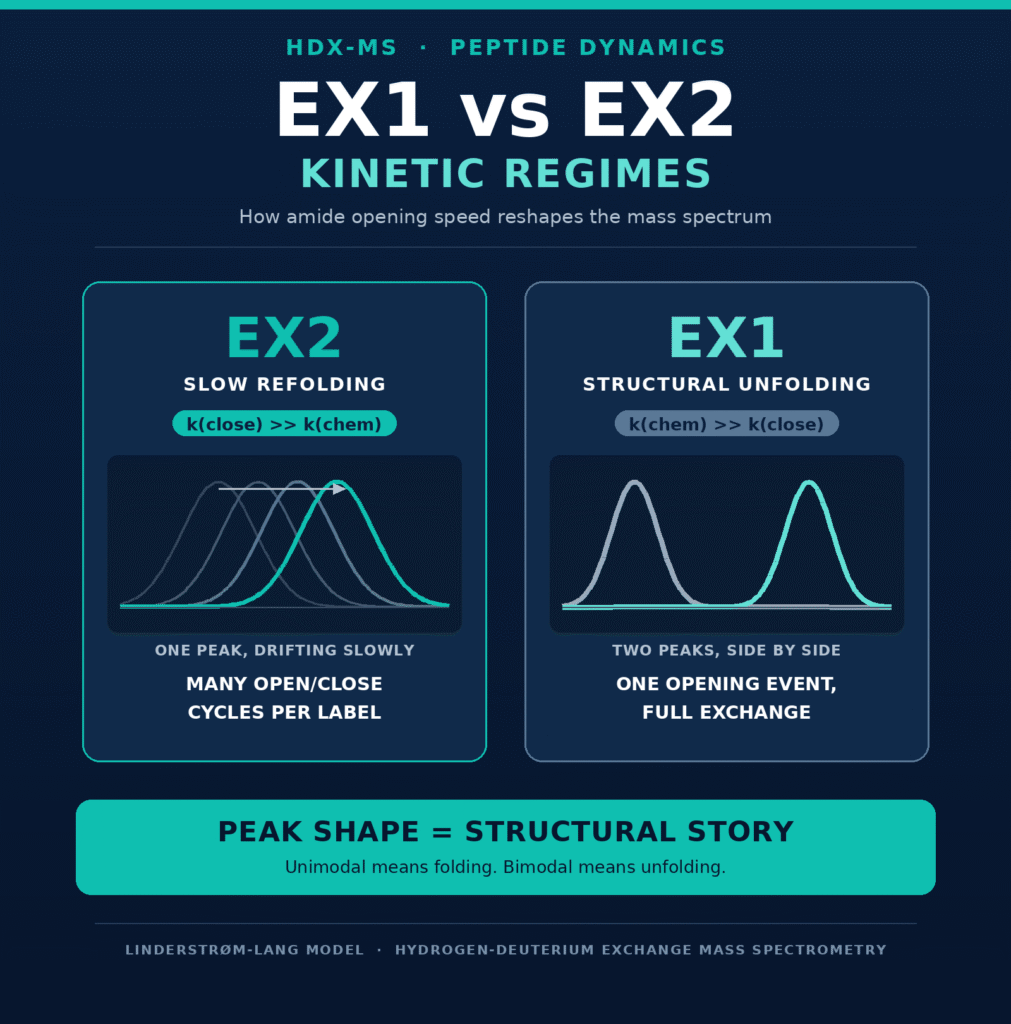
Two primary kinetic regimes can be distinguished according to the relative rates of structural refolding, represented by kcl, and chemical exchange, represented by kch:
- EX2 Kinetic Regime (kcl >> kch): In the EX2 regime, structural closing occurs considerably faster than the intrinsic chemical exchange reaction. As a result, the amide site repeatedly opens and closes many times before an isotopic exchange event successfully takes place. Under these conditions, kex = Kopenkch, where Kopen = kop / kcl corresponds to the local thermodynamic equilibrium constant for opening. In the mass spectrum, EX2 exchange appears as a gradual and continuous unimodal displacement of the peptide isotopic envelope toward increased mass-to-charge (m/z) values as labeling progresses.
- EX1 Kinetic Regime (kch >> kcl): Under EX1 conditions, chemical exchange proceeds much more rapidly than structural re-closing. Consequently, each structural opening event can result in rapid and essentially complete deuteration of the exposed amides within the relevant segment before the structure closes again. In this regime, kex ≈ kop, meaning that the observed exchange behavior directly reflects the structural unfolding rate constant. EX1 kinetics generate clearly separated bimodal isotopic envelopes, representing simultaneous populations of largely unexchanged and highly or fully deuterated peptide molecules.
Examine our specialized capabilities for complex therapeutic peptides through our detailed analysis of peptide characterization of lanreotide generic project standards.
Experimental Optimization and Workflow Architecture for Hydrogen-Deuterium Exchange Mass Spectrometry (HDX-MS)
Reliable peptide HDX-MS analysis depends on rapid acid quenching to approximately pH 2.50 at 0 °C, low-temperature LC separation, and online enzymatic digestion to terminate exchange reactions and minimize deuterium back-exchange. These experimental safeguards help maintain deuterium recovery above 70%, thereby preserving structural information during subsequent mass spectrometric analysis.
A typical HDX-MS experiment begins by incubating the native peptide in a D2O-containing buffer under controlled physiological conditions, such as pH 7.4 and 25 °C, using defined labeling intervals that can extend from milliseconds to several hours. The isotopic exchange reaction is terminated by introducing a cold quench buffer that rapidly lowers the sample temperature to 0 °C while reducing the solution pH to approximately 2.50. Quench formulations often contain denaturing agents such as guanidine hydrochloride or urea, together with non-nucleophilic reducing agents such as tris(2-carboxyethyl)phosphine (TCEP). These components can help unfold highly structured peptides or break disulfide bonds while minimizing conditions that could promote unwanted back-exchange.
After acid quenching, inline proteolysis is performed with immobilized acid-stable proteases, including pepsin, fungal proteases, or aspergillopepsin. The digestion system is maintained within a cooled chamber at approximately 0 °C to minimize additional exchange. The generated peptic fragments are subsequently retained on a C18 trap column, desalted, and separated using a sub-ambient UPLC column. Separation is typically performed with a rapid 7- to 10-minute acetonitrile gradient containing 0.1% formic acid. Maintaining the complete chromatographic flow path at approximately 0 °C limits back-exchange, which refers to the replacement of incorporated deuterium with hydrogen during exposure to H2O-containing mobile phases. Deuterons located on side chains generally exchange back extremely rapidly; consequently, backbone amide deuterons constitute the primary isotopic signal retained for HDX-MS measurement.
Discover how our specialized facilities support complex projects through peptide sameness study services in Canada
and our dedicated peptide sameness study services in united states.
| Experimental Parameter | Bottom-Up HDX-MS | Middle-Down HDX-MS | Top-Down HDX-MS |
|---|---|---|---|
| Digestion Strategy | Inline immobilized acid protease (pepsin) at pH 2.5, 0 °C | Limited proteolysis followed by gas-phase dissociation | Direct injection of intact peptide/protein without cleavage |
| Spatial Resolution | Peptide-level average (typically 5–10 amino acids) | Sub-peptide to single-residue resolution | Residue-level spatial mapping along chain termini |
| Back-Exchange Control | Moderate to High risk (10–30% loss during LC steps) | Moderate risk (mitigated by rapid gas-phase steps) | Low risk (minimal liquid chromatography handling time) |
| Fragmentation Mechanism | Precursor m/z centroid matching without gas fragmentation | Gas-phase ETD/ECD fragmentation of peptic fragments | Gas-phase ETD/ECD or UVPD fragmentation of intact precursor |
| Primary Structural Target | Conformational profiling and biosimilar comparability | Disordered regions, flexible loops, localized sub-sites | Small cyclic peptides, intact macrocycles, short domains |
For comprehensive characterization of metabolic and incretin-based peptides, read about our specialized lc ms characterization of glp 1 peptides.
Resolving Residue-Level Details via Gas-Phase Fragmentation in HDX-MS
Achieving single-residue resolution in peptide HDX-MS requires the integration of soft ionization techniques with non-ergodic gas-phase fragmentation approaches, particularly Electron Transfer Dissociation (ETD) and Electron Capture Dissociation (ECD), which are designed to minimize hydrogen scrambling. In contrast to collision-induced thermal fragmentation, these rapid electron-based dissociation mechanisms can cleave peptide backbone bonds before the isotopic labels have sufficient opportunity to redistribute among neighboring amide sites.
In conventional bottom-up HDX-MS workflows, spatial resolution is primarily determined by the size of the peptic fragments produced during digestion, typically providing an average resolution of approximately 5 to 10 amino acid residues. Attempts to obtain greater spatial resolution through slow-heating activation methods, including Collision-Induced Dissociation (CID) or Higher-energy C-trap Dissociation (HCD), can result in substantial intramolecular hydrogen scrambling. During CID, vibrational energy becomes distributed throughout the peptide ion before the backbone bonds undergo cleavage. This energy redistribution permits protons and deuterons to exchange positions between backbone and side-chain sites. Such scrambling disrupts the original deuterium distribution and can therefore obscure the structural state that existed during the solution-phase labeling reaction.
Non-ergodic fragmentation strategies address this limitation by transferring an electron to multiply charged peptide cations ([M+nH]n+). This process initiates rapid radical-driven cleavage of backbone N–Cα bonds and generates complementary c and z• fragment ions. Because N–Cα bond cleavage takes place on a picosecond timescale, which is faster than extensive internal vibrational energy redistribution, the deuterium distribution established during the solution-phase exchange reaction can remain localized at the corresponding residue.
The deuterium occupancy of individual amino acids can subsequently be determined by comparing the deuterium incorporation of sequential c or z• fragment ions, such as through the difference between cn and cn−1. This approach allows laboratories to construct residue-specific deuterium occupancy maps. Standardized probe peptides with established site-specific deuteration patterns are routinely employed to assess ion-transfer optical parameters, radio-frequency settings, and activation durations. These controls help verify that hydrogen scrambling remains negligible during the analytical process.
Learn how our team provides precision sequence validation by visiting our guide on peptide sequencing of glp 1 drugs
and our dedicated cro for glp 1 peptide characterization solutions.
Evaluating Cyclic and Chameleonic Peptide Landscapes in Hydrogen-Deuterium Exchange Mass Spectrometry (HDX-MS)
Hydrogen-Deuterium Exchange Mass Spectrometry (HDX-MS) can characterize cyclic and chameleonic peptide landscapes by monitoring changes in backbone hydrogen bonding and solvent accessibility as peptides transition between distinct conformational states. The technique provides insight into how macrocycles dynamically rearrange internal polar groups, enabling them to transition between conformations that facilitate movement across hydrophobic cell membranes and conformations that support interactions with target proteins.
Macrocyclization can be introduced through approaches such as head-to-tail amide coupling, disulfide bridge formation, or synthetic chemical stapling. These modifications restrict conformational freedom and can enhance metabolic stability and target affinity. Nevertheless, macrocyclic peptides remain dynamic molecular ensembles that can populate several low-energy conformational sub-states while in solution. HDX-MS can distinguish backbone amides involved in persistent intramolecular hydrogen bonds from those that remain accessible to the surrounding solvent. Amides protected by hydrogen bonding generally exhibit reduced exchange, producing relatively flat deuteration kinetics over extended incubation periods, whereas flexible regions such as turns can exchange much more rapidly.
Explore how we analyze complex constrained structures in our guide to cyclic peptide characterization
and our insights on 2d nmr for peptide characterization.
Chameleonic peptides undergo structural rearrangements that depend on their surrounding solvent environment, resulting in changes to their hydrogen-bonding networks. Within apolar environments, including membrane lipid bilayers, chameleonic macrocycles can adopt more closed conformations in which internal intramolecular hydrogen bonds shield polar backbone amides from the surrounding environment. In contrast, when exposed to polar aqueous conditions, these molecules may transition toward more open conformations, increasing the accessibility of amide groups to water.
By performing HDX-MS experiments under different co-solvent conditions, such as pure aqueous buffer compared with membrane-mimicking fluorinated alcohols or lipid nanodiscs, researchers can directly monitor these environmentally driven conformational transitions. Combining HDX-MS with Ion Mobility Mass Spectrometry (IM-MS) further expands structural characterization by enabling simultaneous measurement of gas-phase collisional cross-sections (CCS). This combination can help distinguish co-existing geometric conformers that possess identical mass-to-charge ratios but differ in three-dimensional organization.
Differential Analysis and Isotopic Envelope Deconvolution in HDX-MS
Differential HDX-MS is used to quantify localized conformational changes and identify binding interfaces by determining differences in deuterium incorporation (ΔHDX) between different structural or ligand-associated states. More advanced isotopic envelope-fitting approaches extend beyond simple centroid mass measurements and can resolve overlapping dynamic populations and differences in subpopulation abundance.
In differential HDX-MS (ΔHDX), isotopic exchange kinetics are determined in parallel for the same peptide under two or more functional conditions. Examples include apo versus ligand-bound states, unphosphorylated versus phosphorylated states, or wild-type versus mutant variants. Ligand binding or protein-protein assembly commonly shields backbone amides from solvent or stabilizes nearby secondary structural elements, thereby slowing deuterium exchange and producing protection characterized by ΔHDX < 0. In contrast, allosteric destabilization or structural opening can increase solvent accessibility and accelerate exchange, resulting in deprotection characterized by ΔHDX > 0.
To obtain greater structural information from HDX-MS data, computational analysis can fit theoretical isotopic probability distributions directly against experimentally measured mass spectra. Conventional centroid analysis reduces an isotopic envelope to a single weighted-average mass, which may conceal multiple structural populations existing simultaneously within the same sample. Isotopic envelope deconvolution algorithms instead evaluate the detailed distribution of isotopic signals at each labeling timepoint. This enables identification of mixed EX1/EX2 exchange behavior, estimation of structural unfolding rate constants, and detection of low-abundance intermediate conformational states.
Data quality assurance requires predefined statistical criteria to separate genuine structural differences from analytical variability. Processing platforms such as Deuteros 2.0 can perform automated peptide-level statistical assessments using Welch’s t-tests together with Benjamini-Hochberg false discovery rate (FDR) corrections.
Learn how physical stability and higher-order assembly are evaluated using our expert peptide aggregation analysis workflows.
| Quality Control Metric | Target Threshold Value | Analytical Significance |
|---|---|---|
| Sequence Coverage | >85%–95% overall coverage | Ensures comprehensive structural characterization across the peptide backbone while minimizing uncharacterized regions. |
| Replicate Precision | Relative Standard Deviation (RSD) ≤ 10% | Demonstrates strong chromatographic and mass measurement reproducibility across technical replicates. |
| Deuterium Recovery | ≥ 70% retention | Confirms that amide back-exchange remains limited during acid quenching and UPLC separation. |
| Statistical Significance | p < 0.05 (FDR adjusted) | Supports the interpretation that measured uptake differences ($\Delta\text{HDX}$) represent genuine structural changes rather than analytical variation. |
| Mass Accuracy | < 2 ppm on Orbitrap / < 5 ppm on Q-TOF | Supports reliable peptide and fragment identification while enabling accurate monitoring of isotopic centroid shifts. |
Conclusion
In conclusion, Hydrogen-Deuterium Exchange Mass Spectrometry (HDX-MS) continues to serve as a highly valuable analytical methodology for investigating peptide conformational dynamics, macrocyclic flexibility, and higher-order structural changes with high sensitivity. By integrating sub-ambient liquid chromatography, radical-mediated gas-phase fragmentation through ETD/ECD, and computational isotopic envelope-fitting strategies, contemporary HDX-MS workflows can characterize structural flexibility with spatial resolution approaching the residue level. As biopharmaceutical development increasingly incorporates complex macrocycles, peptidomimetics, and engineered conjugates, HDX-MS provides important information regarding molecular stability, binding mechanisms, and conformational landscapes.
Work with our analytical team to meet strict global guidelines via our detailed framework on regulatory requirements for glp 1 peptide characterization.
For advanced mass spectrometry characterization, analytical method validation, and therapeutic structural characterization consultations, connect with the specialist research team through the ResolveMass Laboratories Contact Page.
Frequently Asked Questions (FAQs)
EX2 kinetics occur when structural closing proceeds considerably faster than chemical exchange ($k_{\text{cl}} \gg k_{\text{ch}}$), resulting in a progressive unimodal movement of the isotopic envelope. EX1 kinetics arise when chemical exchange is faster than structural re-closing ($k_{\text{ch}} \gg k_{\text{cl}}$), allowing exposed amides to undergo rapid deuteration during structural opening. Consequently, EX1 behavior generates a bimodal distribution representing distinct conformational populations.
Collision-Induced Dissociation (CID) introduces substantial vibrational energy into peptide ions before backbone fragmentation takes place. This energy redistribution promotes intramolecular hydrogen scrambling, allowing protons and deuterons to migrate between backbone amides and side-chain positions. As a result, the original solution-phase deuterium distribution can be altered, preventing reliable site-specific HDX-MS mapping.
Back-exchange is minimized by maintaining the HDX-MS LC system under cold conditions, typically close to 0 °C, while rapidly separating the generated peptide fragments. Acidic mobile-phase conditions and short 7–10-minute UPLC gradients further reduce the time available for incorporated deuterium to exchange back with hydrogen. These controls help preserve backbone amide deuterium and support deuterium recovery above 70%.
The use of $D_2O$ changes the response of conventional glass electrodes, meaning that the displayed pH value does not directly correspond to the actual hydrogen/deuterium ion activity of the solution. Applying the operational correction $pD = pH_{\text{read}} + 0.4$ compensates for this measurement difference. This adjustment helps establish comparable chemical conditions when transferring protocols between $H_2O$- and $D_2O$-based buffers.
HDX-MS characterizes chameleonic cyclic peptides by monitoring changes in backbone amide exchange as the peptide experiences different solvent environments. Amides protected by intramolecular hydrogen bonds generally exchange more slowly, whereas solvent exposure increases their exchange rates. Comparing HDX behavior across polar and nonpolar conditions therefore reveals environment-dependent conformational rearrangements.
Centroid analysis reduces an isotopic envelope to a single average mass, which can conceal the presence of multiple conformational populations. Full isotopic envelope modeling evaluates the complete distribution of isotope peaks and can distinguish overlapping exchange behaviors. This approach supports characterization of mixed EX1/EX2 kinetics, structural unfolding rates, and low-abundance intermediate conformers.
Pepsin is well suited to online HDX-MS because it remains active under the acidic and low-temperature conditions used during HDX quenching. Its broad cleavage specificity produces numerous peptide fragments, including overlapping sequences that improve structural coverage and spatial resolution. Immobilized pepsin can also be integrated directly into low-temperature workflows to minimize handling time and unwanted back-exchange.
Differential HDX-MS compares deuterium uptake between different molecular states to identify localized structural changes. Regions directly involved in ligand or protein interactions commonly show increased protection, reflected by $\Delta\text{HDX} < 0$, because solvent accessibility is reduced. Allosteric effects can instead produce protection or deprotection in regions distant from the primary interaction site, helping distinguish direct binding effects from broader conformational changes.
Ion Mobility Mass Spectrometry (IM-MS) separates gas-phase peptide ions according to characteristics such as charge, size, and collision cross-section (CCS) before mass measurement. When integrated with HDX-MS, this additional separation dimension can distinguish conformational species that possess the same mass-to-charge ($m/z$) value. The resulting information can improve characterization of co-existing peptide conformers and their structural heterogeneity.
Reference:
- Ozohanics, O., & Ambrus, A. (2020). Hydrogen-deuterium exchange mass spectrometry: A novel structural biology approach to structure, dynamics and interactions of proteins and their complexes. Life, 10(11), 286. https://doi.org/10.3390/life10110286
- Masson, G. R., Jenkins, M. L., Burke, J. E., et al. (2024). Hydrogen/deuterium exchange mass spectrometry: Fundamentals, limitations, and opportunities. Molecules, 29(20). https://doi.org/10.3390/molecules29205007
- Nkyaagye, E., Safoah, H. A., & Do, T. D. (2026). Cyclic peptide conformational landscapes through the lens of mass spectrometry and orthogonal spectroscopy. Journal of Mass Spectrometry, 61(5), e70058. https://doi.org/10.1002/jms.70058
- Kan, Z.-Y., Walters, B. T., Mayne, L., & Englander, S. W. (2013). Protein hydrogen exchange at residue resolution by proteolytic fragmentation mass spectrometry analysis. Proceedings of the National Academy of Sciences of the United States of America, 110(41), 16438–16443. https://doi.org/10.1073/pnas.1315532110
- Wei, H., Ahn, J., Yu, Y. Q., Tymiak, A., Engen, J. R., & Chen, G. (2012). Using hydrogen/deuterium exchange mass spectrometry to study conformational changes in granulocyte colony stimulating factor upon PEGylation. Journal of the American Society for Mass Spectrometry, 23(3), 498–504. https://doi.org/10.1007/s13361-011-0310-x
- Hamuro, Y., Tomasso, J. C., & Coales, S. J. (2008). A simple test to detect hydrogen/deuterium scrambling during gas-phase peptide fragmentation. Analytical Chemistry, 80(17), 6785–6790. https://doi.org/10.1021/ac800645f
- Martens, C., Shekhar, M., Lau, A. M., Tajkhorshid, E., & Politis, A. (2019). Integrating hydrogen–deuterium exchange mass spectrometry with molecular dynamics simulations to probe lipid-modulated conformational changes in membrane proteins. Nature Protocols, 14(11), 3183–3204. https://doi.org/10.1038/s41596-019-0219-6
Get In Touch With Us
About The Author


