
Introduction:
The ICH Q11 CMC drug development guidelines, read together with ICH Q8(R2), explain how sponsors should design, justify and document a drug substance and drug product manufacturing process so that quality is built in rather than tested in at the end. For anyone preparing an IND, CTA, NDA or MAA, the Chemistry, Manufacturing and Controls (CMC) section is where these principles are put to the test.
At ResolveMass Laboratories Inc., a Canadian analytical CRO/CDMO, we work on the analytical evidence behind these filings every day: mass spectrometry-based characterization of biosimilars, nitrosamine testing, and PLGA-based drug delivery systems. This overview shows how Q8 and Q11 are applied in practice, so sponsors can plan CMC studies earlier and avoid avoidable review delays.
These guidelines are relevant to sponsors, CDMOs and biotechnology companies alike, whether the program is a first-in-human study, a 505(b)(2) NDA or an early-stage venture drawing on CMC consulting services for biotech startups. The common thread is moving beyond end-product testing toward a systematic approach in which quality is built in throughout development and manufacturing. Matching the depth of that work to the program stage is the idea behind phase-appropriate CMC development.
Summary:
- ICH Q8(R2) covers pharmaceutical development of the drug product. ICH Q11 covers the development and manufacture of the drug substance (chemical and biotechnological/biological). Together they anchor the ICH Q11 CMC drug development guidelines most regulators expect to see applied.
- Both guidelines promote Quality by Design (QbD): define the target product profile, identify critical quality attributes (CQAs), link them to material attributes and process parameters, and build a control strategy.
- Sponsors may take a traditional or an enhanced development approach. The enhanced approach needs more data but offers more regulatory flexibility across the lifecycle.
- Q11 gives clear principles for justifying drug substance starting materials, a frequent source of review questions.
- Q8 and Q11 work with Q9 (risk management), Q10 (pharmaceutical quality system), Q12 (lifecycle management) and Q14 (analytical procedure development).
- Robust analytical characterization is the evidence that makes any CMC development story credible.
- Applying Q8 and Q11 early improves process understanding, technology transfer, scale-up readiness and commercial manufacturing consistency.
1: What Are ICH Q8 and ICH Q11, and How Do They Relate?
ICH Q8(R2) describes how to develop and justify the drug product (the finished dosage form), while ICH Q11 describes how to develop and justify the drug substance (the active pharmaceutical ingredient). They share one philosophy, QbD, and feed the same Common Technical Document (CTD) quality module.
| Guideline | Focus | Core concepts | Where it appears in the CTD |
|---|---|---|---|
| ICH Q8(R2) | Pharmaceutical development of the drug product | QTPP, CQAs, design space, control strategy | 3.2.P.2 |
| ICH Q11 | Development and manufacture of the drug substance | Starting material justification, CQAs, process development, control strategy | 3.2.S.2.2 to 3.2.S.2.6 |
| ICH Q9 | Quality risk management | Risk assessment tools, risk-based decisions | Supports both |
| ICH Q10 | Pharmaceutical quality system | Lifecycle quality management | Supports both |
Why the ICH Q11 CMC Drug Development Guidelines Matter to Sponsors
They set a shared vocabulary between sponsors and regulators. ICH guidelines are implemented by regulators such as the US FDA, the EMA, Health Canada and Japan’s PMDA, so a development package built around Q8 and Q11 is easier to defend across regions.
The practical benefits are:
- Fewer information requests about why a process or specification was chosen.
- A documented link between process parameters and product quality.
- Greater scope for post-approval changes managed under the quality system.
Practical example: consider an oral tablet containing a synthetic API. ICH Q11 principles guide the API process: reaction conditions, starting materials, impurity formation and purification. ICH Q8 principles guide the tablet: excipient selection, granulation parameters, compression conditions, dissolution performance and finished-product quality. Both feed one integrated CMC strategy.
2: What Does ICH Q8(R2) Expect From Pharmaceutical Development?
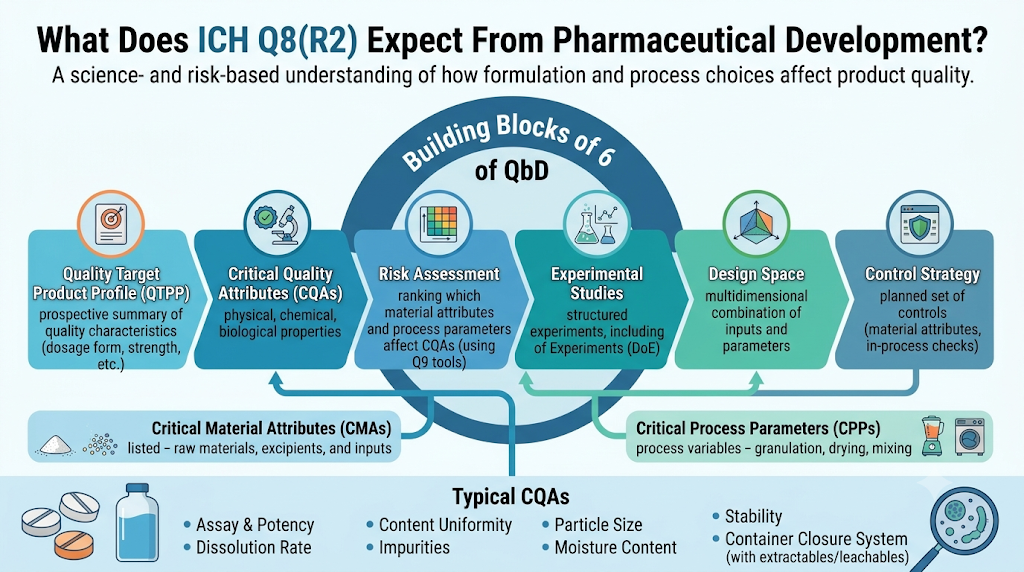
ICH Q8(R2) expects sponsors to show a science- and risk-based understanding of how formulation and process choices affect product quality. The aim is a defined target, a justified design, and a control strategy that reliably delivers the intended performance.
The QbD Building Blocks in Q8
- Quality Target Product Profile (QTPP): a prospective summary of the quality characteristics the product must have, such as dosage form, route, strength, release profile and stability.
- Critical Quality Attributes (CQAs): physical, chemical, biological or microbiological properties that must stay within limits to ensure the desired quality.
- Risk assessment: using Q9 tools to rank which material attributes and process parameters may affect CQAs.
- Experimental studies: structured experiments, including design of experiments (DoE), to quantify those effects.
- Design space: the multidimensional combination of inputs and process parameters shown to assure quality. Working within an approved design space is not considered a change.
- Control strategy: the planned set of controls, from material attributes to in-process checks and specifications, derived from product and process understanding.
Two terms sit beneath CQAs in Q8 practice:
- Critical Material Attributes (CMAs): properties of raw materials, excipients and other inputs that can influence quality, such as API particle size, excipient moisture content or polymer viscosity.
- Critical Process Parameters (CPPs): parameters whose variability can affect a CQA and therefore need monitoring or control, such as granulation time, drying temperature, mixing speed, compression force or coating temperature.
Typical CQAs include assay and potency, dissolution rate, content uniformity, impurity levels, particle size distribution, moisture content and stability-indicating parameters. The container closure system belongs in the QTPP too, and its interaction with the product is assessed through extractables and leachables studies.
How This Applies to Complex Drug Products
For modified-release systems such as PLGA-based microspheres or implants, CQAs often include particle size distribution, polymer molecular weight, residual solvent and in vitro release. Each of these depends on analytical methods that are sensitive enough to detect meaningful process shifts, which is why method development should start alongside formulation work, not after it.
Injectable and depot products show how this plays out. A leuprolide depot CMC strategy must control polymer and release attributes, a dexamethasone injection has its own CMC requirements, and a broader CMC strategy for complex generic injectables has to show equivalence of complex formulation attributes.
3: How Do the ICH Q11 CMC Drug Development Guidelines Apply to Drug Substances?
ICH Q11 applies QbD principles to the drug substance: sponsors describe the manufacturing process, justify the starting materials, identify drug substance CQAs, and show how the control strategy keeps those attributes within limits. It covers both chemical entities and biotechnological/biological entities.
How Should Sponsors Justify Drug Substance Starting Materials?
A starting material should be a defined chemical with established properties and structure, incorporated as a significant structural fragment into the drug substance, and positioned so that downstream steps and controls can purge impurities. Regulators look closely at this choice because it sets where GMP and the regulatory filing begin.
A sound justification typically shows:
- How impurities in the starting material are understood and controlled.
- That enough synthetic steps follow it for the process to remove or control variability.
- How the supplier’s changes would be communicated and assessed.
- Supporting analytical data on impurity fate and purge.
The ICH Q11 Questions and Answers document gives further examples and is worth reviewing before finalizing the regulatory starting material.
What Should Process Development Show?
Q11 expects the development history to explain why the process looks the way it does. Sponsors should link process parameters and material attributes to drug substance CQAs, identify which parameters are critical, and define ranges, such as normal operating ranges and proven acceptable ranges, supported by data.
Typical development activities include:
- Evaluating synthetic or biological production routes and identifying critical steps.
- Understanding reaction mechanisms, yield and impurity formation.
- Optimizing purification and assessing scalability.
For synthetic APIs, studies often cover reaction temperature and time, reagent equivalents, solvent selection and crystallization. For biotechnology-derived drug substances, they cover cell culture or fermentation conditions, harvest, purification and product-related impurities.
How Are Impurities Handled?
Impurity control is central to Q11. Sponsors should describe the origin and fate of organic impurities, residual solvents and elemental impurities, and show how the control strategy limits them. Mutagenic and nitrosamine-related risks must also be assessed alongside Q11, using ICH M7 principles and current regulatory expectations, which makes sensitive trace-level analytical methods a practical necessity.
Impurity classes to consider include starting material-related impurities, reaction intermediates, by-products, degradation products, residual solvents, elemental impurities and genotoxic impurities. Purge studies are especially useful where a potentially harmful impurity must be shown to be removed by later steps. Depending on the impurity, supporting techniques include HPLC, LC-MS, LC-MS/MS, GC-MS, GC-HRMS and ICP-MS.
What Is the Control Strategy Under ICH Q11?
The control strategy is the combination of controls on materials, process steps, in-process testing and the final specification. Q11 notes that it can include controls at multiple points, not only end-product testing, and that real-time or in-process monitoring can support parametric release approaches in some cases.
4: Traditional vs. Enhanced Approach: Which Should Sponsors Choose?
Choose the traditional approach for simpler products and early-phase programs, and the enhanced approach when you want design space, reduced end-product testing or more flexible lifecycle management. Both are acceptable, and many programs move from one to the other as data accumulate.
| Aspect | Traditional approach | Enhanced (QbD) approach |
|---|---|---|
| Development focus | Set points and fixed ranges | Understanding of parameter and attribute effects |
| Experimental work | Mostly univariate studies | Multivariate studies, DoE, modeling |
| Control strategy | Mainly specifications and fixed process steps | Risk-based, with in-process and real-time controls |
| Regulatory flexibility | Changes often need prior filing | Movement within an approved design space is not a change |
| Data burden | Lower at filing | Higher at filing, lower friction later |
A Practical CMC Checklist for Sponsors
Use this sequence as a planning aid when applying the ICH Q11 CMC drug development guidelines:
- Define the QTPP and a provisional list of drug substance and drug product CQAs.
- Run an early risk assessment (ICH Q9) to rank parameters and material attributes.
- Select and justify the starting materials, including impurity purge data.
- Develop and qualify analytical methods early, aligned with ICH Q14 and Q2(R2).
- Design experiments to define ranges and, where useful, a design space.
- Draft the control strategy and link each control to a CQA.
- Plan process validation and stability studies that match the control strategy.
- Document development history clearly for CTD sections 3.2.S.2.6 and 3.2.P.2.
5: How Do ICH Q9 and Q10 Support Q8 and Q11?
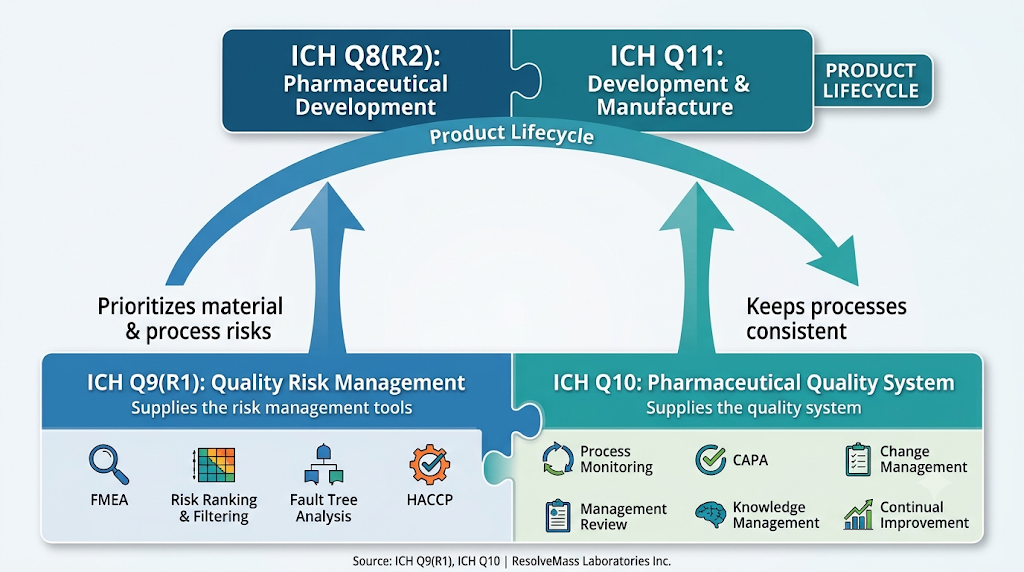
ICH Q9(R1) supplies the risk management tools and ICH Q10 supplies the quality system that make Q8 and Q11 work in practice. Together they support a consistent quality strategy across the product lifecycle.
- ICH Q9(R1), Quality Risk Management: tools such as FMEA, risk ranking and filtering, fault tree analysis and HACCP help prioritize material attributes, process parameters, analytical controls and process risks.
- ICH Q10, Pharmaceutical Quality System: process performance and product quality monitoring, CAPA, change management, management review, knowledge management and continual improvement keep processes consistent as development moves to commercial production.
6: What CMC Documentation Should Sponsors Prepare Under Q8 and Q11?
Sponsors should prepare documentation that demonstrates product and process understanding, appropriate controls and the ability to manufacture consistently, organized in the CTD structure. The depth should match the development stage, product characteristics and regulatory requirements. Generic programs have their own expectations; see CMC documentation at a CDMO for ANDA for an example.
| CTD section | Guideline | Key documentation |
|---|---|---|
| 3.2.S.2.2 | ICH Q11 | Manufacturing process description and process controls |
| 3.2.S.2.3 | ICH Q11 | Starting materials, reagents, solvents and material controls |
| 3.2.S.2.4 | ICH Q11 | Critical steps and intermediate controls |
| 3.2.S.2.5 | ICH Q11 | Process validation and/or evaluation |
| 3.2.S.2.6 | ICH Q11 | Manufacturing process development studies |
| 3.2.P.2 | ICH Q8 | Pharmaceutical development and formulation rationale |
| 3.2.P.3 | GMP and development guidance | Drug product manufacturing process and controls |
| 3.2.P.5 | Specification and analytical guidance | Drug product specifications and analytical procedures |
Supporting reports typically include process development, formulation development, analytical method development and validation, impurity characterization, stability, risk assessment, DoE, technology transfer and, where applicable, process validation.
7: How Can Sponsors Apply Q8 and Q11 Across the Development Lifecycle?
Sponsors should apply Q8 and Q11 principles from early development rather than waiting for submission preparation. This keeps drug substance development, formulation, manufacturing and commercial readiness connected.
- Early development: define initial quality objectives, identify potential CQAs and CMAs, evaluate routes and develop preliminary analytical methods.
- Process and formulation optimization: run development experiments, evaluate CPPs, profile impurities, use DoE and set a preliminary control strategy.
- Scale-up and technology transfer: assess robustness at larger scale and equipment differences, set material and process specifications and transfer analytical procedures. See scale-up and tech transfer in CMC.
- Submission preparation: compile CTD Module 3, document starting material justification and address identified risks.
- Commercial manufacturing: monitor process performance, investigate deviations, apply CAPA, evaluate changes and continue process verification.
Each stage should be sized to the program, as described in our guide to phase-appropriate CMC development.
8: What Are the Most Common CMC Development Pitfalls?
The most common pitfalls are weak starting material justification, late analytical method development, and development data that never connect to the control strategy. Each one is avoidable with early planning.
- Late method development: methods built after the process is fixed rarely show whether they can detect meaningful variation.
- Unjustified starting materials: a missing impurity purge argument invites questions and may force the starting material further back or forward.
- Parameters labelled critical without evidence: classification should follow risk assessment and data.
- Impurity gaps: overlooking nitrosamine or mutagenic risks until late in development.
- Thin development reports: results exist, but the reasoning that links them to CQAs is not documented.
9: How Does Analytical Characterization Support Q8 and Q11 Compliance?
Analytical characterization provides the objective evidence for every Q8 and Q11 claim: identity, purity, impurity profile, structure and performance. Without it, a design space or control strategy is only a hypothesis.
At ResolveMass Laboratories Inc., our scientists apply high-resolution mass spectrometry and orthogonal techniques to characterize complex molecules, including biosimilars, and to detect trace impurities such as nitrosamines. For PLGA-based delivery systems, we generate data on polymer and release attributes that feed directly into CQA assessment. Our approach is to design studies around what a reviewer will ask, document the reasoning clearly, and keep data traceable so sponsors can defend it in a filing.
Depending on the product and the analytical question, sponsors may need:
| Technique | Typical CMC use |
|---|---|
| HPLC / UHPLC | Assay, purity and related substances |
| LC-MS/MS | Sensitive impurity quantification |
| HRMS | Molecular mass confirmation and impurity identification |
| GC-MS | Residual solvents and volatile impurities |
| ICP-MS | Elemental impurity assessment |
| NMR | Structural characterization |
| SEC-MALS | Molecular weight and aggregation of suitable macromolecules |
Results should always be read alongside process knowledge, risk assessments and specifications. No single technique replaces a comprehensive control strategy.
ResolveMass capabilities relevant to Q8 and Q11 work include:
- Drug substance characterization: identity, purity and impurity profiles using LC-MS, HRMS, HPLC, NMR and other platforms.
- Impurity profiling: investigation of process-related impurities and degradation products.
- Complex molecules: specialized approaches for peptides and oligonucleotides, including CMC services for peptide and oligonucleotide conjugates.
- Method development and validation: fit-for-purpose methods that support specifications and regulatory documentation.
Conclusion:
The ICH Q11 CMC drug development guidelines, together with ICH Q8(R2), ask sponsors for one thing: demonstrate that you understand your product and process well enough to control them. A clear QTPP, risk-ranked CQAs, justified starting materials and a data-linked control strategy make that case. Strong analytical evidence turns the story into a defensible filing.
Frequently Asked Questions:
ICH Q8 focuses on drug product formulation and manufacturing, whereas ICH Q11 focuses on drug substance manufacturing and process development. Both guidelines help sponsors establish product and process understanding and develop appropriate quality control strategies.
ICH Q11 provides guidance for developing and manufacturing drug substances with consistent quality. It covers manufacturing process development, starting material selection, impurity control, critical process steps, and process validation or evaluation.
Quality by Design is a systematic pharmaceutical development approach that builds quality into a product through scientific understanding and risk management. It involves defining the Quality Target Product Profile (QTPP), identifying Critical Quality Attributes (CQAs), evaluating process parameters, and establishing an appropriate control strategy.
Critical Quality Attributes are physical, chemical, biological, or microbiological properties that must remain within appropriate limits to ensure product quality. Examples include assay, dissolution, impurity levels, particle size, potency, and content uniformity.
Starting material selection determines the point at which the drug substance manufacturing process and associated controls are established for regulatory purposes. Sponsors must scientifically justify starting materials by considering manufacturing process complexity, impurity risks, material properties, and downstream purification capabilities.
ICH Q8 primarily relates to CTD Section 3.2.P.2 (Pharmaceutical Development). ICH Q11 primarily relates to drug substance manufacturing sections, particularly 3.2.S.2.2 through 3.2.S.2.6, covering manufacturing processes, material controls, critical steps, process validation or evaluation, and process development.
Reference
- Cha KJ, Rosenberg M. Regulatory and quality considerations of antibody-drug conjugates. AAPS PharmSciTech. 2026 Sep 4;27(7):262.https://link.springer.com/article/10.1208/s12249-026-03503-6
- Kapadia R, Shevalkar G, Das U, Singhai V, Bari D, Pardeshi CV. Introduction to quality by design. InIntroduction to quality by design (QbD) from theory to practice 2024 Apr 10 (pp. 1-33). Singapore: Springer Nature Singapore.https://link.springer.com/chapter/10.1007/978-981-99-8034-5_1
- DiPaolo M, Locher M. Biopharmaceuticals: CMC Development “Points to Consider” from a Regulatory Perspective. InRegulatory Toxicology 2021 Jun 8 (pp. 1-20). Berlin, Heidelberg: Springer Berlin Heidelberg.https://link.springer.com/content/pdf/10.1007/978-3-642-36206-4_131-1.pdf
- Eichinger T. Introduction to Chemistry Manufacturing and Controls–From Compound and Development Candidate to Drug. Principles of Biomedical Sciences and Industry: Translating Ideas into Treatments. 2022 Oct 3:99-118.https://onlinelibrary.wiley.com/doi/abs/10.1002/9783527824014.ch6
About the Author