Introduction
In pharmaceutical manufacturing and chemical synthesis, accurately monitoring reaction components is essential for maintaining product quality, process efficiency, and regulatory compliance. Identification of In-Process Organic Compounds using LCMS has become a reliable analytical approach for detecting intermediates, impurities, and by-products formed during chemical reactions. Liquid Chromatography–Mass Spectrometry (LC-MS) offers exceptional sensitivity, selectivity, and structural insight, making it a valuable tool for analyzing complex reaction mixtures. As a Contract Research Organization (CRO) specializing in custom synthesis and analytical services, Resolvemass Laboratories utilizes advanced LC-MS technologies to support comprehensive compound identification and characterization, helping clients optimize their processes and achieve consistent, high-quality manufacturing outcomes.
Share via:
Understanding In-Process Organic Compound Identification
In-process organic compounds include starting materials, intermediates, by-products, and degradation products formed during chemical reactions. Accurate identification and quantification of these compounds are essential for:
Process Optimization: Understanding reaction pathways and identifying key intermediates and by-products can help optimize reaction conditions, improve yields, and reduce waste.
Quality Control: Ensuring that the final product meets specified quality standards by monitoring and controlling impurities and degradation products throughout the manufacturing process.
Regulatory Compliance: Meeting regulatory requirements for impurity profiling and ensuring the safety and efficacy of pharmaceutical products.
The Role of LC-MS in Process Control
LC-MS combines the separation capabilities of liquid chromatography (LC) with the detection and identification power of mass spectrometry (MS). This synergy makes LC-MS an ideal tool for the analysis of complex mixtures, providing detailed information on the composition and structure of organic compounds. Key advantages of LC-MS include:
- High Sensitivity and Specificity: LC-MS can detect and quantify trace levels of compounds with high specificity, distinguishing between structurally similar molecules.
- Versatility: Suitable for a wide range of compounds, from small molecules to large biomolecules, in various matrices.
- Structural Elucidation: MS provides molecular weight and structural information, aiding in the identification of unknown compounds.
Achieve deeper insights into your chemical structures: Explore High-Resolution Mass Spectrometry (HRMS) Analysis
Advantages of LC-MS Compared with Conventional Analytical Techniques
Traditional analytical techniques such as HPLC with UV detection or gas chromatography provide useful information about compound separation and concentration, but they often lack the structural insight required for confident identification. LC-MS offers a significant advantage because it combines chromatographic separation with molecular-level identification through mass spectrometry. This combination allows analysts to determine molecular weights, isotopic patterns, and fragmentation structures, which helps distinguish between compounds that may appear identical using other analytical methods.
Another important advantage of LC-MS is its ability to analyze highly complex mixtures without requiring extensive sample purification. Many chemical synthesis reactions generate multiple intermediates and side products simultaneously, making separation and identification challenging. LC-MS enables rapid screening of such mixtures, helping chemists quickly determine reaction progress and impurity profiles. This capability greatly enhances decision-making during process development and reduces analytical turnaround time.
Importance of Early Detection of Process-Related Compounds
Early identification of organic compounds formed during chemical reactions plays a vital role in maintaining process consistency and minimizing downstream complications. During multi-step synthesis, even small quantities of unintended intermediates or side products can accumulate and influence reaction outcomes. If these compounds are not detected early, they may persist through purification steps and affect final product purity. Analytical monitoring using sensitive techniques such as LC-MS allows scientists to detect these components at very low concentrations, helping teams address issues before they escalate into large-scale manufacturing problems.
Early detection also supports proactive process optimization and troubleshooting. When chemists gain visibility into intermediate formation and reaction dynamics, they can modify parameters such as temperature, solvent composition, catalyst loading, or reaction time. This improves reaction efficiency and reduces the formation of undesirable by-products. By integrating analytical monitoring early in development, pharmaceutical companies can significantly reduce costly process failures during later development stages or commercial manufacturing.
Ensure product safety by monitoring trace contaminants: Learn more about Impurity Profiling using LC-MS
LC-MS Workflow for In-Process Compound Identification
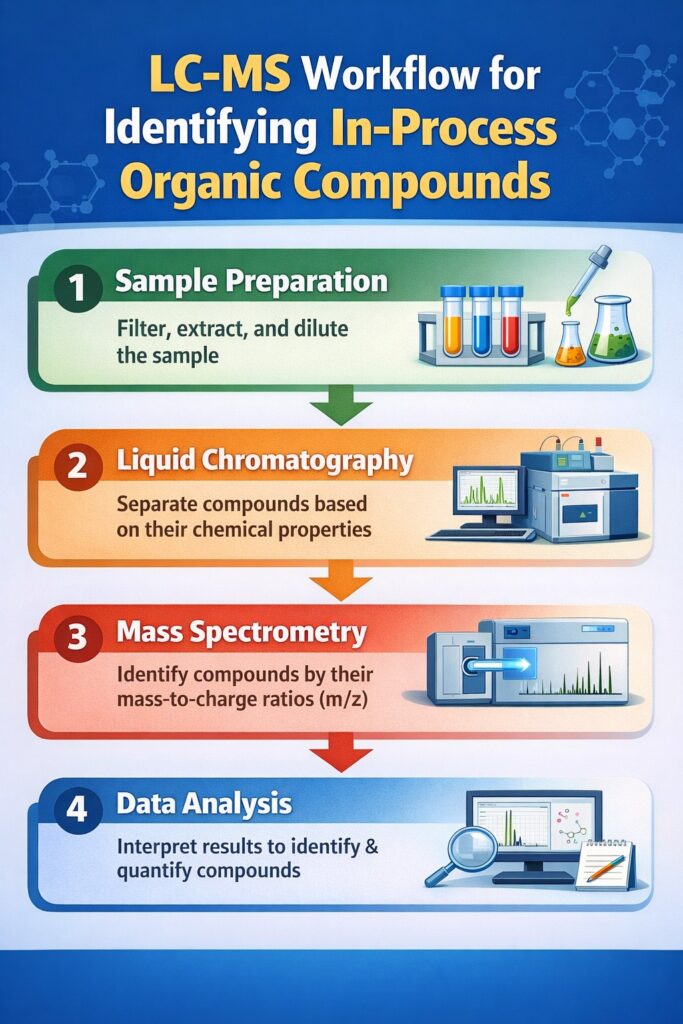
At Resolvemass Laboratories, our LC-MS workflow for identifying in-process organic compounds involves several key steps:
1. Sample Preparation
Proper sample preparation is crucial for accurate LC-MS analysis. Depending on the sample matrix and target compounds, preparation methods may include:
- Filtration: Removing particulate matter to prevent clogging of the LC column and MS ion source.
- Extraction: Isolating target compounds from complex matrices using techniques such as solid-phase extraction (SPE) or liquid-liquid extraction (LLE).
- Dilution: Adjusting the concentration of the sample to fall within the dynamic range of the LC-MS system.
2. Liquid Chromatography
LC separates the components of the sample based on their chemical properties, such as polarity and hydrophobicity. Key considerations for LC include:
- Column Selection: Choosing the appropriate stationary phase (e.g., reversed-phase, normal-phase, or ion-exchange) to achieve optimal separation of target compounds.
- Mobile Phase Optimization: Adjusting the composition and gradient of the mobile phase to enhance resolution and peak shape.
- Flow Rate and Temperature: Optimizing these parameters to balance separation efficiency and analysis time.
3. Mass Spectrometry
MS detects and identifies the separated compounds based on their mass-to-charge (m/z) ratios. Key aspects of MS analysis include:
- Ionization Technique: Choosing the appropriate ionization method (e.g., electrospray ionization (ESI) or atmospheric pressure chemical ionization (APCI)) based on the chemical nature of the compounds.
- Mass Analyzer: Selecting the mass analyzer (e.g., quadrupole, time-of-flight (TOF), or orbitrap) to achieve the desired resolution, accuracy, and sensitivity.
- Data Acquisition: Collecting full-scan MS data or targeted MS/MS data to obtain detailed information on the molecular weight and structure of the compounds.
4. Data Analysis and Interpretation
The data generated by LC-MS are processed and interpreted using advanced software tools. Key steps include:
- Peak Identification: Identifying peaks in the chromatogram and correlating them with the corresponding mass spectra.
- Compound Identification: Comparing the obtained mass spectra with reference libraries or using de novo analysis to identify unknown compounds.
- Quantification: Determining the concentration of identified compounds using calibration curves and internal standards.
- Structural Elucidation: Interpreting MS/MS fragmentation patterns to elucidate the structure of unknown compounds.
Detect and quantify mutagenic impurities with precision: Explore specialized Nitrosamine Analysis Services
Role of High-Resolution Mass Spectrometry in Compound Identification
High-resolution mass spectrometry (HRMS) has significantly enhanced the capability of LC-MS systems to identify unknown organic compounds during chemical synthesis. HRMS instruments such as Orbitrap or Time-of-Flight analyzers can measure molecular masses with extremely high accuracy, often within a few parts per million (ppm). This high mass accuracy enables scientists to determine precise molecular formulas, which is particularly valuable when analyzing unknown intermediates or unexpected impurities.
In addition to accurate mass measurement, HRMS provides detailed isotopic patterns and fragmentation information that further support compound identification. When combined with LC separation, HRMS allows scientists to differentiate compounds that have very similar masses but different structures. This level of analytical precision is especially useful during pharmaceutical process development, where even minor structural differences can influence drug efficacy, safety, or regulatory acceptance.
Applications of LC-MS in In-Process Compound Identification
Resolvemass Laboratories utilizes LC-MS for a wide range of applications in process control and quality assurance:
1. Reaction Monitoring
LC-MS enables real-time monitoring of chemical reactions, providing insights into reaction kinetics, intermediate formation, and by-product profiles. This information is invaluable for optimizing reaction conditions and improving yields.
2. Impurity Profiling
Identifying and quantifying impurities at various stages of the manufacturing process helps ensure product quality and compliance with regulatory standards. LC-MS can detect trace impurities that may impact the safety and efficacy of the final product.
3. Degradation Studies
LC-MS is used to study the stability of compounds under different conditions, identifying degradation products and elucidating degradation pathways. This information is essential for developing robust formulations and ensuring product shelf-life.
4. Process Development and Scale-Up
During process development and scale-up, LC-MS provides detailed information on the composition of reaction mixtures, helping to identify potential issues and optimize process parameters for large-scale production.
Understand your molecule’s stability under stress: Request a Forced Degradation Study
Integration of LC-MS with Process Analytical Technology (PAT)
Modern pharmaceutical manufacturing increasingly adopts Process Analytical Technology (PAT) strategies to improve real-time monitoring and control of production processes. LC-MS can play an important role within PAT frameworks by providing detailed molecular information about reaction mixtures. By integrating LC-MS data with automated monitoring systems, manufacturers can obtain continuous insights into reaction progress, impurity formation, and intermediate stability.
The integration of LC-MS into PAT workflows allows faster decision-making and improved process control. For example, real-time data analysis can trigger adjustments in reaction parameters when impurity levels begin to increase or when intermediate concentrations fall outside expected ranges. This proactive approach helps maintain consistent product quality and minimizes batch failures. As pharmaceutical manufacturing moves toward more automated and data-driven systems, LC-MS is becoming an increasingly valuable component of advanced process monitoring strategies.
Case Study: Enhancing Process Control in Pharmaceutical Manufacturing
A pharmaceutical company approached Resolvemass Laboratories for LC-MS analysis of their manufacturing process for a new drug compound. The project involved:
Challenges in Identifying Unknown Process Impurities
Despite its powerful capabilities, identifying unknown process-related impurities can still present significant analytical challenges. Chemical reactions may generate structurally similar compounds with nearly identical masses or chromatographic behavior. These similarities can make it difficult to distinguish between compounds using a single analytical technique. Analysts often need to combine LC-MS with additional tools such as tandem MS, nuclear magnetic resonance (NMR), or infrared spectroscopy to obtain a complete structural understanding.
Another challenge involves the presence of very low-level impurities that may appear only under specific reaction conditions or during long-term storage. These trace compounds may be difficult to detect without highly sensitive instrumentation and carefully optimized analytical methods. Accurate identification requires not only advanced instrumentation but also experienced scientists who can interpret complex fragmentation patterns and chromatographic profiles. Overcoming these challenges is essential for developing reliable and regulatory-compliant manufacturing processes.
Validate your structural findings with orthogonal techniques: Explore Small Molecule NMR Analysis
Challenges
- Complex Reaction Pathways: The synthesis involved multiple steps with potential for intermediate formation and by-product generation.
- Trace Impurities: Detecting and controlling trace impurities to meet stringent regulatory standards.
- Scalability: Ensuring that the optimized process could be scaled up for commercial production without compromising quality.
Solution
- Comprehensive LC-MS Analysis: We performed LC-MS analysis at various stages of the synthesis, identifying key intermediates, by-products, and impurities.
- Reaction Monitoring: Real-time monitoring of the reaction enabled optimization of reaction conditions, improving yields and reducing by-products.
- Impurity Profiling: Detailed impurity profiling ensured that trace impurities were identified and controlled, meeting regulatory requirements.
- Process Optimization: The insights gained from LC-MS analysis were used to refine the process, ensuring scalability and consistent product quality.
Outcome
The successful identification and control of in-process organic compounds enabled the pharmaceutical company to optimize their manufacturing process, ensuring high-quality production and regulatory compliance. Our comprehensive LC-MS services facilitated the development of a robust and scalable process, accelerating the time-to-market for their new drug compound.
Future Trends in LC-MS for Process Monitoring
The role of LC-MS in chemical process monitoring continues to expand as analytical technologies evolve. Advances in instrumentation are improving sensitivity, speed, and data processing capabilities, enabling faster identification of compounds during reaction monitoring. New software tools incorporating artificial intelligence and automated spectral interpretation are helping scientists analyze complex datasets more efficiently. These innovations allow laboratories to extract meaningful insights from analytical data with greater speed and accuracy.
Another important trend is the development of more compact and automated LC-MS systems designed for continuous process monitoring. Such systems can be integrated directly into manufacturing environments, enabling near real-time analysis of reaction mixtures. As pharmaceutical production increasingly moves toward continuous manufacturing models, LC-MS technologies will likely become an integral part of process monitoring and quality assurance strategies.
Conclusion
The identification of in-process organic compounds plays a crucial role in maintaining control over chemical reactions, ensuring product quality, and meeting regulatory expectations in pharmaceutical and chemical manufacturing. Advanced analytical tools such as LC-MS provide scientists with the ability to monitor complex reaction mixtures, detect trace impurities, and gain detailed structural insights into intermediates and by-products formed during synthesis.
By integrating LC-MS analysis throughout process development and manufacturing stages, companies can improve reaction efficiency, minimize impurity formation, and develop more reliable production processes. At Resolvemass Laboratories, our expertise in advanced LC-MS technologies allows us to support clients with comprehensive analytical solutions for compound identification, reaction monitoring, and impurity characterization. Through scientific expertise and state-of-the-art instrumentation, we help organizations strengthen process understanding, accelerate development timelines, and deliver safe, high-quality pharmaceutical products to the market.
Contact Us
For more information about our LC-MS services and how we can assist with your process control and quality assurance needs, please Resolvemass laboratories & contact us
Frequently Asked Questions:
Identifying in-process compounds helps scientists understand how a reaction progresses and what substances are formed along the way. Monitoring intermediates and impurities ensures that unwanted compounds do not accumulate during production. This improves product quality, process efficiency, and safety. It also supports regulatory compliance by ensuring proper impurity control throughout manufacturing.
LC-MS enables researchers to analyze reaction samples at different time points to observe the formation and consumption of compounds. By examining chromatographic peaks and mass spectra, scientists can track intermediates and detect new by-products. This information helps determine reaction pathways and optimize reaction conditions. As a result, chemists can improve yield and minimize side reactions.
LC-MS can detect a wide range of organic compounds, including starting materials, intermediates, degradation products, and impurities. It is suitable for both small molecules and moderately large compounds commonly found in pharmaceutical synthesis. The technique can analyze compounds present in very low concentrations. This makes it particularly useful for identifying trace impurities during manufacturing processes.
Compared to methods such as HPLC with UV detection, LC-MS provides more detailed molecular information. Mass spectrometry can determine molecular weight, isotopic patterns, and fragmentation structures of compounds. This allows accurate identification even when compounds have similar chromatographic behavior. Additionally, LC-MS can detect trace levels of compounds that might be missed by other analytical methods.
High-resolution mass spectrometry (HRMS) measures molecular masses with very high accuracy, often within a few parts per million. This precise measurement helps scientists determine the exact molecular formula of unknown compounds. HRMS also provides detailed fragmentation patterns that reveal structural features. These capabilities make it easier to identify unknown intermediates and impurities during synthesis.
One major challenge is that some impurities may have similar molecular weights or structures, making them difficult to distinguish. Complex reaction mixtures can also contain numerous compounds that overlap in chromatographic separation. In such cases, scientists often combine LC-MS with additional techniques like MS/MS or NMR for confirmation. Careful method development and data interpretation are essential for accurate identification.
Reference:
- Sani, S. N., Zhou, W., Ismail, B. B., Zhang, Y., Chen, Z., Zhang, B., Bao, C., Zhang, H., & Wang, X. (2023). LC-MS/MS based volatile organic compound biomarkers analysis for early detection of lung cancer. Cancers, 15(4), 1186. https://doi.org/10.3390/cancers15041186
- Alanazi, S. (2025). Recent advances in liquid chromatography–mass spectrometry (LC–MS) applications in biological and applied sciences. Analytical Science Advances, 6(1), e70024. https://doi.org/10.1002/ansa.70024
- Kalinski, J.-C., Brandão da Costa, B. R., Schramm, T., Buckett, L. R., Carlson, L. T., Coffey, N. R., Damiani, T., Dechent, E., El Abiead, Y., Heuckeroth, S., Jennings, E. K., Kaesler, J., Stock, N. L., Orme, A. M., Torres, R. R., Trojahn, S., Whelton, H. L., Yan, Y., Aron, A. T., … Petras, D. (2026). Comparability of liquid chromatography tandem mass spectrometry analysis of dissolved organic matter across laboratories. Environmental Science & Technology. https://doi.org/10.1021/acs.est.5c12691
- Nazir, S., Asif, M., Ahmad, S., Bukhari, F., Afzal, M. T., & Aljuaid, H. (2020). Important citation identification by exploiting content and section-wise in-text citation count. PLOS ONE, 15(3), e0228885. https://doi.org/10.1371/journal.pone.0228885