


Introduction: Why Immunogenicity Assessment in Biosimilar Development Is Non-Negotiable
Immunogenicity assessment in biosimilar development refers to the structured process of evaluating whether a biosimilar product can trigger an unintended immune response in patients — a safety and efficacy concern that regulatory agencies worldwide treat as a critical gating criterion. Unlike small-molecule generics, biosimilars are large, complex biological molecules that interact with the immune system in ways that are difficult to predict from structure alone. A biologic that elicits anti-drug antibodies (ADAs) can lose therapeutic efficacy, cause adverse events ranging from infusion reactions to life-threatening anaphylaxis, or — in the worst cases — trigger cross-reactive immune responses against endogenous proteins.
For biosimilar manufacturers, immunogenicity data is not just a regulatory checkbox. It is a central pillar of demonstrating biosimilarity. Both the U.S. Food and Drug Administration (FDA) and the European Medicines Agency (EMA) require sponsors to characterize, test, and compare the immunogenic potential of their biosimilar against the originator reference product, as part of the totality-of-evidence package submitted in a Biologics License Application (BLA).
This article provides a comprehensive, technically authoritative overview of immunogenicity testing strategies, regulatory expectations, assay platforms, and the analytical expertise required to generate defensible immunogenicity data packages for biosimilar development programs.
Summary:
- Immunogenicity assessment in biosimilar development is a mandatory regulatory requirement under FDA and EMA guidelines to detect unwanted immune responses against biologic drugs.
- Key testing approaches include anti-drug antibody (ADA) assays, neutralizing antibody (NAb) assays, and T-cell/B-cell immunogenicity assays.
- A tiered testing strategy — screening, confirmatory, and characterization — is the globally accepted framework.
- Critical quality attributes (CQAs) such as aggregation, glycosylation, and post-translational modifications directly influence immunogenic potential.
- Regulatory submissions for biosimilars (BLA/NDA) require comparative immunogenicity data versus the reference product.
- Validated, sensitive ADA assays with a drug tolerance approach are essential for accurate immunogenicity profiling.
- ResolveMass Laboratories Inc. provides end-to-end immunogenicity testing and regulatory support for biosimilar developers.
1: What Is Immunogenicity in the Context of Biologics?
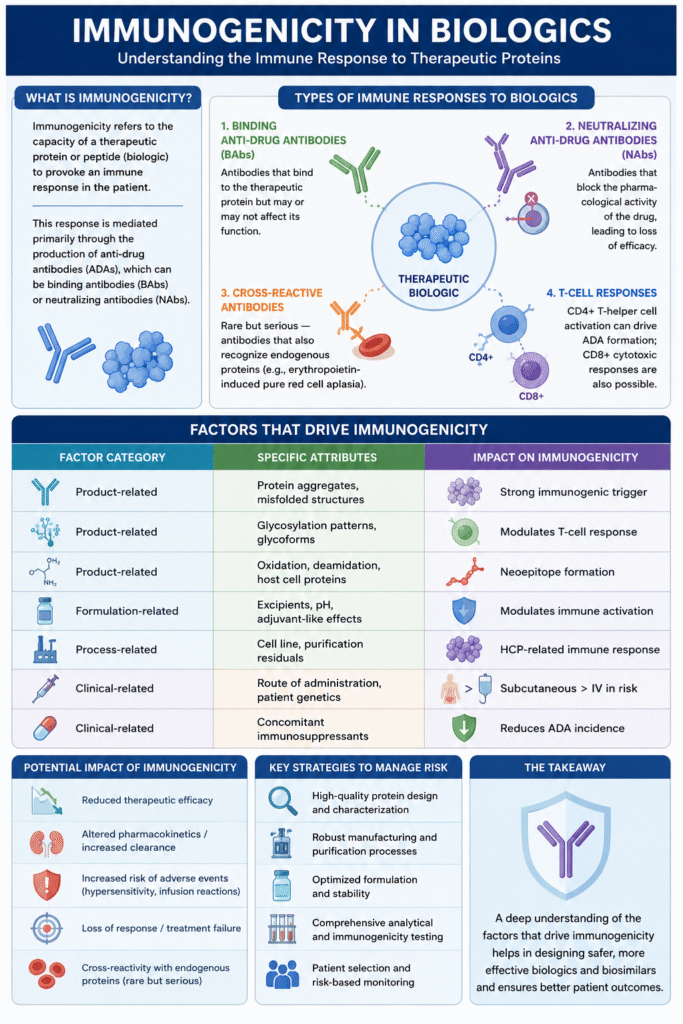
Immunogenicity in biologics refers to the capacity of a therapeutic protein or peptide to provoke an immune response in the patient. This response is mediated primarily through the production of anti-drug antibodies (ADAs), which can be binding antibodies (BAbs) or neutralizing antibodies (NAbs).
Types of Immune Responses to Biologics
The immune response to a biologic can take several forms:
- Binding Anti-Drug Antibodies (BAbs): Antibodies that bind to the therapeutic protein but may or may not affect its function.
- Neutralizing Anti-Drug Antibodies (NAbs): Antibodies that directly block the pharmacological activity of the drug, leading to loss of efficacy.
- Cross-Reactive Antibodies: Rare but serious — antibodies that also recognize endogenous proteins (e.g., erythropoietin-induced pure red cell aplasia).
- T-Cell Responses: CD4+ T-helper cell activation can drive ADA formation; CD8+ cytotoxic responses are also possible.
Factors That Drive Immunogenicity
The immunogenic potential of a biosimilar is shaped by multiple product- and patient-related factors:
| Factor Category | Specific Attributes | Impact on Immunogenicity |
|---|---|---|
| Product-related | Protein aggregates, misfolded structures | Strong immunogenic trigger |
| Product-related | Glycosylation patterns, glycoforms | Modulates T-cell response |
| Product-related | Oxidation, deamidation, host cell proteins | Neoepitope formation |
| Formulation-related | Excipients, pH, adjuvant-like effects | Modulates immune activation |
| Process-related | Cell line, purification residuals | HCP-related immune response |
| Clinical-related | Route of administration, patient genetics | Subcutaneous > IV in risk |
| Clinical-related | Concomitant immunosuppressants | Reduces ADA incidence |
2: Regulatory Framework for Immunogenicity Assessment in Biosimilar Development
Regulatory agencies require comparative immunogenicity data as a key component of the biosimilar approval pathway. Both FDA and EMA have published detailed guidance documents that define expectations for immunogenicity testing strategy, assay validation, and clinical data integration.
FDA Guidance on Immunogenicity Testing
The FDA’s guidance on immunogenicity testing for therapeutic proteins (2019) and its biosimilar development guidance outline a risk-based approach. Key requirements include:
- Comparative immunogenicity studies between the biosimilar and U.S.-licensed reference product.
- ADA assay development using validated, drug-tolerant methods capable of detecting low-titer antibodies.
- Characterization of ADA response (isotype, titer, neutralizing potential).
- Inclusion of immunogenicity data in clinical pharmacology and clinical safety sections of the BLA.
- Use of a tiered testing approach: screening → confirmatory → characterization.
EMA Guideline on Immunogenicity Assessment
The EMA’s guideline on immunogenicity assessment of biotechnology-derived therapeutic proteins (EMEA/CHMP/BMWP/14327/2006, revised) requires:
- Pre-clinical and clinical immunogenicity evaluation using validated assays.
- Head-to-head comparative clinical immunogenicity studies for most biosimilar categories.
- Risk-based categorization of products based on immunogenic potential (high/low risk).
- Post-marketing pharmacovigilance for ongoing immunogenicity monitoring.
ICH Guidelines Relevant to Immunogenicity
- ICH Q6B: Specifications for biotechnological products — defines relevant quality attributes.
- ICH S6(R1): Preclinical safety evaluation — addresses immunogenicity in animal studies.
- ICH E8(R1): General considerations for clinical trials — applicable to immunogenicity clinical design.
3: The Tiered Testing Strategy for Immunogenicity Assessment in Biosimilar Development
The globally accepted framework for immunogenicity testing is a tiered approach, designed to maximize sensitivity at the screening stage while minimizing false positives through confirmatory and characterization steps. This is the structure recommended by both FDA and EMA.
| Tier | Purpose | Key Assay | Decision Output |
|---|---|---|---|
| Tier 1 – Screening | Detect all potential ADA-positive samples | ELISA, MSD-ECL, Bridging assay | Positive / Negative |
| Tier 2 – Confirmation | Confirm specificity of ADA signal | Competitive inhibition assay | Confirmed Positive / Negative |
| Tier 3 – Titer | Quantify ADA level | Serial dilution of confirmed positives | ADA Titer |
| Tier 4 – Isotyping | Characterize antibody class | IgG, IgE, IgM-specific assays | Isotype profile |
| Tier 5 – Neutralization | Assess functional impact | Cell-based or competitive NAb assay | Neutralizing / Non-neutralizing |
Screening Assay Design Considerations
The screening assay must demonstrate the following validated performance characteristics:
- Sensitivity: Ability to detect a low positive control (typically 250–500 ng/mL equivalent ADA).
- Drug tolerance: Capacity to detect ADA in the presence of residual drug (critical for patients on therapy).
- Cut point: Statistically derived (typically 5th percentile for 1-sided, or 1% false positive rate) from drug-naive healthy donor matrices.
- Selectivity: Non-reactive against common interfering substances (lipemia, hemolysis, bilirubin).
- Precision: Intra- and inter-assay %CV within acceptance criteria.
Neutralizing Antibody (NAb) Assay Platforms
Neutralizing antibody assays are the most complex tier of immunogenicity testing and require specialized platforms:
- Cell-Based NAb Assays: Gold standard for cytokines and receptor agonists/antagonists; require biologically active cells expressing the drug target.
- Competitive Ligand-Binding NAb Assays: Used when cell-based formats are not feasible; competitive displacement of the drug’s binding to its target.
- Receptor-Binding Inhibition Assays: Applicable when the mechanism of action involves a well-defined receptor interaction.
4: Linking Critical Quality Attributes (CQAs) to Immunogenic Risk
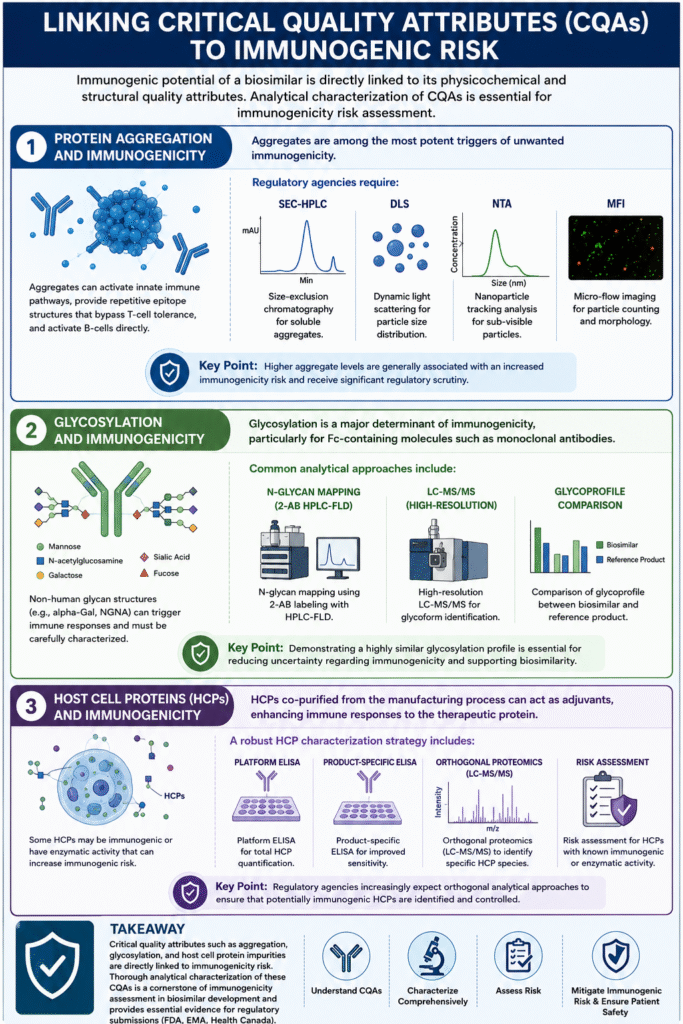
Immunogenic potential is not an isolated property — it is directly linked to the physicochemical and structural quality attributes of the biosimilar. Analytical characterization of CQAs is therefore integral to immunogenicity risk assessment.
Protein Aggregation and Immunogenicity
Aggregates are among the most potent triggers of unwanted immunogenicity. They can activate innate immune pathways, provide repetitive epitope structures that bypass T-cell tolerance, and activate B-cells directly. Regulatory agencies require:
- Size-exclusion chromatography (SEC-HPLC) for soluble aggregates.
- Dynamic light scattering (DLS) and nanoparticle tracking analysis (NTA) for sub-visible particles.
- Micro-flow imaging (MFI) for particle counting and morphology.
Glycosylation and Immunogenicity
Glycosylation is a major determinant of protein immunogenicity, particularly for Fc-containing molecules such as monoclonal antibodies. Non-human glycan structures (e.g., alpha-Gal, NGNA) can trigger immune responses and must be characterized by:
- N-glycan mapping by 2-AB labeling with HPLC-FLD.
- High-resolution mass spectrometry (LC-MS/MS) for glycoform identification.
- Comparison of glycoprofile between biosimilar and reference product.
Host Cell Proteins (HCPs) and Immunogenicity
HCPs co-purified from the manufacturing process can act as adjuvants, enhancing immune responses to the therapeutic protein. HCP characterization requires:
- Platform ELISA and product-specific ELISA for HCP quantification.
- Orthogonal proteomics (LC-MS/MS) to identify specific HCP species.
- Risk assessment for HCPs with known immunogenic or enzymatic activity.
5: Comparative Immunogenicity Studies: Biosimilar vs. Reference Product
Comparative immunogenicity is the cornerstone of biosimilar approval. The objective is to demonstrate that the immunogenic response profile of the biosimilar is not clinically meaningfully different from that of the reference product.
Study Design Considerations
- Population: Immunogenicity studies are typically conducted in the most sensitive patient population or in healthy volunteers (depending on guidance and risk level).
- Design: Randomized, double-blind, parallel-group or crossover designs.
- Sample timing: Pre-dose, and at defined intervals through treatment; immunogenicity sampling windows must capture peak ADA incidence.
- Equivalence margins: ADA incidence rates are compared using predefined equivalence or non-inferiority margins.
- Assay used: Identical validated ADA assay should be used for both biosimilar and reference product samples.
Pharmacokinetic/Pharmacodynamic (PK/PD) Integration
Immunogenicity data should be interpreted alongside PK and PD outcomes:
- ADA-positive patients should be evaluated for changes in drug clearance (PK impact).
- Neutralizing antibodies should be correlated with loss of pharmacodynamic response.
- Population PK modeling may be used to quantify the impact of ADA on drug exposure.
6: Assay Validation Requirements for Immunogenicity Testing
Robust assay validation is mandatory before clinical immunogenicity samples can be analyzed. The FDA’s 2019 immunogenicity guidance and the EMA CHMP guideline both require fit-for-purpose validation demonstrating the following parameters:
| Validation Parameter | Requirement | Regulatory Reference |
|---|---|---|
| Cut Point | Statistical (5th percentile, drug-naive donors) | FDA 2019, EMA CHMP |
| Sensitivity | ≤250–500 ng/mL positive control equivalent | FDA 2019 |
| Drug Tolerance | Minimum Required Dilution (MRD) and drug spike studies | FDA 2019, EMA |
| Selectivity | ≥80% of individual sera meet cut point criteria | FDA 2019 |
| Precision (Intra-assay) | ≤20% CV for QC samples | FDA 2019 |
| Precision (Inter-assay) | ≤25% CV across days/analysts/plates | FDA 2019 |
| Hook Effect | Verified absence at high ADA concentrations | EMA CHMP |
| Stability | Freeze-thaw, bench-top, long-term storage | FDA Bioanalytical Guidance |
Drug Tolerance and Its Criticality
Drug tolerance is one of the most technically challenging aspects of ADA assay development. In patients receiving biologic therapy, circulating drug can mask ADA detection by occupying the antibody’s binding sites. Solutions include:
- Acid dissociation pretreatment to separate drug-ADA complexes before assay.
- Use of high-affinity antibody capture reagents that outcompete free drug.
- Soluble target blocking techniques for receptor-binding assays.
- Electrochemiluminescence (ECL) platforms (e.g., Meso Scale Discovery) which offer superior sensitivity and drug tolerance vs. conventional ELISA.
7: ResolveMass Laboratories Inc.: Specialized Immunogenicity Testing for Biosimilar Programs
ResolveMass Laboratories Inc. is a USFDA-registered Canadian Contract Research and Development and Manufacturing Organization (CRO/CDMO) offering comprehensive analytical, bioanalytical, and regulatory services for biopharmaceutical developers. Our immunogenicity testing capabilities are purpose-built for the demands of biosimilar development programs seeking FDA and Health Canada approval.
Our Immunogenicity Testing Services Include
- ADA assay development and validation (ELISA, MSD-ECL, bridging formats)
- Neutralizing antibody (NAb) assay development — cell-based and ligand-binding platforms
- T-cell immunogenicity assays (ELISPOT, proliferation assays)
- Tiered immunogenicity testing: screening, confirmation, titer, isotyping, neutralization
- Aggregate characterization linked to immunogenic risk assessment (SEC, DLS, MFI, NTA)
- Host cell protein (HCP) analysis by ELISA and LC-MS/MS
- Glycan analysis and glycoform profiling by HPLC and high-resolution MS
- Regulatory strategy consulting for FDA BLA and Health Canada submissions
- Study report preparation aligned with FDA, EMA, and ICH guidelines
Why Biosimilar Developers Choose ResolveMass
- USFDA-registered facility with GLP-compliant analytical infrastructure
- Deep regulatory fluency in FDA 351(k) biosimilar pathway requirements
- Experience across monoclonal antibodies, Fc-fusion proteins, and peptide biologics
- Integrated analytical-regulatory team reduces timeline from assay development to submission-ready data package
- Rigorous quality systems ensuring data integrity for regulatory submissions
Conclusion:
Immunogenicity assessment in biosimilar development is a multidimensional scientific and regulatory challenge that requires deep analytical expertise, validated testing infrastructure, and a thorough understanding of global regulatory expectations. From the design of sensitive ADA screening assays to the integration of comparative immunogenicity data into a totality-of-evidence BLA package, every step demands technical rigor and regulatory precision.
The stakes are significant. An inadequately characterized immunogenicity profile can delay regulatory approval, require costly additional studies, or — in the worst case — result in post-market safety signals. Conversely, a well-executed immunogenicity strategy, grounded in fit-for-purpose assay validation, CQA linkage, and robust comparative clinical data, provides the evidentiary foundation that agencies need to grant biosimilar designation with confidence.
ResolveMass Laboratories Inc. brings the scientific depth, regulatory knowledge, and validated assay capabilities that biosimilar developers need to navigate immunogenicity assessment with confidence. Whether you are in early development, preparing for an IND, or assembling a BLA data package, our team is ready to support your program.
Frequently Asked Questions:
Immunogenicity testing is essential because unwanted immune responses can reduce the effectiveness of a biologic therapy or increase the risk of adverse events. Even minor manufacturing differences may influence immunogenicity. Regulatory authorities require comparative testing to ensure patient safety and product performance. The results support the demonstration of biosimilarity under the totality-of-evidence approach. Robust immunogenicity data also strengthen regulatory submissions.
Anti-drug antibodies (ADAs) are antibodies produced by the body’s immune system in response to a therapeutic biologic. Some ADAs simply bind to the drug, while others may affect its pharmacokinetics or therapeutic activity. Their presence can reduce drug efficacy or increase the likelihood of adverse reactions. ADA testing is therefore a fundamental component of immunogenicity assessment. Sensitive and validated assays are used to detect and characterize these antibodies.
Neutralizing antibodies (NAbs) are a subset of anti-drug antibodies that interfere with the biological function of a therapeutic protein. They can block the drug’s mechanism of action and reduce its clinical effectiveness. NAb testing is typically performed after a patient tests positive for ADAs. Cell-based functional assays are commonly used because they closely mimic biological activity. The results help determine the clinical significance of the immune response.
Major regulatory agencies include the U.S. Food and Drug Administration (FDA), the European Medicines Agency (EMA), and Health Canada. These organizations recommend a risk-based and comparative approach to immunogenicity evaluation. Their guidance emphasizes validated analytical methods, sensitive ADA assays, clinical immunogenicity studies, and post-marketing monitoring. Although the requirements may differ slightly, all agencies focus on demonstrating no clinically meaningful differences between the biosimilar and reference product.
Immunogenicity can be influenced by both product-related and patient-related factors. Product factors include protein aggregation, glycosylation changes, impurities, formulation, and manufacturing variations. Patient characteristics such as genetics, immune status, disease condition, and previous exposure to biologics also play important roles. Storage conditions and the route of administration may further affect immune responses. A thorough risk assessment helps identify and mitigate these factors.
Clinical immunogenicity studies compare the biosimilar and reference product by measuring the incidence and persistence of ADAs and NAbs. Researchers also evaluate the impact of immune responses on pharmacokinetics, pharmacodynamics, efficacy, and safety. Samples are collected at predefined intervals throughout the study. The data are analyzed to determine whether any observed immune response has clinical significance. These findings support the overall demonstration of biosimilarity.
Immunogenicity testing presents several technical challenges, including drug interference, matrix effects, assay sensitivity, and variability among patient samples. Establishing appropriate assay cut points and selecting reliable positive controls are also critical. These challenges can affect the accuracy of antibody detection if not properly managed. Careful assay validation and robust study design help ensure reliable and reproducible results. Regulatory agencies expect these challenges to be addressed during method development.
Reference
- Pineda C, Castañeda Hernández G, Jacobs IA, Alvarez DF, Carini C. Assessing the immunogenicity of biopharmaceuticals. BioDrugs. 2016 Jun;30(3):195-206.https://link.springer.com/article/10.1007/s40259-016-0174-5
- Jarab AS, Abu Heshmeh SR, Al Meslamani AZ. Biosimilars and immunogenicity: a matter of concern?. Expert Opinion on Drug Safety. 2025 May 4;24(5):519-27.https://www.tandfonline.com/doi/abs/10.1080/14740338.2025.2467817
- Kirchhoff CF, Wang XZ, Conlon HD, Anderson S, Ryan AM, Bose A. Biosimilars: key regulatory considerations and similarity assessment tools. Biotechnology and bioengineering. 2017 Dec;114(12):2696-705.https://analyticalsciencejournals.onlinelibrary.wiley.com/doi/abs/10.1002/bit.26438
- Schreitmüller T, Barton B, Zharkov A, Bakalos G. Comparative immunogenicity assessment of biosimilars. Future Oncology. 2018 Oct 3;15(3):319-29.https://www.tandfonline.com/doi/abs/10.2217/fon-2018-0553
- Civoli F, Kasinath A, Cai XY, Wadhwa M, Exley A, Oldfield P, Alvandkouhi S, Schaffar G, Chappell J, Bowsher R, Devanarayan V. Recommendations for the development and validation of immunogenicity assays in support of biosimilar programs. The AAPS Journal. 2019 Dec 2;22(1):7.https://link.springer.com/article/10.1208/s12248-019-0386-y
- Vandivort TC, Horton DB, Johnson SB. Regulatory and strategic considerations for addressing immunogenicity and related responses in biopharmaceutical development programs. Journal of Clinical and Translational Science. 2020 Dec;4(6):547-55.https://www.cambridge.org/core/journals/journal-of-clinical-and-translational-science/article/regulatory-and-strategic-considerations-for-addressing-immunogenicity-and-related-responses-in-biopharmaceutical-development-programs/29283919388249EDB3605E49A7121E35
- Cai XY, Thomas J, Cullen C, Gouty D. Challenges of developing and validating immunogenicity assays to support comparability studies for biosimilar drug development. Bioanalysis. 2012 Sep 1;4(17):2169-77.https://www.tandfonline.com/doi/abs/10.4155/bio.12.185
About the Author


