

Introduction
The Immunogenicity Risk Assessment of Peptide Impurities represents a critical regulatory evaluation framework established by the U.S. Food and Drug Administration (FDA) to demonstrate that generic synthetic peptides do not generate clinically significant adverse immune responses when compared with reference listed drugs (RLDs). This structured risk assessment is designed to determine whether minor chemical differences introduced during solid-phase or solution-phase peptide synthesis could affect patient safety or therapeutic performance in Abbreviated New Drug Application (ANDA) submissions.
Synthetic therapeutic peptides containing 40 or fewer amino acids—including glucagon, teriparatide, liraglutide, semaglutide, and tirzepatide—are regulated as synthetic drug substances through the generic drug pathway rather than under the regulatory framework applied to biological products. Nevertheless, when a proposed generic synthetic peptide is developed against an NDA drug product originating from recombinant DNA (rDNA) technology, the transition from biological cell expression to chemical synthesis can generate substantially different impurity profiles. Such profiles may contain truncated sequences, deletion variants, insertion analogs, regioisomers, aggregation species, and residual chemical reagents.
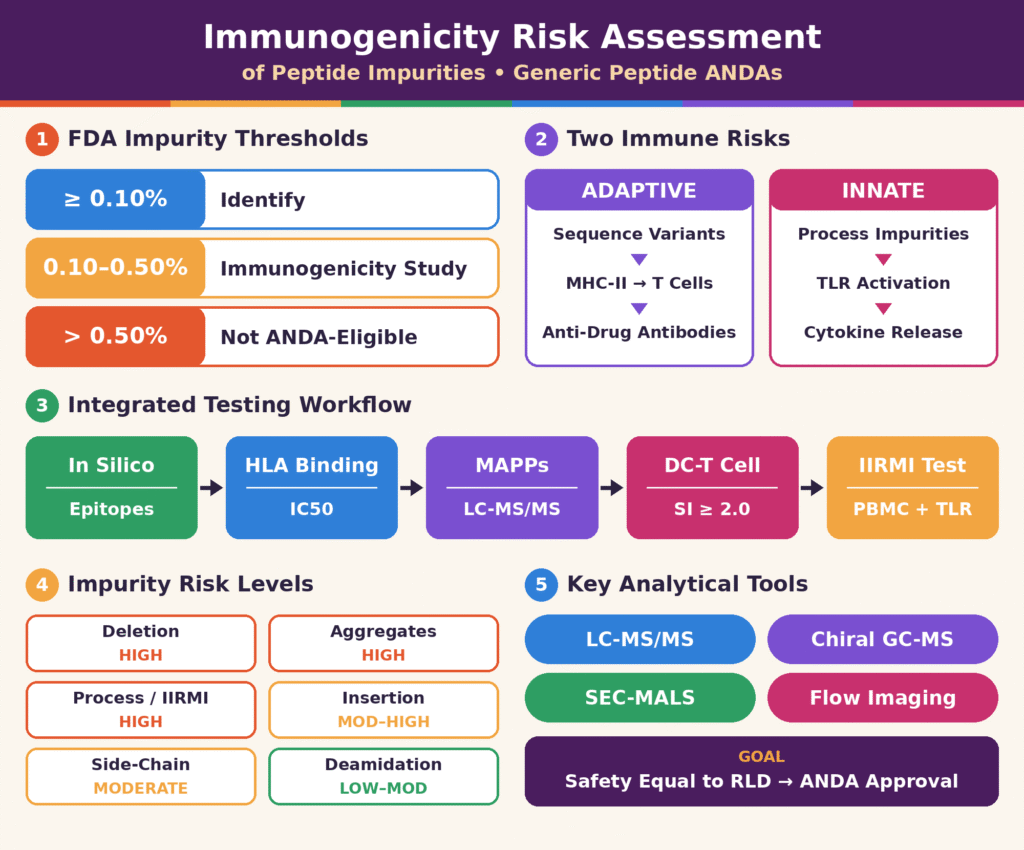
According to the current FDA framework, peptide-related impurities present at or above 0.10% require structural identification, whereas a new impurity within the 0.10% to 0.50% range requires a comprehensive Immunogenicity Risk Assessment of Peptide Impurities. Importantly, when an individual new peptide-related impurity exceeds 0.50%, the candidate drug will generally be unable to qualify for the abbreviated ANDA pathway. Therefore, generic developers need an integrated and highly validated testing strategy that incorporates orthogonal analytical characterization, computational in silico T-cell epitope mapping, cell-free Human Leukocyte Antigen (HLA) binding assays, and primary human cell-based functional models to support regulatory approval.
Explore our regulatory requirements for GLP-1 peptide characterization to strengthen your peptide characterization strategy for regulatory submissions.
Share via:
Quick Summary:
- Why it exists: FDA requires a structured immunogenicity risk assessment to show that a generic synthetic peptide (≤40 amino acids, e.g. glucagon, liraglutide, semaglutide) is as safe as its RLD, since switching from rDNA expression to chemical synthesis creates a different impurity profile.
- Threshold rules: Peptide-related impurities at ≥0.10% must be structurally identified; new impurities between 0.10% and 0.50% need a full comparative immunogenicity justification; anything above 0.50% generally disqualifies the product from the ANDA pathway. “Common” impurities are acceptable if present at or below RLD levels.
- Two risk pathways: Adaptive risk comes from sequence variants (deletions, insertions, side-chain changes) creating new MHC Class II epitopes that drive CD4+ T-cell activation and anti-drug antibodies. Innate risk comes from process residues and IIRMIs (solvents, scavengers, metals, endotoxin) triggering TLR signaling and pro-inflammatory cytokines that act as an adjuvant.
- Tiered testing strategy: In silico epitope mapping (EpiMatrix-type 9-mer scanning across global HLA alleles) screens all impurities first, then experimental confirmation follows for the flagged ones.
- In vitro adaptive assays: Competitive HLA Class II binding (IC50), MAPPs with LC-MS/MS to see which peptides are actually presented, and DC-T cell proliferation plus IL-2/IFN-γ ELISpot across ≥30 HLA-diverse donors, with a positive call at SI ≥2.0 and >50 spot-forming cells per million.
- Innate (IIRMI) testing: Drug product incubated with primary PBMCs or TLR2/4/7/8 reporter lines, measuring IL-6, TNF-α and IL-1β, with fit-for-purpose validation, LOD/LOQ, LPS spike controls, and testing across at least three commercial-scale batches at the highest non-toxic concentration.
- Analytical backbone and outcome: Orthogonal methods — multi-dimensional LC-MS/MS, chiral GC-MS for D-amino acids, SEC-MALS and micro-flow imaging for aggregates — resolve variants below 0.10%. Together these build the case for therapeutic equivalence, reducing ANDA risk and potentially avoiding clinical immunogenicity studies.
Regulatory Thresholds for the Immunogenicity Risk Assessment of Peptide Impurities
Regulatory requirements specify that new peptide-related impurities occurring between 0.10% and 0.50% in a generic synthetic peptide ANDA require detailed immunogenicity justification, whereas new impurities above 0.50% are not acceptable. These peptide-specific requirements supplement conventional ICH drug substance impurity controls by introducing additional safety considerations that influence the regulatory pathway for generic synthetic peptides.
The regulatory assessment of generic synthetic peptides combines conventional small-molecule impurity principles described under ICH Q3A(R2) and Q3B(R2) with advanced bio-characterization expectations commonly associated with biological therapeutics. International standards, including European Pharmacopoeia (Ph. Eur.) Monograph 2034, may permit default identification thresholds of 0.50% and unqualified known impurity levels of up to 1.0%; however, the FDA applies a considerably more stringent approach to synthetic peptide impurities. For “common” peptide impurities, meaning impurities detected in both the generic candidate and the RLD, the safety justification is supported when the impurity concentration in the proposed generic is less than or equal to the concentration measured in the RLD. In contrast, “new” peptide impurities, which are absent from the RLD or occur at higher concentrations in the generic product, require non-clinical comparative immunogenicity evaluation.
| Regulatory Guideline / Framework | Reporting Threshold | Identification Threshold | Qualification Threshold & New Impurity Ceiling |
|---|---|---|---|
| ICH Q3A(R2) / Q3B(R2) | Scaled to Maximum Daily Dose (MDD); typically 0.05% | 0.10% or 1.0 mg TDI, whichever is lower | 0.15% or 1.0 mg TDI (Explicitly excludes synthetic therapeutic peptides) |
| FDA Synthetic Peptide Guidance Overlay | Scaled directly against the RLD profile | ≥ 0.10%: Complete structural identification and characterization required | 0.10% – 0.50%: Comparative immunogenicity assessment required. > 0.50%: Strictly prohibited for ANDA submission. |
| European Pharmacopoeia (Ph. Eur. 2034) | > 0.10% | > 0.50% | > 1.0% for unqualified known impurities |
| ICH Q3C / Q3D / M7 Standards | Solvents, catalysts, and mutagenic inputs | Governed by Permitted Daily Exposure (PDE) | Class-specific toxicological threshold limits |
Immunogenicity Risk Assessment of Peptide Impurities: Adaptive vs. Innate Pathways
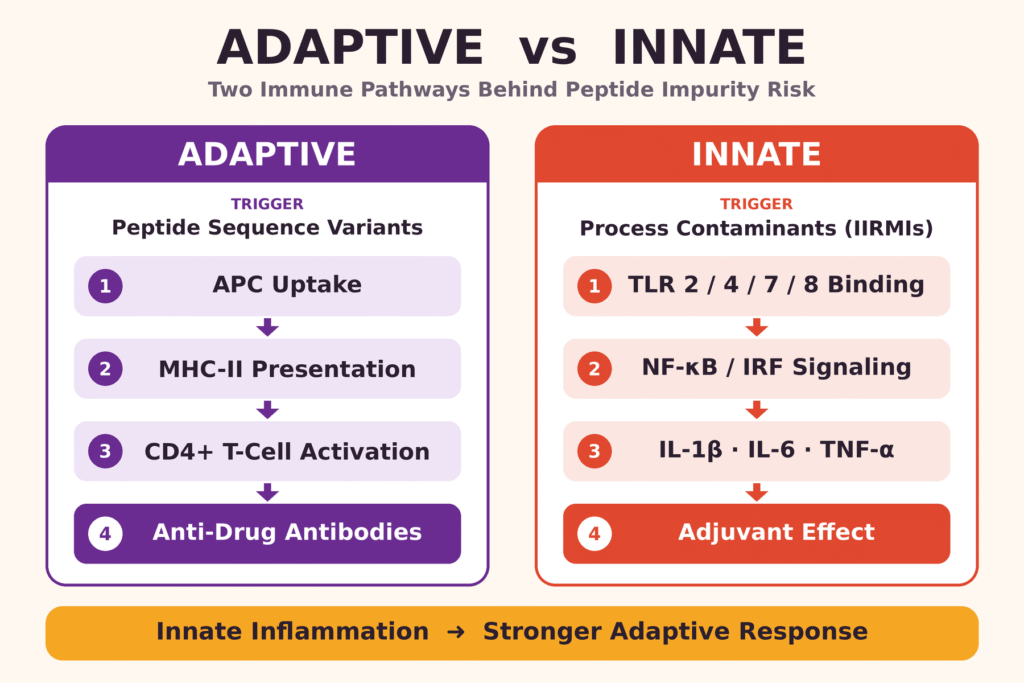
A robust Immunogenicity Risk Assessment of Peptide Impurities must address two separate immunological mechanisms: adaptive T-cell activation associated with peptide sequence variants and innate immune stimulation associated with process-related contaminants. Characterizing both pathways enables generic drug developers to evaluate potential cellular memory responses as well as acute inflammatory effects during generic product development.
Adaptive Immune Activation Driven by Peptide-Related Impurities
Adaptive immune responses can begin when peptide-related impurities are taken up by antigen-presenting cells, processed intracellularly, and presented through Major Histocompatibility Complex (MHC) Class II molecules to naive CD4+ T cells. Changes in peptide sequences, including individual amino acid deletions or side-chain modifications, may generate previously absent T-cell epitopes capable of initiating anti-drug antibody (ADA) production.
Peptide-related impurities can primarily originate from incomplete amino acid coupling, amino acid deletion, double insertion, racemization, or degradation mechanisms such as deamidation, oxidation, and aggregation. Deletion variants, including des-Leu or des-His sequences, and side-chain acetylations may modify the primary sequence or higher-order conformation and consequently alter the 9-mer core reading frame within the HLA binding groove. If a modified sequence demonstrates greater binding affinity toward human leukocyte antigen (HLA-DR, DP, DQ) alleles than the native active pharmaceutical ingredient (API), it may interact with naive CD4+ T-cell receptors (TCRs). Subsequent helper T-cell activation and clonal expansion can stimulate memory B cells to generate high-affinity ADAs. Neutralizing ADAs represent a significant clinical concern because they may cross-react with endogenous human hormones, potentially resulting in prolonged metabolic or physiological deficiencies.
Learn more about GLP-1 peptide impurity characterization for comprehensive identification and evaluation of peptide-related variants.
Innate Immune Activation via Process-Related Contaminants and IIRMIs
Innate immune responses may occur when process-related impurities and Innate Immune Response Modulating Impurities (IIRMIs) activate cell-surface and endosomal pattern recognition receptors. This stimulation establishes a pro-inflammatory cytokine environment that can function as an adjuvant and substantially increase the overall immunogenicity of the drug product.
Process-related contaminants may include residual organic solvents, solid-phase resin cleavage scavengers, heavy metal catalysts, host-cell proteins, and microbial endotoxins or beta-glucans. These substances can act as IIRMIs by interacting with cell-surface and endosomal Pattern Recognition Receptors (PRRs), particularly Toll-Like Receptors such as TLR2, TLR4, TLR7, and TLR8 on primary monocytes and dendritic cells. Receptor engagement activates intracellular NF-κB and Interferon Regulatory Factor (IRF) signaling pathways, resulting in the secretion of pro-inflammatory cytokines such as IL-1β, IL-6, and TNF-α while increasing CD80/CD86 co-stimulatory surface markers. This inflammatory microenvironment promotes maturation of local antigen-presenting cells and may allow even weak, sub-threshold peptide-related epitopes to produce strong T-cell activation and ADA responses.
Integrated Testing Workflows for the Immunogenicity Risk Assessment of Peptide Impurities
A complete Immunogenicity Risk Assessment of Peptide Impurities follows a multi-level evaluation strategy that integrates computational in silico epitope mapping, cell-free HLA binding assays, and functional primary human cell models. Combining these approaches provides broad coverage of both adaptive and innate immune risks before regulatory submission.
In Silico Epitope Prediction and Computational Hotspot Mapping
Computational in silico modeling platforms can rapidly screen peptide sequences to predict MHC Class II binding affinities and identify potential T-cell epitope hotspots across HLA allele panels representing diverse human populations. These computational approaches provide an efficient initial risk assessment for the complete set of identified peptide-related impurities.
Platforms such as EpiMatrix and WhIM analyze synthetic peptide sequences by dividing them into overlapping 9-mer amino acid frames. These sequences are evaluated against major HLA Class II alleles, including HLA-DRB1, DQB1, and DPB1, selected to represent global human population diversity. The algorithms generate normalized parameters, including the EpiMatrix Cluster Score (EMX) and Janatox Score (JMX), to estimate epitope density and sequence “humanness” in comparison with the active pharmaceutical ingredient. Impurities producing higher EMX scores or lower humanness values than the native API are considered computationally higher risk and are therefore prioritized for experimental confirmation. Conversely, impurities with calculated epitope densities that are equal to or below those of the native API indicate a lower baseline probability of adaptive immune activation.
In Vitro Adaptive Immunogenicity Assays: HLA Binding, MAPPs, and DC-T Cell Assays
Functional in vitro adaptive immunogenicity assays assess actual MHC Class II binding affinity, dendritic cell peptide processing through MAPPs, and CD4+ T-cell proliferation using primary human cells. These experimental approaches provide empirical confirmation of computational predictions and help determine the physiological potential of an impurity to stimulate T cells.
- Competitive HLA Class II Binding Assays: Purified synthetic peptide impurities are tested over a seven-point concentration gradient together with labeled biotinylated reference ligands and isolated human HLA Class II molecules. These cell-free competitive binding assays establish the concentration required to inhibit 50% of reference peptide binding (IC50), thereby providing a direct measurement of binding affinity:
IC50 = Concentration of impurity required to inhibit 50% binding of reference ligand
- MHC-Associated Peptide Proteomics (MAPPs): To characterize actual intracellular antigen processing and presentation, primary human monocyte-derived dendritic cells (moDCs) obtained from HLA-typed donor cohorts are exposed to the drug product or isolated impurity. HLA-DR complexes are subsequently immunoprecipitated, while naturally presented peptides are eluted and identified through high-resolution tandem mass spectrometry (LC-MS/MS). MAPPs therefore provides direct evidence regarding which 9-mer sequences are presented on the surfaces of antigen-presenting cells (APCs).
- DC-T Cell Proliferation and Cytokine ELISpot Assays: Pulsed primary dendritic cells are co-cultured with autologous primary CD4+ T cells isolated from healthy donors selected to represent global HLA diversity (n ≥ 30 donors). T-cell activation is assessed using proliferation assays, including 3H-thymidine incorporation or CFSE dye dilution, together with cytokine secretion measurements such as IL-2 and IFN-γ ELISpot. A response is classified as positive when the Stimulation Index (SI) is greater than or equal to 2.0 and the response exceeds 50 spot-forming cells per million cells:
Stimulation Index (SI) = Mean Response of Test Impurity / Mean Response of Culture Medium Control ≥ 2.0
Discover GLP-1 peptide sequencing CRO services for advanced analytical support in peptide sequence confirmation and characterization.
In Vitro Testing of Innate Immune Response Modulating Impurities
In vitro IIRMI testing uses primary human peripheral blood mononuclear cell cultures and reporter cell lines to determine whether the drug product contains innate immunostimulatory activity. These assays require appropriate sensitivity, validated performance characteristics, and robust suitability controls to meet FDA regulatory expectations.
Assessment of process-related innate immune risks involves incubating minimally manipulated drug product batches with fresh primary human peripheral blood mononuclear cells (PBMCs) or engineered cell lines expressing human TLR2, TLR4, TLR7, or TLR8 linked to NF-κB reporter genes. The resulting secretion of pro-inflammatory cytokines, including IL-6, TNF-α, and IL-1β, is measured using multiplex bead arrays or high-sensitivity ELISAs. Regulatory expectations require IIRMI assays to demonstrate fit-for-purpose validation, including established limits of detection (LOD) and quantification (LOQ), supported by standard suitability controls such as low-dose LPS spikes. To avoid false-negative outcomes resulting from cell toxicity, testing should be performed at the highest drug concentration that maintains acceptable cell viability across at least three distinct commercial-scale drug product release and stability batches.
Analytical Characterization and Impurity Control Strategies
Analytical characterization of generic synthetic peptides depends on high-resolution orthogonal analytical methods capable of resolving, identifying, and quantifying sequence variants, stereoisomers, and aggregates at levels below 0.10%. Establishing comprehensive impurity control strategies is essential for maintaining product quality, consistency, and safety throughout the complete product lifecycle.
Synthetic peptide manufacturers should use complementary chromatographic, electrophoretic, and spectroscopic methods to characterize active pharmaceutical ingredients and their degradation profiles. Multi-dimensional liquid chromatography coupled with high-resolution orbitrap mass spectrometry (LC-MS/MS) enables detailed sequence identification and can determine the precise locations of amino acid deletions, insertions, deamidation, and oxidation. Racemization assessment requires chiral acid hydrolysis followed by chiral gas chromatography-mass spectrometry (GC-MS) or reverse-phase liquid chromatography to identify D-amino acid enantiomers at sub-0.10% concentrations. Aggregate characterization can be conducted using size-exclusion chromatography with multi-angle light scattering (SEC-MALS) and micro-flow imaging (MFI) to establish that soluble oligomer concentrations in the generic candidate remain at or below the levels detected in the RLD.
Explore our GLP-1 peptide characterization CRO services for orthogonal analytical approaches supporting comprehensive peptide characterization.
| Impurity Structural Class | Mechanism of Formation | Primary Analytical Method | Secondary Orthogonal Technique | Immunogenicity Risk Level |
|---|---|---|---|---|
| Deletion Peptides (e.g., Des-Leu, Des-His) | Incomplete coupling during solid-phase synthesis cycles | High-Resolution RP-HPLC-MS | Ion-Exchange Chromatography (IEC) | High: Shifts frame alignments, exposing novel MHC-II epitopes. |
| Insertion Peptides (e.g., Endo-Leu) | Over-activation or incomplete washing of protected amino acids | LC-MS/MS Peptide Mapping | Hydrophobic Interaction Chromatography (HIC) | Moderate to High: Alters peptide conformation and receptor binding. |
| Side-Chain Modifications (e.g., Lys-Ac) | Reagent interactions or unintended capping reactions | High-Resolution Orbitrap LC-MS | Isoelectric Focusing (IEF) | Moderate: Modifies local charge and T-cell receptor contact points. |
| Deamidation Variants (Asp / Glu) | Hydrolysis of Asn / Gln residues via succinimide intermediates | Reverse-Phase HPLC, IEC | High-Resolution LC-MS/MS | Low to Moderate: Alters charge distribution; minor TCR impact. |
| Soluble Aggregates and Fibrils | Non-covalent hydrophobic association or disulfide crosslinking | SEC-MALS | Micro-Flow Imaging (MFI), Sedimentation Velocity AUC | High: Multivalent arrays cross-link B-cell receptors efficiently. |
| Process Solvents and IIRMIs | Resin cleavage cocktail residues, scavengers, microbial inputs | Headspace GC-MS | Primary PBMC Cytokine Release, TLR Reporter Lines | High (Innate): Induces cytokine release, functioning as a potent adjuvant. |
Conclusion
A comprehensive Immunogenicity Risk Assessment of Peptide Impurities provides the scientific and regulatory rationale necessary to demonstrate that generic synthetic peptides are therapeutically equivalent to, and comparably safe as, their reference listed drugs. Combining high-resolution analytical characterization, in silico epitope modeling, cell-free HLA binding assays, and primary human cellular platforms provides an integrated strategy that supports alignment with FDA synthetic peptide requirements. Applying advanced non-clinical testing frameworks enables generic developers to reduce the regulatory risks associated with ANDA submissions, potentially avoid unnecessary clinical studies, and preserve patient safety throughout the product lifecycle.
Strengthen your peptide analytical strategy with comprehensive peptide physicochemical characterization services designed to support structural, purity, and quality assessment.
For technical guidance and specialized testing support for synthetic peptide development programs, contact the team at ResolveMass Laboratories Inc.
Frequently Asked Questions
Peptide-related impurities present at or above 0.10% require structural identification and characterization under the FDA framework. Analytical techniques such as high-resolution LC-MS/MS can be used to establish the sequence, modification, or cleavage site. New impurities between 0.10% and 0.50% may additionally require non-clinical immunogenicity assessment when absent from the RLD.
Adaptive immunogenicity occurs when peptide sequence variants are processed and presented through MHC Class II molecules, potentially activating CD4+ T cells and promoting anti-drug antibody production. Innate immunogenicity is associated with process-related contaminants or IIRMIs that stimulate Pattern Recognition Receptors such as TLRs. The resulting inflammatory response can enhance subsequent adaptive immune activation.
Adaptive immunogenicity occurs when peptide sequence variants are processed and presented through MHC Class II molecules, potentially activating CD4+ T cells and promoting anti-drug antibody production. Innate immunogenicity is associated with process-related contaminants or IIRMIs that stimulate Pattern Recognition Receptors such as TLRs. The resulting inflammatory response can enhance subsequent adaptive immune activation.
In silico platforms divide peptide sequences into overlapping 9-mer frames and assess their predicted interactions with HLA Class II alleles. Tools such as EpiMatrix can estimate epitope density and sequence humanness relative to the reference API. These predictions help prioritize peptide impurities that require further experimental immunogenicity testing.
IIRMIs are process-related substances that can stimulate innate immune signaling, including residual scavengers, endotoxins, host-cell proteins, and resin cleavage-related contaminants. Their activity can be investigated using primary human PBMC cytokine release assays measuring IL-6, TNF-α, and IL-1β. TLR2, TLR4, TLR7, and TLR8 reporter systems can also be used to characterize receptor-mediated innate immune activation.
MHC-Associated Peptide Proteomics (MAPPs) identifies peptide fragments that are actually processed and presented by HLA Class II molecules on primary human dendritic cells. Following exposure to the test peptide, HLA complexes are isolated and naturally presented peptides are characterized using tandem LC-MS/MS. This provides experimental evidence of immune presentation rather than relying solely on computational predictions.
Generic synthetic peptides may reference certain rDNA-derived RLDs through the ANDA pathway when the required criteria for active ingredient sameness and comparative product characterization are satisfied. Chemical synthesis can generate impurity profiles that differ from those associated with recombinant production. Comparative non-clinical evaluations are therefore important for determining whether these differences introduce additional immunogenicity concerns.
Orthogonal LC-MS testing supports detailed identification and structural characterization of peptide impurities, including sequence variants and degradation products at low concentrations. Combining techniques such as RP-HPLC, IEC, and HIC with high-resolution tandem mass spectrometry improves separation and characterization capabilities. This approach helps distinguish closely related impurities and supports comprehensive impurity profiling.
Clinical immunogenicity trials are generally not required when the regulatory criteria for a generic synthetic peptide are satisfied and comparative non-clinical assessments do not indicate an increased immunogenicity risk. Sponsors can use complementary approaches such as in silico prediction, HLA binding, MAPPs, DC-T cell assays, and IIRMI testing. The appropriate evidence package depends on the specific product and regulatory requirements.
European Pharmacopoeia (Ph. Eur.) Monograph 2034 generally uses higher default impurity thresholds than the peptide-specific framework applied by the U.S. FDA. The FDA approach requires identification of peptide-related impurities at 0.10% and generally limits new impurities to 0.50% for the abbreviated pathway. Developers targeting multiple markets should therefore consider the more stringent requirements when establishing impurity control strategies.
Reference:
- Verthelyi, D. (2022, September 20). Assessing impurities to inform peptide immunogenicity risk: Developing informative studies [Presentation slides]. U.S. Food and Drug Administration. https://www.fda.gov/media/166573/download
- Pang, E. (2022, September 20). Assessing immunogenicity risk of peptides: The synthetic peptide guidance and PSGs [Presentation slides]. U.S. Food and Drug Administration. https://www.fda.gov/media/166571/download
- U.S. Food and Drug Administration. (2026, July 28). FDA publishes revised draft product-specific guidances for certain generic peptide products. https://www.fda.gov/drugs/drug-alerts-and-statements/fda-publishes-revised-draft-product-specific-guidances-certain-generic-peptide-products
- Pananchukunnath, M. K. (2025, June). Challenges in immunogenicity risk assessment for complex active ingredients (like peptide related drug products) [Presentation slides]. U.S. Food and Drug Administration. https://www.fda.gov/media/188010/download
- Mattei, A. E., Roberts, B. J., Lelias, S., Miah, S., Howard, K. E., Weaver, J. L., Verthelyi, D., Pang, E. S., Edwards, K., & De Groot, A. S. (2025). Immunogenicity risk assessment of peptide-related impurities identified in generic teriparatide products. Frontiers in Immunology, 16, 1730346. https://doi.org/10.3389/fimmu.2025.1730346
- Mattei, A. E., Roberts, B. J., Lelias, S., Miah, S., Howard, K. E., Weaver, J. L., Verthelyi, D., Pang, E. S., Edwards, K., & De Groot, A. S. (2025). Immunogenicity risk assessment of peptide-related impurities identified in generic teriparatide products. Frontiers in Immunology, 16, 1730346. https://doi.org/10.3389/fimmu.2025.1730346
Get In Touch With Us
About The Author


