


Introduction
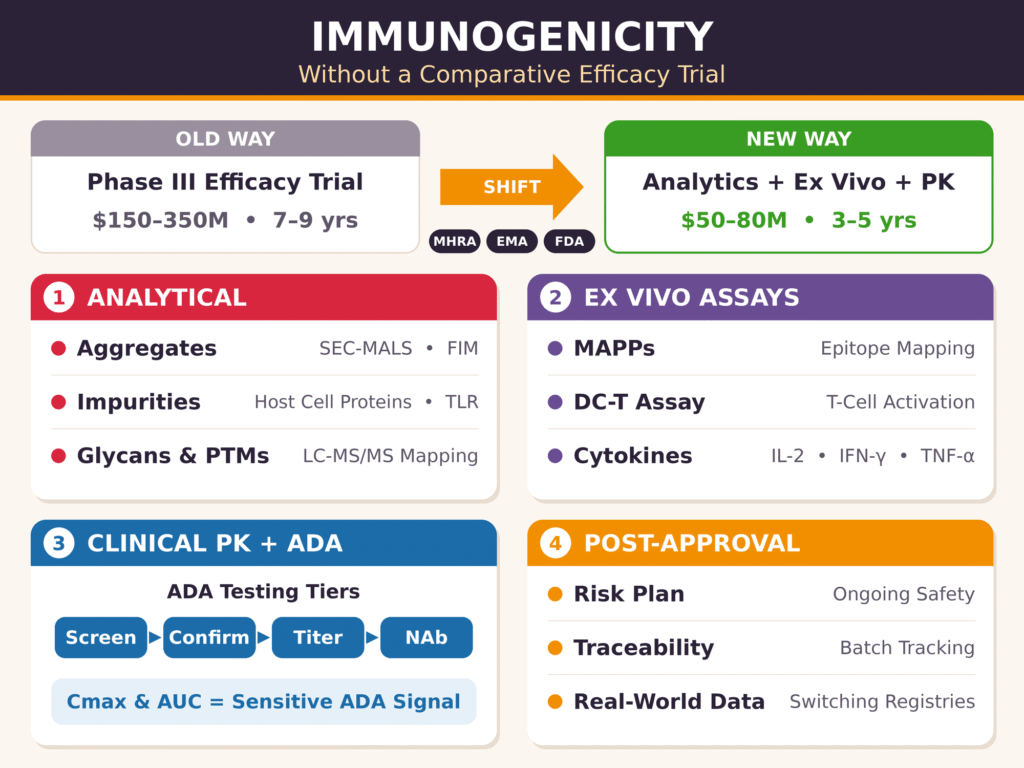
Evaluating immunogenicity without a comparative efficacy trial relies on replacing Phase III clinical efficacy studies with orthogonal bioanalytical characterization, ex vivo immunogenicity assays, and clinical pharmacokinetic/pharmacodynamic (PK/PD) studies integrated with anti-drug antibody (ADA) profiling. This modern regulatory approach shifts the primary source of safety evidence away from clinical endpoints with limited sensitivity toward high-resolution molecular and cell-based platforms that can identify immunogenic risks earlier and with greater precision.
Historically, regulatory agencies required comparative clinical efficacy trials (CETs) involving hundreds of patients to establish that a proposed biosimilar demonstrated equivalent efficacy and safety, including immunogenicity, to its Reference Medicinal Product (RMP). However, clinical efficacy endpoints, such as overall response rate and disease progression, are inherently insensitive to subtle immunological differences resulting from minor structural variations or trace impurities. Global regulatory authorities, including Great Britain’s Medicines and Healthcare products Regulatory Agency (MHRA), the European Medicines Agency (EMA), and the U.S. Food and Drug Administration (FDA), have established streamlined regulatory frameworks. Under these frameworks, comparative Phase III efficacy studies can be waived for well-characterized biologics when comparative physicochemical, functional, and pharmacokinetic similarity has been adequately demonstrated. This shift can substantially reduce development costs from 150–350 million to 50–80 million and shorten development timelines.
For a deeper understanding of the scientific evidence required to establish biosimilarity, review the key elements of biosimilar comparability studies.
Share via:
Quick Summary:
- Paradigm shift: Regulators (MHRA, EMA, FDA) now allow biosimilar developers to skip Phase III comparative efficacy trials when strong analytical, functional, and PK similarity is shown. Efficacy endpoints are too insensitive to detect subtle immunogenicity differences anyway.
- Major savings: The streamlined pathway can cut development costs from about $150–350M to $50–80M and shorten timelines from 7–9 years to 3–5 years.
- Analytical foundation: Orthogonal bioanalytical methods detect immunogenic risk factors before clinical exposure. These include aggregates and subvisible particles (SEC-MALS, AUC, FIM), host-cell and microbial impurities (TLR reporter assays), and PTM and glycosylation differences (LC-MS/MS, HILIC).
- Ex vivo epitope mapping: MAPPs identifies the actual peptides that human dendritic cells present on MHC-II. DC-T cell co-culture assays then measure whether those peptides trigger T-cell proliferation and cytokine release (IL-2, IFN-γ, TNF-α).
- Clinical PK/PD with ADA sampling: Comparative PK studies with dense, multi-timepoint ADA sampling replace large efficacy trials. A four-tier assay strategy (screen, confirm, titer, neutralizing) evaluates the antibodies, and changes in Cmax and AUC act as sensitive markers of clinically relevant immunogenicity.
- Post-approval surveillance: Risk Management Plans, batch traceability, and long-term real-world registries monitor rare adverse events and switching safety after launch. More than a decade of switching data supports this approach.
- Bottom line: Integrating analytical, ex vivo, and clinical PK evidence produces a more sensitive and cost-effective way to show biosimilarity and immunogenicity safety without relying on traditional Phase III trials.
Regulatory Framework Comparison
| Regulatory Parameter | Traditional Biosimilar Pathway | Tailored / Streamlined Pathway |
|---|---|---|
| Primary Immunogenicity Data Source | Phase III comparative clinical efficacy studies (CETs) with clinical cohort ADA monitoring. | Orthogonal bioanalytical profiling, MAPPs ex vivo assays, and comparative clinical PK/PD trials. |
| Phase III Efficacy Trial Requirement | Mandatory in almost all jurisdictions for complex biologics, such as mAbs. | Waived in most cases when supported by a sound scientific rationale and analytical similarity. |
| In Vitro & Ex Vivo Epitope Mapping | Optional or supplementary research-level characterization. | Essential regulatory component for early risk assessment and epitope presentation mapping. |
| Clinical ADA Assessment Domain | Extended clinical trials involving multiple patient indications. | Comparative single-dose or multi-dose clinical PK/PD studies with intensive ADA sampling. |
| Development Cost & Timeline | 150–350 million; 7–9 years. | 50–80 million; 3–5 years. |
The Regulatory Evolution of Immunogenicity Without a Comparative Efficacy Trial
The regulatory shift toward establishing immunogenicity without a comparative efficacy trial has been driven by global evidence showing that clinical efficacy trials are fundamentally insensitive to immunogenicity signals associated with trace impurities or subtle structural variations. More than a decade of clinical switching data, combined with advances in analytical mass spectrometry, has strengthened the position of regulatory agencies such as the MHRA, EMA, and FDA that analytical non-inferiority, supported by clinical PK equivalence, can provide more informative safety evidence than traditional Phase III efficacy trials in appropriately selected cases.
The MHRA helped advance this paradigm shift by issuing guidance indicating that comparative clinical efficacy trials are generally unnecessary for biosimilar licensing in most cases when a robust scientific justification demonstrates high analytical similarity, equivalent target binding, and comparable pharmacokinetic profiles. The EMA subsequently published its reflection paper on a tailored clinical approach, establishing a framework in which comparative efficacy studies may be waived systematically for well-characterized biotherapeutics when the totality of evidence supports this decision. Similarly, the U.S. FDA has issued updated guidance intended to streamline biosimilar development by reducing redundant clinical study requirements and emphasizing comparative analytical and pharmacokinetic evidence.
This global movement toward streamlined development is supported by the fact that biological reference products undergo manufacturing process changes throughout their lifecycles without requiring new Phase III clinical efficacy trials after every change. Instead, originator manufacturers establish comparability through comprehensive analytical characterization and batch-release testing. Applying the same scientific principles to biosimilar development enables regulatory authorities to evaluate immunogenicity potential using sensitive in vitro, ex vivo, and pharmacokinetic assessment methods.
Explore the scientific and regulatory principles behind a comprehensive comparability exercise in biosimilar development.
Bioanalytical Domain: Structural Attributes and Impurity Profiles Driving Immunological Risk
Physicochemical and structural characterization establishes the primary foundation for biosimilar immunogenicity risk assessment by identifying structural abnormalities, protein aggregates, and host cell impurities before clinical exposure. Because immune responses against biotherapeutics can be triggered by changes in higher-order structure or by impurities with adjuvant-like activity, orthogonal bioanalytical assays provide highly sensitive tools for detecting potential immunogenicity risks during early development.
For an overview of the quality attributes that support this assessment, read about critical quality attributes (CQAs) in biosimilars.
Protein Aggregation and Subvisible Particle Assessment
Protein aggregates, ranging from soluble dimers to subvisible particles measuring 1–100 µm, represent an important risk factor for disrupting immunological tolerance. Aggregates can present repetitive antigenic structures that efficiently cross-link B-cell receptors, potentially initiating classical T-cell-independent or T-cell-dependent immune activation. Under a streamlined regulatory approach, biosimilar candidates undergo detailed characterization using complementary biophysical techniques. Size-Exclusion Chromatography coupled with Multi-Angle Light Scattering (SEC-MALS) quantifies low-molecular-weight oligomers, while Analytical Ultracentrifugation (AUC-SV) provides a matrix-free reference method for characterizing aggregate species. Additionally, Resonant Mass Measurement (RMM) and Flow Imaging Microscopy (FIM) are used to characterize subvisible particles and distinguish proteinaceous aggregates from silicone oil droplets and container-closure contaminants.
Learn more about analytical approaches for identifying and characterizing aggregation in biosimilars.
Innate Immune Response Modulating Impurities (IIRMIs)
Trace impurities originating from host cell expression systems or manufacturing processes can act as potent danger signals that amplify drug immunogenicity. Host Cell Proteins (HCPs), host cell nucleic acids, and microbial components, including lipopolysaccharides and flagellin, can interact with Toll-like receptors (TLRs) and Pattern Recognition Receptors (PRRs) on antigen-presenting cells (APCs). These interactions stimulate dendritic cell maturation, increase the expression of co-stimulatory markers such as CD80 and CD86, and promote cytokine release. Consequently, they can drive immune responses even against fully humanized protein sequences.
Advanced liquid chromatography-tandem mass spectrometry (LC-MS/MS) immunopeptidomics and cell-based TLR activation assays help quantify IIRMIs and establish whether the impurity profile of a proposed biosimilar is comparable to that of the reference product.
Discover analytical strategies for impurity profiling of biosimilars and evaluating product-related and process-related impurities.
Post-Translational Modifications and Glycosylation Patterns
Variations in primary sequence, terminal truncation, deamidation, oxidation, and glycosylation can influence protein conformation or expose neo-epitopes. In glycosylated biologics, including monoclonal antibodies (mAbs) and fusion proteins, terminal sialylation, core fucosylation, and high-mannose structures can influence Fc-receptor binding, clearance rates, and receptor-mediated endocytosis by APCs. High-resolution Orbitrap mass spectrometry-based peptide mapping helps establish whether micro-heterogeneity between a biosimilar and its reference product remains within clinically qualified boundaries.
Read more about how post-translational modifications (PTMs) influence biosimilar characterization.
| Analytical Method | Quality Attribute Evaluated | Immunological Significance |
|---|---|---|
| LC-MS/MS Peptide Mapping | Primary sequence identity, deamidation, and oxidation. | Helps prevent neo-epitope formation that could trigger T-cell recognition. |
| SEC-MALS / AUC-SV | Soluble aggregates and oligomeric species. | Reduces the potential for B-cell receptor cross-linking and disruption of immune tolerance. |
| Flow Imaging Microscopy (FIM) | Subvisible particles (1–100 µm). | Helps mitigate macrophage uptake and localized adjuvant effects. |
| HILIC-FLD / Mass Spectrometry | N-glycan profiling, including fucose, sialic acid, and mannose. | Helps ensure consistent Fc-gamma receptor interactions and clearance kinetics. |
| Cell-Based TLR Reporter Assays | Innate Immune Response Modulating Impurities (IIRMIs). | Helps prevent excessive APC activation and co-stimulatory marker expression. |
For additional insight into glycan-related structural differences, explore glycosylation analysis of biosimilars.
Next-Generation In Vitro and Ex Vivo Platforms: MAPPs and Cell-Based Assays
Next-generation ex vivo assays, particularly Major Histocompatibility Complex-Associated Peptide Proteomics (MAPPs) and primary human dendritic cell-T cell (DC-T) co-cultures, provide direct mechanistic assessments of human antigen processing, presentation, and T-cell activation. These human-relevant platforms complement or, in appropriate development programs, replace reliance on clinical trial observations alone by mapping the actual T-cell epitopes presented by primary immune cells.
Major Histocompatibility Complex-Associated Peptide Proteomics (MAPPs)
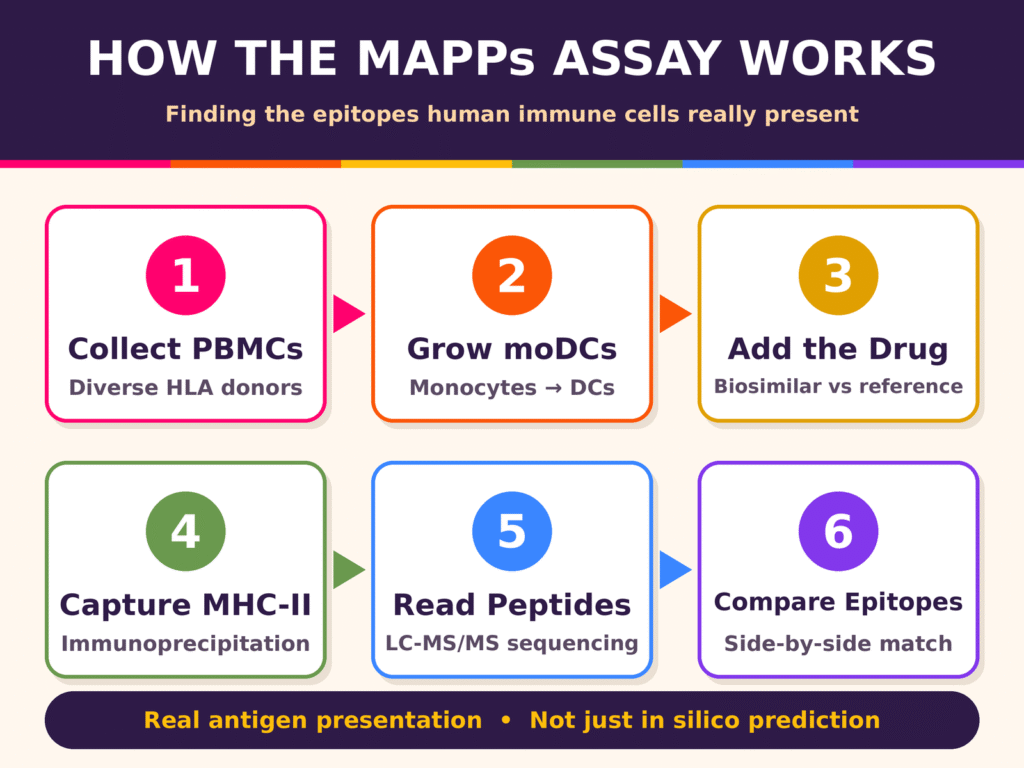
The MAPPs assay examines key steps in human immune processing to identify specific peptide sequences displayed on cell surfaces for recognition by CD4+ T-helper cells. Unlike predictive in silico algorithms, which rely on binding-motif calculations and can produce high false-positive rates, MAPPs evaluates actual antigen processing and presentation by primary human cells.
The assay follows a structured biological workflow:
- Peripheral Blood Mononuclear Cell (PBMC) isolation and donor selection: PBMCs are collected from healthy human donors representing diverse Human Leukocyte Antigen (HLA-DR, DP, DQ) alleles. This approach helps account for genetic variation across the human population and supports broader assessment of potential immunogenicity.
- Monocyte isolation and dendritic cell differentiation: Monocytes are separated through immunomagnetic selection and differentiated into monocyte-derived dendritic cells (moDCs) under controlled culture conditions.
- Therapeutic protein exposure: Semi-mature moDCs are exposed side by side to either the proposed biosimilar or the reference product. The dendritic cells internalize the therapeutic proteins, process them through endolysosomal pathways, and load the resulting peptide fragments onto MHC Class II molecules.
- MHC-II complex isolation: Mature moDCs are harvested and lysed. MHC-II complexes are then selectively isolated through immunoprecipitation using specific monoclonal antibodies.
- Peptide elution and mass spectrometry analysis: The bound peptides are eluted under acidic conditions and analyzed using ultra-high-resolution LC-MS/MS peptidomics to identify the peptide sequences presented by the cells.
- Bioinformatics and comparative epitope analysis: Bioinformatics platforms map the identified peptide sequences to the primary sequence of the biotherapeutic. Comparative sequence-alignment profiles are then used to determine whether the biosimilar and reference product present comparable epitopes or whether unexpected peptide clusters are detected.
Learn how complementary proteomics approaches for biosimilars can support detailed molecular characterization.
Dendritic Cell-T Cell (DC-T) Proliferation and Cytokine Release Assays
Although MAPPs identifies the peptides presented by immune cells, DC-T cell functional assays determine whether those peptides stimulate functional T-cell expansion and downstream immune responses. Naïve CD4+ T-cells isolated from HLA-typed donors are co-cultured with autologous moDCs previously exposed to the biosimilar or reference drug.
T-cell proliferation is quantified through flow cytometry by tracking cell division dyes. Meanwhile, multiplexed immunoassays measure the release of cytokines, including Interleukin-2 (IL-2), Interferon-gamma (IFN-γ), and Tumor Necrosis Factor-alpha (TNF-α). A biosimilar that demonstrates equivalent or lower T-cell stimulation indices than the reference product provides important functional evidence supporting immunological comparability.
Comparative Clinical PK/PD Studies: Dense ADA Sampling and Exposure-Response Correlation
Comparative clinical PK/PD studies conducted in healthy volunteers or appropriately selected, sensitive patient populations represent a key source of clinical immunogenicity evidence when Phase III efficacy trials are not conducted. Systemic drug exposure parameters, including maximum concentration (Cmax) and area under the concentration-time curve (AUC), can be highly sensitive to anti-drug antibody (ADA) formation. Consequently, exposure-response analysis can provide a more sensitive assessment of clinical immunogenicity than disease response scales in suitable study settings.
Integrated ADA Sampling Design
To obtain comprehensive immunogenicity data, multi-timepoint ADA sampling is incorporated directly into the comparative PK trial design. Blood samples are collected before dosing, at intermediate washout intervals, and during extended post-dosing follow-up periods. This sampling strategy helps detect early IgM-mediated immune responses as well as affinity-matured IgG responses that may develop later.
Bioanalytical assessment relies on a validated, multi-tiered assay strategy:
- Tier 1 Screening Immunoassay: Highly sensitive bridging electrochemiluminescence (ECL) or ELISA assays are used to screen patient serum samples for low-affinity and high-affinity ADAs.
- Tier 2 Confirmatory Assay: Samples that test positive during Tier 1 are incubated with an excess of unlabeled drug to confirm target specificity through signal inhibition.
- Tier 3 Characterization and Titration: Confirmed positive samples undergo quasi-quantitative titration to estimate antibody magnitude. Isotype profiling is also performed to characterize antibody subclasses and classes, including IgG1–4, IgE, and IgM.
- Tier 4 Neutralizing Antibody (NAb) Assays: ADA-positive samples are evaluated using competitive ligand-binding assays (CLBAs) or cell-based bioassays to determine whether the detected antibodies interfere with the therapeutic mechanism of action.
Exposure-Response and Clearance Impact Analysis
The clinical significance of immunogenicity is evaluated by examining the relationship between ADA status and clinical PK parameters. Neutralizing antibodies or antibodies that promote immune-complex formation can accelerate drug clearance, resulting in a lower maximum concentration (Cmax) and a reduced area under the concentration-time curve (AUC0–∞).
Comparative analyses of ADA-positive and ADA-negative subjects across both biosimilar and reference treatment arms allow bioanalysts to assess whether ADA incidence, titer patterns, and effects on drug exposure are comparable between the two products. These findings contribute to the overall assessment of clinical immunogenicity and help establish whether observed differences have potential clinical implications.
Explore the broader requirements for biosimilar characterization services to support a comprehensive analytical and comparative development strategy.
Post-Authorization Surveillance and Real-World Evidence
Post-authorization pharmacovigilance and real-world evidence (RWE) are essential for monitoring long-term immunogenicity, the safety of clinical switching, and rare adverse events after a biosimilar enters routine clinical practice. Comprehensive Risk Management Plans (RMPs), robust batch traceability, and long-term registry data support continuous safety monitoring across diverse patient populations.
Regulatory frameworks establish post-marketing obligations and safety-monitoring expectations for biosimilars through several mechanisms:
- Risk Management Plans: Biosimilar manufacturers maintain dedicated RMPs that describe ongoing safety activities, specific immunogenicity-monitoring protocols, and routine pharmacovigilance measures.
- Product identification and batch traceability: Biosimilars are subject to product identification and traceability requirements designed to support accurate adverse-event attribution. In the UK and EU, the inverted black triangle symbol may also be used where applicable under the relevant additional-monitoring requirements.
- Long-term observational monitoring: Longitudinal observational cohorts and nationwide prescribing registries track patients who switch between reference biologics and biosimilars. More than a decade of real-world switching experience across multiple regions has contributed evidence supporting the use of analytical similarity and comparable PK profiles as important predictors of clinical performance and immunogenicity.
These post-authorization activities complement pre-approval analytical and clinical evidence by helping identify uncommon safety signals and evaluate immunogenicity under routine conditions of use.
Conclusion: The Future of Immunogenicity Without a Comparative Efficacy Trial
Establishing immunogenicity without a comparative efficacy trial represents a significant shift toward more sensitive, scientifically rigorous, and cost-effective biosimilar development. By integrating orthogonal physicochemical characterization, ex vivo MAPPs epitope sequencing, functional T-cell assays, and clinical PK/PD immunogenicity profiling, drug developers can build a comprehensive evidence package to demonstrate biosimilarity and support safety assessments without relying exclusively on traditional Phase III clinical efficacy studies.
This scientific framework supports compliance with rigorous safety and regulatory expectations while potentially shortening approval timelines and improving patient access to high-quality biological therapies. Partnering with specialized bioanalytical organizations such as ResolveMass Laboratories Inc. can help developers navigate streamlined regulatory pathways through advanced LC-MS/MS immunopeptidomics, state-of-the-art biophysical characterization, and validated ADA bioanalytical assays. These capabilities support a comprehensive evaluation of structural similarity, immunogenicity risk, and clinical comparability.
For support with regulatory-ready analytical documentation, explore the end-to-end biosimilar analytical package for a regulatory submission.
To learn how advanced bioanalytical testing platforms can help reduce risk throughout your biosimilar development program, contact the regulatory bioanalysis experts through the ResolveMass Contact Page.
Frequently Asked Questions
Immunogenicity is assessed through complementary bioanalytical and clinical approaches, including protein aggregation analysis, impurity profiling, and ex vivo antigen presentation assays such as MAPPs. Functional DC-T cell assays evaluate immune activation, while comparative clinical PK/PD studies incorporate anti-drug antibody (ADA) testing to determine whether immune responses affect drug exposure or clearance.
Major Histocompatibility Complex-Associated Peptide Proteomics (MAPPs) is an ex vivo technique that examines how human dendritic cells process therapeutic proteins and present peptide fragments through MHC Class II molecules. Mass spectrometry identifies these presented peptides, helping researchers characterize potential T-cell epitopes. Comparing biosimilar and reference product profiles provides evidence of their immunological similarity.
Comparative pharmacokinetic/pharmacodynamic (PK/PD) studies provide important clinical evidence for assessing biosimilar immunogenicity when Phase III efficacy trials are waived. Repeated blood sampling enables the detection and characterization of ADAs and neutralizing antibodies. Researchers evaluate whether these immune responses influence maximum drug concentration (Cmax), overall drug exposure (AUC), or clearance compared with the reference product.
Innate Immune Response Modulating Impurities (IIRMIs), including host cell proteins, host cell nucleic acids, and microbial contaminants such as endotoxins, can stimulate innate immune pathways. By activating pattern recognition receptors on antigen-presenting cells, these impurities may promote dendritic cell maturation and inflammatory cytokine release. Sensitive bioanalytical testing helps characterize these impurities and assess their potential contribution to immunogenicity.
In vitro and ex vivo assays, including MAPPs and dendritic cell-T cell proliferation assays, help identify potential immunogenicity risks by examining antigen presentation and functional T-cell responses. However, these methods do not independently establish clinical immunogenicity or fully reproduce immune responses in patients. Clinical ADA data obtained through appropriate comparative PK/PD studies may therefore remain an important component of the overall evidence package.
ADA testing generally follows a validated, multi-tiered approach designed to identify and characterize treatment-related immune responses. The process includes screening immunoassays, confirmatory testing, antibody titer determination and characterization, and neutralizing antibody (NAb) assays. Together, these methods help establish the incidence, magnitude, specificity, and potential functional consequences of ADAs in biosimilar and reference product recipients.
For complex biologics such as monoclonal antibodies, regulatory authorities assess a broad range of analytical attributes, including primary structure, higher-order structure, glycosylation, Fc-receptor binding, and biological activity. MAPPs epitope mapping, functional assays, and comparative PK/PD studies can provide additional evidence regarding immunological similarity. The overall assessment considers the totality of evidence to determine whether remaining uncertainties require further investigation.
Minor analytical differences, such as variations in glycosylation or post-translational modifications, require a scientifically justified assessment of their potential clinical significance. Developers may use functional bioassays, MAPPs data, and targeted analytical studies to determine whether these differences influence biological activity, safety, or immunogenicity. The acceptability of the findings depends on the nature of the differences and the strength of the supporting evidence.
Long-term immunogenicity is evaluated through post-authorization pharmacovigilance, Risk Management Plans (RMPs), product traceability systems, and real-world evidence (RWE) registries. These approaches help identify uncommon adverse events, monitor patients switching between reference biologics and biosimilars, and evaluate potential immune responses during routine clinical use. Continued safety monitoring complements pre-approval analytical and clinical evidence throughout the product lifecycle.
Reference:
- Medicines and Healthcare products Regulatory Agency. (2021, May 6). Guidance on the licensing of biosimilar products (last updated February 27, 2025). GOV.UK. https://www.gov.uk/government/publications/guidance-on-the-licensing-of-biosimilar-products/guidance-on-the-licensing-of-biosimilar-products
- Grabowski, T. (2021, June 15). Phase III not necessary in biosimilars development? New MHRA guidance, will there be a “snowball effect”? ResearchGate. https://www.researchgate.net/post/Phase_III_not_necessary_in_biosimilars_development_New_MHRA_guidance_will_there_be_a_snowball_effect
- European Medicines Agency. (2026, March 16). Reflection paper on a tailored clinical approach in biosimilar development (EMA/CHMP/BMWP/60916/2025). https://www.ema.europa.eu/en/documents/other/reflection-paper-tailored-clinical-approach-biosimilar-development_en.pdf-0
- Di Ianni, A., Fraone, T., Balestra, P., Cowan, K., Riccardi Sirtori, F., & Barbero, L. (2024). Assessing MAPPs assay as a tool to predict the immunogenicity potential of protein therapeutics. Life Science Alliance, 7(1), Article e202302095. https://doi.org/10.26508/lsa.202302095
- Van Doninck, T., Thijs, L., Ackaert, C., Boonen, K., Mazy, A., Pattyn, S., & Pepermans, E. (2025). MHC-associated peptide proteomics (MAPPs) as a tool for assessment of immunogenicity risk potential of therapeutic monoclonal antibodies. LCGC International, 2(6), 22–29. https://doi.org/10.56530/lcgc.int.fe7068r4
- Civoli, F., Kasinath, A., Cai, X.-Y., Wadhwa, M., Exley, A., Oldfield, P., Alvandkouhi, S., Schaffar, G., Chappell, J., Bowsher, R., Devanarayan, V., Marini, J., Rebarchak, S., Anderson, M., Koppenburg, V., & Lester, T. (2020). Recommendations for the development and validation of immunogenicity assays in support of biosimilar programs. The AAPS Journal, 22(1), Article 7. https://doi.org/10.1208/s12248-019-0386-y
Get In Touch With Us
About The Author