


Introduction
Impurity Control Strategies Under ICH Q3A and Q3B establish a risk-based regulatory framework used by global health authorities to identify, quantify, assess, and qualify impurities associated with Abbreviated New Drug Applications (ANDAs). By defining quantitative thresholds according to the maximum daily exposure of a drug substance or drug product, these guidelines help ensure that generic medicines maintain appropriate safety, quality, and efficacy characteristics comparable to their reference listed drugs.
Within generic pharmaceutical development governed by the Hatch-Waxman regulatory framework, the development and implementation of an effective impurity control strategy is essential for demonstrating therapeutic equivalence. Chemistry, Manufacturing, and Controls (CMC) information presented in Module 3 of the Common Technical Document (eCTD) must provide adequate characterization of process-related contaminants, degradation pathways, and relevant impurity profiles. Coordinating analytical testing capabilities with dose-based International Council for Harmonisation (ICH) thresholds helps reduce the likelihood of regulatory deficiencies, lowers the potential for Complete Response Letters (CRLs) from the U.S. Food and Drug Administration (FDA), and supports consistent quality across commercial manufacturing batches.
Streamline your ANDA dossier submission with our expert CMC Documentation at a CDMO for ANDA services to ensure full eCTD Module 3 compliance.
Share via:
Quick Summary:
- ICH Q3A(R2) controls impurities in the drug substance/API, while ICH Q3B(R2) focuses on degradation products in finished drug products.
- Impurity limits are dose-dependent, based on the Maximum Daily Dose (MDD) to keep patient exposure within acceptable safety limits.
- Thresholds classify impurities into reporting, identification, and qualification categories, with the lower of the percentage or absolute TDI limit applied.
- Advanced qualification strategies include Reference Listed Drug (RLD) profiling, human metabolite data, USP monograph alignment, and ICH M7 assessment of mutagenic/genotoxic impurities.
- Robust analytical methods such as RP-HPLC, LC-MS/MS, GC-MS, ICP-MS, and NMR are essential for sensitive impurity detection, identification, and characterization.
- Common ANDA deficiencies include unqualified degradation products, inadequate method sensitivity, missing unspecified impurity limits, mass-balance gaps, and incomplete extractables/leachables assessments.
- A science-based impurity control strategy strengthens the CMC package, reduces regulatory deficiencies and CRL risk, supports consistent quality and patient safety, and enables a smoother path to generic market approval.
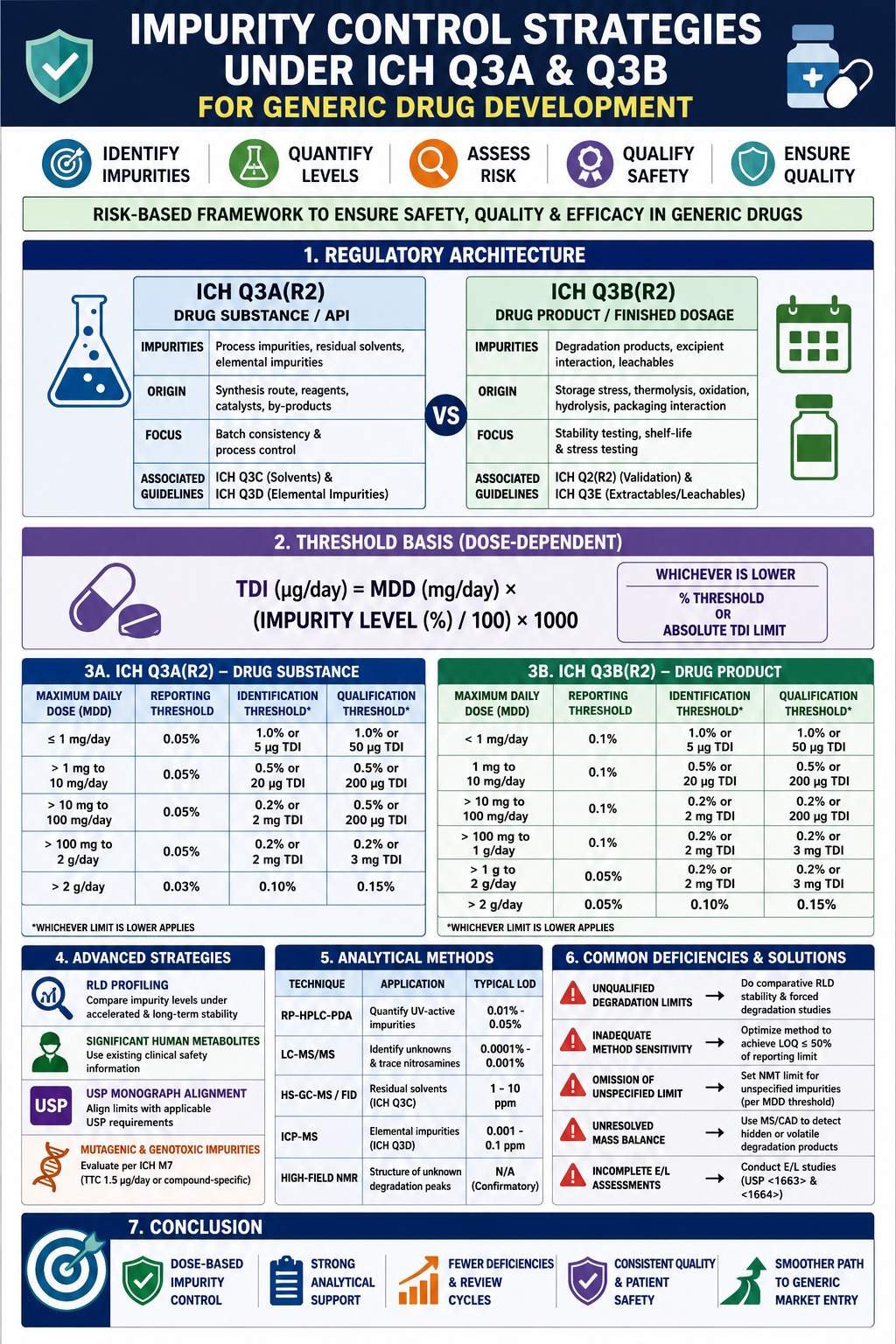
Regulatory Architecture of Impurity Control Strategies Under ICH Q3A and Q3B
The regulatory architecture of Impurity Control Strategies Under ICH Q3A and Q3B establishes separate control considerations for impurities generated during active pharmaceutical ingredient (API) synthesis and degradation products formed within finished drug products. ICH Q3A(R2) addresses organic process-related impurities, inorganic contaminants, and residual solvents associated with drug substances, while ICH Q3B(R2) addresses degradation products that may develop in drug products because of storage conditions, formulation components, or interactions with excipients.
The chemical origin and classification of an impurity determine the appropriate risk assessment, analytical strategy, control measures, and validation activities required to support ANDA approval. Organic impurities associated with drug substances may arise from starting materials, synthetic intermediates, reagents, catalysts, reaction by-products, or side reactions. Inorganic impurities, such as elemental catalysts and inorganic salts, are assessed through the elemental impurity framework described in ICH Q3D. Residual solvents introduced during manufacturing are evaluated according to the applicable requirements and limits established under ICH Q3C. By comparison, ICH Q3B(R2) primarily addresses degradation products generated through thermolysis, oxidation, hydrolysis, photolysis, packaging interactions, or chemical interactions between active moieties and inactive excipients.
Understanding molecular complexity is vital for risk profiling. Explore our technical comparison on the Difference Between a Peptide and a Small Molecule Drug to refine your analytical strategy.
| Regulatory Parameter | ICH Q3A(R2) Guideline | ICH Q3B(R2) Guideline |
|---|---|---|
| Primary Scope | New Drug Substances / APIs | Finished Drug Products / Finished Dosage Forms |
| Target Impurities | Synthetic process impurities, starting materials, intermediates, by-products | Degradation products, excipient interaction products, leachables |
| Origin of Contaminants | Chemical synthesis route, reagents, catalysts, and side reactions | Storage stress, thermolysis, oxidation, hydrolysis, and packaging interaction |
| Analytical Focus | Batch-to-batch consistency and process control capability | Stability testing, shelf-life specification setting, and stress testing |
| Associated ICH Guidelines | ICH Q3C (Solvents) and ICH Q3D (Elemental Impurities) | ICH Q2(R2) (Validation) and ICH Q3E (Extractables/Leachables) |
Establishing Impurity Control Strategies Under ICH Q3A and Q3B Thresholds
Establishing Impurity Control Strategies Under ICH Q3A and Q3B thresholds requires the determination of appropriate toxicological safety boundaries according to the Maximum Daily Dose (MDD) administered to the patient. These dose-dependent thresholds classify impurities according to reporting, identification, and qualification requirements. As the maximum daily dose increases, the applicable percentage thresholds generally become more restrictive so that the patient’s overall exposure to an impurity remains within an acceptable range.
The total daily intake (TDI) of an impurity can be determined using the following mathematical relationship:
TDI (µg/day) = MDD (mg/day) × (Impurity Level (%) / 100) × 1000
When interpreting ICH threshold tables, the applicable regulatory limit is determined using the “whichever is lower” principle when a percentage-based threshold and an absolute TDI limit are both provided. This approach ensures that the impurity exposure remains within the more protective of the two applicable limits.
High-yield, high-purity production demands robust process engineering. Discover our specialized solutions for Peptide API Scale-Up.
Impurity Control Strategies Under ICH Q3A: Drug Substance Thresholds
Impurity Control Strategies Under ICH Q3A define the thresholds applicable to organic impurities in APIs and establish when process-related contaminants must be reported, identified, or qualified from a toxicological perspective. Depending on the daily intake of the API, reporting thresholds generally range from 0.03% to 0.05%, while identification and qualification thresholds vary according to the applicable dose category and may extend from 0.10% to 1.0%.
| Maximum Daily Dose (MDD) | Reporting Threshold | Identification Threshold | Qualification Threshold |
|---|---|---|---|
| ≤ 1 mg/day | 0.05% | 1.0% or 5 µg TDI* | 1.0% or 50 µg TDI* |
| > 1 mg to 10 mg/day | 0.05% | 0.5% or 20 µg TDI* | 0.5% or 200 µg TDI* |
| > 10 mg to 100 mg/day | 0.05% | 0.2% or 2 mg TDI* | 0.5% or 200 µg TDI* |
| > 100 mg to 2 g/day | 0.05% | 0.2% or 2 mg TDI* | 0.2% or 3 mg TDI* |
| > 2 g/day | 0.03% | 0.10% | 0.15% |
*Note: Whichever limit is lower applies.
Impurity Control Strategies Under ICH Q3B: Drug Product Degradation Thresholds
Impurity Control Strategies Under ICH Q3B establish thresholds for degradation products in finished dosage forms according to patient daily exposure and stability behavior over the proposed shelf life. Reporting thresholds for degradation products generally range from 0.05% to 0.1%, with the applicable threshold depending on the maximum daily dose of the drug product. These requirements help account for degradation behavior associated with different drug product formulations while maintaining appropriate control over patient exposure.
| Maximum Daily Dose (MDD) | Reporting Threshold | Identification Threshold | Qualification Threshold |
|---|---|---|---|
| < 1 mg/day | 0.1% | 1.0% or 5 µg TDI* | 1.0% or 50 µg TDI* |
| 1 mg to 10 mg/day | 0.1% | 0.5% or 20 µg TDI* | 0.5% or 200 µg TDI* |
| > 10 mg to 100 mg/day | 0.1% | 0.2% or 2 mg TDI* | 0.2% or 200 µg TDI* |
| > 100 mg to 1 g/day | 0.1% | 0.2% or 2 mg TDI* | 0.2% or 3 mg TDI* |
| > 1 g to 2 g/day | 0.05% | 0.2% or 2 mg TDI* | 0.2% or 3 mg TDI* |
| > 2 g/day | 0.05% | 0.10% | 0.15% |
*Note: Whichever limit is lower applies.
Minimizing degradation in moisture-sensitive dosage forms requires tailored freeze-drying protocols. Learn about Formulating a Lyophilized Peptide Injectable.
Advanced Impurity Control Strategies Under ICH Q3A and Q3B for Generic Drug Qualification
Advanced Impurity Control Strategies Under ICH Q3A and Q3B provide generic ANDA applicants with several risk-based approaches for qualifying impurities that exceed conventional thresholds. Comparative Reference Listed Drug (RLD) profiling, evaluation of significant human metabolites, alignment with applicable compendial requirements, and specific assessment of mutagenic or genotoxic impurities can provide scientific and regulatory justification for impurity controls. These approaches can establish biological safety and regulatory acceptability without automatically requiring repetitive nonclinical toxicological investigations when adequate supporting evidence is available.
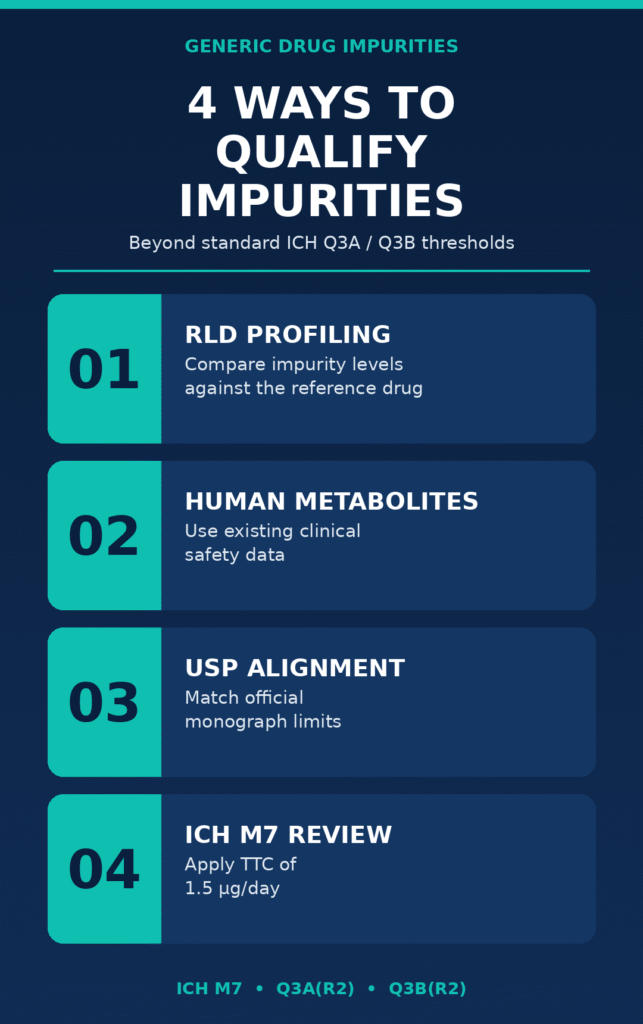
Generic drug sponsors may rely on four primary regulatory mechanisms when qualifying impurities during dossier development and regulatory assessment:
- Comparative Reference Listed Drug (RLD) Profiling: Comparative analytical characterization of multiple commercial lots of the RLD under accelerated (40°C / 75% RH) and long-term (25°C / 60% RH) stability conditions can establish the impurity profile naturally observed in the innovator product. Such studies allow the generic applicant to compare impurity and degradation-product levels between the proposed generic drug product and the RLD and can support justification that the proposed impurity specification is appropriate and does not exceed levels demonstrated in the reference product.
- Significant Human Metabolites: Impurities that have been established as major circulating human metabolites of the active drug substance may receive qualification based on existing clinical safety information. Because these metabolites have been present and evaluated in humans during the development of the active drug, available clinical and pharmacological evidence can provide an important basis for assessing their safety without automatically requiring an entirely new toxicological program.
- United States Pharmacopeia (USP) Monograph Alignment: Establishing specified impurity limits that are consistent with applicable official USP monograph requirements can provide a recognized compendial basis for impurity control. When the relevant impurity and acceptance criteria are adequately covered by the applicable monograph, alignment with the compendial specification can strengthen the regulatory justification for the proposed control strategy and may reduce the need for additional safety justification where otherwise appropriate.
- Assessment of Mutagenic and Genotoxic Impurities (ICH M7): Impurities with structural alerts indicating potential DNA reactivity require evaluation under the principles of ICH M7 rather than being managed solely through conventional Q3A/Q3B thresholds. Such impurities may be controlled according to the Threshold of Toxicological Concern (TTC) of 1.5 µg/day, where applicable, or according to compound-specific acceptable daily intakes supported by appropriate scientific assessment, including Quantitative Structure-Activity Relationship ((Q)SAR) computational modeling.
Benchmark your generic candidate effectively by utilizing our expertise in Reference Listed Drug (RLD) Sourcing and Reverse Engineering.
Analytical Method Validation Requirements under ICH Guidelines
Analytical method validation for generic drug impurity control requires confirmation that chromatographic and other analytical procedures possess adequate specificity, precision, accuracy, and a Limit of Quantitation (LOQ) appropriate for the applicable regulatory threshold. Stability-indicating analytical methods should be capable of distinguishing the active pharmaceutical ingredient from degradation products and synthetic process impurities and should demonstrate suitable performance during forced degradation and stability studies.
Standard analytical methodologies used for generic impurity characterization must satisfy appropriate analytical performance and regulatory expectations:
| Analytical Technique | Primary CMC Application | Typical Limit of Detection (LOD) | Performance Criteria |
|---|---|---|---|
| RP-HPLC-PDA | Quantification of UV-active impurities and degradants | 0.01% – 0.05% | Specificity, baseline resolution (Rs > 1.5), system suitability |
| LC-MS/MS | Structural identification of unknowns and trace nitrosamines | 0.0001% – 0.001% | High mass accuracy and structural fragmentation data |
| HS-GC-MS / FID | Volatile residual solvents analysis (ICH Q3C) | 1 – 10 ppm | Temperature programming precision and head-space recovery |
| ICP-MS | Heavy metals and elemental impurities (ICH Q3D) | 0.001 – 0.1 ppm | Plasma stability and matrix effect suppression |
| High-Field NMR | Structural elucidation of isolated unknown degradation peaks | N/A (Confirmatory) | Signal-to-noise ratio and 1D/2D spectrum resolution |
Access complete analytical validation and testing protocols through our dedicated One-Stop CDMO Analytical Services for ANDA.
Resolving Common ANDA Deficiencies and Complete Response Letters
Resolving common ANDA deficiencies requires systematic evaluation of regulatory concerns that may arise from unqualified degradation products, inadequate analytical sensitivity, insufficient impurity characterization, or unassessed container-closure leachables. Generic drug sponsors can reduce the potential for Complete Response Letters (CRLs) by establishing scientifically justified impurity specifications and completing comparative RLD stability and degradation assessments before submitting the ANDA dossier.
Key regulatory deficiencies that may be identified during FDA assessment and their corresponding technical solutions include:
- Unqualified Degradation Limits: Submitting an ANDA with degradation-product specifications above the applicable ICH Q3B qualification thresholds without sufficient supporting RLD or toxicological data can create a significant regulatory deficiency. Generic applicants should perform comparative forced degradation and real-time stability studies using multiple commercial RLD lots to characterize the observed degradation profile and provide scientific justification for any elevated acceptance criteria.
- Inadequate Method Sensitivity: Employing analytical procedures in which the Limit of Quantitation (LOQ) is above the applicable ICH reporting threshold may prevent reliable detection and quantification of impurities at the required level. Analytical methods should therefore be optimized through appropriate detector selection, chromatographic improvements, or sample pre-concentration approaches to achieve an LOQ at or below 50% of the reporting threshold when such performance is required by the analytical strategy.
- Omission of Unspecified Impurity Controls: Failure to include a general acceptance criterion of “not more than” (NMT) the applicable identification threshold for unspecified impurities can leave an important gap in the drug product specification. The drug product specifications should clearly define an unspecified impurity limit based on the applicable MDD-calculated identification threshold and the relevant regulatory requirements.
- Unresolved Mass Balance Discrepancies: A loss of mass balance during forced degradation studies may indicate the presence of degradation products that are not detected by conventional UV-based analytical methods or may result from volatile degradation products and other analytical losses. Investigating these discrepancies with complementary analytical technologies, such as mass spectrometry (MS) or charged aerosol detection (CAD), can provide additional detection capability and improve overall mass balance accountability.
- Incomplete Extractables and Leachables (E/L) Assessments: Failure to evaluate container-closure interaction products can be particularly important for liquid, ophthalmic, and injectable formulations. Formal extractable and leachable studies conducted according to applicable USP requirements, including USP <1663> and USP <1664> where relevant, can provide systematic characterization of potential chemical species originating from packaging components and help demonstrate appropriate control of these substances.
Complex sterile suspensions carry unique particulate and impurity challenges. Read more about Generic Ophthalmic Suspension ANDA Development.
Conclusion
Implementing effective Impurity Control Strategies Under ICH Q3A and Q3B is essential for demonstrating that generic drug products satisfy applicable international quality expectations while supporting FDA requirements associated with therapeutic equivalence and patient safety. Establishing impurity controls according to dose-based regulatory thresholds provides a structured approach to identifying, characterizing, qualifying, and controlling process-related impurities and drug product degradation products.
Integrating appropriate analytical capabilities with ICH-based thresholds can strengthen the CMC package, reduce the likelihood of avoidable regulatory deficiencies, minimize additional review cycles, and reduce the risk of costly Complete Response Letters. A scientifically justified impurity control strategy also supports consistent manufacturing performance, reliable product quality, and a more efficient pathway toward generic market entry.
For specialized analytical support in forced degradation studies, unknown impurity identification, and regulatory CMC compliance, visit the ResolveMass Contact Page to consult directly with senior analytical experts.
Frequently Asked Questions (FAQs)
The reporting threshold under ICH Q3A is determined according to the Maximum Daily Dose (MDD) of the drug substance. For APIs with an MDD ≤ 2 g/day, the applicable reporting threshold is generally 0.05%, while APIs administered at more than 2 g/day are subject to a lower reporting threshold of 0.03%.
A degradation product above the applicable ICH Q3B qualification threshold requires an appropriate safety assessment and supporting scientific justification. The applicant may use comparative RLD data, evidence demonstrating that the impurity is a significant human metabolite, or suitable toxicological studies to establish that the proposed impurity level is safe.
An ANDA applicant can compare impurity profiles from the proposed generic product with those obtained from multiple commercial RLD lots. Testing should use suitable stability-indicating analytical procedures under comparable storage conditions, allowing the applicant to determine whether the impurity occurs in the RLD at a similar or higher concentration.
ICH Q3A and Q3B primarily establish controls for general organic impurities and degradation products according to dose-based thresholds. ICH M7 specifically addresses DNA-reactive or mutagenic impurities and applies a more stringent risk-based approach, including a Threshold of Toxicological Concern of 1.5 µg/day where applicable.
The LOQ should be sufficiently low to reliably quantify impurities at concentrations relevant to the applicable regulatory reporting limit. Maintaining the LOQ at or below the reporting threshold enables accurate monitoring of impurities during release testing and stability studies and supports compliance with established specifications.
Impurities identified as significant circulating human metabolites may have an established safety basis because patients were exposed to these metabolites during clinical development of the reference product. However, qualification should still be supported by appropriate scientific and regulatory evidence demonstrating that the impurity is adequately characterized and relevant to the proposed product.
For a finished drug product administered at a Maximum Daily Dose of 500 mg, which falls within the ≤ 1 g/day dose category, the ICH Q3B(R2) reporting threshold is 0.1%. This threshold is used to determine when a degradation product must be reported in the drug product impurity profile.
Unknown impurities requiring structural characterization may be investigated using complementary analytical technologies selected according to their chemical properties and concentration. Common approaches include LC-MS/MS, GC-MS, nuclear magnetic resonance (NMR) spectroscopy, and preparative HPLC, with multiple techniques often combined to establish a confident structural assignment.
Frequently encountered impurity-related deficiencies include insufficient justification for degradation limits that exceed the RLD profile, missing controls for unspecified impurities, inadequate analytical sensitivity, and insufficient method validation. Deficiencies may also involve incomplete impurity characterization or inadequate assessment of extractables and leachables associated with the container-closure system.
Reference:
- U.S. Food and Drug Administration. (2010, November). ANDAs: Impurities in drug products: Guidance for industry. Center for Drug Evaluation and Research. FDA guidance document
- U.S. Food and Drug Administration. (2009, June). ANDAs: Impurities in drug substances: Guidance for industry. Center for Drug Evaluation and Research. FDA guidance document
- U.S. Food and Drug Administration. (2025, April 10). Common quality major deficiencies in ANDAs. Center for Drug Evaluation and Research. FDA document
- European Medicines Agency. (2006, October 25). ICH Q3A (R2) impurities in new drug substances: Scientific guideline. EMA guideline
- International Council for Harmonisation of Technical Requirements for Pharmaceuticals for Human Use. (2022, March 8). ICH Q3D(R2) guideline: Guideline for elemental impurities. ICH Q3D(R2) guideline
- U.S. Food and Drug Administration. (2020, May 1). Establishing impurity acceptance criteria as part of specifications for NDAs, ANDAs, and BLAs based on clinical relevance (MAPP 5017.2 Rev. 1). Center for Drug Evaluation and Research. FDA document
Get In Touch With Us
About The Author


