Introduction:
Impurity profiles in active ingredient sameness determinations are not a regulatory formality — they are a scientific proof of equivalence. When a generic drug manufacturer seeks approval, demonstrating that their active pharmaceutical ingredient (API) is the “same” as the innovator’s requires far more than matching a molecular formula or CAS number. Regulators expect a thorough, quantified, and qualified account of every chemical entity present in the drug substance beyond the principal molecule itself.
At ResolveMass Laboratories Inc., our analytical scientists have supported over a decade of regulatory submissions, helping pharmaceutical companies across Canada, the United States, and internationally navigate the complexities of impurity profiling as it relates to active ingredient sameness. This blog draws on that accumulated expertise to give pharmaceutical scientists, regulatory affairs professionals, and quality teams a clear, actionable understanding of what impurity profiles are, why they matter, and how to build a defensible profile for regulatory review.
Summary:
- Impurity profiles are the complete catalogue of chemical contaminants — organic, inorganic, and residual solvents — present in a drug substance, and they are a primary criterion regulators use to determine whether a generic drug’s active ingredient is truly the “same” as the reference listed drug (RLD).
- Regulatory agencies such as Health Canada, the US FDA, and the EMA require that impurity profiles of generic active ingredients be comparable to — and ideally no worse than — those of the innovator product.
- Impurity profiling encompasses identification, quantification, and qualification of all impurities above specified thresholds.
- Sameness of an active ingredient is not determined solely by molecular structure; the source, synthesis route, and resulting impurity signature all factor into regulatory acceptability.
- Advanced analytical techniques — including HPLC, LC-MS/MS, GC-MS, ICP-MS, and NMR — are essential for generating defensible impurity data.
- ResolveMass Laboratories Inc. provides full-scope impurity profiling, method development, and regulatory submission support for pharmaceutical manufacturers navigating active ingredient sameness requirements.
1: What Is an Impurity Profile?
An impurity profile is the complete, documented characterization of all extraneous chemical species present in a drug substance or drug product. Every impurity present above a specified reporting threshold must be identified, quantified, and — where necessary — toxicologically qualified.
Impurities are classified into three broad categories under ICH Q3A(R2) and ICH Q3B(R2):
| Impurity Type | Definition | Common Examples |
|---|---|---|
| Organic Impurities | Process- or degradation-related chemical entities | Starting materials, by-products, intermediates, degradation products |
| Inorganic Impurities | Reagents, ligands, catalysts, heavy metals | Residual palladium, iron, lead, arsenic, sulfate, chloride |
| Residual Solvents | Volatile chemicals used in synthesis or purification | Methanol, acetonitrile, ethyl acetate, dichloromethane |
A complete impurity profile documents each of these categories with the following information for every detected species:
- Identification (structural elucidation or cross-reference to known standards)
- Quantification (expressed as a percentage of the API or in ppm)
- Classification (specified vs. unspecified; known vs. unknown)
- Qualification (toxicological risk assessment, particularly for genotoxic impurities)
2: How Impurity Profiles Define “Sameness” of an Active Ingredient
Active ingredient sameness means the generic product’s API is pharmaceutically equivalent to the reference listed drug’s API — same molecular entity, same salt form (where applicable), and the same impurity signature. Regulators evaluate sameness using multiple lenses, and impurity profiling is one of the most scrutinized.
Regulatory Definitions Across Key Jurisdictions
Health Canada (Guidance for Industry: Submission of Comparative Bioavailability Information) Health Canada requires that the drug substance in a generic submission be the same as in the Canadian Reference Product. This includes a comparison of impurity profiles. Where the generic manufacturer sources their API from a different supplier or uses a different synthetic route, a detailed impurity comparison is mandatory.
US FDA (21 CFR Part 314; Orange Book) The FDA’s ANDA pathway requires that the active ingredient in a generic drug be the same as in the reference listed drug. FDA guidance documents, including those under the pharmaceutical development framework and the ICH Q series, require impurity profiling as part of the chemistry, manufacturing, and controls (CMC) section.
European Medicines Agency (EMA) The EMA applies ICH Q3A(R2) directly to new drug substances and expects generic applicants to demonstrate that their impurity profiles are no worse than the reference product’s, with toxicological justification for any unique impurities.
The Concept of “Comparable” vs. “Identical” Impurity Profiles
A common misconception is that sameness requires identical impurity profiles. In practice, regulators accept comparable profiles — meaning:
- All impurities present in the generic API are also present in the reference product at similar or lower levels, or
- Any new or elevated impurities in the generic are toxicologically qualified and shown to be safe at the proposed levels.
This is a nuanced but critical distinction. A generic manufacturer whose synthesis route introduces a novel process-related impurity not seen in the innovator product must either:
- Reduce that impurity below the reporting threshold through process optimization, or
- Conduct formal qualification studies (including ICH Q3A-guided safety assessment) to justify its acceptance.
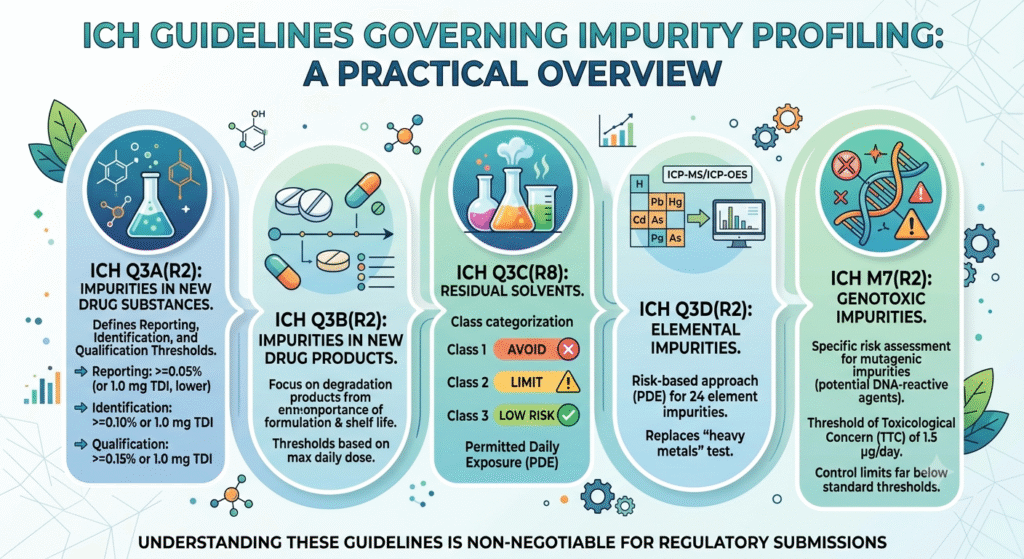
3: ICH Guidelines Governing Impurity Profiling: A Practical Overview
The ICH Q3 series forms the backbone of impurity profiling requirements globally. Understanding these guidelines is non-negotiable for regulatory submissions.
ICH Q3A(R2) — Impurities in New Drug Substances
- Establishes reporting, identification, and qualification thresholds for organic impurities in drug substances.
- Reporting threshold: ≥0.05% (or 1.0 mg TDI, whichever is lower)
- Identification threshold: ≥0.10% or 1.0 mg TDI (whichever is lower)
- Qualification threshold: ≥0.15% or 1.0 mg TDI (whichever is lower)
ICH Q3B(R2) — Impurities in New Drug Products
- Addresses degradation products formed during formulation and shelf life.
- Thresholds differ from Q3A based on maximum daily dose.
ICH Q3C(R8) — Residual Solvents
- Classifies solvents into Class 1 (avoid), Class 2 (limit), and Class 3 (low risk).
- Provides permitted daily exposure (PDE) limits for each classified solvent.
ICH Q3D(R2) — Elemental Impurities
- Introduces a risk-based approach (Permitted Daily Exposure, PDE) for 24 elemental impurities.
- Replaces the historical “heavy metals” limit test with targeted ICP-MS/ICP-OES analysis.
ICH M7(R2) — Genotoxic Impurities
- Requires a specific risk assessment for mutagenic impurities (potential DNA-reactive agents).
- Sets a threshold of toxicological concern (TTC) of 1.5 µg/day for mutagenic impurities in most drug products.
- DNA-reactive (mutagenic) impurities require control limits far below standard impurity thresholds.
4: Analytical Techniques Used in Impurity Profiling
Accurate impurity profiling demands selecting the right analytical tools for each impurity class. At ResolveMass Laboratories Inc., we deploy a suite of orthogonal techniques to ensure comprehensive and defensible impurity data.
Chromatographic Methods
| Technique | Best Suited For | Key Advantage |
|---|---|---|
| HPLC-UV/DAD | Organic impurities, related substances | Robust, widely accepted by regulators |
| LC-MS/MS | Trace organic impurities, genotoxic impurities | High sensitivity and structural elucidation |
| GC-MS / GC-FID | Residual solvents, volatile organic impurities | Selective for volatiles; ICH Q3C standard method |
| ICP-MS / ICP-OES | Elemental impurities (ICH Q3D) | Multi-element, low detection limits (ppb–ppt) |
| NMR Spectroscopy | Structural confirmation of unknown impurities | Definitive structural elucidation |
| Ion Chromatography | Inorganic anions/cations (sulfate, chloride) | Specific for ionic species |
Method Validation Requirements
All impurity methods must be validated per ICH Q2(R2) for:
- Specificity/Selectivity — Ability to distinguish impurity peaks from API and excipients
- Linearity — Response proportional to concentration over the reporting range
- Accuracy — Percent recovery at reporting, identification, and qualification thresholds
- Precision — Repeatability and intermediate precision
- Limit of Detection (LOD) and Limit of Quantitation (LOQ) — Must be below reporting thresholds
- Robustness — Performance under deliberate, small variations in method parameters
5: Impurity Profile Comparison: Generic vs. Reference Product
A side-by-side impurity profile comparison is one of the most important assessments used to establish active ingredient sameness. Regulatory reviewers examine whether the generic API contains the same impurities as the reference product, whether impurity levels are comparable, and whether any new impurities introduce potential safety concerns.
Step 1: Generate Comparative Impurity Data
The first step is to generate reliable impurity data for both products. The generic API and the reference product (or innovator API, when available) are analyzed using the same validated analytical method under identical testing conditions. This ensures that any differences observed are due to the products themselves rather than analytical variability.
Results are typically reported as:
- Percentage of the API peak area
- Percentage of total impurities
- Individual impurity concentrations
- Total impurity content
Consistent analytical methodology is essential for meaningful comparisons.
Step 2: Classify Each Impurity
Once impurities have been detected, each impurity is categorized according to its presence and concentration in the two products.
- Shared impurities: Present in both generic and reference product — comparability is straightforward if levels are similar or lower in the generic.
- Elevated impurities: Present in both, but at higher levels in the generic — requires justification and possibly qualification.
- Unique impurities: Present only in the generic — highest regulatory scrutiny; must be identified and toxicologically qualified per ICH Q3A/M7.
Step 3: Apply Qualification Toxicology
Any impurity that exceeds regulatory qualification thresholds—or any impurity unique to the generic product—must undergo a scientific safety assessment.
This evaluation commonly includes:
- Review of published toxicological literature
- Assessment of known safety data for the impurity or related chemical structures
- Genotoxicity evaluation using ICH M7 principles
- In silico QSAR modeling and expert toxicological review
- Determination of acceptable daily exposure limits
- Safety margin calculations using available NOEL or NOAEL data
Particular attention is given to DNA-reactive (mutagenic) impurities, which often require control at extremely low levels due to their potential carcinogenic risk.
Step 4: Prepare the Regulatory Dossier Section
The final step is to compile all impurity-related information into the regulatory dossier. This information forms a critical part of the drug substance section of the submission and provides evidence that the generic API meets quality, safety, and comparability expectations.
The submission typically includes:
- Impurity profile comparison tables
- Analytical method validation reports
- Structural characterization data
- Toxicological qualification assessments
- Justification for impurity limits
- Batch analysis results
- Stability study data
For submissions following the Common Technical Document (CTD) format, these data are generally presented within Module 3 (Quality) and serve as a key component in demonstrating active ingredient sameness and overall pharmaceutical equivalence.

6: Common Challenges in Impurity Profiling for Active Ingredient Sameness
Even experienced pharmaceutical teams encounter pitfalls. ResolveMass Laboratories Inc. frequently helps clients navigate the following:
- Unknown impurity peaks that cannot be structurally identified by standard techniques — requiring LC-MS/MS, NMR, or reference standard synthesis.
- Variable impurity profiles across API batches from the same supplier — indicating process inconsistency that must be addressed before regulatory submission.
- Genotoxic impurity alerts triggered by in silico structural analysis — requiring sensitive, validated methods capable of detecting impurities at the µg/g (ppm) or sub-ppm level.
- Elemental impurity risk assessment gaps — particularly when API manufacturers have not yet transitioned from the old heavy metals test to ICH Q3D-compliant ICP-MS testing.
- Residual solvent overages discovered late in development — requiring urgent process changes or formal justification via PDE calculations.
7: ResolveMass Laboratories Inc.: Your Trusted Partner in Impurity Profiling
ResolveMass Laboratories Inc. is a Canadian contract analytical laboratory dedicated exclusively to pharmaceutical analytical services. Our scientific team combines regulatory knowledge with hands-on method development expertise to deliver impurity profiling services that stand up to regulatory review.
Our Impurity Profiling Capabilities Include:
- Related substance method development and validation (HPLC, LC-MS/MS)
- Residual solvent testing per ICH Q3C (GC-FID, GC-MS)
- Elemental impurity testing per ICH Q3D (ICP-MS, ICP-OES)
- Genotoxic impurity method development with sub-ppm sensitivity (LC-MS/MS)
- Forced degradation / stress testing to characterize degradation-related impurity profiles
- Comparative impurity profiling for generic vs. reference product sameness assessments
- Full CTD Module 3 documentation support
Our ISO-compliant laboratory, experienced regulatory scientists, and commitment to data integrity make ResolveMass Laboratories Inc. a trusted analytical partner for pharmaceutical companies preparing submissions to Health Canada, the US FDA, and the EMA.
Conclusion:
Impurity profiles in active ingredient sameness determinations represent one of the most demanding — and most important — elements of generic drug development. A well-constructed impurity profile does more than satisfy a regulatory checkbox: it provides the scientific evidence that a proposed generic API is safe, consistent, and truly equivalent to the reference product that patients and clinicians already trust.
Meeting this standard requires more than running a single HPLC assay. It demands a systematic, ICH-aligned approach to impurity profiling — covering organic, inorganic, residual solvent, elemental, and genotoxic impurities — supported by fully validated analytical methods, rigorous toxicological qualification, and clear, accurate regulatory documentation.
ResolveMass Laboratories Inc. brings the depth of experience, the analytical infrastructure, and the regulatory acumen to help pharmaceutical manufacturers get this right the first time. Whether you are preparing an ANDS submission for Health Canada, an ANDA for the US FDA, or a marketing authorization application for the EMA, our team is ready to support you at every stage of the impurity profiling process.
Frequently Asked Questions:
Impurity profiles help determine whether two APIs with the same chemical structure are truly comparable in quality and manufacturing history. Similar impurity profiles indicate that the products have comparable synthesis routes, purification processes, and quality controls. Regulatory agencies use impurity data to support assessments of pharmaceutical equivalence and patient safety.
Yes. Two manufacturers may produce the same API using different starting materials, reaction pathways, catalysts, solvents, or purification methods. While the final molecular structure may be identical, these manufacturing differences can create distinct impurity profiles that require evaluation during regulatory review.
Common impurity categories include organic impurities, process-related impurities, degradation products, residual solvents, elemental impurities, and genotoxic impurities. Each type provides valuable information about the API’s manufacturing process, storage stability, and overall quality characteristics.
Regulatory authorities compare impurity levels, identify unique impurities, assess toxicological risks, and verify compliance with established reporting, identification, and qualification thresholds. Agencies also review analytical methods, validation data, and impurity control strategies to ensure product safety and consistency.
A unique impurity generally receives heightened regulatory scrutiny. The manufacturer must identify and characterize the impurity, evaluate its toxicological risk, and demonstrate that it does not negatively affect product safety or efficacy. Additional studies may be required to support regulatory approval.
DNA-reactive (mutagenic) impurities are compounds capable of interacting with genetic material and potentially causing mutations. Because of their potential carcinogenic risk, these impurities are controlled at extremely low levels and are assessed according to ICH M7 guidelines using toxicological and computational risk assessment approaches.
Impurity profiling helps generic manufacturers demonstrate that their API possesses comparable quality characteristics to the reference product. It provides evidence supporting pharmaceutical equivalence, manufacturing consistency, and regulatory compliance, which are critical for successful regulatory submissions.
Identified impurities have been structurally characterized and their source is known. Unidentified impurities are detected analytically but their chemical structure has not yet been determined. Regulatory agencies often require further investigation when unidentified impurities exceed established thresholds.
Reference
- Bari SB, Kadam BR, Jaiswal YS, Shirkhedkar AA. Impurity profile: significance in active pharmaceutical ingredient. Eurasian J Anal Chem. 2007 Mar 1;2(1):32-53.https://www.academia.edu/download/30229442/40-170-1-PB.pdf
- Venkatesan P, Valliappan K. Impurity profiling: theory and practice. Journal of pharmaceutical sciences and research. 2014 Jul 1;6(7):254.https://www.academia.edu/download/43185866/impurity.pdf
- Nagpal S, Upadhyay A, R Bhardwaj T, Thakkar A. A review on need and importance of impurity profiling. Current Pharmaceutical Analysis. 2011 Feb 1;7(1):62-70.https://www.ingentaconnect.com/content/ben/cpa/2011/00000007/00000001/art00008
- Tegeli VS, Gajeli GB, Chougule GK, Thorat YS, Shivsharan US, Kumbhar ST. Significance of impurity profiling: A Review. International Journal of Drug Formulation and Research. 2011 Jul;2(4):174-95.https://www.academia.edu/download/5910654/Impurity_profiling.pdf
- Zhou L, Mao B, Reamer R, Novak T, Ge Z. Impurity profile tracking for active pharmaceutical ingredients. Journal of pharmaceutical and biomedical analysis. 2007 Jun 28;44(2):421-9.https://www.sciencedirect.com/science/article/pii/S0731708506007400
- Finotti Cordeiro C, Lopardi Franco L, Teixeira Carvalho D, Bonfilio R. Impurities in active pharmaceutical ingredients and drug products: A critical review. Critical Reviews in Analytical Chemistry. 2026 Jan 2;56(1):55-75.https://www.tandfonline.com/doi/abs/10.1080/10408347.2024.2384046
About the Author