


Introduction
Impurity profiling and structural elucidation for generic small-molecule injectable Abbreviated New Drug Applications (ANDAs) is an essential analytical activity used to detect, identify, and qualify unknown degradation products that exceed internationally established safety thresholds. During generic drug development, demonstrating bioequivalence and quality comparability with the Reference Listed Drug (RLD) requires the clear identification and appropriate toxicological qualification of unknown peaks detected in the active pharmaceutical ingredient (API) or finished drug product. Parenteral dosage forms require particular attention because the injectable route bypasses gastrointestinal degradation and protective hepatic first-pass metabolism, allowing dissolved components to enter systemic circulation directly. As a result, even very low levels of unidentified impurities in small-molecule injectable products may present risks such as systemic toxicity, organ injury, or serious immune-mediated reactions.
Learn how an experienced CDMO can help accelerate generic drug development through advanced analytical support.
Impurity Profiling and Structural Elucidation therefore represents a fundamental scientific approach for protecting patients and supporting successful regulatory submissions. During stability evaluation of parenteral formulations, previously unobserved degradation products may develop as a consequence of API instability, manufacturing or processing stresses, or chemical interactions involving excipients and primary container closure systems. Regulatory authorities such as the United States Food and Drug Administration (USFDA), Health Canada, and the European Medicines Agency (EMA) apply rigorous requirements to pharmaceutical submissions. Regulatory filings containing unidentified chromatographic peaks above applicable thresholds may consequently be subject to Refuse-to-Receive (RTR) actions or formal Complete Response Letters (CRLs).
Explore specialized regulatory support for generic drugs in the US and Canada.
This case study describes the investigation of an unexpected unknown degradation peak identified during accelerated stability testing of a generic small-molecule parenteral formulation. The investigation illustrates how an integrated analytical strategy incorporating high-resolution mass spectrometry, multi-nuclear magnetic resonance spectroscopy, forced degradation studies, and quantitative structure-activity relationship ((Q)SAR) modeling successfully addressed regulatory questions raised by health authorities.
Share via:
Quick Summary:
- Impurity profiling is critical for generic injectable ANDAs to detect, identify, and qualify unknown degradation products and ensure patient safety and regulatory compliance.
- ICH Q3A(R2), Q3B(R2), and Q7? establish impurity thresholds for reporting, identification, and qualification, while ICH M7(R2) applies stricter controls when an impurity may be DNA-reactive.
- In the case study, an unknown peak at RRT 1.18 increased to 0.16% during accelerated stability testing, triggering a comprehensive structural investigation.
- An integrated analytical workflow using UHPLC-HRMS/MS, semi-preparative HPLC, and 1D/2D NMR identified the impurity as a 6-hydroxy degradation product of the API.
- Forced degradation and excipient studies identified polysorbate 80 autoxidation as the root cause, with peroxide species promoting aromatic hydroxylation of the API.
- The degradation was controlled by using a low-peroxide surfactant grade and nitrogen sparging/headspace replacement, reducing impurity formation to <0.03% w/w under accelerated stability conditions.
- (Q)SAR assessment and human metabolite comparison supported toxicological qualification: the impurity was a known CYP2D6 human metabolite, and its proposed 0.15% specification limit was accepted without additional animal toxicity studies—strengthening the ANDA dossier and reducing regulatory risk.
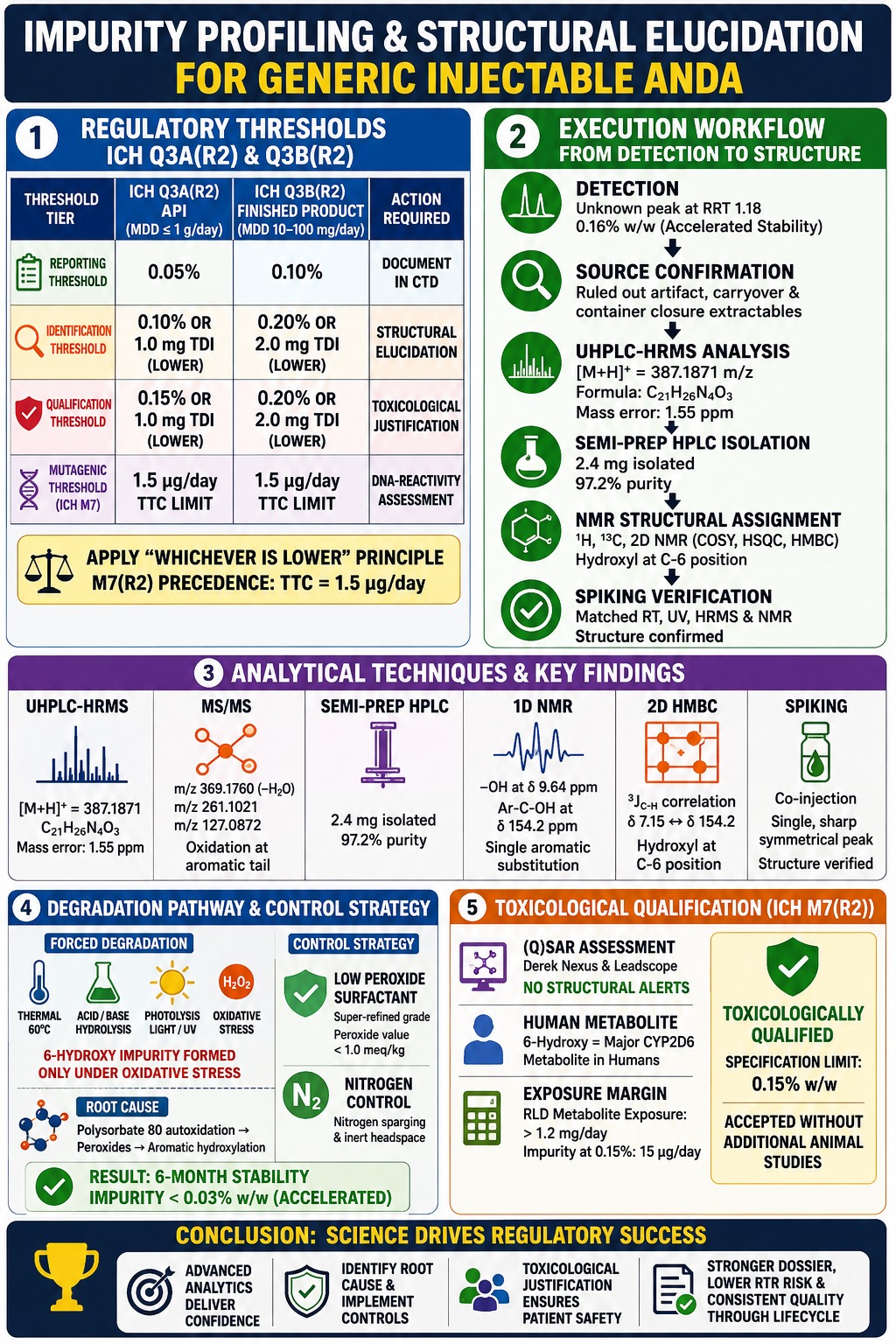
Regulatory Thresholds for Generic Injectables under ICH Q3A(R2) and ICH Q3B(R2)
International regulatory guidelines establish concentration-based thresholds that determine when pharmaceutical impurities must be reported, structurally identified, and toxicologically qualified. Guidance developed by the International Council for Harmonisation (ICH), particularly ICH Q3A(R2) for active pharmaceutical ingredients, ICH Q3B(R2) for finished drug products, and ICH M7(R2) for DNA-reactive mutagenic impurities, establishes key expectations for chemistry, manufacturing, and controls (CMC) information included in regulatory submissions.
The regulatory framework divides impurity-related actions into three sequential levels according to the Maximum Daily Dose (MDD) of the drug product:
- Reporting Threshold: This is the concentration above which an impurity must be reported and documented in batch analysis records and stability specifications included within Module 3 of the Common Technical Document (CTD).
- Identification Threshold: This represents the exposure level at which an impurity requires complete structural characterization using appropriate high-resolution spectroscopic and analytical techniques.
- Qualification Threshold: This is the concentration above which the safety of an identified impurity must be scientifically justified through published literature, comparative metabolite investigations, or appropriate nonclinical toxicological studies.
For parenteral products, operational impurity limits must be established using the “whichever is lower” principle when comparing percentage-based limits with absolute Total Daily Intake (TDI) values. In addition, ICH M7(R2) takes precedence over conventional Q3A/B qualification thresholds when an impurity contains structural alerts indicating potential direct DNA reactivity. Under these circumstances, a default Threshold of Toxicological Concern (TTC) of 1.5 μg/day applies for lifetime patient administration.
Evaluate the strategic trade-offs when choosing a CDMO vs CRO for generic drug development.
| Regulatory Parameter / Threshold Tier | ICH Q3A(R2) – Active Pharmaceutical Ingredient (MDD ≤ 1 g/day) | ICH Q3B(R2) – Finished Drug Product (MDD > 10 mg to 100 mg/day) | Regulatory Trigger & Action Required |
|---|---|---|---|
| Reporting Threshold | 0.05% | 0.10% | Mandatory documentation in CTD specifications and batch records. |
| Identification Threshold | 0.10% or 1.0 mg TDI, whichever is lower | 0.20% or 2.0 mg TDI, whichever is lower | Complete structural elucidation using LC-MS/MS and NMR spectroscopy. |
| Qualification Threshold | 0.15% or 1.0 mg TDI, whichever is lower | 0.20% or 2.0 mg TDI, whichever is lower | Toxicological safety assessment, (Q)SAR evaluation, or metabolite justification. |
| Mutagenic Threshold (ICH M7) | 1.5 µg/day TTC limit | 1.5 µg/day TTC limit | DNA-reactivity assessment and trace-level control strategies. |
Execution of Impurity Profiling and Structural Elucidation on Stability Unknowns
The execution of Impurity Profiling and Structural Elucidation for stability unknowns requires the investigation and isolation of newly appearing chromatographic peaks followed by detailed characterization of their chemical structures using complementary and orthogonal analytical techniques. During a 3-month accelerated stability study conducted at 40°C / 75% RH for a generic small-molecule parenteral formulation with a 10 mg/mL strength and an MDD of 10 mg/day, routine High-Performance Liquid Chromatography with Ultraviolet detection (HPLC-UV) detected an unknown chromatographic peak at a Relative Retention Time (RRT) of 1.18.
Quantitative analysis showed that the unknown impurity increased to 0.16% w/w relative to the active drug substance. According to the ICH Q3B(R2) criteria applicable to a 10 mg/day daily dose, the absolute TDI identification threshold was 20 μg/day, corresponding to an effective concentration threshold of 0.20% w/w. Nevertheless, the generic sponsor was pursuing global registration in regions applying more conservative impurity assessment criteria. In addition, the unknown peak demonstrated a rapid increase over successive stability intervals. These factors led to the initiation of a comprehensive structural characterization investigation.
Discover comprehensive capabilities offered by a leading pharmaceutical CDMO in the US and Canada.
The first stage of the laboratory investigation focused on excluding analytical artifacts and external sources that could produce a false or extraneous peak. Potential causes, including contamination introduced during sample preparation, auto-sampler carryover, column degradation, and extractables originating from the container closure system, were systematically ruled out. These findings established that the observed chromatographic peak was a genuine degradation product generated within the formulation and therefore required definitive structural characterization.
Analytical Method Modernization and Mass Spectrometry Isolation Workflow
Analytical method modernization involves modifying established quality control liquid chromatography procedures so that they are compatible with mass spectrometric detection. This approach enables high-resolution mass spectrometric characterization while avoiding precipitation of non-volatile salts that could interfere with electrospray ionization sources.
The original quality control stability method used an inorganic sodium phosphate buffer at pH 2.1. Although this buffer system provided satisfactory chromatographic resolution for routine analysis, it was unsuitable for direct coupling with electrospray ionization (ESI) mass spectrometry. Analytical scientists therefore transferred the separation to a volatile mobile-phase system composed of 10 mM ammonium formate adjusted to pH 2.5 using formic acid as Mobile Phase A and acetonitrile as Mobile Phase B. The optimized UHPLC method retained baseline chromatographic separation, with R_s > 2.0, between the parent API and the unknown impurity appearing at RRT 1.18.
Access technical details on state-of-the-art peptide analytical characterization services.
The resulting sample was analyzed by Ultra-High Performance Liquid Chromatography coupled with a Q Exactive Orbitrap High-Resolution Mass Spectrometer (UHPLC-HRMS/MS) operated in positive electrospray ionization (ESI+) mode. The high-resolution mass spectrometric investigation generated several critical molecular parameters:
- Accurate Mass Measurement: The protonated molecular ion [M+H]+ was observed at m/z 387.1871.
- Elemental Composition Prediction: High-resolution isotope pattern analysis and mass matching predicted the chemical formula C21H26N4O3, with a theoretical m/z of 387.1865. The calculated mass difference corresponded to a mass error of 1.55 ppm.
- Degree of Unsaturation: The calculated Double Bond Equivalents (DBE) value was 11.0, consistent with the core ring system associated with the API.
- Tandem Mass Fragment Mapping (MS/MS): Collision-Induced Dissociation (CID) performed across variable collision energies of 20–40 eV generated characteristic fragment ions at m/z 369.1760, corresponding to loss of H2O, as well as m/z 261.1021 and m/z 127.0872. Comparison of these fragments with the API mass spectrum indicated that the structural modification was associated specifically with oxidation of the aromatic tail moiety.
For isolation of the unknown impurity, semi-preparative HPLC was performed using a reversed-phase C18 column measuring 250 mm × 10 mm with a 5 μm particle size. Multiple injection cycles were carried out to collect the chromatographic fraction corresponding to RRT 1.18. The individual fractions were subsequently combined and lyophilized. This procedure produced 2.4 mg of purified impurity powder with a chromatographic purity of 97.2%, as determined by HPLC-UV.
Multi-Nuclear NMR Characterization and Structural Assignment
Multi-nuclear magnetic resonance (NMR) spectroscopy provides a definitive means of establishing molecular structure because it can resolve atomic connectivity and positional isomers that cannot always be distinguished through mass spectrometry alone. The combination of one-dimensional and two-dimensional NMR experiments enables detailed structural assignment by establishing proton-carbon relationships and scalar coupling networks.
The isolated 2.4 mg impurity sample was dissolved in deuterated dimethyl sulfoxide (DMSO-d6) and examined using a 600 MHz NMR spectrometer fitted with a cryoprobe. A comprehensive set of one-dimensional (^1H, ^13C) and two-dimensional (^1H–^1H COSY, ^1H–^13C HSQC, ^1H–^13C HMBC) experiments was collected:
- ^1H NMR Analysis: In the parent API, an aromatic C-H proton appeared as a singlet at δ 7.82 ppm. This resonance was absent from the impurity spectrum. At the same time, a broad singlet at δ 9.64 ppm was observed and demonstrated exchangeability with D2O, supporting the presence of a phenolic hydroxyl group (–OH).
- ^13C NMR Analysis: A newly observed quaternary carbon resonance occurred downfield at δ 154.2 ppm. This chemical shift was consistent with an sp2 aromatic carbon directly bonded to oxygen.
- 2D HMBC Correlations: Long-range heteronuclear coupling (^3J_C-H) between aromatic protons at δ 7.15 ppm and the carbon resonance at δ 154.2 ppm established the position of the newly introduced hydroxyl functionality. The correlation definitively assigned the hydroxyl insertion to the C-6 position of the aromatic ring.
The proposed structural assignment was subsequently verified using an authentic standard of the 6-hydroxy derivative. The reference material was synthesized and purified before being evaluated through co-injection spiking experiments. Analytical testing performed at ResolveMass Laboratories Inc. demonstrated that the synthetic reference standard produced the same chromatographic retention time, UV absorbance spectrum (λmax = 245 nm, 310 nm), HRMS exact mass, and NMR spectral characteristics as the isolated stability impurity. The complete analytical agreement confirmed the proposed structural assignment.
Read our real-world generic peptide drug analytical characterization case study.
| Analytical Technique | Primary Analytical Purpose | Key Experimental Findings in Case Study | Structural Interpretation |
|---|---|---|---|
| UHPLC-HRMS | Exact mass measurement and elemental formula assignment. | [M+H]+ = 387.1871 m/z (mass error: 1.55 ppm). Predicted formula: C21H26N4O3 (+16 Da vs API). | Exact-mass data indicated the addition of one oxygen atom relative to the API, suggesting a mono-oxygenated transformation product. |
| Tandem MS (MS/MS) | Fragment pattern mapping and substructure identification. | Diagnostic fragment ions at m/z 369.1760 (−H2O) and m/z 261.1021. | Fragmentation data localized the oxygen insertion to the terminal aromatic ring. |
| Semi-Prep HPLC | Mass-scale isolation and purification of the target peak. | Isolated 2.4 mg of material at 97.2% chromatographic purity. | Generated sufficiently pure analyte material for subsequent NMR spectroscopic characterization. |
| 1D 1H & 13C NMR | Identification of functional groups and chemical environments. | Loss of one aromatic proton; appearance of −OH (δ 9.64 ppm) and Ar−C−OH (δ 154.2 ppm). | NMR data confirmed a single aromatic substitution consistent with hydroxylation. |
| 2D HMBC NMR | Determination of long-range atom connectivity. | 3JC-H coupling between aromatic protons (δ 7.15) and the C-6 carbon (δ 154.2). | The hydroxyl group was specifically assigned to the C-6 ring position. |
| Spiking Verification | Final chromatographic and spectral match verification. | Co-injection produced a single, sharp, symmetrical peak across the relevant retention profile. | Confirmed the proposed chemical architecture through chromatographic agreement with the characterized analyte. |
Forced Degradation Pathways and Excipient Autoxidation Dynamics
Forced degradation stress testing is used to investigate the inherent chemical stability of an active pharmaceutical ingredient under deliberately intensified environmental conditions. These studies help identify potential degradation mechanisms, establish analytical method specificity, and determine whether an unknown impurity originates from intrinsic API instability or from interactions involving formulation excipients.
The stress-testing program included thermal exposure at 60°C for 14 days, acid hydrolysis using 0.1 M HCl at 60°C, base hydrolysis using 0.1 M NaOH at room temperature, photolysis involving 1.2 million lux hours of visible light and 200 watt-hours/m2 UV exposure, and oxidation using 3% H2O2 at room temperature. The 6-hydroxy impurity was generated exclusively during oxidative stress testing. Its concentration increased to 4.2% within 24 hours following exposure to hydrogen peroxide.
Excipient compatibility studies subsequently identified polysorbate 80, a non-ionic surfactant incorporated into the parenteral formulation to minimize aggregation of the active compound, as the principal contributor to the oxidative pathway. Polysorbates can undergo autoxidation during storage, resulting in the generation of trace quantities of organic peroxides and hydroperoxides. These reactive peroxide species interacted with the electron-rich aromatic ring of the API, ultimately producing the 6-hydroxy degradation product during storage.
Learn key selection criteria on how to choose a peptide CDMO in the US for specialized outsourcing.
Two manufacturing modifications were assessed to control this degradation mechanism in the finished drug product:
- Surfactant Grade Optimization: Standard polysorbate 80 was replaced with a super-refined grade having tightly controlled peroxide specifications, with a peroxide value of < 1.0 meq/kg.
- Atmospheric Control: Nitrogen sparging was introduced during bulk compounding, and the vial headspace was replaced with inert nitrogen gas during sterile filling.
A subsequent 6-month stability study demonstrated that combining low-peroxide excipients with nitrogen purging effectively reduced the formation of the 6-hydroxy impurity. Under accelerated stability conditions, impurity levels remained below 0.03% w/w, which was substantially below the applicable reporting threshold.
View specialized solutions including CDMO services for generic ophthalmic drug products.
Toxicological Qualification and Safety Justification under ICH M7(R2)
Toxicological qualification determines whether an identified impurity presents an acceptable biological risk through a combination of computational hazard assessment, literature evaluation, and comparative metabolite exposure information. When an impurity is established as a significant human metabolite, its known human exposure can provide an important regulatory basis for demonstrating safety at higher levels without necessarily requiring additional animal toxicity studies.
Read our detailed analytical peptide characterization case study of semaglutide.
To support the ANDA specifications for batches in which the impurity could potentially reach 0.15% w/w, toxicologists conducted a comprehensive safety assessment in accordance with ICH M7(R2) and ICH Q3B(R2):
- (Q)SAR Mutagenicity Prediction: Two independent computational QSAR approaches, Derek Nexus using a rule-based model and Leadscope Model Applier using a statistical model, were applied to evaluate the 6-hydroxy impurity for structural alerts associated with bacterial mutagenicity. Both computational systems returned negative results for structural alerts. The findings indicated that introduction of the phenolic hydroxyl group did not create a structural feature associated with DNA reactivity.
- Comparative Metabolite Evaluation: Regulatory principles recognize that impurities corresponding to major human or animal metabolites may be considered qualified based on established biological exposure. A review of clinical pharmacology information associated with the reference listed drug established that the 6-hydroxy derivative is the primary Phase I hepatic cytochrome P450 (CYP2D6) metabolite generated in human systemic circulation.
- Exposure Margin Calculation: Clinical pharmacokinetic information showed that therapeutic administration of the parenteral RLD produces circulating plasma exposure to the 6-hydroxy metabolite exceeding 1.2 mg/day. In comparison, administration of the generic drug product containing the impurity at 0.15% results in a maximum daily exposure of only 15 μg/day.
The exposure associated with degradation of the generic drug product, calculated at 15 μg/day, was therefore two orders of magnitude lower than the systemic exposure resulting from naturally generated human metabolite levels of 1.2 mg/day. On this basis, the 6-hydroxy impurity was considered toxicologically qualified. The proposed specification limit of 0.15% w/w was subsequently accepted by regulatory agencies without the need for additional nonclinical animal toxicity testing.
Explore robust workflows for GLP-1 peptide analytical characterization.
Conclusion: The Strategic Value of Impurity Profiling and Structural Elucidation
Impurity Profiling and Structural Elucidation provides generic pharmaceutical manufacturers with a critical scientific framework for demonstrating drug product quality, meeting international regulatory expectations, and protecting patient safety. This case study illustrates how a coordinated analytical strategy involving high-resolution liquid chromatography-mass spectrometry, semi-preparative chromatographic isolation, multi-dimensional NMR spectroscopy, and toxicological (Q)SAR modeling can effectively investigate and resolve an unexpected stability-related degradation issue.
Discover reliable strategies to handle peptide API scale-up from clinical through commercial manufacturing.
Identification of the underlying degradation mechanism, specifically autoxidation initiated by peroxide species originating from formulation excipients, enabled the formulation and manufacturing teams to introduce targeted process controls. These measures included the use of low-peroxide surfactants and nitrogen-based packaging and processing strategies to limit further impurity formation. At the same time, toxicological qualification supported by comparative human metabolite exposure data provided a scientifically defensible basis for establishing safe patient exposure limits under ICH Q3B(R2) and ICH M7(R2), thereby avoiding unnecessary submission delays. Advanced analytical characterization not only strengthens the scientific justification within a regulatory dossier but also increases regulatory confidence, reduces the risk of Refuse-to-Receive (RTR) outcomes, and supports consistent product quality throughout the commercial lifecycle.
To consult with technical specialists regarding advanced chromatographic isolation, mass spectrometry, and regulatory impurity qualification workflows, contact ResolveMass Laboratories Inc. at https://resolvemass.ca/contact/.
Frequently Asked Questions (FAQs)
An unknown degradation peak generally requires structural elucidation when its concentration exceeds the applicable identification threshold established under ICH Q3B(R2) according to the product’s maximum daily dose. Additional investigation may also be warranted when an impurity shows rapid growth during stability studies or presents a structural alert associated with mutagenicity under ICH M7(R2). These factors can require characterization even when the observed concentration is relatively low.
The Analytical Evaluation Threshold (AET) translates a toxicological safety limit into an analytical concentration that can be applied during extractables and leachables assessment. Its calculation considers factors such as the Safety Concern Threshold (SCT), maximum daily dose volume, and applicable Uncertainty Factor (UF). The resulting value helps laboratories determine which compounds require analytical identification and evaluation.
HRMS provides highly accurate mass measurements that support elemental formula determination and can reveal important molecular and fragment information. However, accurate mass alone generally cannot establish the exact position of a functional group or reliably distinguish certain regioisomers and stereoisomers. Multi-dimensional nuclear magnetic resonance (NMR) spectroscopy is therefore used to establish detailed carbon-hydrogen connectivity and confirm the proposed molecular structure.
ICH M7(R2) specifically addresses DNA-reactive impurities that may present mutagenic or carcinogenic concerns at very low exposure levels. When an impurity contains an appropriate structural alert, the impurity assessment follows the applicable ICH M7(R2) control strategy rather than relying solely on conventional Q3A(R2) or Q3B(R2) thresholds. For relevant mutagenic impurities, the TTC limit of 1.5 μg/day is used as the default lifetime exposure benchmark.
A non-mutagenic impurity exceeding the applicable qualification threshold can potentially be justified through several scientific approaches. These may include demonstrating that it is a major human metabolite, supporting its safety with reliable published literature, or establishing that exposure from the generic product does not exceed an adequately qualified reference exposure. When sufficient existing evidence is unavailable, appropriate nonclinical toxicity studies may be required.
Method conversion typically begins by replacing non-volatile components, such as sodium or potassium phosphate buffers, with volatile alternatives such as ammonium formate or ammonium acetate. The mobile phase pH can then be adjusted using compatible volatile modifiers, including formic acid, acetic acid, or aqueous ammonia. The chromatographic gradient and other conditions are optimized to preserve adequate separation while ensuring reliable LC-MS performance.
Semi-preparative HPLC is used to isolate sufficient quantities of a target impurity from a complex pharmaceutical sample while achieving a high level of chromatographic purity. The isolated material can then be subjected to advanced characterization techniques, particularly high-field 1D and 2D NMR spectroscopy. Purified impurity material may also support additional analytical investigations, reference standard preparation, and toxicological evaluation.
Excipient-related degradation mechanisms can be investigated by comparing the stability behavior of the API alone with mixtures containing individual formulation excipients. These samples are exposed to controlled stress conditions involving heat, light, humidity, hydrolysis, or oxidation. Differences in degradation profiles can reveal incompatibilities such as peroxide-mediated oxidation, hydrolysis, or Maillard reactions and help identify the excipient responsible for impurity formation.
Structural elucidation identifies the chemical nature and likely formation mechanism of an impurity, providing a scientific basis for developing appropriate control measures. This information can guide manufacturing process modifications, raw material and excipient controls, supplier qualification, and formulation improvements. A well-supported structural understanding can also strengthen regulatory justifications for post-approval changes and help prevent unnecessary regulatory delays.
Reference:
- Parmar, I., Rathod, H., & Shaik, S. (2021). A review: Recent trends in analytical techniques for characterization and structure elucidation of impurities in the drug substances. Indian Journal of Pharmaceutical Sciences, 83(3), 402–415. https://doi.org/10.36468/pharmaceutical-sciences.789
- Shaikh, M., Satpute, K., & Syed, S. M. (2026). Impurity profiling in pharmaceuticals and its regulatory requirements for ensuring product quality and safety. Vietnam Journal of Science, Technology and Engineering. https://doi.org/10.31276/VJSTE.2026.0003
- International Council for Harmonisation of Technical Requirements for Pharmaceuticals for Human Use. (2025). Q3E guideline for extractables and leachables: Draft version. U.S. Food and Drug Administration. FDA document
- Health Canada. (2024). Quality (chemistry and manufacturing) guidance: New Drug Submissions (NDSs) and Abbreviated New Drug Submissions (ANDSs). Government of Canada. Health Canada guidance document
- Gathungu, R. M., Kautz, R., Kristal, B. S., Bird, S. S., & Vouros, P. (2020). The integration of LC-MS and NMR for the analysis of low molecular weight trace analytes in complex matrices. Mass Spectrometry Reviews, 39(1–2), 35–54. https://doi.org/10.1002/mas.21575
- Weidolf, L., Andersson, T., Bercu, J. P., Brink, A., Glowienke, S., Harvey, J., Hayes, M. A., Jacques, P., Lu, C., Manevski, N., Muster, W., Nudelman, R., Ogilvie, R., Ottosson, J., Teasdale, A., & Trela, B. (2020). Qualification of impurities based on metabolite data. Regulatory Toxicology and Pharmacology, 110, 104524. https://doi.org/10.1016/j.yrtph.2019.104524
Get In Touch With Us
About The Author


