
Introduction:
A virtual biotech can reach IND clearance in about 9 months when its CMC (Chemistry, Manufacturing and Controls) strategy is outsourced to an integrated partner and run in parallel with nonclinical work. This IND clearance outsourced CMC strategy case study walks through how that timeline was built, month by month, and which decisions protected it.
Virtual biotechs hold a molecule, a clinical hypothesis, and a small team. They rarely hold a lab, a quality system, or a regulatory CMC specialist. That gap is where first-in-human timelines usually slip.
Note on this case study: the client is anonymized, and the scenario is a composite built from typical outsourced IND-enabling CMC programs. Timelines are illustrative. Every program depends on its molecule, modality, and FDA feedback.
Summary:
- A virtual biotech reached IND clearance in 9 months by placing its CMC strategy with one analytical and development partner instead of juggling several vendors.
- The approach rested on four moves: an early CMC gap assessment, phase-appropriate analytical methods, parallel workstreams, and a pre-IND meeting with FDA.
- FDA’s 30-day IND review was the final month of the timeline. CMC readiness, not the agency, was the real bottleneck.
- Most CMC-related clinical holds trace back to thin characterization, weak impurity control, or missing stability data. All three are preventable with the right plan.
- Virtual biotechs gain the most from outsourcing CMC strategy because they have no internal labs, no QA system, and no time to build either.
- Coordinated analytical, formulation, manufacturing, stability, and documentation work reduces the delays caused by fragmented vendor management and inconsistent data.
- Choosing an experienced CRO/CDMO partner improves data quality, documentation readiness, and resource efficiency.
1: Why Is CMC the Bottleneck for IND Clearance at Virtual Biotechs?
CMC is the bottleneck because FDA must be satisfied that the drug product is consistently made, well characterized, and safe to dose before any patient is exposed. Under 21 CFR 312.23, every IND must describe the composition, manufacture, and control of the drug substance and drug product. An IND becomes effective 30 days after FDA receives it unless the agency places a clinical hold.
Virtual biotechs hit three predictable walls:
- No analytical capability: methods must be developed, qualified, and documented before batches can be released.
- No GMP supply chain: clinical material must be made under phase-appropriate cGMP.
- No regulatory CMC writer: Module 3-style content must be assembled into a coherent, reviewable dossier.
2: Case Study Background: The Virtual Biotech and Its Challenge
The client was a five-person virtual biotech with a long-acting injectable program built on a PLGA microsphere platform. It had efficacy data in animals and an investor milestone tied to first-patient-dosed within 12 months.
| Factor | Starting position |
|---|---|
| Company model | Virtual, no internal laboratory |
| Modality | PLGA-based long-acting injectable |
| Regulatory CMC experience | One part-time consultant |
| Analytical methods | Research-grade only, not qualified |
| Funding constraint | Milestone-linked, no room for a clinical hold |
| Target | IND clearance within 9–10 months |
3: IND Clearance Outsourced CMC Strategy Case Study: The 9-Month Timeline
The program reached IND clearance in 9 months because analytical development, GMP manufacturing, stability, and dossier writing ran in parallel under one CMC plan. The table shows the overlap.
| Months | Workstream | Outcome |
|---|---|---|
| 1–2 | CMC gap assessment and regulatory strategy | Phase-appropriate CMC plan; pre-IND meeting requested |
| 2–5 | Analytical method development and qualification | Qualified assays for identity, assay, impurities, and release |
| 3–6 | Process definition and GMP clinical batch | Released clinical lot with a certificate of analysis |
| 4 | Pre-IND meeting | FDA feedback on CMC and stability expectations |
| 6–8 | Stability study and CMC dossier writing | Initial stability data and a submission-ready CMC section |
| 8 | IND submission | Complete IND filed |
| 9 | FDA 30-day review | IND effective, no clinical hold |
Months 1–2: How Did the CMC Gap Assessment Set the Direction?
The gap assessment identified every missing CMC element against FDA expectations before any lab work began. It produced a risk-ranked list: unqualified methods, undefined impurity limits, no extractables and leachables plan, and no stability protocol. Requesting the pre-IND meeting in month 2 gave FDA time to respond before the dossier was locked.
Months 2–5: How Were Analytical Methods Built for a Phase 1 Standard?
Methods were built to be phase-appropriate: scientifically sound and fit for purpose, but not over-validated. For a PLGA product, that meant characterizing polymer molecular weight, residual solvents, particle size distribution, drug loading, and in vitro release. Mass spectrometry supported impurity identification and structural confirmation. Because nitrosamine risk is now a routine reviewer question, a risk assessment was documented early rather than added after a query.
Months 3–6: What Made the GMP Clinical Batch Release on Schedule?
The batch released on schedule because the process was defined only as far as Phase 1 required, and release specifications were agreed before manufacturing began. FDA’s guidance on cGMP for Phase 1 investigational drugs supports this phase-appropriate approach. The same partner that qualified the methods tested the batch, which removed a method-transfer step that often costs weeks.
Months 6–8: How Did Early Stability Data Support the Submission?
Initial stability data supported the proposed clinical use period and storage conditions. Stability pulls began as soon as the lot was released, so the IND carried real-time data rather than a promise to generate it later. The CMC section was drafted while the study ran, then updated with the latest time point before filing.
4: What Do the Five CMC Workstreams Look Like in an Outsourced IND Program?
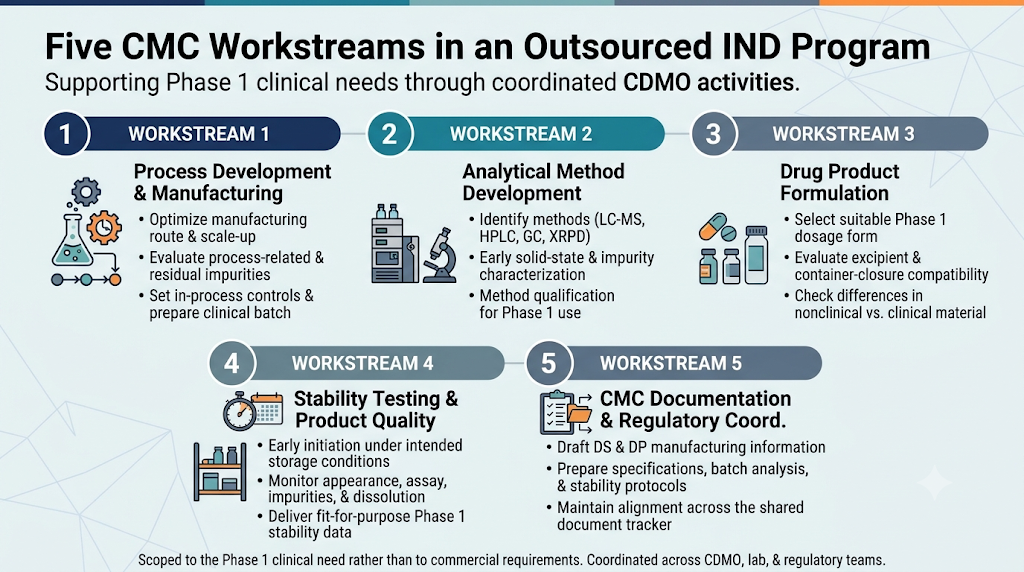
An outsourced IND program runs five coordinated workstreams: process development, analytical development, drug product development, stability testing, and regulatory documentation. Each is scoped to the Phase 1 clinical need rather than to commercial requirements.
Workstream 1: Process Development and Manufacturing
The CDMO reviews the manufacturing route, critical process parameters (CPPs), and critical quality attributes (CQAs), following the principles in the ICH Q11 CMC drug development guidelines. Key activities include:
- Reviewing the existing route and laboratory-scale process.
- Optimizing reaction or formulation conditions and purification steps.
- Evaluating process-related and residual impurities.
- Setting in-process controls and preparing a representative clinical batch.
Process understanding built early reduces the risk of shifting impurity profiles or assay results later. A planned approach to scale-up and tech transfer in CMC keeps the clinical batch representative of the intended process.
Workstream 2: Analytical Method Development and Characterization
Analytical development is the most important workstream, because every quality decision depends on reliable methods. Methods are chosen from the molecule’s physicochemical properties and likely degradation pathways.
| Analytical requirement | Typical technique | Objective |
|---|---|---|
| Identity confirmation | LC-MS, HRMS, NMR | Confirm molecular identity |
| Assay | HPLC/UHPLC | Quantify the active ingredient |
| Related substances | HPLC/UPLC | Monitor organic impurities |
| Residual solvents | GC/GC-MS | Evaluate process solvents |
| Elemental impurities | ICP-MS | Assess elemental contaminants |
| Degradation profiling | Stability-indicating HPLC | Evaluate degradation products |
| Solid-state form | XRPD, DSC, FTIR | Evaluate physical form |
Where physical form affects performance, polymorphism and solid-state characterization in CMC should be planned early. For Phase 1, methods are qualified for their intended use rather than fully validated. The package still covers specificity, accuracy and precision, linearity and range, robustness, system suitability, reference standards, and data integrity.
Workstream 3: Drug Product Formulation Development
The formulation team selects a simple, suitable Phase 1 presentation based on solubility, stability, dose, and route of administration. Typical activities are excipient compatibility, preliminary formulation screening, dosage form selection, and manufacturing feasibility. Container-closure compatibility matters too, and a plan for extractables and leachables in CMC should start before the clinical batch.
The team also checks whether differences between nonclinical and clinical material could change how safety findings are read. Injectable programs raise extra questions. The CMC pages on complex generic injectables, dexamethasone injection CMC requirements, and leuprolide depot CMC strategy show how these are handled for specific products.
Workstream 4: Stability Testing and Product Quality
Stability testing starts early enough to produce useful data before submission. It reflects the intended storage conditions, proposed packaging, and expected clinical supply period.
| Stability parameter | Purpose |
|---|---|
| Appearance | Identify visible physical changes |
| Assay | Monitor active ingredient content |
| Related substances | Evaluate impurity formation |
| Water content | Assess moisture-related changes |
| Dissolution or release | Evaluate performance where applicable |
| pH | Monitor formulation changes |
| Container-closure integrity | Assess packaging protection |
An IND does not need the full long-term dataset expected for a marketing application. The data should fit the phase, the proposed clinical use, and the product. The sponsor also commits to continue stability monitoring after filing.
Workstream 5: CMC Documentation and Regulatory Coordination
The analytical lab, CDMO, and regulatory writer work from one shared document tracker so gaps and inconsistencies surface before submission. Core documentation includes:
- Drug substance and drug product manufacturing information.
- Specifications and analytical procedures.
- Batch analysis and impurity characterization.
- Stability protocols and available results.
- Container-closure and facility information.
CMC content must stay aligned with the nonclinical and clinical sections of the IND. The same documentation discipline applies to CMC documentation at a CDMO for ANDA filings. Sponsors planning a reformulated or repurposed product should also review CMC requirements for a 505(b)(2) NDA.
5: What Does FDA Actually Require for IND Clearance?
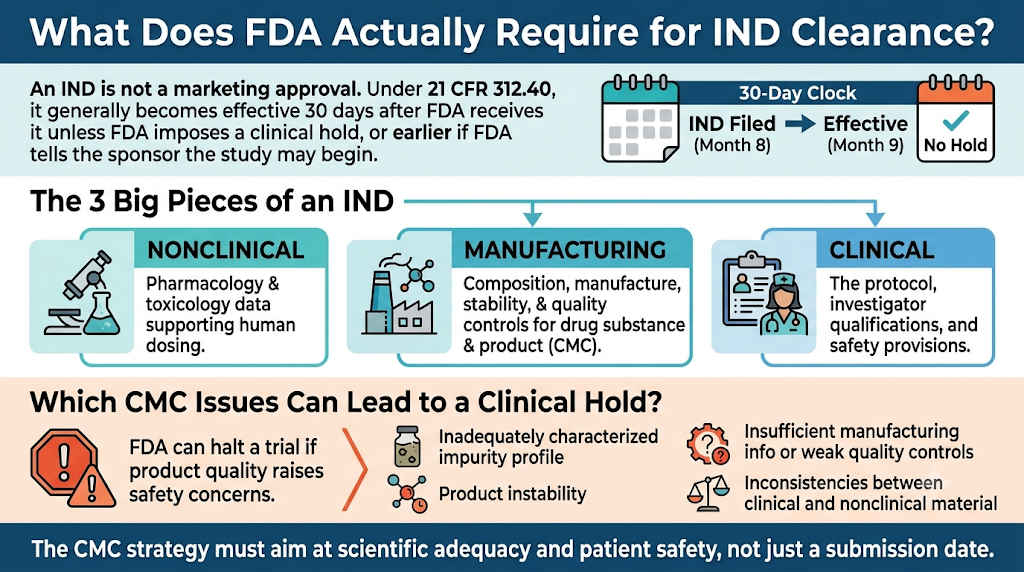
An IND is not a marketing approval. Under 21 CFR 312.40, it generally becomes effective 30 days after FDA receives it unless FDA imposes a clinical hold, or earlier if FDA tells the sponsor the study may begin. In this case study, the IND was filed in month 8 and took effect in month 9 with no hold.
An IND broadly contains three categories of information:
- Nonclinical: pharmacology and toxicology data supporting human dosing.
- Manufacturing: composition, manufacture, stability, and quality controls for the drug substance and drug product.
- Clinical: the protocol, investigator qualifications, and safety provisions.
Which CMC Issues Can Lead to a Clinical Hold?
FDA lists product quality concerns, including potentially hazardous impurities and inadequate stability, among reasons for a clinical hold. Typical CMC triggers are:
- An inadequately characterized impurity profile.
- Product instability that raises safety or quality concerns.
- Insufficient manufacturing information or weak quality controls.
- Inconsistencies between clinical and nonclinical material.
The CMC strategy must therefore aim at scientific adequacy and patient safety, not just a submission date.
6: What Decisions Made 9-Month IND Clearance Possible?
Four decisions did most of the work: one integrated partner, phase-appropriate rigor, parallel execution, and early FDA engagement.
- One integrated partner: analytical development, characterization, and release testing sat under one roof, so no data or methods were handed between vendors.
- Phase-appropriate rigor: methods were qualified for Phase 1 use, with a documented plan to validate later.
- Parallel workstreams: the dossier was written while the stability study ran.
- Early FDA engagement: a pre-IND meeting turned unknowns into written expectations.
7: Which CMC Pitfalls Most Often Delay IND Clearance?
The most common delays come from incomplete characterization, uncontrolled impurities, and missing stability data. Each one can trigger an information request or a clinical hold.
| Pitfall | Why it delays IND clearance | How the outsourced strategy avoided it |
|---|---|---|
| Thin product characterization | Reviewers cannot judge consistency | Orthogonal methods, including mass spectrometry |
| Undefined impurity limits | Safety margins cannot be justified | Limits set early using ICH Q3A/Q3B logic |
| Unaddressed nitrosamine risk | Triggers late reviewer questions | Documented risk assessment at the start |
| No stability data | Clinical use period cannot be supported | Stability started at lot release |
| Vendor handoffs | Method transfer adds weeks and errors | Single analytical partner |
| Over-validated methods | Wastes time and budget at Phase 1 | Fit-for-purpose qualification |
8: Why Does Outsourcing CMC Strategy Work So Well for Virtual Biotechs?
Outsourcing works because it converts fixed costs into on-demand expertise. A virtual biotech cannot justify an internal analytical lab, a QA unit, and a CMC regulatory writer for one asset. A specialist partner already has validated instruments, trained scientists, and documented procedures, so the first lot is not also the first time the system is tested.
The risk of outsourcing is fragmentation. Sponsors who split strategy, testing, and writing across vendors often lose the time they hoped to save.
9: How Do You Choose the Right CRO/CDMO Partner for an IND Program?
Choose a partner on technical depth, quality systems, and coordination, not on price and turnaround alone. For early-stage sponsors, CMC consulting services for biotech startups can help set that scope before vendors are engaged.
| Evaluation area | What the sponsor should assess |
|---|---|
| Analytical capabilities | LC-MS, LC-MS/MS, HPLC, GC-MS, HRMS, NMR, ICP-MS |
| Manufacturing expertise | Drug substance and drug product development |
| Quality systems | GMP controls, documentation, deviation management |
| Regulatory experience | IND, NDA, ANDA, CTD, and CMC documentation |
| Stability capabilities | Stability-indicating methods and programs |
| Project management | Milestone tracking and cross-functional coordination |
| Data integrity | Traceable records, audit trails, reliable reporting |
A common failure is each vendor optimizing its own deliverable. An analytical lab may report an acceptable assay while the manufacturer works to a different specification. A coordinated model prevents this through shared milestones, defined technical responsibilities, consistent analytical documentation, regular cross-functional meetings, and regulatory-focused document reviews. A phase-appropriate CMC development approach at a CDMO keeps that coordination proportionate to the clinical phase.
The sponsor still owns the regulatory responsibility. Contracts, quality agreements, and data ownership terms should be defined before work starts.
How Does ResolveMass Laboratories Support IND-Enabling CMC Programs?
ResolveMass Laboratories Inc. is a Canadian analytical CRO and CDMO that supports IND-enabling CMC work through scientific, not just administrative, expertise. Its focus areas map directly to the challenges in this case study:
- Mass spectrometry: structural confirmation, impurity identification, and high-resolution characterization.
- Biosimilar characterization: orthogonal analytical comparability for complex biologics.
- PLGA-based drug delivery: polymer, release, and particle characterization for long-acting injectables.
- Nitrosamine testing: risk assessment support and sensitive analytical detection.
ResolveMass is a USFDA-registered Canadian CRO/CDMO. Its analytical toolkit relevant to IND-enabling work includes:
- LC-MS, LC-MS/MS, and HRMS for molecular characterization and impurity analysis.
- HPLC and UHPLC for assay and related substances.
- GC-MS and GC-HRMS for volatile and semi-volatile compounds.
- ICP-MS for elemental impurities, and NMR for structural characterization.
- Method development, optimization, validation, verification, and transfer, scoped to project needs.
Specialized characterization can extend to peptide and oligonucleotide work (see CMC services for peptide-oligonucleotide conjugates), extractables and leachables, nitrosamine and NDSRI analysis, impurity identification, and polymer molecular weight characterization.
Analytical testing alone does not establish IND readiness. Manufacturing, nonclinical, clinical, quality, and regulatory responsibilities must also be addressed, and ResolveMass’s role is defined by the agreed project scope.
What Are the Key Lessons for Biotech Startups Planning an IND?
The main lesson is to start CMC early, pick partners on capability, and keep documentation consistent. Six practices stand out:
- Start CMC planning before preclinical work ends. Early planning leaves time for analytical development, manufacturing, and stability.
- Choose partners on capability, not price alone. The cheapest provider may lack the instruments or quality systems the program needs.
- Establish analytical methods early. They are needed for process development, batch testing, and stability.
- Keep documentation consistent. Review batch records, reports, specifications, and stability results against each other throughout.
- Avoid commercial-stage requirements too soon. FDA’s Phase 1 CMC guidance supports phase-appropriate information that maintains safety without unnecessary work.
- Retain sponsor oversight. Outsourcing activities does not outsource regulatory responsibility.
Conclusion:
This IND clearance outsourced CMC strategy case study shows that speed comes from sequencing, not shortcuts: an early gap assessment, phase-appropriate analytics, parallel execution, and early FDA dialogue. For virtual biotechs, an integrated partner removes the handoffs that most often stall a first-in-human filing.
Frequently Asked Questions:
No. FDA generally expects stability information appropriate to the development stage and proposed clinical use. Sponsors should provide available supporting data and an appropriate ongoing stability commitment.
Potential reasons include inadequate impurity characterization, insufficient manufacturing controls, product instability, incomplete analytical information, and quality concerns that could affect patient safety.
Many CMC activities can be outsourced, including analytical testing, formulation development, manufacturing, and stability studies. However, the sponsor must maintain regulatory accountability, quality oversight, and control over critical development decisions.
Outsourcing can reduce capital expenditure on laboratory infrastructure, analytical instruments, manufacturing facilities, and specialized personnel. It also provides access to technical capabilities when required rather than maintaining them permanently.
Reference
- Hotha KK. Fast-to-clinic, fast-to-market in biotech innovation: Optimizing chemistry manufacturing & controls (CMC) excellence for clinical and commercial success. Advances in Chemical Engineering and Science. 2024 Jul 24;14(3):155-71.https://www.scirp.net/journal/paperinformation?paperid=134745
- Higgins MF, Abu‐Absi N, Gontarz E, Gorr IH, Kaiser K, Patel P, Ritacco F, Sheehy P, Thangaraj B, Gill T. Accelerated CMC workflows to enable speed to clinic in the COVID‐19 era: A multi‐company view from the biopharmaceutical industry. Biotechnology Progress. 2023 Mar;39(2):e3321.https://aiche.onlinelibrary.wiley.com/doi/abs/10.1002/btpr.3321
- Troiano G, Nolan J, Parsons D, Van Geen Hoven C, Zale S. A quality by design approach to developing and manufacturing polymeric nanoparticle drug products. The AAPS journal. 2016 Nov;18(6):1354-65.https://link.springer.com/article/10.1208/s12248-016-9969-z
About the Author