


Introduction
Intact Mass Analysis and Average Mass Determination are fundamental techniques used to confirm the primary structure of complex multi-chain heterodimers, inter-chain disulfide-linked peptides, and branched therapeutic peptide constructs. The characterization of these sophisticated molecular architectures requires advanced liquid chromatography-mass spectrometry (LC-MS) methodologies capable of addressing challenges such as charge-state dispersion, extensive isotopic envelope overlap, and spectral complexity caused by adduct formation.
As biopharmaceutical development progresses beyond simple linear peptide sequences toward highly engineered multi-chain systems, including insulin analogs, heterodimeric bicyclic peptides, and branched conjugates such as poly-lysine dendritic structures, PEGylated peptides, and lipidated scaffolds, analytical characterization becomes significantly more challenging. In molecules with molecular weights ranging from approximately 3,000 Da to 15,000 Da, naturally occurring stable isotopes including ^13C, ^15N, ^18O, and ^34S contribute to substantial isotopic envelope broadening. As a result, the relative intensity of the monoisotopic peak decreases considerably, making average mass determination through centroided spectral analysis the preferred quantitative approach for confirming molecular composition, sequence integrity, and synthetic or post-translational modifications in accordance with ICH Q6B expectations.
Ensure your therapeutic peptides meet regulatory expectations with specialized GLP-1 peptide characterization services.
Share via:
Article Summary:
- Intact mass analysis is essential for confirming the identity, composition, and structural integrity of complex multi-chain, disulfide-linked, and branched therapeutic peptides.
- Average mass determination is preferred for larger peptides (~3,000–15,000 Da) because extensive isotope distributions make monoisotopic peak assignment unreliable.
- Complex architectures such as heterodimers, dendritic/MAP peptides, lipidated or stapled peptides, and PEGylated conjugates create challenges including charge-state dispersion, ion suppression, and spectral overlap.
- An optimized UHPLC–high-resolution ESI-MS workflow using wide-pore C4/C18 columns and suitable mobile-phase conditions improves separation, ionization, and mass accuracy.
- MaxEnt, UniDec, and Reconstruct algorithms convert complex multiply charged spectra into neutral mass profiles for reliable average mass determination.
- Disulfide mapping, truncation assessment, and desalting help resolve structural heterogeneity, synthesis-related impurities, and Na⁺/K⁺ adduct interference.
- Regulatory-focused characterization should demonstrate high mass accuracy, impurity/modification detection, and method validation aligned with ICH Q6B and ICH Q2(R1), supporting quality control and regulatory submissions.
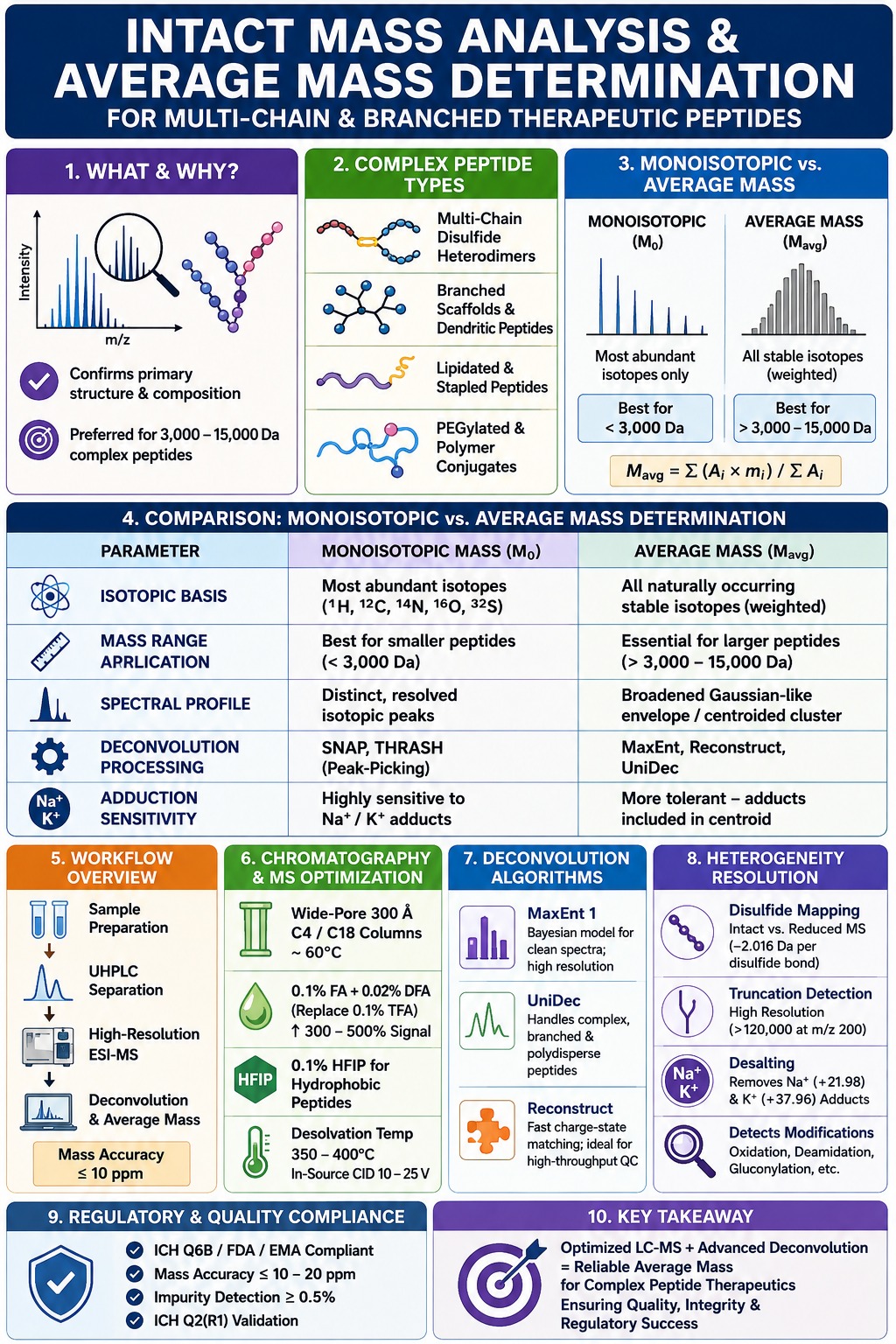
Advanced Structural Complexity in Multi-Chain and Branched Therapeutic Peptides
Multi-chain and branched therapeutic peptides present distinct mass spectrometric challenges arising from complex topologies, multidirectional amide linkages, inter-chain disulfide bonding, and localized ionization effects. In contrast to linear peptides, these structurally intricate molecules distribute charge across non-linear conformations, making gas-phase desolvation and mass spectral deconvolution substantially more difficult.
The increasing structural diversity of synthetic and recombinant peptide therapeutics introduces several analytical obstacles during mass spectrometric evaluation:
- Multi-Chain Disulfide Heterodimers: Therapeutic constructs such as recombinant insulin analogs and bispecific heterodimeric peptides depend on carefully controlled inter-chain and intra-chain disulfide connectivity. Partial disulfide formation or disulfide bond scrambling can alter higher-order structure and affect gas-phase protonation behavior, leading to shifts in charge-state distributions.
- Branched Scaffolds and Dendritic Architectures: Lysine-centered branched systems, including K₂K and K₄K₂K Multiple Antigen Peptide (MAP) constructs, contain multiple available amino termini. These basic functionalities promote extensive protonation during electrospray ionization (ESI), generating highly charged ion populations that increase spectral congestion in lower m/z regions.
- Lipidated and Hydrocarbon-Stapled Peptides: Modifications such as palmitoylation, myristoylation, and hydrocarbon stapling introduce pronounced hydrophobicity. These changes enhance chromatographic retention while simultaneously increasing susceptibility to ion suppression if mobile phase conditions are not properly optimized.
- Polydisperse Polymer Conjugates: PEGylated branched peptides exhibit inherent polymer heterogeneity, causing well-defined charge-state distributions to transform into broad and unresolved spectral envelopes that require sophisticated computational deconvolution approaches.
Tackle complex topologies with expert cyclic peptide characterization and structural analysis workflows.
Monoisotopic vs. Average Mass Determination in High-Molecular-Weight Peptides
Monoisotopic mass determination refers to the calculation of the exact molecular mass using only the most abundant isotopes (^1H, ^12C, ^14N, ^16O, and ^32S), whereas average mass determination represents the weighted mean mass derived from all naturally occurring stable isotopes within the isotopic distribution. For complex multi-chain and branched peptides with molecular weights exceeding approximately 3,000–5,000 Da, isotopic envelope broadening makes Intact Mass Analysis and Average Mass Determination the preferred analytical approach.
The shift from monoisotopic mass assignment to average mass determination is governed by isotope statistics. For peptides below approximately 2,000 Da, the monoisotopic species (M₀) generally remains the most abundant component of the isotopic cluster. However, as molecular size increases and the carbon atom count exceeds roughly 300 atoms, which is common in multi-chain or branched molecules ranging from 6–12 kDa, the probability of a molecule containing no ^13C atoms decreases dramatically to less than 1.5%.
Mavg = Σ(Ai × mi) / ΣAi
Under these circumstances, selecting a monoisotopic peak from a broad isotopic distribution becomes increasingly unreliable. Misassignment of M+2 or M+3 isotopic species as the monoisotopic peak can introduce systematic mass errors of 1–3 Da. Average mass determination addresses this limitation by incorporating the complete isotopic distribution into the calculation, producing highly reproducible molecular mass values that accurately reflect the elemental composition of the analyte.
Validate your formulations using robust peptide-physicochemical-characterization-services.
Comparison: Monoisotopic Mass vs. Average Mass Determination
| Analytical Parameter | Monoisotopic Mass (M₀) | Average Mass Determination (Mavg) |
|---|---|---|
| Isotopic Basis | Calculated exclusively from the most abundant isotopes (^1H, ^12C, ^14N, ^16O, ^32S). | Based on the weighted contribution of all naturally occurring stable isotopes. |
| Mass Range Application | Best suited for smaller peptides (<3,000 Da) with clearly resolved isotopic peaks. | Essential for larger peptides (>3,000–15,000 Da) and complex multi-chain systems. |
| Spectral Profile | Consists of distinct and individually resolved isotopic peaks. | Appears as a broadened Gaussian-like isotopic envelope or centroided cluster. |
| Deconvolution Processing | Commonly uses peak-picking algorithms such as SNAP and THRASH. | Utilizes algorithms such as MaxEnt, Reconstruct, and UniDec. |
| Adduction Sensitivity | Highly sensitive to individual sodium and potassium adducts. | More tolerant because adduct contributions are incorporated into the centroided distribution. |
Deepen your structural insights with advanced native mass spectrometry for therapeutic peptide characterization.
Analytical Workflows for Intact Mass Analysis and Average Mass Determination
Successful intact mass characterization depends on the integration of ultra-high-performance liquid chromatography (UHPLC) with high-resolution Orbitrap or Time-of-Flight (ToF) mass spectrometry platforms equipped with advanced charge-state deconvolution capabilities. This combination enables efficient desolvation, minimizes alkali metal adduction, and supports mass accuracy below 10 ppm for structurally complex peptide therapeutics.
Chromatographic Separation and ESI-MS Optimization for Intact Mass Analysis
Reversed-phase liquid chromatography (RPLC) employing wide-pore 300 Å C4 or C18 stationary phases operated at elevated temperatures around 60°C provides enhanced recovery and separation efficiency for branched and multi-chain peptide therapeutics. Mobile phase composition must be carefully optimized to achieve an appropriate balance between chromatographic performance and ionization efficiency.
During Intact Mass Analysis and Average Mass Determination of branched, stapled, or highly hydrophobic peptides, conventional ion-pairing conditions using 0.1% trifluoroacetic acid (TFA) often result in significant ion suppression during electrospray ionization. Several alternative strategies are commonly employed to improve analytical performance:
- Alternative Acid Modifiers: Substituting 0.1% TFA with 0.1% formic acid (FA) combined with 0.02% difluoroacetic acid (DFA) maintains strong chromatographic performance while significantly enhancing ESI signal intensity, often increasing ion abundance by approximately 300–500%.
- Hexafluoroisopropanol (HFIP) Mobile Phases: For highly hydrophobic stapled or lipidated peptides, inclusion of 0.1% HFIP within the aqueous mobile phase can improve desolvation efficiency and reduce chromatographic carryover.
- Ion Source Temperature Optimization: Desolvation temperatures between 350°C and 400°C, combined with moderate in-source collision-induced dissociation voltages of approximately 10–25 V, help eliminate solvent-related adducts without disrupting labile disulfide bonds or branched amide linkages.
Optimize your separation protocols with specialized glp-1-peptide-stability-analytical-methods.
High-Resolution MS Deconvolution Algorithms for Average Mass Determination
Mass deconvolution software converts complex multiply charged electrospray ionization spectra into zero-charge molecular mass profiles, enabling accurate average mass determination. Algorithms such as Maximum Entropy (MaxEnt 1), Reconstruct, and UniDec utilize advanced mathematical models to resolve overlapping charge states and broad isotopic envelopes associated with branched or heterogeneous peptide systems.
Several deconvolution approaches are widely used for transforming raw ESI spectra into neutral mass representations:
- Maximum Entropy (MaxEnt 1): This algorithm employs Bayesian statistical modeling to process clean denatured ESI spectra of multi-chain heterodimeric peptides, generating highly resolved zero-charge mass distributions.
- UniDec (Universal Deconvolution): UniDec uses sparse Bayesian deconvolution principles and accommodates non-linear charge-state assignments. It is particularly valuable for PEGylated peptides, polydisperse branched structures, and native multi-subunit complexes.
- Reconstruct Algorithm: This method performs rapid charge-state matching across adjacent spectral peaks, making it well suited for automated high-throughput quality control applications.
Uncover precise structural details using comprehensive peptide sequencing of glp-1 peptide.
Resolving Isotopic Envelope Broadening and Structural Heterogeneity
The broadening of isotopic envelopes in multi-chain and branched peptide therapeutics arises from the combined influence of naturally occurring isotopes and structural microheterogeneities such as incomplete disulfide formation, C-terminal truncation, and synthesis-related laddering products generated during solid-phase peptide synthesis (SPPS). Addressing these overlapping spectral features often requires complementary reduction experiments and high-resolution tandem mass spectrometry approaches.
To improve confidence in structural characterization, analytical laboratories routinely apply targeted strategies such as:
- Disulfide Mapping Through Comparative Intact and Reduced MS: Comparison of intact mass spectra with spectra obtained following reduction using DTT or TCEP enables confirmation of inter-chain stoichiometry and total disulfide bond content. Each intact disulfide bond contributes a mass decrease of 2.016 Da relative to the fully reduced form.
- Branch Deletion and Truncation Assessment: In highly branched synthetic peptides, including four-branch MAP constructs, incomplete coupling reactions during SPPS may generate N−1 or N−2 truncation products. Orbitrap instruments operating at resolutions greater than 120,000 at m/z 200 are often required to distinguish these low-level truncation species from the desired product envelope.
- On-Line Desalting and Alkali Metal Removal: Sodium (+21.98 Da) and potassium (+37.96 Da) adducts broaden charge-state distributions and can shift observed average mass values. Trap-and-elute micro-LC desalting systems effectively reduce these interferences prior to mass spectrometric analysis.
Ensure high product purity by tracking aggregation profiles using dedicated peptide aggregation analysis.
Regulatory Compliance and Mass Accuracy Criteria under ICH Q6B
Global regulatory agencies, including the FDA, EMA, and organizations operating under ICH Q6B guidance, recognize intact mass verification as a critical component of identity testing and comparability assessments for therapeutic peptides. Typical acceptance criteria for intact average mass determination are generally within ≤20 ppm, or ≤0.1 Da for peptides below 10 kDa, ensuring consistent product identity and manufacturing reproducibility.
To support regulatory submissions and ongoing quality control programs, intact mass characterization methods are expected to demonstrate:
- Verified Mass Accuracy: Sub-10 ppm mass accuracy achieved through the use of internal reference standards or frequent external calibration procedures.
- Impurity Characterization and Quantification: Reliable detection and reporting of low-level modifications at relative abundances as low as 0.5%, including methionine oxidation (+15.99 Da), asparagine deamidation (+0.98 Da), and gluconylation (+178.04 Da).
- Method Validation in Accordance with ICH Q2(R1): Demonstration of specificity, linearity, repeatability, intermediate precision, and overall analytical robustness.
Streamline your submissions with guidance from regulatory requirements for glp-1 peptide characterization.
Conclusion
Intact Mass Analysis and Average Mass Determination represent essential components of biopharmaceutical characterization for multi-chain and branched therapeutic peptides, providing accurate structural confirmation throughout drug development, quality control, and regulatory release activities. Through the combination of optimized wide-pore liquid chromatography, high-resolution ESI-MS instrumentation, and advanced deconvolution software such as UniDec and MaxEnt, analytical laboratories can consistently achieve sub-10 ppm mass accuracy even when evaluating highly complex multi-subunit peptide systems.
As therapeutic peptide pipelines continue to evolve toward increasingly sophisticated branched, conjugated, and multi-chain modalities, reliable intact mass analytical workflows remain indispensable for maintaining product quality, ensuring molecular integrity, and supporting successful regulatory approvals.
For specialized intact mass characterization, structural elucidation of complex branched peptide therapeutics, and ICH Q6B-compliant analytical services, connect with the biopharmaceutical mass spectrometry experts at ResolveMass Laboratories Inc. today.
Frequently Asked Questions (FAQs)
Intact mass analysis helps verify the presence and number of disulfide bonds by comparing the molecular mass of the native peptide with that of the reduced form. When disulfide bonds are chemically reduced, predictable mass changes occur due to hydrogen incorporation. Any deviation from the expected mass shift may indicate incomplete disulfide formation, bond scrambling, or incorrect chain pairing, allowing analysts to assess structural integrity.
Trifluoroacetic acid (TFA) is effective for chromatographic separation but can significantly suppress ionization in electrospray mass spectrometry. To improve signal intensity while maintaining acceptable peak shape, laboratories often use formic acid combined with low concentrations of difluoroacetic acid (DFA). For highly hydrophobic peptides, additives such as hexafluoroisopropanol (HFIP) may further enhance desolvation efficiency and improve mass spectrometric sensitivity.
Branched peptides frequently contain multiple amino termini and additional basic functional groups that readily accept protons during electrospray ionization. This results in the formation of higher charge states compared with linear peptides of similar molecular weight. Consequently, the mass spectrum often displays broader and more complex charge-state distributions that require advanced deconvolution techniques for accurate interpretation.
Regulatory agencies such as the FDA and EMA expect highly accurate mass measurements as part of therapeutic peptide characterization and release testing programs. In most applications, average mass determinations are expected to fall within tight ppm-level tolerances to confirm molecular identity and batch consistency. Demonstrating consistent mass accuracy is an important component of compliance with ICH Q6B and related regulatory guidance.
Intact mass analysis is highly effective for determining molecular weight but cannot independently distinguish between molecules that share the same elemental composition and exact mass. Structural variants such as sequence isomers or disulfide bond rearrangements may produce identical intact masses. In these situations, complementary techniques such as peptide mapping, tandem mass spectrometry (MS/MS), or ion mobility spectrometry are required for definitive structural differentiation.
Both UniDec and MaxEnt are widely used deconvolution tools, but they employ different computational approaches. MaxEnt is particularly effective for relatively clean spectra with predictable charge-state patterns, whereas UniDec offers greater flexibility when analyzing heterogeneous samples, non-linear charge distributions, and polydisperse conjugates. This makes UniDec especially valuable for complex branched peptides and polymer-modified therapeutic constructs.
Salt adducts formed by sodium and potassium ions can broaden spectral peaks and interfere with accurate mass calculations. To reduce these effects, samples are commonly subjected to desalting procedures such as reversed-phase trap columns, buffer exchange, or specialized clean-up methods before mass spectrometric analysis. Effective salt removal improves spectral clarity, enhances deconvolution quality, and increases confidence in mass measurements.
High-resolution mass spectrometry provides the resolving power necessary to distinguish closely related peptide species that differ by only a single amino acid residue. This capability is particularly important for identifying low-level synthesis-related impurities, including deletion sequences generated during solid-phase peptide synthesis. By separating overlapping mass signals, HRMS enables more accurate impurity profiling and product characterization.
Denaturing LC-MS conditions unfold peptide structures and disrupt non-covalent interactions that can complicate mass spectral interpretation. This promotes more uniform ionization, improves desolvation efficiency, and generates cleaner charge-state distributions. As a result, denaturing workflows generally provide more consistent and reproducible intact mass measurements for routine characterization and quality control of multi-chain peptide therapeutics.
Reference:
- European Medicines Agency. (1999). ICH Q6B: Specifications: test procedures and acceptance criteria for biotechnological/biological products – Scientific guideline (CPMP/ICH/365/96). European Medicines Agency. EMA Guideline Page
- Liu, X., Inbar, Y., Dorrestein, P. C., Wynne, C., Edwards, N., Souda, P., Whitelegge, J. P., Bafna, V., & Pevzner, P. A. (2010). Deconvolution and database search of complex tandem mass spectra of intact proteins: A combinatorial approach. Molecular & Cellular Proteomics, 9(12), 2772–2782. https://doi.org/10.1074/mcp.M110.002766
- Marty, M. T. (2020). A retrospective on native mass spectrometry and the rise of intact protein analysis. Journal of the American Society for Mass Spectrometry, 31(10), 2177–2188. https://doi.org/10.1021/jasms.0c00112
- Mast, N., Muneeruddin, K., Jozwiak, K., & Schriemer, D. C. (2025). Online native hydrophobic interaction chromatography–mass spectrometry of antibody-drug conjugates. Analytical Chemistry, 97(1), 168–177. https://doi.org/10.1021/acs.analchem.4c03940
Get In Touch With Us
About The Author


