


Introduction
In the rapidly evolving fields of pharmaceutical sciences and nanotechnology, the development of advanced drug delivery systems is essential to meet the growing demands for more effective, safer, and targeted therapies. This Introduction to Cyclodextrin-Based Dendrimers highlights their growing importance as a promising class of nanocarriers, owing to their unique combination of properties derived from both cyclodextrins and dendrimers. These hybrid molecules offer a versatile platform for enhancing drug solubility, stability, and controlled release—critical factors in modern drug delivery systems.
At Resolvemass Laboratories, we are at the forefront of custom synthesis and analytical services, offering specialized expertise in the development and characterization of cyclodextrin-based dendrimers for a wide range of biomedical applications. This blog provides an in-depth overview of these innovative molecules, exploring their structure, synthesis, and potential applications in controlled drug delivery.
Learn more about our specialized Custom Synthesis and Analytical Services for advanced nanocarriers.
Share via:
Key Highlights
- Cyclodextrin-based dendrimers are advanced nanocarriers that combine the inclusion capability of cyclodextrins with the highly branched structure of dendrimers for improved drug delivery.
- These hybrid systems enhance drug solubility, stability, and bioavailability, making them especially useful for poorly water-soluble therapeutic compounds.
- Their multifunctional design enables targeted drug delivery and controlled release, reducing side effects and improving therapeutic efficiency.
- Structural design, surface functionalization, and synthesis methods play a crucial role in tailoring their performance for specific biomedical applications.
- They are widely explored in drug delivery, gene therapy, imaging, and nanomedicine due to their versatility and biocompatibility.
- Despite challenges like scalability and regulatory approval, ongoing advancements are driving their future potential in precision medicine and next-generation therapeutics.
Understanding Cyclodextrins and Dendrimers
To fully appreciate the potential of cyclodextrin-based dendrimers, it is crucial to understand the individual components that make up these complex nanostructures.
Cyclodextrins: Cyclodextrins are cyclic oligosaccharides composed of glucose units linked by α-1,4-glycosidic bonds. These molecules have a distinctive toroidal shape, characterized by a hydrophobic cavity on the inside and a hydrophilic surface on the outside. This unique structure enables cyclodextrins to form host-guest inclusion complexes with various hydrophobic molecules, effectively encapsulating them within the cavity. The ability of cyclodextrins to increase the solubility and stability of poorly water-soluble drugs makes them highly valuable in pharmaceutical applications. Additionally, their biocompatibility and low toxicity contribute to their widespread use in drug formulation and delivery.
Discover more about the properties and applications of Cyclodextrins in pharmaceutical science.
Dendrimers: Dendrimers are highly branched, symmetrical macromolecules with a well-defined, tree-like architecture. They consist of three main components: a central core, branching units (also known as dendrons), and terminal functional groups. The precise control over the size, shape, and surface functionality of dendrimers during synthesis allows for the creation of molecules with tailored properties for specific applications. Dendrimers are known for their high degree of multivalency, which enables the attachment of multiple functional groups or active agents to their surface. This makes them ideal candidates for drug delivery, where they can serve as carriers for therapeutic agents, targeting ligands, or imaging molecules.
Structural Design Considerations of Cyclodextrin-Based Dendrimers
The structural design of cyclodextrin-based dendrimers plays a critical role in determining their functionality and performance in drug delivery applications. Factors such as dendrimer generation, type of cyclodextrin (α, β, or γ), and the density of surface functional groups significantly influence their physicochemical properties. By carefully selecting these parameters, researchers can tailor the size, molecular weight, and drug-loading capacity of the nanocarrier to suit specific therapeutic needs.
Moreover, the spatial arrangement of cyclodextrin units on the dendrimer surface affects the accessibility of the hydrophobic cavities for drug encapsulation. A well-optimized design ensures maximum interaction between the drug molecule and the carrier system. This structural precision enables the development of highly efficient delivery platforms capable of overcoming biological barriers and improving drug bioavailability.
We provide high-resolution NMR for Small Molecules to verify structural design and branch density.
Cyclodextrin-Based Dendrimers: A Synergistic Approach
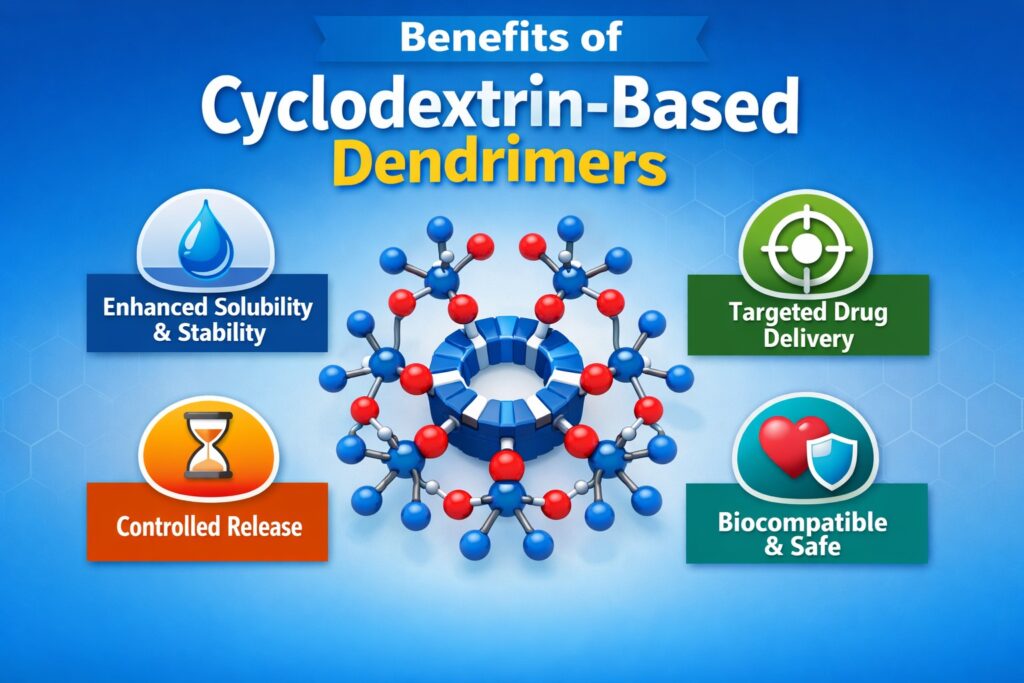
Cyclodextrin-based dendrimers represent a novel class of nanocarriers that combine the favorable properties of both cyclodextrins and dendrimers, resulting in a synergistic approach to drug delivery and other biomedical applications. The integration of cyclodextrins into the dendrimer structure offers several key advantages:
Enhanced Solubility and Stability:
- The hydrophobic cavity of cyclodextrins allows them to encapsulate poorly water-soluble drugs, thereby enhancing their solubility and bioavailability. This is particularly important for drugs with low aqueous solubility, which often present challenges in formulation and therapeutic efficacy.
- The dendritic structure of the dendrimer provides an additional layer of protection for the encapsulated drug, shielding it from environmental factors such as light, oxygen, and enzymes. This stabilization helps to prolong the shelf life of the drug and maintain its therapeutic potency.
Targeted Drug Delivery:
- Cyclodextrin-based dendrimers can be functionalized with targeting ligands, such as antibodies, peptides, or small molecules, that recognize specific receptors on the surface of target cells or tissues. This targeting capability enables the selective delivery of drugs to the desired site of action, reducing off-target effects and enhancing therapeutic outcomes.
- The multivalency of dendrimers allows for the attachment of multiple targeting ligands, increasing the likelihood of binding to target cells and improving the efficiency of drug delivery.
Controlled Release Mechanisms:
- The encapsulated drug can be released from the cyclodextrin-based dendrimer in a controlled manner, either through environmental triggers such as changes in pH, temperature, or ionic strength, or by enzymatic degradation of the dendrimer structure. This controlled release minimizes the frequency of drug administration and reduces the risk of side effects associated with high systemic drug concentrations.
- The ability to tailor the release profile of the drug by modifying the dendrimer structure or the type of cyclodextrin used offers significant flexibility in designing drug delivery systems for specific therapeutic needs.
Stimuli-Responsive Behavior in Drug Delivery
Cyclodextrin-based dendrimers can be engineered to respond to specific physiological or external stimuli, making them highly adaptable drug delivery systems. These stimuli may include variations in pH, temperature, redox conditions, or even light exposure. For instance, in tumor microenvironments where the pH is slightly acidic, these dendrimers can undergo structural changes that trigger the release of the encapsulated drug precisely at the target site.
This responsiveness enhances therapeutic efficiency while minimizing systemic side effects. The incorporation of stimuli-sensitive linkers or functional groups allows for dynamic control over drug release kinetics. As a result, such smart delivery systems are gaining prominence in precision medicine, where treatment can be tailored according to the biological environment of the disease.
Biocompatibility and Low Toxicity:
- Cyclodextrins are derived from natural sources, and their biocompatibility and low toxicity make them suitable for use in pharmaceutical applications. When combined with dendrimers, the resulting hybrid molecules retain these favorable properties, making cyclodextrin-based dendrimers a safe and effective option for drug delivery.
- The choice of dendrimer core and surface modifications can further enhance the biocompatibility and reduce the potential toxicity of these nanocarriers, ensuring their suitability for clinical use.
Ensure the purity of your hybrid molecules with our HPLC Analysis services.
Pharmacokinetics and Biodistribution
Understanding the pharmacokinetics and biodistribution of cyclodextrin-based dendrimers is essential for their successful clinical application. These parameters determine how the nanocarrier is absorbed, distributed, metabolized, and eliminated from the body. The size, surface charge, and functionalization of dendrimers significantly influence their circulation time and interaction with biological systems.
Optimizing these properties helps in achieving prolonged systemic circulation and efficient accumulation at the target site. Additionally, surface modifications such as PEGylation can reduce recognition by the immune system, thereby enhancing stability in the bloodstream. A well-balanced pharmacokinetic profile ensures improved therapeutic outcomes and reduced toxicity.
Synthesis of Cyclodextrin-Based Dendrimers
The synthesis of cyclodextrin-based dendrimers involves the conjugation of cyclodextrins to dendritic structures, which can be achieved through various strategies depending on the desired properties of the final product.
Covalent Conjugation:
- Covalent conjugation involves the formation of strong, stable bonds between cyclodextrins and the dendrimer core through chemical reactions such as click chemistry, esterification, or amidation. This approach ensures that the cyclodextrins are securely attached to the dendrimer, preventing their dissociation under physiological conditions.
- Covalent conjugation allows for precise control over the number and orientation of cyclodextrin units on the dendrimer surface, enabling the fine-tuning of drug encapsulation capacity, release rate, and targeting properties.
Non-Covalent Assembly:
- Non-covalent assembly relies on weaker interactions, such as hydrogen bonding, electrostatic forces, or host-guest interactions, to attach cyclodextrins to the dendrimer. This method is often easier to implement and allows for reversible assembly and disassembly of the dendrimer structure.
- Non-covalent assembly is particularly useful for applications where dynamic release or exchange of the cyclodextrin component is desired, such as in responsive drug delivery systems or stimuli-sensitive nanocarriers.
Surface Functionalization:
- Post-synthetic modification of cyclodextrin-based dendrimers involves the addition of functional groups to the surface of the dendrimer, which can be used for targeting, imaging, or other purposes. Surface functionalization enhances the versatility of the dendrimer and allows for customization according to specific application requirements.
- Functional groups can be chosen based on the desired interactions with biological targets, the intended route of administration, or the need for additional diagnostic or therapeutic functionalities.
Identify and quantify synthetic by-products using our Impurity Profiling using LCMS.
Scalability and Manufacturing Challenges
While cyclodextrin-based dendrimers show immense potential in laboratory settings, scaling up their production for industrial and clinical use presents several challenges. The complexity of synthesis, purification processes, and reproducibility of the final product can affect large-scale manufacturing. Maintaining consistency in structure and functionality is crucial for regulatory approval and commercialization.
Furthermore, cost-effectiveness is a significant consideration when transitioning from research to market. Advanced synthesis techniques and automation may help overcome these limitations. Continuous efforts are being made to develop simplified and scalable production methods without compromising the quality and performance of these nanocarriers.
Applications of Cyclodextrin-Based Dendrimers
The unique properties of cyclodextrin-based dendrimers make them suitable for a wide range of applications in the pharmaceutical and biomedical fields, including:
Drug Delivery Systems:
- Cyclodextrin-based dendrimers are extensively explored as carriers for anticancer drugs, antibiotics, and other therapeutic agents. Their ability to enhance solubility, stability, and targeted delivery makes them ideal candidates for developing advanced drug delivery systems that can improve the therapeutic index of existing drugs.
- These dendrimers are particularly promising for delivering chemotherapeutic agents, where targeted delivery and controlled release are critical for maximizing efficacy and minimizing toxicity. The ability to conjugate targeting ligands and imaging agents to the dendrimer surface further enhances their potential for use in theranostic applications.
Gene Therapy:
- The multivalency of dendrimers allows for the attachment of nucleic acids (e.g., DNA, siRNA) for gene delivery applications. Cyclodextrin-based dendrimers can protect the nucleic acid payload from degradation by nucleases, facilitate cellular uptake, and enhance transfection efficiency, making them valuable tools for gene therapy.
- Targeted gene delivery using cyclodextrin-based dendrimers can improve therapeutic outcomes by ensuring that the genetic material is delivered specifically to diseased cells, reducing the risk of off-target effects and increasing the precision of gene therapy.
Imaging and Diagnostics:
- Cyclodextrin-based dendrimers can be functionalized with imaging agents (e.g., fluorescent dyes, MRI contrast agents) for use in diagnostic applications. These dendrimers enable targeted imaging of specific tissues or disease markers, improving the accuracy and sensitivity of diagnostic procedures.
- The controlled release properties of these dendrimers also make them suitable for theranostic applications, where diagnosis and therapy are combined in a single platform. For example, a cyclodextrin-based dendrimer could be designed to deliver a therapeutic agent to a tumor site while simultaneously providing real-time imaging of the tumor’s response to treatment.
Nanomedicine:
- As nanocarriers, cyclodextrin-based dendrimers are part of the broader field of nanomedicine, which seeks to develop nanoscale systems for drug delivery, imaging, and therapy. Their versatility and biocompatibility position them as valuable tools in the design of next-generation nanomedicines that can address unmet medical needs and improve patient outcomes.
- The potential of cyclodextrin-based dendrimers in nanomedicine extends beyond drug delivery, as they can
For dendrimers functionalized with targeting peptides, explore our NMR for Peptides services for precise conformation data.
Regulatory and Safety Considerations
The clinical translation of cyclodextrin-based dendrimers requires thorough evaluation of their safety, efficacy, and regulatory compliance. Regulatory agencies demand comprehensive data on toxicity, immunogenicity, and long-term effects before approving these nanocarriers for human use. Preclinical and clinical studies must demonstrate that the system is safe for repeated administration.
In addition, standardized protocols for characterization and quality control are essential to ensure consistency across batches. Regulatory frameworks for nanomedicine are still evolving, which can pose challenges for developers. However, ongoing advancements in regulatory science are expected to facilitate smoother approval processes in the future.
Future Perspectives and Emerging Trends
The future of cyclodextrin-based dendrimers lies in the integration of advanced technologies such as artificial intelligence, machine learning, and precision medicine. These tools can assist in predicting optimal dendrimer structures, drug interactions, and patient-specific treatment strategies. This convergence of technologies is expected to accelerate the development of highly efficient and personalized drug delivery systems.
Additionally, research is expanding into multifunctional dendrimers capable of simultaneous drug delivery, imaging, and therapeutic monitoring. Innovations in green chemistry and sustainable synthesis methods are also gaining attention, aiming to reduce environmental impact. As research progresses, cyclodextrin-based dendrimers are poised to play a pivotal role in the next generation of biomedical innovations.
Conclusion
Cyclodextrin-based dendrimers represent a powerful and versatile platform in the field of advanced drug delivery and nanomedicine. By combining the inclusion capabilities of cyclodextrins with the highly branched architecture of dendrimers, these hybrid systems offer enhanced solubility, stability, targeting, and controlled release of therapeutic agents. Their adaptability and multifunctionality make them suitable for a wide range of biomedical applications, from drug delivery to diagnostics and gene therapy.
Despite existing challenges related to scalability, regulatory approval, and long-term safety, ongoing research and technological advancements continue to address these limitations. As the field evolves, cyclodextrin-based dendrimers are expected to contribute significantly to the development of safer, more effective, and personalized therapeutic solutions, ultimately improving patient care and treatment outcomes.
Get in touch with us today to discover how we can help accelerate your next breakthrough in pharmaceutical and nanotechnology research – Contact us
Frequently Asked Questions (FAQs)
Cyclodextrins are used because they can trap poorly soluble drugs within their hydrophobic cavity, improving solubility and stability. This helps enhance the bioavailability of drugs that would otherwise be difficult to deliver effectively. Their natural origin and low toxicity further make them suitable for pharmaceutical use.
Dendrimers improve drug delivery by offering a highly controlled and uniform structure with multiple surface groups for drug attachment. Their branched architecture allows for high drug-loading capacity and targeted delivery. This helps reduce side effects while increasing the therapeutic effectiveness of the drug.
Unlike traditional carriers, these dendrimers provide both encapsulation and surface functionalization in a single system. This dual capability enhances drug stability, targeting, and controlled release. As a result, they offer more precise and efficient delivery compared to many conventional methods.
They are generally considered biocompatible, especially when designed with safe materials and proper surface modifications. However, their safety depends on factors like size, charge, and dosage. Extensive preclinical and clinical studies are required to confirm their safety for specific medical applications.
Some major challenges include complex synthesis procedures, high production costs, and scalability issues. Additionally, regulatory approval requires detailed safety and efficacy data. Researchers are actively working on simplifying production and improving their clinical translation.
Reference:
- González-Gaitano, G., Isasi, J. R., Velaz, I., & Zornoza, A. (2022). Cyclodextrin-based drug delivery systems: Current status and future perspectives. Pharmaceutics, 14(11), 2388. https://doi.org/10.3390/pharmaceutics14112388
- Wang, H., Shao, N., Qiao, S., & Cheng, Y. (2012). Host–guest chemistry of dendrimer–cyclodextrin conjugates: Selective encapsulations of guests within dendrimer or cyclodextrin cavities revealed by NOE NMR techniques. The Journal of Physical Chemistry B, 116(36), 11217–11224. https://doi.org/10.1021/jp3062916
- Zhang, Y., Xu, Y., Li, H., Sun, Y., & Chen, G. (2022). β-Cyclodextrin and oligoarginine peptide-based dendrimer-entrapped gold nanoparticles for improving drug delivery to the inner ear. Frontiers in Bioengineering and Biotechnology, 10, 838508. https://doi.org/10.3389/fbioe.2022.838508

