

Introduction
The Isotope Effect in OLED Materials has emerged as one of the most effective molecular engineering strategies for improving device stability. In simple terms, hydrogen atoms in organic molecules are replaced with deuterium. This small atomic change leads to lower vibrational energy, reduced non-radiative decay, and better resistance to exciton-driven degradation. These improvements directly translate into longer OLED lifetime.
In blue and deep-blue OLED systems, exciton energies often exceed 2.7 eV. At such high energy levels, weaker C–H bonds are more likely to break under electrical excitation. Deuteration strengthens these vulnerable bonds without changing the core electronic structure or altering the emission color.
This article focuses specifically on how the Isotope Effect in OLED Materials enhances operational lifetime. The discussion is supported by peer-reviewed experimental studies and real device performance data.
Learn more about the latest trends in the field: Deuterated Polymers: A Cornerstone Guide to Synthesis, Applications, and Future Trends
🔎 Executive Summary
- Isotope Effect in OLED Materials directly improves operational lifetime by suppressing non-radiative decay pathways through C–H to C–D substitution.
- Deuteration reduces high-frequency vibrational modes, lowering exciton–vibration coupling and minimizing bond cleavage under electrical stress.
- Peer-reviewed studies (Nature Communications, Advanced Functional Materials, RSC, ACS, Wiley, MDPI) demonstrate 2–4× lifetime extension in deuterated TADF, phosphorescent, and host materials.
- The kinetic isotope effect strengthens chemical stability, reducing exciton-induced degradation and triplet–triplet annihilation damage.
- Deuteration enhances photoluminescence quantum yield (PLQY), stabilizes excited states, and mitigates hot-exciton degradation.
- The strategy is especially impactful in deep-blue OLEDs, where high-energy excitons accelerate C–H bond cleavage.
- Selective vs. perdeuteration approaches influence cost-performance balance.
- Advanced isotopic synthesis and analytical validation are critical to ensure material purity and reproducibility.
1️⃣ Why Does the Isotope Effect in OLED Materials Improve Device Lifetime?
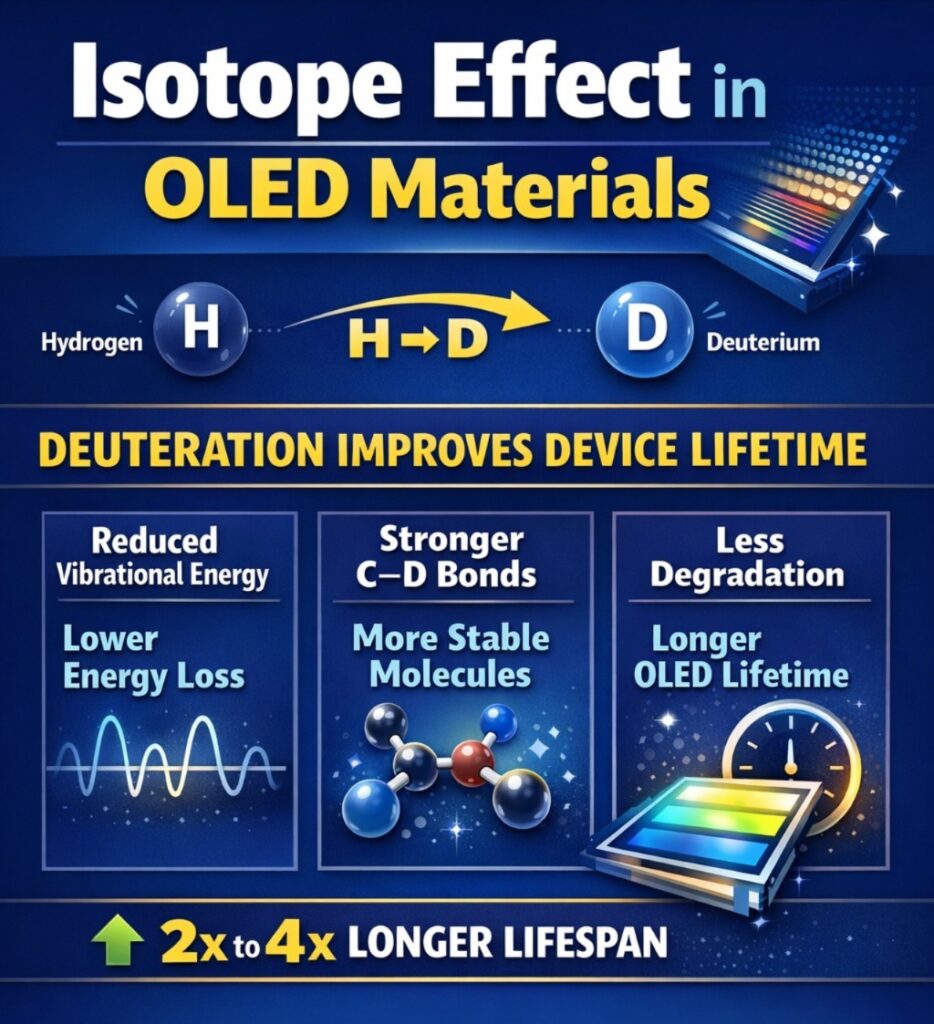
C–D bonds vibrate at lower frequencies and are slightly stronger than C–H bonds. This reduces exciton-induced bond cleavage and limits non-radiative energy loss.
Mechanistic Insight into the Isotope Effect in OLED Materials
The performance improvement can be explained through three connected mechanisms.
✔ Reduced Vibrational Energy
C–H stretching frequency ≈ 3000 cm⁻¹
C–D stretching frequency ≈ 2200 cm⁻¹
Lower vibrational energy reduces the probability of energy loss through vibrational relaxation. This means fewer excitons decay without emitting light. As a result, more energy is converted into useful emission instead of heat.
✔ Suppression of Internal Conversion
Non-radiative decay rate (k_nr) decreases when high-frequency vibrations are suppressed. Deuteration reduces internal conversion from excited singlet or triplet states. This stabilizes the excited-state population and supports better delayed fluorescence in TADF systems.
Studies such as Huang et al., 2024 (Nature Photonics) and Cheng et al., 2022 report measurable reductions in k_nr for deuterated emitters. These improvements help maintain emission efficiency during extended operation.
✔ Higher Bond Dissociation Energy
C–D bonds are approximately 5–10 kJ/mol stronger than C–H bonds. This small increase makes a significant difference under electrical stress. Stronger bonds reduce radical formation and slow down chemical degradation pathways inside the emissive layer.
Explore high-quality materials for your next project: Buy Deuterated Benzene D6 for OLED Applications
2️⃣ How the Isotope Effect in OLED Materials Suppresses Non-Radiative Decay
Deuteration reduces exciton–vibration coupling, which lowers non-radiative decay and improves PLQY.
Non-radiative decay competes directly with light emission. When k_nr decreases, efficiency increases and long-term stability improves. The Isotope Effect in OLED Materials changes the vibrational profile of the molecule, shifting the balance toward radiative decay.
Experimental Evidence Supporting the Isotope Effect in OLED Materials
Huang et al., 2024 (Nature Photonics) demonstrated that perdeuterated blue TADF emitters showed reduced k_nr and improved operational stability under constant current testing.
Cheng et al., 2022 (Chemical Engineering Journal) reported higher luminescence efficiency and longer device lifetime in donor-deuterated TADF systems. The study clearly confirmed a positive isotope effect.
Song et al., 2025 (RSC) observed improved structural stability and longer lifetime in deuterated Pt(II) phosphorescent complexes. Reduced vibrational coupling played a key role.
Shao et al., 2014 (Nature Communications) showed that isotopic substitution in conducting polymers enhanced voltage stability. This indicates broader electronic benefits beyond emissive materials.
Across different material classes, deuterated systems consistently show higher PLQY and lower vibrational losses. These improvements are especially important in high-energy blue OLED devices.
Partner with a leading expert in the industry: Deuterated Labelled Chemical Synthesis Company in United States
3️⃣ Why the Isotope Effect in OLED Materials Is Crucial for Blue OLED Stability
Blue OLEDs operate at higher energies, making C–H bonds more vulnerable to cleavage.
Blue and deep-blue emitters often exceed 2.8 eV triplet energy. At these levels, bond rupture becomes more likely. Over time, this leads to defect formation and brightness decay. The Isotope Effect in OLED Materials strengthens these sensitive bonds and reduces degradation risk.
Jung et al., 2023 (Nature Communications) showed that deuteration of acceptor units in TADF compounds improved device lifetime by up to four times under constant luminance testing.
Yuan et al., 2025 (Nature Communications) reported extended LT95 lifetime in deep-blue phosphorescent OLEDs using deuterated host materials. Host stabilization reduced energy-transfer-related degradation.
Because blue devices operate close to bond dissociation thresholds, even small increases in bond strength can result in significant stability improvements.
Understand the science behind the stability: Why Benzene D6 Improves Stability in OLEDs
4️⃣ Device-Level Improvements from the Isotope Effect in OLED Materials
Deuterated OLED materials consistently show longer LT50 and LT95 lifetimes at the same brightness levels.
Reported improvements include:
- Blue TADF (perdeuteration): 2–3× lifetime extension
- Deep-blue phosphorescent (host deuteration): 3–4× improvement
- Pt(II) emitters (selective deuteration): improved exciton stability
- Copper(I) sensitizers (ligand deuteration): LT95 extended to 3689 h @ 1000 cd/m²
In addition to longer lifetime, devices often show reduced efficiency roll-off at high brightness. Lower exciton-induced quenching improves operational stability during prolonged use.
Importantly, emission efficiency is typically maintained or slightly improved. The Isotope Effect in OLED Materials strengthens stability without sacrificing performance.
Access a comprehensive range of specialized chemicals: Availability of All the Deuterated Chemicals
5️⃣ Selective vs. Perdeuteration: Maximizing the Isotope Effect in OLED Materials
Selective deuteration can achieve strong stability gains with lower cost.
Selective deuteration targets specific vibrational hotspots, such as donor or acceptor units. This focused approach reduces synthetic complexity while maintaining significant isotope benefits. It is especially useful when exciton localization is well understood.
Perdeuteration replaces all hydrogen atoms with deuterium. This provides maximum vibrational damping and uniform protection. However, it increases material cost and synthesis time.
Research indicates that acceptor-unit deuteration strongly influences stability, while donor deuteration can enhance delayed fluorescence. A balanced design strategy ensures the best commercial outcome.
Optimize your device performance with custom solutions: Custom Deuterated Compounds for Specialized Research
6️⃣ Kinetic Isotope Effect and Exciton Stability in OLED Materials
The kinetic isotope effect slows degradation reactions.
Reaction rates depend on vibrational frequency. Because C–D bonds vibrate more slowly than C–H bonds, chemical reactions involving bond cleavage proceed at a slower rate. This delays defect formation inside the device.
This effect is important in triplet–triplet annihilation and exciton–polaron interactions. Slower reaction kinetics reduce radical formation and improve thermal and electrochemical stability.
Recent ACS and RSC studies (2025) confirm that deuterated materials exhibit improved resistance to vibrationally assisted decay. These findings reinforce the importance of the Isotope Effect in OLED Materials for long-term durability.
Source your materials from a trusted global provider: Supplier of Deuterated Reagents for Advanced Technology
7️⃣ Advanced Characterization Validating the Isotope Effect in OLED Materials
To confirm the isotope effect, multiple analytical methods are used to verify structure and performance.
Common techniques include:
- Time-resolved photoluminescence (TRPL)
- Transient absorption spectroscopy
- Fourier-transform infrared spectroscopy (FTIR)
- LT50 and LT95 lifetime testing
- Mass spectrometry for isotopic purity
FTIR confirms C–D incorporation through characteristic vibrational shifts. TRPL measures changes in excited-state decay. Mass spectrometry ensures high isotopic purity.
Incomplete substitution reduces measurable benefits. Therefore, precise synthesis and analytical validation are essential for consistent performance.
Ensure the highest standards of purity for your materials: Analytical Characterization of Deuterated Compounds
8️⃣ Industrial Implications of the Isotope Effect in OLED Materials
The Isotope Effect in OLED Materials is not limited to laboratory research. It has direct implications for commercial manufacturing.
Applications include:
- Commercial blue OLED displays
- Automotive lighting systems
- AR/VR microdisplays
- High-brightness signage panels
Deuteration enables higher brightness operation and reduces burn-in risk. This improves warranty performance and lowers long-term replacement costs.
Although isotopic synthesis increases material cost, the extended lifetime often justifies the investment in high-performance applications. Manufacturers must balance cost with durability and reliability targets.
Conclusion
The Isotope Effect in OLED Materials represents a powerful and practical strategy for improving device lifetime. By replacing C–H bonds with C–D bonds, researchers can reduce non-radiative decay, slow chemical degradation, and stabilize excited states. These changes result in measurable lifetime improvements.
Peer-reviewed studies consistently report 2–4× longer operational lifetimes, especially in blue and deep-blue systems. At the same time, efficiency is maintained or slightly enhanced.
As OLED devices move toward higher brightness and longer warranty requirements, isotopic engineering will remain an essential tool for achieving reliable and durable performance.
Frequently Asked Questions (FAQs)
The isotope effect refers to the change in physical or chemical behavior when one atom in a molecule is replaced with its heavier isotope. For example, replacing hydrogen with deuterium changes bond vibration and reaction speed. Because heavier isotopes vibrate more slowly, they can influence reaction rates and material stability. This effect is widely used in chemistry and materials science to improve performance.
OLED displays use organic semiconductor materials that emit light when electricity passes through them. Common materials include small organic molecules and polymers such as Alq₃ (tris(8-hydroxyquinoline) aluminum), TADF emitters, and phosphorescent metal complexes containing iridium or platinum. These compounds are carefully designed to produce red, green, or blue light. The exact chemical depends on the device structure and desired color output.
One main disadvantage of OLED technology is its limited lifetime compared to some inorganic display technologies. Blue OLED materials, in particular, tend to degrade faster under continuous operation. OLED panels can also be sensitive to moisture and oxygen, requiring strong encapsulation. In some cases, long-term use may lead to brightness reduction or image retention.
The biggest challenge for OLED technology is long-term stability, especially for blue emitters. High-energy excitons can damage organic molecules over time, leading to reduced brightness. This degradation affects overall device lifetime and warranty performance. Improving material stability remains a major focus of research and development.
An OLED works by passing an electric current through thin layers of organic materials placed between two electrodes. When electrons and holes meet inside the emissive layer, they form excitons. These excitons release energy in the form of visible light. The color of light depends on the specific organic emitter used.
OLED displays offer excellent color contrast because each pixel emits its own light. They are also very thin and flexible, allowing innovative screen designs. In addition, OLEDs provide wide viewing angles and fast response times. These advantages make them popular in smartphones, TVs, and wearable devices.
OLED devices contain several organic layers, including hole transport materials, electron transport materials, and emissive materials. The emissive layer may consist of fluorescent, phosphorescent, or TADF compounds. These materials are made of carbon-based molecules designed for efficient charge transport and light emission. Each layer plays a specific role in achieving high efficiency and stable performance.
Reference
- Munir, R., Zahoor, A. F., Khan, S. G., Hussain, S. M., Noreen, R., Mansha, A., Hafeez, F., Irfan, A., & Ahmad, M. (2025, August 21). Total syntheses of deuterated drugs: A comprehensive review. Top Current Chemistry (Cham), 383(3), 31. https://doi.org/10.1007/s41061-025-00515-x
- Di Martino, R. M., Maxwell, B. D., & Pirali, T. (2023). Deuterium in drug discovery: Progress, opportunities and challenges. Nature Reviews Drug Discovery, 22(7), 562–584. https://doi.org/10.1038/s41573-023-00703-8
- Kopf, S., Bourriquen, F., Li, W., … & Morandi, B. (2022). Recent developments for the deuterium and tritium labeling of organic molecules. Chemical Reviews, 122(6), 6634-6713. https://doi.org/10.1021/acs.chemrev.1c00795
Get In Touch With Us
About The Author


