

Introduction:
IVIVC for PLGA based Injectable Formulations has become increasingly important in the development of long-acting parenteral drug delivery systems. Pharmaceutical companies developing PLGA microsphere formulation development, nanoparticles, implants, and depot injections rely on IVIVC models to predict clinical performance using laboratory-based release testing.
PLGA (poly(lactic-co-glycolic acid)) for parenteral use is one of the most widely used biodegradable polymers for injectable sustained-release formulations. However, PLGA systems are scientifically complex because drug release depends on multiple interconnected mechanisms including diffusion, polymer erosion, hydration, autocatalysis, and degradation kinetics.
The selection of appropriate polymer grade also plays a critical role in release behavior and product performance. Learn more about the role of PLGA polymer grade in long-acting release formulation.
A well-designed IVIVC model enables formulators to:
- Predict in vivo drug release behavior
- Optimize formulation parameters
- Reduce formulation development cycles
- Minimize costly in vivo studies
- Support regulatory submissions and lifecycle management
For pharmaceutical developers working on long-acting injectables, robust IVIVC strategies are now considered a major component of risk reduction and product quality assurance in long-acting injectable drug delivery technologies.
Summary:
- IVIVC for PLGA based Injectable Formulations helps predict in vivo drug release and pharmacokinetic behavior using in vitro data.
- Establishing a robust IVIVC can reduce development timelines, minimize animal studies, and support regulatory submissions.
- PLGA injectable systems present unique challenges due to polymer degradation, burst release, and complex release kinetics.
- Advanced analytical characterization, dissolution modeling, and pharmacokinetic evaluation are essential for successful IVIVC development.
- Regulatory agencies encourage scientifically justified IVIVC models to support formulation optimization and post-approval changes.
- ResolveMass Laboratories Inc. provides analytical expertise for PLGA characterization, release testing, degradation profiling, and bioanalytical support for long-acting injectable development.
1: What is IVIVC for PLGA Based Injectable Formulations?
IVIVC for PLGA based Injectable Formulations refers to the mathematical relationship between an in vitro drug release profile and the corresponding in vivo pharmacokinetic response. In other words, it helps scientists predict how a PLGA injectable formulation will behave inside the body based on laboratory release testing.
For PLGA-based long-acting injectables, IVIVC plays a crucial role in formulation development, quality control, and regulatory evaluation. Since these systems are designed to release drugs over weeks or months, understanding the correlation between laboratory data and actual biological performance is essential for ensuring consistent therapeutic outcomes.
PLGA formulations are highly sensitive to multiple formulation and manufacturing variables, including polymer molecular weight, lactide:glycolide ratio, particle size distribution, and residual solvent content. Comprehensive PLGA characterization methods are therefore essential for establishing reproducible IVIVC relationships.
- Polymer molecular weight
- Lactide:glycolide ratio
- Particle size distribution
- Residual solvent content
- Drug loading and encapsulation efficiency
- Manufacturing process conditions
For generic long-acting injectables, advanced PLGA polymer characterization for generics helps support formulation equivalence and regulatory submissions.
Even small changes in these parameters can significantly alter drug release kinetics and in vivo behavior.
Why IVIVC Matters for PLGA Injectables
A robust and validated IVIVC model offers several important advantages during pharmaceutical development:
| Benefit | Impact |
|---|---|
| Faster formulation optimization | Reduces R&D timelines |
| Fewer animal studies | Lowers development costs |
| Better batch consistency | Improves product quality |
| Regulatory support | Facilitates post-approval changes |
| Predictive dissolution methods | Enhances QC reliability |
For long-acting injectable products, predictive release behavior is especially critical because the dosage form may remain active in the body for extended periods. A scientifically sound IVIVC model helps developers better understand formulation performance, reduce development risks, and improve regulatory confidence in PLGA-based injectable drug products.
2: Understanding PLGA-Based Injectable Formulations
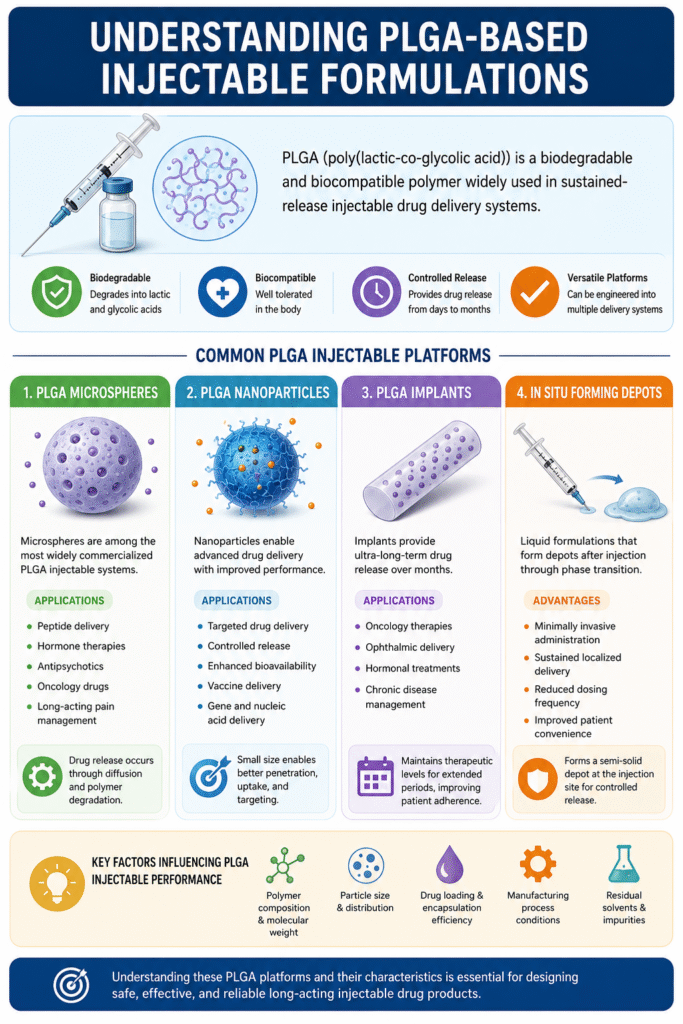
PLGA (poly(lactic-co-glycolic acid)) is a biodegradable and biocompatible polymer widely used in sustained-release injectable drug delivery systems. Due to its excellent safety profile and controlled degradation characteristics, PLGA has become one of the most important polymers for developing long-acting parenteral formulations.
PLGA-based injectables are designed to deliver therapeutic agents over extended periods ranging from days to several months. The polymer gradually degrades into lactic acid and glycolic acid, which are naturally metabolized by the body. This makes PLGA especially attractive for pharmaceutical applications requiring controlled and predictable drug release.
The versatility of PLGA allows it to be formulated into multiple injectable delivery platforms depending on the therapeutic objective, release duration, and drug properties.
Common PLGA Injectable Platforms:
1. PLGA Microspheres
PLGA microspheres are among the most widely commercialized sustained-release injectable systems. Detailed understanding of PLGA microsphere formulation development is essential for controlling drug release kinetics and ensuring formulation reproducibility.
For peptide-based products, specialized approaches for PLGA peptide delivery are often required to maintain peptide stability and encapsulation efficiency.
Developers working with highly potent compounds can also explore strategies for formulating highly potent APIs using PLGA microspheres.
Microsphere-based formulations are commonly used for:
- Peptide delivery
- Hormone therapies
- Antipsychotic medications
- Oncology treatments
- Long-acting pain management therapies
Drug release from PLGA microspheres typically occurs through a combination of diffusion and polymer degradation mechanisms. Factors such as particle size, polymer molecular weight, and drug loading significantly influence release kinetics.
2. PLGA Nanoparticles
PLGA nanoparticles are widely investigated for targeted drug delivery and controlled release applications. Understanding the differences between PLGA nanoparticles vs microspheres is important when selecting the appropriate delivery platform.
PLGA nanoparticles are frequently utilized for:
- Targeted drug delivery
- Controlled and sustained release
- Enhanced bioavailability
- Vaccine delivery systems
- Gene and nucleic acid delivery
Nanoparticle systems are especially valuable for poorly soluble drugs and therapies requiring site-specific targeting.
3. PLGA Implants
PLGA implants are designed for ultra-long-term drug release and are increasingly used in oncology and ophthalmic applications. Explore additional insights on PLGA for oncology implant development and the dexamethasone implant PLGA characterization case study.
Common therapeutic applications include:
- Oncology therapies
- Ophthalmic drug delivery
- Hormonal treatments
- Chronic disease management
Because implants maintain therapeutic drug concentrations for extended durations, they can improve patient compliance and reduce dosing frequency.
4. In Situ Forming Depots
In situ forming depots are injectable liquid formulations that transform into semi-solid or solid depots after administration. Depot formation occurs through mechanisms such as solvent exchange, phase inversion, or polymer precipitation.
These systems offer several advantages:
- Minimally invasive administration
- Sustained localized drug delivery
- Reduced dosing frequency
- Improved patient convenience
In situ depot technologies are increasingly explored for peptides, biologics, oncology agents, and chronic disease therapies.
3: Why IVIVC is Challenging for PLGA Systems
Developing IVIVC for PLGA based Injectable Formulations is considerably more complex than establishing IVIVC for conventional oral dosage forms. PLGA systems involve multiple overlapping release mechanisms, polymer-related variability, and highly dynamic physiological interactions that are difficult to reproduce under laboratory conditions.
Even small polymer-related changes can alter in vivo performance. Careful supplier selection and raw material consistency are therefore essential. Learn more about important PLGA supplier benefits and GMP PLGA requirements.
1. Multiple Drug Release Mechanisms
Drug release from PLGA formulations rarely occurs through a single mechanism. Instead, several processes may occur simultaneously or sequentially throughout the release period.
Common release mechanisms include:
- Initial burst release from surface-associated drug
- Diffusion-controlled release through the polymer matrix
- Polymer erosion during biodegradation
- Bulk degradation of the PLGA polymer backbone
- Pore formation within the formulation matrix
- Autocatalytic degradation caused by acidic degradation products
Because these mechanisms overlap, PLGA systems often exhibit complex and non-linear drug release profiles. This makes it challenging to directly correlate in vitro dissolution data with in vivo pharmacokinetic behavior.
2. Polymer Variability
PLGA polymer characteristics strongly influence drug release kinetics and overall formulation performance. Even small variations in polymer properties can significantly alter degradation behavior and release profiles.
Critical PLGA Variables Affecting IVIVC
| PLGA Attribute | Impact on Drug Release |
|---|---|
| Lactide:glycolide ratio | Controls degradation rate |
| Molecular weight | Affects erosion kinetics |
| End-group chemistry | Influences hydrophilicity |
| Polymer crystallinity | Alters diffusion behavior |
| Residual monomers | Can accelerate degradation |
For example, a higher glycolide content generally increases polymer hydrophilicity and accelerates degradation, while higher molecular weight PLGA often prolongs drug release duration.
These polymer-dependent effects create substantial challenges when attempting to develop robust and predictive IVIVC models.
3. Physiological Complexity
In vivo environments introduce numerous biological variables that are difficult to replicate accurately in vitro. Once administered, PLGA injectables interact with tissues, fluids, enzymes, and immune components that can alter degradation and drug release behavior.
Important physiological factors include:
- Enzymatic activity
- Local pH fluctuations
- Tissue fluid dynamics
- Immune response and inflammation
- Injection site variability
- Cellular interactions
For long-acting injectable formulations, these physiological influences may change continuously over weeks or months, further complicating IVIVC development.
As a result, designing biorelevant in vitro release methods that accurately predict in vivo performance remains one of the biggest scientific challenges in PLGA formulation development.
4: Types of IVIVC Models Used for PLGA Injectables
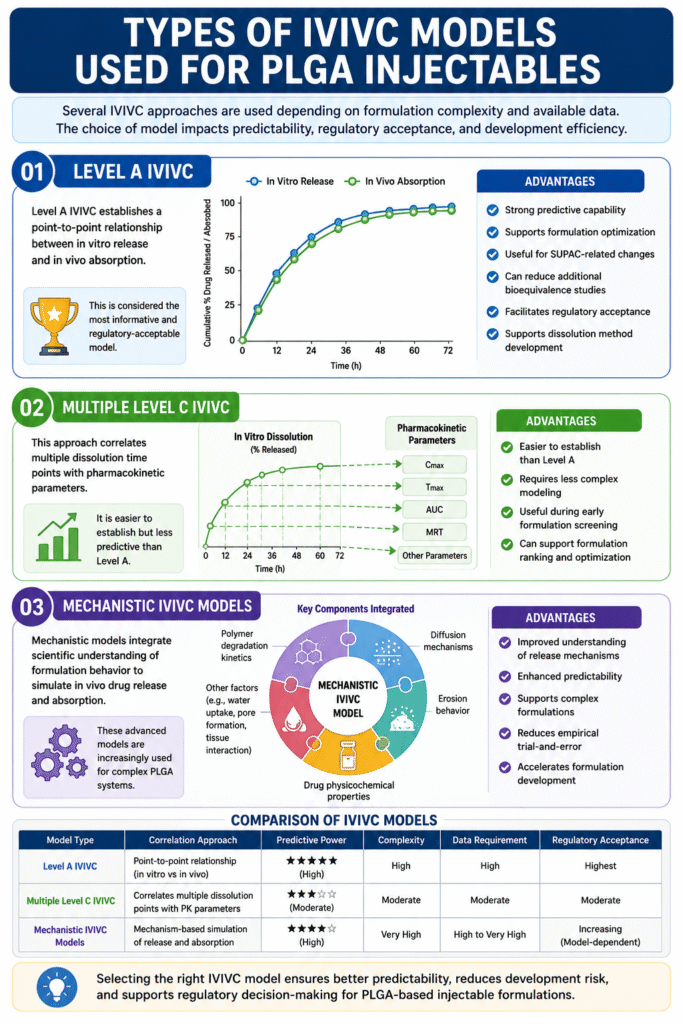
Several types of In Vitro–In Vivo Correlation (IVIVC) models are used for PLGA injectable formulations depending on the complexity of the formulation, release kinetics, and the availability of pharmacokinetic data. Since PLGA systems often exhibit multiphasic and non-linear drug release behavior, selecting the appropriate IVIVC approach is critical for achieving reliable predictability and regulatory acceptance.
1. Level A IVIVC
Level A IVIVC establishes a direct point-to-point relationship between the in vitro drug release profile and the in vivo absorption profile. This means that every time point in the dissolution curve is mathematically correlated with the corresponding in vivo drug absorption data.
Level A is considered the most informative and scientifically robust IVIVC model because it provides the highest predictive capability for formulation performance.
Advantages of Level A IVIVC
- Strong predictive capability
- Supports formulation optimization
- Useful for SUPAC-related changes
- Can reduce additional bioequivalence studies
- Facilitates regulatory acceptance
- Supports dissolution method development
Because of its predictive strength, regulatory agencies such as the FDA generally consider Level A IVIVC the preferred model whenever feasible.
However, establishing Level A IVIVC for PLGA systems can be difficult due to complex release mechanisms such as burst release, polymer degradation, and erosion-controlled drug release.
2. Multiple Level C IVIVC
Multiple Level C IVIVC correlates several in vitro dissolution time points with one or more pharmacokinetic parameters such as:
- Cmax
- Tmax
- AUC
- Mean residence time
Unlike Level A IVIVC, this model does not provide a complete point-to-point correlation. Instead, it evaluates whether specific dissolution characteristics are associated with important in vivo outcomes.
Advantages of Multiple Level C IVIVC
- Easier to establish than Level A
- Requires less complex mathematical modeling
- Useful during early formulation screening
- Can support formulation ranking and optimization
Although Multiple Level C IVIVC is less predictive than Level A, it remains valuable for many complex PLGA formulations where full Level A correlation may not be achievable.
3. Mechanistic IVIVC Models
Mechanistic IVIVC approaches are increasingly important for reverse engineering and complex generic development programs. Pharmaceutical developers working on generic long-acting injectables often utilize PLGA reverse engineering for ANDA strategies to establish formulation equivalence.
Additional insights are available through PLGA reverse engineering CRO services and the case study on reverse engineering of PLGA polymer in Lupron Depot.
Mechanistic approaches may integrate:
- Polymer degradation kinetics
- Diffusion mechanisms
- Polymer erosion behavior
- Drug physicochemical properties
- Water penetration dynamics
- Pore formation processes
- Tissue interaction effects
These advanced models attempt to describe the actual physical and chemical processes occurring within the formulation after administration.
Advantages of Mechanistic Models
| Benefit | Importance |
|---|---|
| Improved understanding of release mechanisms | Better formulation design |
| Enhanced predictability | More accurate IVIVC |
| Supports complex formulations | Useful for long-acting injectables |
| Reduces empirical trial-and-error | Faster development |
Mechanistic IVIVC models are increasingly supported by advanced computational tools, PBPK modeling, and artificial intelligence-driven simulations, making them highly promising for next-generation PLGA injectable development.
5: Critical Factors Affecting IVIVC for PLGA Based Injectable Formulations
Detailed polymer characterization remains one of the most important factors for predictive IVIVC development. Advanced PLGA characterization methods help evaluate molecular weight distribution, copolymer ratio, degradation kinetics, and residual solvents.
Complex depot products such as Lupron require extensive analytical evaluation. Learn more about PLGA characterization of Lupron Depot and common leuprolide depot formulation challenges.
1. Polymer Characteristics
PLGA polymer properties are central determinants of release behavior.
Key considerations include:
- Polymer molecular weight distribution
- Copolymer ratio
- Glass transition temperature
- Acid end-group concentration
- Residual solvent content
Detailed polymer characterisation is essential for reproducible IVIVC.
2. Drug Physicochemical Properties
Drug characteristics can strongly influence encapsulation efficiency and release kinetics.
Important parameters include:
- Solubility
- pKa
- Molecular weight
- Stability
- Partition coefficient
Poorly soluble drugs may exhibit different release mechanisms than hydrophilic molecules.
3. Manufacturing Process Variables
Processing conditions directly impact formulation microstructure.
Critical process parameters include:
| Manufacturing Variable | Potential Impact |
|---|---|
| Emulsification speed | Particle size distribution |
| Solvent evaporation rate | Porosity formation |
| Homogenization conditions | Encapsulation efficiency |
| Drying process | Residual solvent levels |
| Sterilization method | Polymer degradation |
Process consistency is essential for predictive IVIVC.
6: In Vitro Release Testing for PLGA Injectables
Reliable release testing methods are critical for IVIVC development and formulation optimization. Case studies such as Exenatide PLGA microsphere characterization demonstrate how peptide-polymer interactions can significantly influence release behavior.
Common Release Testing Methods:
1. Sample-and-Separate Method
This method periodically removes release media samples for analysis.
Advantages:
- Simple setup
- Widely used
- Flexible conditions
Limitations:
- Potential particle loss
- Media replacement variability
2. Dialysis Method
Formulations are placed inside dialysis membranes to separate released drug from particles.
Advantages:
- Reduced particle interference
- Better sink condition maintenance
Limitations:
- Membrane diffusion artifacts
- Potential lag time
3. Flow-Through Cell Method
Continuous media flow provides dynamic release conditions.
Advantages:
- Improved reproducibility
- Better sink conditions
- Suitable for long-acting systems
This approach is increasingly preferred for complex PLGA injectables.
7: Pharmacokinetic Studies in IVIVC Development
For complex generic products, reverse engineering strategies combined with pharmacokinetic evaluation can improve formulation understanding. Additional examples include reverse engineering risperidone PLGA microspheres.
1. Key PK Parameters
Commonly evaluated parameters include:
- Cmax
- Tmax
- AUC
- Mean residence time
- Absorption rate
These parameters are compared against in vitro release profiles.
2. Importance of Study Design
Poorly designed PK studies can compromise IVIVC development.
Critical considerations include:
- Appropriate animal model selection
- Sampling frequency
- Analytical sensitivity
- Dose normalization
- Statistical robustness
8: Regulatory Expectations for IVIVC of PLGA Injectables
Regulatory agencies increasingly support model-informed drug development approaches.
1. FDA Perspective
The FDA encourages scientifically justified IVIVC approaches for:
- Formulation optimization
- Manufacturing changes
- Dissolution method development
- Post-approval modifications
However, PLGA systems often require product-specific justification due to formulation complexity.
2. Documentation Expectations
Regulatory submissions typically require:
- Detailed analytical validation
- Dissolution method qualification
- Statistical model evaluation
- Predictability assessment
- Batch-to-batch consistency data
Strong analytical datasets improve regulatory confidence.
9: Emerging Trends in IVIVC for PLGA Based Injectable Formulations
The field continues evolving with advanced computational and analytical technologies.
1. Physiologically Based Pharmacokinetic (PBPK) Modeling
PBPK models integrate:
- Drug properties
- Polymer behavior
- Tissue physiology
- Absorption kinetics
These models improve prediction accuracy for complex injectables.
2. Artificial Intelligence and Machine Learning
AI-driven modeling is increasingly used to:
- Predict release kinetics
- Optimize formulations
- Identify critical variables
- Improve IVIVC predictability
Machine learning approaches can analyze large multidimensional datasets more effectively than traditional models.
3. Advanced Imaging Technologies
Modern imaging tools support mechanistic understanding of PLGA degradation.
Examples include:
- Micro-CT imaging
- Confocal microscopy
- Raman mapping
- Real-time degradation monitoring
These approaches help correlate structural evolution with drug release.
10: How ResolveMass Laboratories Inc. Supports IVIVC Studies
ResolveMass Laboratories Inc. provides specialized analytical and characterization support for complex PLGA injectable formulations.
Key capabilities include:
- Extractables and leachables evaluation
- PLGA polymer characterization
- Residual solvent analysis
- Drug release testing
- LC-MS/MS bioanalysis
- Forced degradation studies
- Stability-indicating method development
- Particle characterization
- Impurity profiling
The company’s expertise in advanced analytical chemistry helps pharmaceutical developers generate high-quality datasets necessary for successful IVIVC modeling and regulatory submissions.
Conclusion:
IVIVC for PLGA based Injectable Formulations is a critical scientific and regulatory tool for modern long-acting injectable drug development. Although PLGA systems present substantial complexity due to polymer degradation and multiphasic drug release mechanisms, well-designed IVIVC strategies can significantly accelerate formulation optimization and improve product predictability.
Advanced analytical characterization, robust in vitro release testing, and carefully designed pharmacokinetic studies are all essential for building reliable IVIVC models. As computational modeling, AI-driven analytics, and mechanistic approaches continue evolving, IVIVC development for PLGA injectables is expected to become even more predictive and efficient.
As long-acting injectable technologies continue evolving, the importance of advanced polymer characterization, reverse engineering, and mechanistic IVIVC development will continue to grow. Pharmaceutical companies developing PLGA-based injectables can benefit from specialized expertise in long-acting injectable drug delivery technologies, PLGA polymer characterization for generics, and PLGA reverse engineering CRO services.
Pharmaceutical companies developing PLGA microspheres, nanoparticles, implants, and depot formulations increasingly require integrated analytical expertise to navigate these challenges successfully. ResolveMass Laboratories Inc. supports these efforts through specialized analytical testing, polymer characterization, and bioanalytical solutions tailored for complex injectable drug products.
Frequently Asked Questions:
PLGA systems are complex because drug release occurs through multiple overlapping mechanisms such as diffusion, polymer degradation, erosion, and burst release. In vivo conditions also introduce biological variables like enzymes, pH changes, and tissue interactions that are difficult to simulate in vitro. Small changes in polymer composition can significantly alter release kinetics. These factors create non-linear release behavior that complicates predictive modeling. As a result, establishing accurate IVIVC for PLGA formulations can be scientifically challenging.
The most commonly used IVIVC models are Level A IVIVC, Multiple Level C IVIVC, and Mechanistic IVIVC models. Level A provides a direct point-to-point relationship between in vitro release and in vivo absorption. Multiple Level C correlates dissolution time points with pharmacokinetic parameters such as Cmax and AUC. Mechanistic models integrate polymer degradation and diffusion behavior to simulate release kinetics. Each model offers different levels of predictive capability and regulatory acceptance depending on formulation complexity.
Level A IVIVC is the highest level of correlation between in vitro drug release and in vivo absorption. It establishes a direct point-to-point mathematical relationship across the entire release profile. This model is considered the most predictive and is widely accepted by regulatory agencies. Level A IVIVC supports formulation optimization, dissolution method development, and post-approval changes. It can also reduce the need for additional bioequivalence studies during product development.
Drug release from PLGA injectables is influenced by several formulation and polymer-related factors. Important variables include polymer molecular weight, lactide:glycolide ratio, particle size, drug loading, and residual solvent levels. Manufacturing conditions such as homogenization and solvent evaporation also affect release behavior. Physiological factors like pH and tissue fluid interactions can further influence degradation kinetics. Even minor formulation changes may significantly impact in vivo performance.
In vitro release testing evaluates how a drug is released from a PLGA formulation under controlled laboratory conditions. Common methods include sample-and-separate techniques, dialysis methods, and flow-through cell systems. These approaches simulate sustained drug release over time and generate dissolution profiles for IVIVC studies. The choice of method depends on formulation characteristics and release duration. Reliable release testing is essential for predicting in vivo behavior and ensuring batch consistency.
Several advanced analytical techniques support IVIVC development for PLGA formulations. HPLC and UHPLC are used for drug quantification and impurity analysis, while LC-MS/MS supports bioanalysis and pharmacokinetic studies. GPC evaluates polymer molecular weight degradation during release studies. DSC helps characterize thermal properties and polymer stability. SEM is used to visualize particle morphology, pore formation, and structural degradation over time.
Yes, a validated IVIVC model can significantly reduce the number of animal studies required during formulation development. By predicting in vivo performance using in vitro release data, developers can optimize formulations more efficiently before conducting extensive in vivo testing. This reduces both development costs and timelines. Regulatory agencies also encourage scientifically justified IVIVC approaches to support formulation changes. However, confirmatory in vivo studies may still be required for complex formulations.
Reference
- Mitra A, Wu Y. Use of in vitro-in vivo correlation (IVIVC) to facilitate the development of polymer-based controlled release injectable formulations. Recent patents on drug delivery & formulation. 2010 Jun 1;4(2):94-104.https://www.benthamdirect.com/content/journals/ddf/10.2174/187221110791185024
- Wan B, Bao Q, Burgess DJ. In vitro-in vivo correlation of PLGA microspheres: Effect of polymer source variation and temperature. Journal of Controlled Release. 2022 Jul 1;347:347-55.https://www.sciencedirect.com/science/article/pii/S0168365922002759
- Muddineti OS, Omri A. Current trends in PLGA based long-acting injectable products: The industry perspective. Expert opinion on drug delivery. 2022 May 4;19(5):559-76.https://www.tandfonline.com/doi/abs/10.1080/17425247.2022.2075845
- Ayoub MM, Jasti B, Elantouny NG, Elnahas H, Ghazy FE. Comparative study of PLGA in-situ implant and nanoparticle formulations of entecavir; in-vitro and in-vivo evaluation. Journal of Drug Delivery Science and Technology. 2020 Apr 1;56:101585.https://www.sciencedirect.com/science/article/pii/S1773224719316314
- Kim SS, Ro SW, Na DH. In vitro–in vivo correlation of microsphere formulations: recent advances and challenges. Journal of Pharmaceutical Investigation. 2024 Jan;54(1):37-49.https://link.springer.com/article/10.1007/s40005-023-00655-6
About the Author


