


Introduction
Selecting the right development partner is one of the most important strategic decisions in Leuprolide Depot CDMO Selection for generic drug development. Unlike standard injectable drugs, leuprolide depot formulations use polymer-based controlled-release systems, usually PLGA microspheres. These systems require strong formulation expertise, advanced analytical tools, and carefully controlled manufacturing processes. The goal is to release the drug slowly over several weeks or months while maintaining stability and therapeutic effectiveness.
Because of this complexity, companies working on generic versions of long-acting leuprolide depots must carefully evaluate potential partners during the Leuprolide Depot CDMO Selection process. A CDMO without experience in peptide depot technologies may struggle with formulation challenges, which can lead to delayed timelines, failed bioequivalence studies, or regulatory issues. Even small variations in formulation parameters can affect drug release behavior and clinical performance.
Explore our specialized services: How to Develop Generic Leuprolide Depot
This article provides a practical checklist to guide Leuprolide Depot CDMO Selection for generic development programs. It highlights the critical technical, analytical, regulatory, and manufacturing capabilities that pharmaceutical companies should evaluate. Understanding these requirements can help sponsors choose a reliable partner and reduce development risks. With the right CDMO, complex depot programs can move more smoothly from early formulation development to regulatory approval.
Share via:
Watch the full video: CDMO for Leuprolide Depot Generic Development
Why Leuprolide Depot Generics Require Specialized CDMO Expertise
Long-acting leuprolide depot products require CDMOs that have specialized expertise in peptide formulation and controlled-release injectable systems. These formulations involve complex interactions between peptides, biodegradable polymers, and manufacturing conditions. Each component must be carefully optimized to protect the drug and maintain consistent release over time. Because of this, expertise in depot technologies is essential.
Leuprolide acetate depot formulations are injectable drug-device combinations designed to release the peptide gradually over several weeks or months. Most formulations use biodegradable PLGA (poly-lactic-co-glycolic acid) microspheres that control the drug release process. After injection, the polymer matrix slowly breaks down, allowing the drug to diffuse into the surrounding tissue at a controlled rate.
Learn more about the technical hurdles: Leuprolide Depot Analytical Challenges
Scientific studies show that developing long-acting peptide injectables involves many formulation variables. These include polymer composition, particle size distribution, encapsulation efficiency, and drug release kinetics (Gonella et al., 2022). Even small changes in these parameters can significantly affect product performance, which makes careful optimization essential.
Key complexity drivers include:
- Peptide stability during manufacturing
- Polymer degradation behavior
- Microsphere morphology and particle size distribution
- Drug diffusion and polymer erosion mechanisms
- Sterile manufacturing requirements
Because of these challenges, Leuprolide Depot CDMO Selection should focus on partners with proven expertise in long-acting injectable and microsphere technologies. CDMOs that already have experience with depot systems can better manage formulation variables and manufacturing processes. Their experience helps maintain product quality and reduces the risk of unexpected development problems.
Key Technical Capabilities Required in a Leuprolide Depot CDMO
1. Proven Experience in PLGA Microsphere Formulation for Leuprolide Depot CDMO Selection
One of the most important criteria in Leuprolide Depot CDMO Selection is proven experience with PLGA microsphere formulation. Microspheres act as the delivery system that controls how the drug is released over time. Developing a stable and reproducible microsphere system requires advanced formulation techniques and strict process control.
Microsphere properties directly influence drug release, stability, and bioavailability. Factors such as particle size distribution and drug loading must remain consistent to achieve predictable therapeutic performance. If microsphere characteristics vary, the drug release profile can change, which may affect clinical results.
A qualified CDMO should demonstrate experience in:
- Double-emulsion solvent evaporation techniques
- Polymer molecular weight optimization
- Drug-polymer compatibility studies
- Microsphere morphology control
- Encapsulation efficiency optimization
- Residual solvent control
Research shows that manufacturing parameters like solvent systems, emulsification speed, and polymer characteristics strongly influence microsphere performance and release kinetics (Muddineti & Omri, 2022). Therefore, experienced CDMOs rely on advanced process monitoring and analytical testing to maintain tight control over formulation development.
Compare development models: CRO vs In-House ANDA Development
2. Advanced Analytical Characterization Capabilities
Another essential factor in Leuprolide Depot CDMO Selection is the availability of strong analytical characterization capabilities. Generic depot products must demonstrate similarity to the reference product through detailed physicochemical and analytical studies. Without comprehensive characterization, it is difficult to confirm whether the formulation behaves like the original product.
Analytical testing provides insight into formulation structure, drug stability, and release performance. These studies also help developers identify formulation problems early and make adjustments before moving to large-scale production.
CDMOs must support complex analytical testing including:
| Analytical Requirement | Importance |
|---|---|
| Particle size distribution | Impacts release kinetics |
| Polymer molecular weight analysis | Determines degradation rate |
| Residual solvent analysis | Regulatory compliance |
| Peptide purity and degradation profiling | Ensures stability |
| In-vitro release testing | Predicts in-vivo behavior |
| Morphology analysis (SEM imaging) | Validates microsphere structure |
Regulatory agencies require extensive physicochemical characterization and release testing to establish similarity between generic and reference depot products (Panchal et al., 2023). Strong analytical capabilities also allow CDMOs to troubleshoot formulation challenges and optimize performance during development.
Dive into analytical specifics: Analytical Requirements for ANDA Generic Drugs
3. Scalable Manufacturing Process Development in Leuprolide Depot CDMO Selection
A major challenge in depot development is scaling up microsphere formulations from laboratory experiments to commercial manufacturing. Many formulations perform well at the research stage but face problems during scale-up. Therefore, scalability must be a key consideration during Leuprolide Depot CDMO Selection.
The right CDMO should provide:
- Scalable emulsion solvent evaporation processes
- Controlled particle size distribution during scale-up
- Reproducible encapsulation efficiency
- Optimized drying processes such as lyophilization
During scale-up, factors such as mixing speed, solvent evaporation rate, and equipment configuration can affect microsphere formation. These changes may alter the final product characteristics if not properly controlled.
Experienced CDMOs use pilot-scale studies, process modeling, and engineering expertise to reduce these risks. Demonstrated success in scaling complex microsphere formulations from laboratory development to commercial production is a strong indicator of technical capability.
Speed up your time-to-market: CDMO to Accelerate Generic Drug Development in US and Canada
4. Sterile Fill-Finish Infrastructure
Leuprolide depot products are injectable medicines and must be manufactured under strict sterile conditions. During Leuprolide Depot CDMO Selection, sponsors should evaluate whether the CDMO has appropriate sterile manufacturing facilities and validated aseptic processes.
Essential infrastructure includes:
- Sterile injectable manufacturing suites
- Lyophilization systems
- Powder filling technologies
- Vial or prefilled syringe packaging capability
These facilities must operate under GMP compliance and include environmental monitoring systems to maintain sterility. Advanced manufacturing equipment and automated controls help maintain consistent production quality and meet global regulatory standards.
5. In-Vitro Release Testing Expertise in Leuprolide Depot CDMO Selection
In-vitro release testing is one of the most technically demanding aspects of depot formulation development. These tests measure how the drug releases from the microsphere matrix over time. Accurate release testing methods are essential during Leuprolide Depot CDMO Selection because they help predict clinical performance.
Release testing must simulate how the drug behaves in the body and track release over several weeks or months. Designing reliable testing methods requires specialized laboratory expertise and long-term monitoring.
CDMOs should demonstrate capabilities in:
- Long-term release studies
- Accelerated release testing
- IVIVC modeling (in vitro–in vivo correlation)
- Method validation for regulatory submissions
Experts highlight that reliable release testing methods are critical for predicting the clinical behavior of long-acting injectables (Yadav et al., 2024). These tests also help maintain consistent product quality during manufacturing.
Optimize your clinical prediction: IVIVC for Leuprolide Depot
6. Peptide Handling and Stability Expertise
Leuprolide is a peptide drug, which adds additional complexity to formulation development. Peptides are more sensitive than many small-molecule drugs and can degrade through oxidation, hydrolysis, or aggregation.
CDMOs must carefully manage:
- Peptide degradation pathways
- Oxidation and hydrolysis risks
- Aggregation and impurity formation
- Stability during encapsulation processes
Peptides can be sensitive to temperature, solvents, and mechanical stress during processing (Thundimadathil, 2019). Experienced CDMOs use specialized processing conditions and analytical monitoring to maintain peptide integrity throughout manufacturing and storage.
Access specialized peptide support: Specialized Peptide CDMO Services
7. Regulatory Strategy for Complex Generics
Regulatory expertise is another important consideration in Leuprolide Depot CDMO Selection. Depot formulations fall under the category of complex generics, which require more detailed characterization and regulatory documentation than standard generics.
A capable CDMO should support:
- ANDA regulatory pathways
- Comparative characterization studies
- Bioequivalence strategy design
- Regulatory documentation preparation
Regulatory agencies increasingly require multiple layers of evidence, including analytical data, release studies, and clinical information for complex injectables (Panchal et al., 2023). CDMOs with regulatory experience can help sponsors prepare stronger submissions and reduce approval delays.
Understand filing requirements: Leuprolide Depot ANDA Requirements
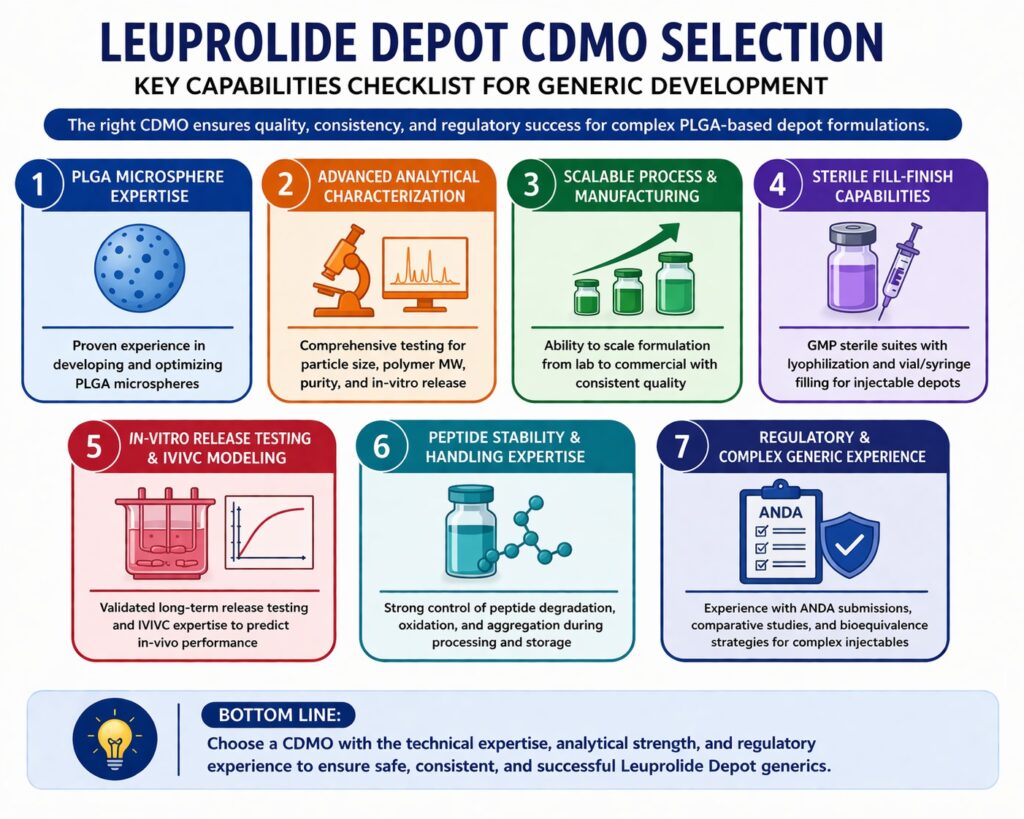
CDMO Capability Evaluation Checklist for Leuprolide Depot CDMO Selection
The following checklist can help pharmaceutical companies evaluate potential partners during Leuprolide Depot CDMO Selection:
| Capability Area | Key Questions |
|---|---|
| Microsphere expertise | Has the CDMO developed PLGA microsphere products previously? |
| Analytical infrastructure | Do they perform advanced polymer and peptide characterization? |
| Process development | Can they scale microsphere processes reliably? |
| Sterile manufacturing | Do they have GMP injectable manufacturing capabilities? |
| Release testing | Can they design validated in-vitro release methods? |
| Regulatory expertise | Do they have experience with complex generic approvals? |
| Peptide stability | Can they handle peptide degradation challenges? |
| Technology transfer | Do they support seamless scale-up to commercial manufacturing? |
Using this structured approach helps sponsors compare multiple CDMO partners objectively. It also reduces technical risk and supports more efficient development planning. A clear evaluation framework ensures that all critical capabilities are assessed before entering a long-term partnership.
See a real-world example: Leuprolide Depot Case Study: Sustained Release
Additional Strategic Factors in CDMO Selection
Beyond technical capabilities, companies should also evaluate operational and strategic factors when making a Leuprolide Depot CDMO Selection decision. Strong scientific expertise must be supported by efficient collaboration and reliable quality systems.
Technical Collaboration
Successful depot development requires continuous communication between sponsor and CDMO scientists. Close collaboration helps teams address formulation challenges quickly and maintain steady development progress.
Quality Systems
CDMOs must operate under strong GMP compliance and data integrity standards. Well-established quality systems ensure that manufacturing processes remain consistent and fully documented.
Project Management
Depot programs involve coordination between formulation scientists, analytical teams, regulatory specialists, and manufacturing engineers. Experienced project management ensures timelines are maintained and technical challenges are resolved efficiently.
Capacity and Scalability
Sponsors should also confirm that the CDMO has enough production capacity to support future commercial demand. Early evaluation of manufacturing capacity helps prevent supply issues after product approval.
Conclusion
Effective Leuprolide Depot CDMO Selection requires identifying partners with deep expertise in microsphere formulation, peptide stability, analytical characterization, and sterile injectable manufacturing. These capabilities are essential for managing the complex development challenges associated with long-acting injectable generics.
Unlike conventional generics, depot formulations require specialized formulation science, scalable manufacturing processes, and detailed regulatory strategies. The interaction between polymers, peptides, and processing parameters must be carefully controlled throughout development. Companies that work with experienced CDMOs can significantly improve their chances of achieving regulatory approval.
Using a structured evaluation checklist during Leuprolide Depot CDMO Selection allows pharmaceutical companies to assess potential partners more effectively. This approach reduces development risks and helps ensure that projects progress smoothly from formulation development to commercial manufacturing.
Partner with us for your next project: Generic Drug Development CRO for ANDA
By prioritizing scientific expertise, analytical infrastructure, regulatory knowledge, and scalable manufacturing capabilities, sponsors can improve the success rate of leuprolide depot generic programs. Careful partner selection not only accelerates development timelines but also supports consistent product quality and long-term commercial success.
For organizations seeking expert support in complex injectable and peptide formulation development, working with specialized scientific teams can help accelerate development and reduce technical risk.
Frequently Asked Questions (FAQs)
Important factors include experience with PLGA microsphere formulation, strong analytical characterization capabilities, scalable manufacturing processes, and regulatory expertise for complex injectables. CDMOs should also have proven peptide handling experience and validated in-vitro release testing methods. These combined capabilities help ensure smooth development and regulatory approval.
Microspheres control how the drug is released from the formulation over time. Their particle size, polymer composition, and structure directly influence release kinetics and therapeutic performance. Proper microsphere engineering ensures the generic product matches the behavior of the reference drug.
Long-acting injectables use advanced delivery systems such as biodegradable polymers or liposomes. Drug release depends on formulation structure and manufacturing processes, not only chemical composition. Because of this complexity, regulators require extensive characterization and sometimes additional clinical data.
Key challenges include maintaining consistent microsphere size, controlling encapsulation efficiency, preventing peptide degradation, managing residual solvents, and ensuring sterile processing. These issues become more complex during large-scale manufacturing. Strong process control and analytical monitoring are required to maintain product consistency.
Polymers such as PLGA determine how quickly the drug is released from the formulation. Factors like polymer molecular weight, lactide-to-glycolide ratio, and end-group chemistry influence degradation rate and release kinetics. Choosing the right polymer is essential for matching the release profile of the reference product.
In-vitro release testing measures how the drug is released from the formulation under simulated physiological conditions. These tests help predict in-vivo performance and compare the generic product with the reference drug. They are also important for routine quality control during manufacturing.
Peptides like leuprolide can degrade due to temperature changes, pH variations, and exposure to organic solvents. If degradation occurs, the product may lose potency or develop impurities. Proper manufacturing controls and stability testing help maintain peptide integrity.
CDMOs with regulatory experience can help design appropriate analytical studies and bioequivalence strategies. They also assist with regulatory documentation and submission preparation. This guidance helps ensure that the development program aligns with regulatory expectations.
Reference:
- Zhou, Z., Zhou, Y., Yan, W., Feng, T., & Liang, Z. (2024). Comparison of the efficacy and safety profiles of generic and branded leuprorelin acetate microspheres in patients with prostate cancer. Oncology Letters, 28(1), 319. https://pmc.ncbi.nlm.nih.gov/articles/PMC11130615/
- U.S. Food and Drug Administration. (2018). NDA 205054: Multi-disciplinary review and evaluation — Lutrate Depot (leuprolide acetate for depot suspension). Center for Drug Evaluation and Research. https://www.accessdata.fda.gov/drugsatfda_docs/nda/2018/205054Orig1s000MultidisciplineR.pdf
- Swayzer, D. V., & Gerriets, V. (2023). Leuprolide. In StatPearls. StatPearls Publishing. https://www.ncbi.nlm.nih.gov/books/NBK551662/
Get In Touch With Us
About The Author


