


Introduction:
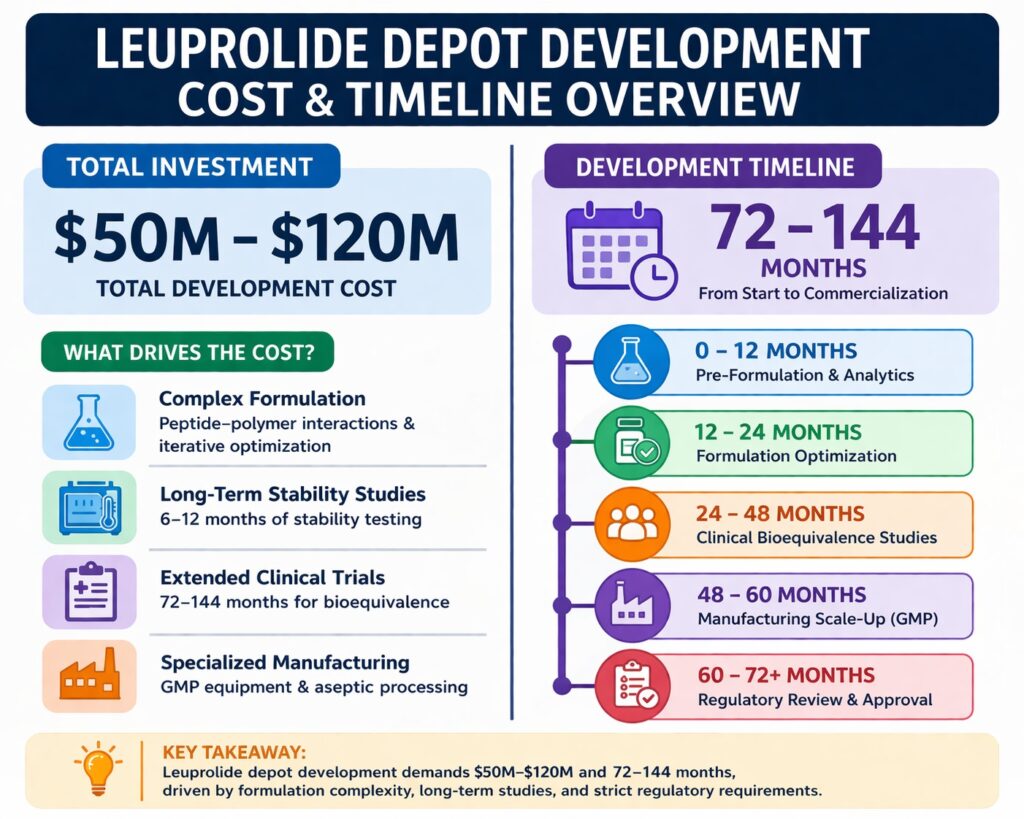
The Leuprolide Depot Development Cost and Timeline typically requires a total investment between $50 million and $120 million, with commercialization timelines ranging from 72 to 144 months. These estimates reflect the scientific complexity and regulatory burden associated with long-acting injectable (LAI) peptide formulations. Unlike conventional generics, depot systems demand extensive formulation screening, long-term stability studies, and prolonged clinical evaluation. Companies entering this segment must prepare for sustained capital investment and strong multidisciplinary expertise. This article provides a structured technical and economic roadmap for organizations planning entry into complex generic LAI development.
Explore our specialized services for complex formulations: Learn more about Generic Drug Development Processes for ANDA
Share via:
Important Note on Cost and Timeline Estimates:
The cost figures presented in this article are highly approximate and should be considered as broad, ballpark estimates, typically represented on the higher side to account for the inherent complexity and uncertainty in long-acting injectable (LAI) development. Due to the multifactorial nature of formulation development, analytical requirements, clinical design, and regulatory pathways, it is not feasible to define an exact cost or timeline for such programs.
The values discussed are not actual or project-specific quotations, but are intended to help readers understand the overall development flow, key milestones, and major cost drivers involved in leuprolide depot generic development. Actual cost and timelines may vary significantly depending on technical strategy, prior knowledge, infrastructure, and regulatory approach.
Comprehensive Economic Modeling of Leuprolide Depot Development Cost and Timeline
The Leuprolide Depot Development Cost and Timeline are strongly influenced by complex peptide-polymer interactions and the extended release characteristics of depot formulations. These factors require long observation periods and multiple iterative development cycles. Programs frequently exceed $100 million once manufacturing scale-up, analytical development, and multi-year bioequivalence studies are included. Additional costs arise from specialized equipment, stability chambers, and validated analytical methods required for polymer-based microspheres. Extended timelines also increase operational overhead, including staffing, regulatory consulting, and clinical site management.
A significant contributor to overall cost is the need for specialized research capabilities and premium raw materials. Unlike standard oral generics, peptide-grade leuprolide acetate and medical-grade PLGA polymers are expensive and must be procured repeatedly during formulation optimization. These materials must also meet strict impurity limits and molecular weight specifications, which increases procurement complexity. In addition, a 6-month depot formulation requires monitoring patients for nearly a year per dose. This results in increased site management, bioanalytical testing, and pharmacokinetic modeling expenses.
Need expert guidance on ANDA submissions? Check the essential requirements for ANDA submission of generic drugs
Investment Breakdown by Development Phase
A typical generic leuprolide depot program requires capital allocation across multiple technical and regulatory phases. Each stage demands dedicated infrastructure, skilled personnel, and validated analytical methods to reduce development risk. Early investment in characterization studies can help minimize downstream clinical failures and avoid costly reformulation cycles. Proper financial planning across phases ensures program continuity and regulatory readiness. Understanding these elements is essential when estimating the Leuprolide Depot Development Cost and Timeline.
| Development Phase | Estimated Expenditure | Percentage of Total Budget | Primary Cost Drivers |
|---|---|---|---|
| Pre-Formulation & Analytics | $5M – $15M | 10% – 15% | High-resolution NMR, GPC, and DSC characterization of RLD batches. |
| Formulation Optimization | $10M – $25M | 20% – 25% | Iterative pilot batches using peptide-grade API and specialized PLGA polymers. |
| Clinical Bioequivalence Studies | $30M – $80M | 50% – 60% | Long-term PK/PD monitoring in prostatic carcinoma or endometriosis patients. |
| Manufacturing Scale-Up (GMP) | $5M – $10M | 5% – 10% | Specialized spray drying or emulsion equipment and cleanroom validation. |
| Regulatory & Filing Fees | $2M – $5M | 2% – 5% | GDUFA user fees and potential response to multi-cycle CRLs. |
The development timeline is equally demanding. While immediate-release generics may reach approval within 3 to 4 years, depot formulations often require 6 to 12 years after patent expiry. Long-term stability testing for 3-month and 6-month depots significantly extends development. Clinical studies also require longer follow-up periods because a single dosing interval may last up to 24 weeks. These combined factors extend regulatory review timelines and delay commercial readiness.
Struggling with complex peptide formulations? Discover our Specialized Peptide CDMO Services
Equipment and Infrastructure Capital Requirements
Establishing a GMP-compliant facility for leuprolide microsphere manufacturing requires investment in precision analytical and processing equipment. The PLGA matrix is sensitive to thermal and mechanical stress, which makes tight process control essential. Equipment must support reproducible emulsification, solvent removal, and particle formation. Facilities also require controlled environments, validated cleaning procedures, and environmental monitoring systems. These infrastructure requirements significantly increase upfront capital expenditure and impact the overall Leuprolide Depot Development Cost and Timeline.
| Equipment Category | Purpose in Depot Development | Typical Price Range (New) | Key Determinants of Price |
|---|---|---|---|
| Spray Dryer (GMP) | Particle formation and solvent removal | $100k – $2M | Evaporation rate, automation level, and explosion-proof certification. |
| High-Pressure Homogenizer | Primary and secondary emulsification | $15k – $50k | Maximum pressure capacity and flow rate. |
| GPC/SEC System | Determining polymer molecular weight distribution | $30k – $150k | Detector sensitivity (RI/MALS) and automation. |
| HPLC/UHPLC System | Peptide assay and impurity profiling | $20k – $150k | Pressure rating, autosampler capacity, and detector type. |
| DSC/TGA Analyzers | Thermal stability and Tg determination | $15k – $45k | Temperature range and cooling accessories. |
Operational expenses further increase ownership costs over time. Spray drying energy consumption, specialized training, and maintenance contracts add recurring expenses. Maintenance alone may reach 5–15% of equipment value annually. Skilled operator training is also required to maintain batch reproducibility. These ongoing costs should be included in long-term financial planning.
Technical Risks in Microsphere Formulation and Peptide Stability
Technical risk in leuprolide depot development is largely associated with burst release and peptide degradation inside the PLGA matrix. Achieving near-zero-order release over several months requires a deep understanding of polymer degradation kinetics. Small variations in particle size or polymer chemistry can significantly shift release profiles. Maintaining reproducibility across batches therefore becomes challenging. These risks directly influence clinical performance and regulatory approval outcomes.
The Challenge of Controlling Initial Burst Release
Initial burst release refers to rapid drug release within the first 24 hours after injection. Excessive burst can cause hormonal flare in prostate cancer patients and temporarily worsen symptoms. Regulatory agencies carefully evaluate this parameter during bioequivalence assessment. Controlling burst release is therefore a critical formulation objective. Failure to manage this effect can lead to clinical or regulatory rejection.
Burst release occurs when peptide migrates toward droplet surfaces during solvent evaporation. Hydrophilic peptides concentrate near the outer shell of microspheres. This creates a drug-rich surface layer that dissolves quickly after injection. Surface morphology and internal porosity further influence release behavior. These microstructural features must be carefully controlled.
Surface Morphology — Smooth surfaces reduce burst, while porous structures increase diffusion. Surface uniformity also improves stability. SEM analysis is typically used for evaluation.
Particle Size Distribution — Smaller particles increase surface-area-to-volume ratio. This typically increases burst release. Tight PSD control improves reproducibility.
Encapsulation Efficiency — High loading disrupts polymer matrix. This creates diffusion pathways. Optimized loading reduces leakage.
Viscosity optimization is one effective mitigation strategy. Increasing primary emulsion viscosity reduces peptide migration toward the surface. Cooling the emulsion can also improve viscosity control and particle uniformity. This approach has shown improved particle span and controlled release behavior. Such process adjustments are often essential for successful development.
Get insights into Leuprolide-specific development: Read our guide on How to Develop Generic Leuprolide Depot
Microclimate pH and Peptide Acylation
Longer depot formulations face additional risk from acidic microenvironments within PLGA microspheres. Polymer hydrolysis generates lactic and glycolic acids over time. Accumulation of these acids reduces internal pH significantly. Extremely low pH accelerates degradation processes. This results in unpredictable release behavior and potential potency loss.
Autocatalysis occurs when acidic conditions accelerate PLGA breakdown. This leads to nonlinear release profiles and increases batch-to-batch variability. Predicting in vivo performance becomes more difficult under these conditions. Chemical modification of leuprolide may also occur in acidic environments. Acylation at the serine residue reduces active drug levels and creates impurities that must meet regulatory limits.
Material Variability: The PLGA Fingerprint
Selection of PLGA polymer is critical for generic success. Even polymers with identical L:G ratios may behave differently in depot formulations. Molecular weight distribution and end-group chemistry directly affect degradation behavior. Supplier variability can also influence performance and stability. Therefore, detailed polymer characterization is essential.
| Polymer Attribute | Impact on Performance | Impact on Bioequivalence |
| L:G Ratio | Determines hydrophobicity and degradation rate. | Slight deviations can shift the entire release curve. |
| Molecular Weight (Mw) | Influences mechanical strength and initial lag phase. | High polydispersity leads to inconsistent degradation. |
| End-Group (Acid vs. Ester) | Acid groups increase hydrophilicity and accelerate initial release. | Required for microstructural (Q3) sameness. |
| Glass Transition Temp (Tg) | Affects storage stability and polymer chain mobility. | Higher Tg (e.g., 48.6^\circ C) suggests strong peptide-polymer interaction. |
Manufacturing Process Risks and Scale-Up Complexity
Leuprolide depot manufacturing is highly process dependent and sensitive to operational parameters. Microsphere structure depends on thermodynamics and fluid dynamics during emulsification and solvent removal. Lab-scale processes often fail during scale-up due to changes in equipment geometry and mixing conditions. These differences create significant risk during technology transfer. Careful process characterization is required to ensure reproducibility.
Deciding between outsourcing and in-house development? Compare CRO vs. In-House ANDA Development
Emulsification and Solvent Removal Dynamics
Microsphere formation typically follows a W1/O/W2 double emulsion process. Each step influences the final particle structure and drug distribution. Small deviations in mixing or solvent evaporation can alter particle size. Solvent removal rate also affects internal porosity and release behavior. Tight control of processing parameters is necessary.
Homogenization Speed — Controls particle size distribution. Excessive shear produces fine particles. Low shear creates large particles.
Solvent Removal Rate — Fast removal creates porous structure. Slow removal causes drug leakage. Optimization is required.
Temperature Control — Maintains viscosity and peptide stability. Fluctuations affect emulsification. Controlled environments are necessary.
Challenges in Spray Drying for LAIs
Spray drying produces uniform particles but introduces additional risks. Droplet evaporation follows wet-bulb kinetics and influences polymer crust formation. Improper conditions can cause drug migration toward particle surfaces. This increases surface drug content and burst release. Poorly optimized spray drying can therefore compromise product performance.
Two-fluid nozzle systems may produce drug-rich surfaces if not optimized. These surfaces degrade quickly and increase burst release. Pore formation can further accelerate diffusion. Burst levels as high as 85% have been reported under non-optimized conditions. Such outcomes may lead to regulatory failure.
Aseptic Processing and Sterility Assurance
Leuprolide depot is a parenteral product that requires strict sterility assurance. Microspheres cannot undergo terminal sterilization because heat damages PLGA. Filtration is also not feasible due to particle size. Therefore, the entire manufacturing process must be aseptic. This requirement increases facility and operational complexity.
Sterile API and excipients must be used throughout production. Aseptic filling requires isolators, robotics, and validated procedures. Environmental monitoring is mandatory during manufacturing. Sterility validation studies are also required before approval. These requirements significantly increase development cost.
Looking for a partner in North America? Explore Pharmaceutical CDMO services in the US and Canada
Regulatory Strategy and Bioequivalence Requirements
Regulatory approval requires both in vivo studies and extensive in vitro characterization. Agencies classify leuprolide depots as complex generics with strict requirements. Q1/Q2 sameness alone is not sufficient for approval. Microstructural equivalence and clinical bioequivalence must be demonstrated. Clinical studies must support pharmacokinetic comparability.
Navigating FDA Product-Specific Guidances
FDA product-specific guidances define study design for each strength. Patient populations are required instead of healthy volunteers. Pharmacokinetic parameters must demonstrate equivalence with the reference product. Long sampling schedules are necessary for sustained-release products. These requirements extend development timelines.
| Product Strength | Indication | Recommended Population | Required PK Parameters |
| 3.75 mg (1-month) | Endometriosis | Patients receiving stable treatment. | C{max}, AUC{0-t}, AUC{7-t} |
| 7.5 mg (1-month) | Prostate Cancer | Prostatic carcinoma patients. | C{max}, AUC{0-t}, AUC{7-t} |
| 22.5 mg (3-month) | Prostate Cancer | Prostatic carcinoma patients. | C{max}, AUC{0-t}, AUC{7-t} |
| 45 mg (6-month) | Prostate Cancer | Prostatic carcinoma patients. | C{max}, AUC{0-t}, AUC{7-t} |
The AUC7-t parameter evaluates sustained release by minimizing initial burst effects. Matching this parameter is technically challenging. Matrix degradation and release kinetics must closely mirror the innovator product. This adds complexity to development.
Understand the regulatory hurdles for Leuprolide: View the detailed Leuprolide Depot ANDA Requirements
Microstructural Equivalence (Q3) and Biowaivers
Q3 equivalence requires detailed structural comparison. SEM imaging evaluates surface morphology and particle shape. Porosity measurements assess internal structure. Polymer extraction confirms compositional sameness. These tests support equivalence claims.
Biowaivers may apply to additional strengths in some cases. Representative strength studies can support other doses. Formulations must remain Q1/Q2/Q3 equivalent. In vitro dissolution profiles must also match closely.
Analytical Challenges and Advanced Characterization
Leuprolide depot development requires extensive analytical techniques. Orthogonal methods confirm polymer properties and peptide stability. Early analytical planning helps prevent late-stage failures. Reverse engineering of the reference listed drug is essential. The analytical burden is therefore significant.
Polymer Extraction and Deformulation
Extracting PLGA without degradation is technically challenging. Water removes soluble excipients during initial steps. THF or DCM dissolves polymer for analysis. GPC determines molecular weight distribution. NMR confirms L:G ratio and end-group chemistry.
In Vitro Release Testing and IVIVC
Accelerated release testing helps speed up formulation screening. Elevated temperatures increase hydrolysis rates. These methods reduce development time during optimization. Establishing Level A IVIVC is ideal for regulatory flexibility. This approach supports post-approval changes.
Detecting Peptide-Polymer Interactions
Mass spectrometry detects degradation products and modifications. UHPLC separates impurities and related substances. Peptide loading can act as an anti-plasticizer in PLGA matrices. Tg increases with higher drug loading. Replicating this interaction is essential for equivalence.
Overcome analytical roadblocks in development: Solve Leuprolide Depot Analytical Challenges
Market Dynamics and Commercial Viability
High development cost is balanced by strong market potential. The global leuprolide acetate market is projected to reach $3.13 billion by 2030. Growth is driven by oncology and reproductive medicine applications. Long-acting depots improve adherence and reduce dosing frequency. Demand continues to expand across therapeutic areas.
| Application | Market Share | Growth CAGR (2025-2030) | Primary End-Users |
|---|---|---|---|
| Prostate Cancer | 46.55% | 6.2% | Hospitals and Oncology Infusion Centers. |
| Endometriosis / Fibroids | 35.00% | 5.8% | Gynecology Clinics. |
| Reproductive Tech (IVF) | 10.43% | 10.4% | Specialty Fertility Clinics. |
| Pediatric (CPP) | 10.00% | 4.5% | Pediatric Endocrinologists. |
Market Segmentation and Demand Drivers
Prostate cancer remains the dominant indication for leuprolide depot products. Gynecology indications also provide strong demand. IVF applications are growing rapidly due to increased treatment adoption. Pediatric CPP contributes additional volume. These segments support revenue diversification.
The 6-month depot is currently the fastest growing segment. Reduced clinic visits improve patient adherence. Payers often prefer longer dosing intervals. Generic entry into this segment is strategically valuable. Market demand continues to increase.
Competitive Landscape and Entry Barriers
Entry barriers in this segment are significant. Manufacturing complexity limits competition. Regulatory hurdles discourage smaller companies. Patent thickets can delay entry timelines. Litigation may further extend commercialization.
Market concentration remains moderate despite these barriers. Prices decline after generic launch. First-to-file exclusivity provides strong advantage. Early entrants capture meaningful revenue share. Technical capability determines long-term success.
Accelerate your time-to-market: How a CDMO can accelerate Generic Drug Development
Conclusion: Strategic Recommendations for Generic Entry
The Leuprolide Depot Development Cost and Timeline represent a technically demanding but commercially attractive opportunity for pharmaceutical companies. Success depends on microstructural replication and strong process understanding. Companies must move beyond traditional generic strategies and adopt science-driven development approaches. Long-term investment and technical expertise are essential for success. Organizations that manage complexity effectively can achieve durable margins.
Companies should prioritize early Q3 characterization to understand polymer structure and end-group chemistry. Process understanding using Quality by Design helps control burst release and sustained delivery. Early regulatory engagement ensures alignment on bioequivalence strategy. Strong analytical capability reduces late-stage development risk. These elements collectively improve probability of approval.
The complexity of leuprolide depot formulations supports sustained profitability compared with simple generics. Companies with strong analytical infrastructure and financial endurance are best positioned to succeed. Strategic planning across formulation, manufacturing, and regulatory domains remains critical. With proper execution, generic entry can deliver significant long-term value.
Find the right development partner: Choose the best CRO for Leuprolide Depot Development
Frequently Asked Questions (FAQs)
The high Leuprolide Depot Development Cost and Timeline is mainly influenced by long clinical bioequivalence studies and extensive analytical characterization. Clinical trials alone can cost between $30M and $80M because patients must be monitored for several months after each dose. Advanced polymer analysis and formulation work may add another $5M to $15M. The timeline extends to 72–144 months due to prolonged release studies and repeated formulation optimization cycles.
Burst release refers to a sudden release of leuprolide immediately after injection, leading to a temporary spike in hormone levels. In prostate cancer patients, this can trigger testosterone surge and worsen symptoms such as bone pain or urinary blockage. Severe cases may lead to complications like spinal cord compression. Regulatory agencies require close matching of burst release to ensure patient safety.
Q1/Q2 sameness means using the same ingredients in similar amounts as the reference product. Q3 equivalence focuses on microstructure, including particle size, porosity, and polymer behavior. Two formulations may look identical on paper but perform differently if their internal structure varies. Achieving Q3 equivalence helps ensure similar drug release and clinical performance.
As PLGA polymer degrades, it releases acidic byproducts that lower the internal pH of microspheres. This acidic environment can chemically modify the leuprolide peptide and reduce its activity. Degradation may also create additional impurities that must be controlled. Managing this pH shift is especially difficult for long-acting 3-month and 6-month depot formulations.
Double emulsion solvent evaporation and spray drying are the most widely used manufacturing approaches. Solvent evaporation may lead to residual solvent issues and inconsistent pore structure. Spray drying can cause drug migration to particle surfaces, increasing burst release. Small changes in process parameters may significantly affect release kinetics and product performance.
GPC is used to determine the molecular weight distribution of the PLGA polymer, which influences drug release duration. NMR helps identify the lactic-to-glycolic acid ratio and end-group chemistry. These measurements allow scientists to understand the polymer fingerprint of the reference product. Matching these properties improves the likelihood of achieving equivalent performance.
In Vitro–In Vivo Correlation (IVIVC) links laboratory release data with drug behavior in patients. A strong Level A IVIVC can predict clinical performance from dissolution results. This may reduce the need for additional clinical studies after formulation changes. Establishing IVIVC requires understanding polymer degradation and drug diffusion mechanisms.
Reference:
- Han, L., Zhai, C., Da, L., & Sun, Y. (2025). The effect of leuprolide acetate 11.25 mg 3-month formulation in children with central precocious puberty: A systematic review and meta-analysis. Advances in Therapy, 42(11), 5282–5299. https://doi.org/10.1007/s12325-025-03222-7
- Krauss, D. J., Taub, H. C., Karrison, T. G., & Mehta, N. (2018). Pharmacokinetic and pharmacodynamic comparison of subcutaneous versus intramuscular leuprolide acetate formulations in male subjects. Clinical Pharmacology in Drug Development, 7(2), 184–192. https://pmc.ncbi.nlm.nih.gov/articles/PMC5805007/
- Zhou, J., Walker, J., Ackermann, R., Olsen, K., Hong, J. K. Y., Wang, Y., & Schwendeman, S. P. (2020). Effect of manufacturing variables and raw materials on the composition-equivalent PLGA microspheres for 1-month controlled release of leuprolide. Molecular Pharmaceutics, 17(5), 1502–1515. https://doi.org/10.1021/acs.molpharmaceut.9b01188
- Michaelides, K., Al Tahan, M. A., Zhou, Y., Trindade, G. F., Cant, D. J. H., Pei, Y., Dulal, P., & Al-Khattawi, A. (2024). New insights on the burst release kinetics of spray-dried PLGA microspheres. Molecular Pharmaceutics, 21(12), 6245–6256. https://doi.org/10.1021/acs.molpharmaceut.4c00686
Get In Touch With Us
About The Author


