


Introduction: Why Leuprolide Depot Stability Studies Demand a Different Scientific Standard
Leuprolide Depot Stability Studies are among the most scientifically demanding stability programs in the pharmaceutical field. The challenge is not only related to the stability of leuprolide acetate itself, but mainly due to its delivery system — biodegradable PLGA microspheres. These microspheres introduce multiple interconnected degradation mechanisms that traditional stability approaches are not designed to evaluate.
Unlike conventional tablets or even lyophilized biologics, leuprolide depot microspheres behave as a dynamic system. The poly(lactic-co-glycolic acid) (PLGA) matrix slowly undergoes hydrolytic degradation, even during storage. This degradation changes drug diffusion, internal micro-pH, peptide structure, and release kinetics at the same time. Designing Leuprolide Depot Stability Studies that properly capture these relationships without relying only on surrogate markers is a major scientific challenge.
Explore our specialized services for complex formulations: Leuprolide Depot Generic Drug Development Services
This article does not repeat basic pharmacology or formulation theory. Instead, it highlights the most common scientific and regulatory gaps observed during stability evaluation of clinical and commercial depot products. These issues typically occur where formulation behavior, analytical limitations, and ICH expectations intersect.
Share via:
Why Microsphere Architecture Creates Compounding Instability — Not Just Linear Degradation
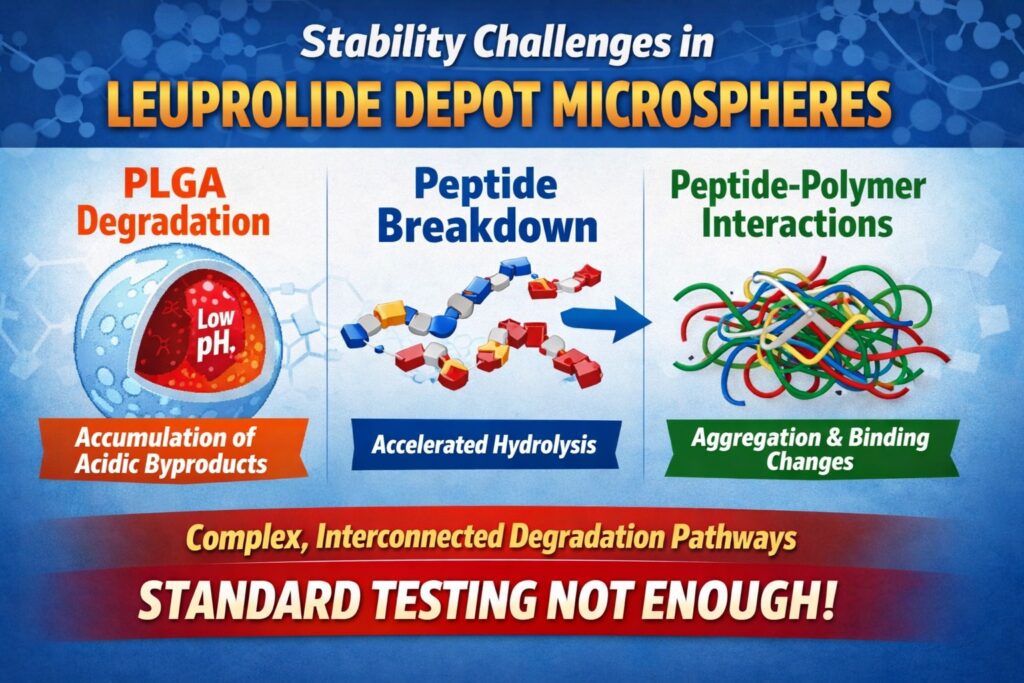
The major stability concern in leuprolide depot products is that PLGA degradation and peptide degradation occur together and influence each other. As PLGA undergoes bulk erosion, acidic end groups accumulate inside the microsphere. This reduces the internal microenvironmental pH, sometimes reaching pH 2–3 in the core, even though the external formulation pH remains unchanged.
This internal acidity accelerates peptide hydrolysis, increases deamidation at the Asn6 residue, and produces PLGA fragments that may interact with the peptide. These changes complicate release testing, impurity profiling, and potency determination.
Learn more about navigating the technical hurdles: Leuprolide Depot Analytical Challenges
Within the microsphere, leuprolide degradation typically occurs through multiple simultaneous pathways not observed in solution-based studies:
- Acid-catalyzed hydrolysis of the peptide backbone driven by internal PLGA degradation products rather than external pH
- Changes in peptide–polymer ionic interactions as PLGA molecular weight decreases, altering binding and increasing burst release
- Solid-state conformational changes such as β-sheet aggregation and intermolecular hydrogen bonding within the polymer matrix
A stability program that only evaluates appearance, reconstitution time, and HPLC purity captures only part of the degradation behavior. Important signals occur inside the microsphere and may not be visible until product performance changes.
PLGA Degradation Dynamics in Leuprolide Depot Stability Studies
Molecular Weight, Polydispersity, and End-Group Chemistry
The initial molecular weight and polydispersity index of PLGA are strong predictors of long-term stability. Acid-terminated PLGA degrades faster than ester-capped material because terminal carboxyl groups promote autocatalytic chain scission. In Leuprolide Depot Stability Studies, lack of control over PLGA end-group chemistry can create batch-to-batch variability that appears as formulation instability.
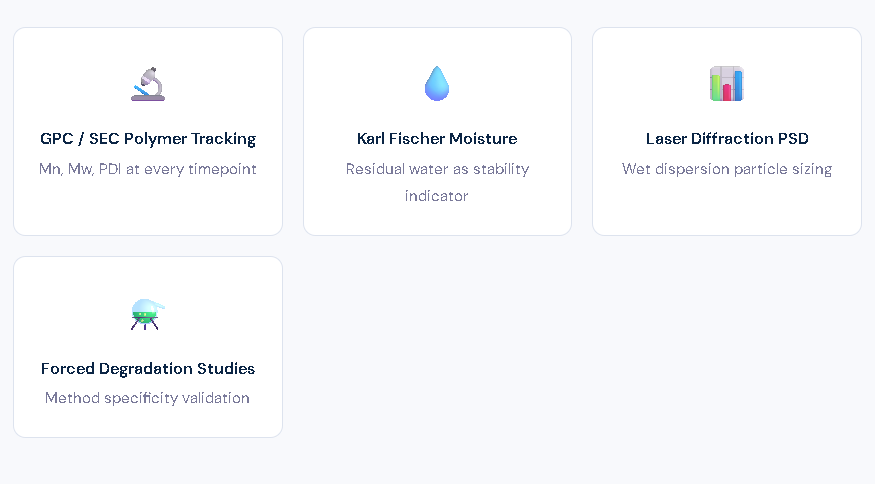
Gel permeation chromatography (GPC) at defined stability timepoints, not only at release, is essential to monitor polymer degradation. However, GPC results alone do not directly predict drug release. The relationship is influenced by microsphere porosity, particle size distribution, and peptide properties.
Understand the core development stages: Generic Drug Development Process for ANDA
Residual Solvent and Residual Moisture: Hidden Accelerants
Residual dichloromethane (DCM) and moisture interact to accelerate PLGA degradation. Even 0.5–1.5% water can initiate hydrolysis under accelerated conditions. Residual solvent lowers the glass transition temperature (Tg) of PLGA and increases molecular mobility of the encapsulated peptide.
Therefore, Karl Fischer moisture testing and headspace GC for residual solvent should be included as stability-indicating parameters, not only release specifications.
See how we handle particle analysis: Lupron Depot Particle Characterization
Critical Stability Stressors in Leuprolide Depot Stability Studies
The following table maps key stressors to degradation pathways and impacted attributes:
| Stressor | Mechanistic Pathway | Primary Attribute Impacted | Severity in Depot |
|---|---|---|---|
| Elevated Temperature (25–40°C) | Accelerated PLGA chain scission; increased peptide molecular mobility; Tg depression | In vitro drug release profile; purity (deamidation) | High |
| Elevated Humidity (>60% RH) | Moisture ingress leading to bulk hydrolysis of PLGA; peptide aggregation; particle caking | Particle size distribution; reconstitutability; drug content uniformity | High |
| Freeze–Thaw Cycling | Ice crystal formation disrupts microsphere surface integrity; redistribution of drug to surface | Burst release; morphology; particle size | High |
| Shear / Mechanical Stress | Microsphere fragmentation; premature drug release; altered PSD | Drug release; particle size; dose accuracy | Medium |
| Light Exposure (UV/Vis) | Photo-oxidation of Trp7 residue; free radical generation in polymer matrix | Purity; degradant profile; peptide potency | Medium |
| Reconstitution Medium pH | pH-dependent peptide aggregation during reconstitution; altered initial release | Syringeability; dose uniformity; burst release | High |
| Oxygen Exposure | Oxidative degradation of Met residues; peroxide-mediated backbone cleavage in PLGA | Purity; potency; degradant increase | Medium |
Analytical Challenges in Leuprolide Depot Stability Studies
Analytical testing for depot formulations is complex because the drug is encapsulated in an insoluble polymer matrix. Efficient extraction without introducing artificial degradation requires careful method development.
Incomplete extraction efficiency
Standard acetonitrile or DMSO extraction often gives only 80–95% recovery. As the matrix degrades, extraction efficiency changes. Recovery should therefore be monitored at every stability timepoint.
In vitro release method limitations
USP Apparatus 4 or membrane diffusion methods may not differentiate burst release, diffusion, and erosion. Without mechanistic clarity, release shifts may be misinterpreted.
Degradant co-elution in HPLC
PLGA degradation products absorb at 215–220 nm, the same range used for leuprolide. Forced degradation with polymer controls is required to confirm method specificity.
Particle size shift interpretation
Dynamic light scattering cannot resolve bimodal distributions caused by aggregation and fragmentation. Laser diffraction with controlled wet dispersion is preferred.
Discover our testing capabilities: Analytical Requirements for ANDA Generic Drugs
ICH-Aligned Leuprolide Depot Stability Studies Protocols
ICH Q1A(R2) provides a base framework, but depot microsphere products require additional testing. Regulatory agencies now expect product-specific stability design.
Standard ICH Conditions Required
- Long-term: 5°C ± 3°C (refrigerated products) for 24–36 months
- Accelerated: 25°C / 60% RH for minimum 6 months
- Photostability: ICH Q1B Option 2
- Intermediate: 25°C / 60% RH if accelerated studies show change
Depot-Specific Supplements Required
- Reconstituted suspension stability (0, 30, 60 minutes)
- Freeze–thaw cycle stress (3–5 cycles; −20°C to 5°C)
- Mechanical shock and vibration simulation
- PLGA molecular weight monitoring at all timepoints
Regulators frequently request in-use stability data for reconstituted suspensions. This requirement is now considered essential for submission packages.
Find the right partner for your project: CRO for Leuprolide Depot Development
Accelerated vs Real-Time Leuprolide Depot Stability Studies: Where Arrhenius Fails
Arrhenius-based predictions are unreliable for PLGA depot systems. Using accelerated data to predict refrigerated shelf life introduces risk.
Non-linear PLGA degradation
PLGA hydrolysis is autocatalytic. As acidic products accumulate, degradation accelerates. The temperature relationship becomes non-linear.
Phase transitions at elevated temperature
When temperature exceeds Tg, molecular mobility increases and new degradation pathways appear. These do not represent refrigerated storage.
Peptide–polymer interaction reversal
At higher temperature, ionic interactions weaken. Peptide migration to the surface increases burst release, which may not occur at 5°C.
A better strategy is to start real-time and accelerated studies together. Accelerated data should support formulation screening, while shelf life should rely on long-term data.
Deep dive into the CMC approach: Leuprolide Depot CMC Strategy
Conclusion: Raising the Standard for Leuprolide Depot Stability Studies
Leuprolide Depot Stability Studies should not be treated as routine stability testing. They require a multidimensional approach that evaluates polymer degradation, internal microsphere environment, and peptide–polymer interactions together.
Many stability failures occur when conventional stability approaches are applied to depot microspheres. Methods not validated for polymer interference, missing reconstituted stability studies, and Arrhenius-based predictions often lead to regulatory gaps.
Learn more about our CDMO expertise: Specialized Peptide CDMO Services
A robust Leuprolide Depot Stability Studies program integrates polymer science, analytical chemistry, and ICH guidance into a single stability strategy. This approach improves predictability, supports regulatory submissions, and ensures consistent performance of leuprolide depot formulations.
Ready to begin your submission? Requirements for ANDA Submission for Generic Drugs
Frequently Asked Questions: Leuprolide Depot Stability Studies
PLGA molecular weight directly controls how quickly the polymer matrix breaks down during storage. As the molecular weight decreases, acidic end groups form and lower the internal pH inside the microspheres. This acidic environment speeds up peptide degradation and increases deamidation risk. For this reason, monitoring PLGA molecular weight using GPC at each stability timepoint is considered essential in Leuprolide Depot Stability Studies.
Refrigerated leuprolide depot products are typically studied at 5°C ± 3°C for long-term stability, with testing performed at multiple intervals up to 24–36 months. Accelerated testing is generally conducted at 25°C/60% RH for six months, and intermediate studies may be required if changes occur. In addition to standard ICH conditions, Leuprolide Depot Stability Studies should include reconstituted stability, freeze–thaw evaluation, and mechanical stress testing. These additional studies help define in-use handling and support shelf-life claims.
Residual moisture significantly accelerates PLGA hydrolysis in depot microspheres. Even small amounts of water can promote ester bond cleavage, reduce the glass transition temperature, and increase molecular mobility within the polymer. This environment can lead to peptide aggregation and increased deamidation of leuprolide. Therefore, moisture monitoring using Karl Fischer titration at each stability timepoint is important for controlling product stability.
Accelerated data alone cannot reliably predict long-term shelf life for PLGA-based depot systems. Polymer degradation follows non-linear, autocatalytic behavior that changes at different temperatures, especially near the glass transition range. At higher temperatures, additional degradation mechanisms may appear that do not occur during refrigerated storage. Because of this, real-time data are typically required to support shelf-life claims in Leuprolide Depot Stability Studies.
Leuprolide in PLGA microspheres mainly degrades through deamidation, oxidation, aggregation, and backbone hydrolysis. Deamidation often occurs due to acidic conditions generated during PLGA breakdown, while oxidation can occur under light or oxygen exposure. Aggregation may develop in the polymer matrix when moisture is present. Among these, deamidation and aggregation are most commonly observed during refrigerated storage.
USP Apparatus 4 (flow-through cell) is commonly used for microsphere-based depot formulations because it supports long testing durations and maintains sink conditions. However, the method must be validated to ensure that release profile changes reflect formulation stability rather than method variability. For practical stability evaluation, cumulative release at specific timepoints is often used instead of complete release profiling. This approach is frequently applied in Leuprolide Depot Stability Studies.
Particle size distribution is critical because microsphere size affects drug release and injection performance. Laser diffraction using wet dispersion is typically preferred since it can detect both aggregation and fragmentation. Parameters such as D10, D50, and D90 should be monitored at each stability timepoint. Significant shifts, especially in D90, should trigger further investigation.
Leuprolide contains light-sensitive amino acid residues that may undergo photo-oxidation when exposed to UV or visible light. Although the PLGA matrix provides partial protection, it does not completely prevent degradation. Photostability testing under ICH Q1B conditions helps identify potential degradants and potency changes. HPLC analysis is typically used to monitor purity during light exposure studies.
Reference:
- Chwalisz, K. (2023). Clinical development of the GnRH agonist leuprolide acetate depot. F&S Reports, 4(2 Suppl), 33–39. https://doi.org/10.1016/j.xfre.2022.11.011
- Vyas, N., Joshi, A., Malviya, S., & Kharia, A. (2020). Artificial intelligence: A new paradigm for pharmaceutical applications in formulations development. Indian Journal of Pharmaceutical Education and Research, 54(4), 175–182. https://archives.ijper.org/article/1364
- Livzon Pharmaceutical Group Inc. (2016). Preparation method of sustained-release leuprolide acetate microspheres (CN106038492A). Google Patents. https://patents.google.com/patent/CN106038492A/en
- Schwendeman, S. P. (2014). Injectable controlled release depots for large molecules. Journal of Controlled Release, 190, 240–253. https://pmc.ncbi.nlm.nih.gov/articles/PMC4261190/
- Dunn, R. L., Garrett, J. S., Ravivarapu, H., & Chandrashekar, B. L. (2004). Polymeric delivery formulations of leuprolide with improved efficacy (U.S. Patent No. 6,773,714 B2). U.S. Patent and Trademark Office. https://patents.google.com/patent/US6773714B2/en
Get In Touch With Us
About The Author


