


Introduction:
Lifecycle management strategies for dexamethasone injectables are essential for pharmaceutical manufacturers aiming to sustain product relevance, regulatory compliance, and commercial value across the entire product lifespan. Dexamethasone, a potent synthetic corticosteroid, has long been a workhorse molecule in injectable therapeutics—used in oncology-supportive care, severe inflammatory conditions, cerebral edema, COVID-19 management, and neonatal lung maturation. Successful lifecycle planning begins with robust Dexamethasone Injection Generic Development, optimized formulation design, and scientifically sound analytical characterization.
A product’s lifecycle does not end at market approval. In fact, for injectable drug products—particularly those with complex excipient systems, solubility challenges, or lyophilized formats—the post-approval period is where the most consequential decisions about product longevity are made. From Dexamethasone Injection Analytical Methods and stability-indicating method development to reformulation for depot delivery, and from generic product entry defense to new indication filings, lifecycle management is a continuous, resource-intensive, and highly strategic discipline.
At ResolveMass Laboratories Inc., our team of pharmaceutical scientists and analytical chemists has hands-on experience supporting Dexamethasone Injectable CRO programs across multiple lifecycle stages. This article provides a comprehensive, stage-by-stage framework for managing the lifecycle of dexamethasone injectable products—the analytical tools, regulatory touchpoints, and strategic decisions manufacturers need to navigate at each phase.
Summary:
- Dexamethasone injectables require multi-phase lifecycle management covering formulation development, analytical characterization, regulatory submission, post-market surveillance, and product extension.
- Key lifecycle stages include IND/NDA/ANDA development, stability studies, impurity profiling, forced degradation, and biosimilar/generic entry strategy.
- Critical analytical methods — HPLC, GC-MS, LC-MS/MS, DSC, and particle size analysis — are central to supporting each lifecycle phase.
- Lifecycle extension strategies such as new delivery formats (depot, nanoparticle), combination products, and new indications can significantly prolong commercial relevance.
- Regulatory alignment with FDA, EMA, and ICH Q guidelines is mandatory at every stage of the product lifecycle.
- ResolveMass Laboratories Inc. provides the full suite of analytical and formulation development services needed to support dexamethasone injectable programs from early development through commercialization.
1: What Is Pharmaceutical Lifecycle Management for Injectable Products?
Pharmaceutical lifecycle management (LCM) refers to the coordinated set of strategies that extend, optimize, and protect the value of a drug product from early development through patent expiry and beyond. For injectable products like dexamethasone formulations, LCM encompasses analytical development, stability management, regulatory compliance maintenance, line extensions, and competitive positioning.
Lifecycle management for injectables is more complex than for oral solid dosage forms due to:
- Sterility and container-closure integrity requirements
- Sensitivity of the API to oxidative, hydrolytic, and photolytic degradation
- Particulate matter and subvisible particle control
- Osmolality, pH, and tonicity management
- Cold-chain storage and distribution requirements for some formulations
Stage 1: Early Development and Preformulation of Dexamethasone Injectables
Early-stage preformulation defines the stability risk profile of the dexamethasone injectable and guides excipient selection, solubilization strategy, and container-closure system. Understanding the characteristics of Dexamethasone Sodium Phosphate Formulation and the differences between Dexamethasone Phosphate vs. Acetate helps scientists select the most appropriate formulation for long-term product performance.
Key Analytical Activities at This Stage
- Solubility profiling: Dexamethasone base has limited aqueous solubility (~89 µg/mL). Most injectable formulations use the more soluble sodium phosphate salt or dexamethasone acetate suspension.
- pH-stability profiling: Determining the pH of maximum stability to set target formulation pH. Dexamethasone sodium phosphate solutions are typically buffered to pH 7.0–8.5.
- Forced degradation studies (stress testing): Exposure to acid/base hydrolysis, oxidation, heat, and UV light to generate degradation products and build a degradation pathway map.
- DSC and thermal analysis: Evaluating API polymorphism (critical for suspension formulations) and excipient compatibility.
- Particle size analysis (for suspensions): Establishing the baseline particle size distribution for dexamethasone acetate suspensions, which governs pharmacokinetics and injectability.
Forced Degradation: An LCM-Critical Step
Forced degradation studies at this stage serve a dual purpose in lifecycle management: they identify potential impurities that must be controlled across the entire product life, and they generate the reference standard data needed to validate stability-indicating analytical methods. Comprehensive Forced Degradation of Dexamethasone studies establish degradation pathways that become invaluable during post-market investigations. The resulting degradation profile also supports future Dexamethasone Impurities Analysis throughout the product lifecycle.
Stage 2: Analytical Method Development and Validation
Stability-indicating HPLC methods are the backbone of lifecycle management for dexamethasone injectables, enabling quantitative tracking of API potency and impurity profiles over time. Robust Dexamethasone Injection Analytical Methods support accurate assay determination, impurity profiling, degradation monitoring, and regulatory compliance across every stage of commercialization.
Core Analytical Methods for Dexamethasone Injectable Programs
| Analytical Technique | Application in Dexamethasone LCM |
|---|---|
| Reverse-Phase HPLC (RP-HPLC) | Potency assay, related substances/impurity profiling |
| LC-MS/MS | Structural identification of unknown degradation products |
| GC-MS | Residual solvent analysis, volatile impurity screening |
| ICP-MS / ICP-OES | Elemental impurities per ICH Q3D |
| DSC / TGA | Thermal stability, polymorph characterization |
| Dynamic Light Scattering (DLS) | Particle size and PDI for nanoformulations |
| Osmometry | Osmolality verification for IV injectables |
| Karl Fischer Titration | Moisture content for lyophilized presentations |
| Container-Closure Integrity Testing | Leachables profiling, seal integrity |
ICH Q2(R1) Validation Parameters to Cover
Method validation for dexamethasone injectables must cover specificity (the most critical parameter for stability-indicating methods), linearity, accuracy, precision (repeatability and intermediate precision), detection/quantitation limits, and robustness. Any changes to the method during the product lifecycle — even minor modifications triggered by new impurity findings — require partial or full revalidation per ICH Q2(R2) principles.
Stage 3: Regulatory Submissions — IND, NDA, and ANDA Strategies
The regulatory submission strategy for dexamethasone injectables must be designed with lifecycle extensibility in mind. Manufacturers pursuing ANDA approval should establish a comprehensive Dexamethasone Injection Generic Development strategy supported by validated analytical methods, impurity qualification, comparative stability data, and a scientifically robust Chemistry, Manufacturing, and Controls (CMC) package.
NDA/505(b)(1) vs. 505(b)(2) Pathways
For novel dexamethasone injectable formulations (e.g., extended-release microspheres, liposomal dexamethasone, or new concentration/presentation combinations), the 505(b)(2) pathway is commonly used. This allows reliance on existing safety and efficacy data while providing a formulation-specific data package.
Key CMC considerations for the regulatory package include:
- Specification setting: Impurity limits must be qualified against ICH Q3B(R2) thresholds. Any degradant above the reporting threshold (0.05%) must be listed; those above the identification threshold (0.10% or 1.0 mg TDI) must be identified.
- Stability protocols: A minimum of 12 months of accelerated and real-time stability data is typically expected at filing, with a commitment to continue through shelf-life.
- Container-closure system: Full extractables and leachables (E&L) evaluation, particularly important for rubber-stoppered vials and prefilled syringes.
- Reference standard qualification: In-house dexamethasone and impurity reference standards must be fully characterized.
ANDA Submissions for Generic Dexamethasone Injectables
Generic manufacturers must demonstrate pharmaceutical equivalence (same active ingredient, dosage form, route, strength, and conditions of use) and bioequivalence (BE). For dexamethasone sodium phosphate solutions, BE is typically waived under the biowaiver provisions for aqueous solutions where both the reference and test products have the same active and inactive ingredients in similar concentrations.
Stage 4: Stability Management and Shelf-Life Extension
Stability studies for dexamethasone injectables must follow ICH Q1A(R2) protocols, with real-time data supporting shelf-life assignment and periodic reviews enabling proactive lifecycle decisions. Comprehensive Dexamethasone Injection Stability studies monitor potency, degradation products, pH, particulate formation, and sterility to ensure long-term product quality and regulatory compliance.
ICH Stability Conditions for Dexamethasone Injectables
| Storage Condition | Temperature | Relative Humidity | Purpose |
|---|---|---|---|
| Long-term (Zone I/II) | 25°C ± 2°C | 60% ± 5% RH | Primary shelf-life assignment |
| Intermediate | 30°C ± 2°C | 65% ± 5% RH | For products stored > 25°C |
| Accelerated | 40°C ± 2°C | 75% ± 5% RH | Early indication of instability |
| Photostability | ICH Q1B | ICH Q1B | Photodegradation assessment |
| Freeze-thaw cycling | Per label claim | N/A | For frozen storage presentations |
Common Stability Failure Modes in Dexamethasone Injectables
- Oxidative degradation: Dexamethasone is susceptible to oxidation at the 11β-hydroxyl position. Headspace oxygen control, antioxidants (sodium bisulfite, EDTA), and nitrogen purging are critical.
- Hydrolytic degradation: Ester-based derivatives (dexamethasone acetate, palmitate) undergo ester hydrolysis under aqueous conditions.
- Photodegradation: UV light induces ring-opening and hydroxylation reactions; amber glass vials or light-protective secondary packaging are standard.
- Particulate formation: Protein aggregates in complex biologics or crystallization of supersaturated dexamethasone solutions upon storage.
Stage 5: Post-Market Surveillance and Lifecycle Maintenance
Post-market analytical surveillance for dexamethasone injectables involves continuous monitoring of annual product reviews (APRs), out-of-specification (OOS) investigations, and change control management for any modifications to the manufacturing process, supplier, or container-closure system. This stage is often underestimated in its analytical resource demands.
Post-market analytical surveillance involves continuous monitoring of annual product reviews, manufacturing trends, and Dexamethasone Impurities Analysis to detect emerging degradation patterns. Manufacturers should also evaluate packaging compatibility through Extractables and Leachables in Dexamethasone Injectables studies whenever container-closure systems or packaging suppliers change.
Annual Product Review (APR) Analytical Scope
- Trending of assay and impurity results across all commercial batches
- Review of out-of-specification and out-of-trend investigations
- Evaluation of any raw material supplier changes and their impact on product quality
- Container-closure integrity trending
- Review of customer complaints related to particulate matter or color
Change Control: When CMC Supplements Are Triggered
Any post-approval change to a dexamethasone injectable must be evaluated against the FDA’s SUPAC-DP (Scale-Up and Post-Approval Changes for Non-Sterile Semisolid and Sterile Drug Products) guidance and, for parenteral products, the relevant FDA guidance on CMC changes. Changes are classified as:
- Minor changes (Annual Report): e.g., minor equipment modifications, in-house standard updates
- Moderate changes (CBE-30): e.g., quantitative formulation changes within established ranges, new supplier of an excipient
- Major changes (Prior Approval Supplement): e.g., change to a new API manufacturer, new dosage form, significant process changes
Stage 6: Lifecycle Extension Strategies for Dexamethasone Injectables
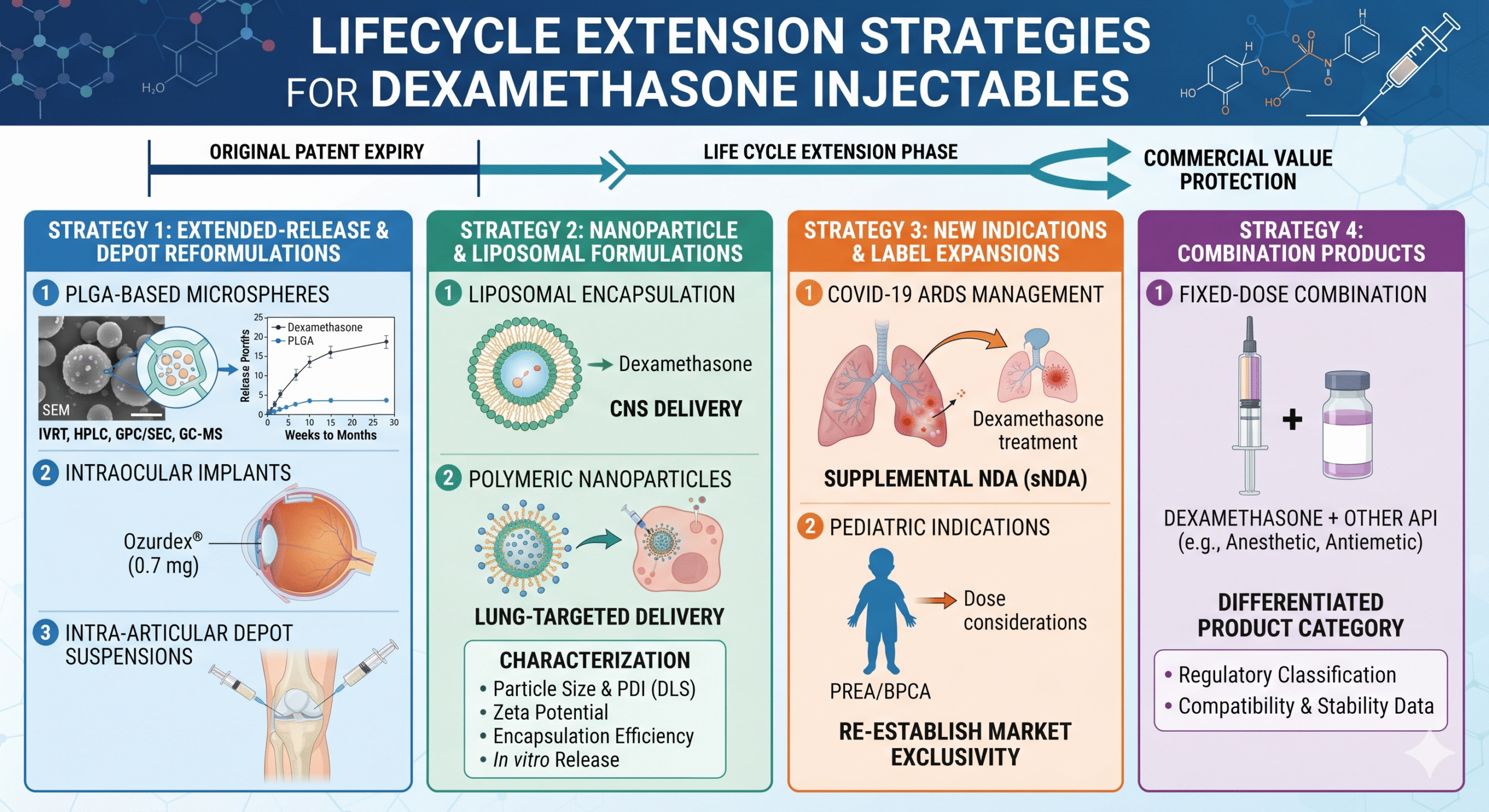
Lifecycle extension strategies for dexamethasone injectables include reformulation into controlled-release depot systems, nanoparticle formulations, combination products, and pursuit of new therapeutic indications — all supported by robust analytical characterization and regulatory data packages. These strategies protect commercial value as the original product faces generic competition.
One of the most effective lifecycle extension strategies involves sustained-release drug delivery systems. Manufacturers developing depot formulations can benefit from insights provided in the Dexamethasone Implant PLGA Characterization Case Study, which highlights analytical characterization requirements for PLGA-based controlled-release systems.
As pharmaceutical innovation continues, companies must also address evolving Dexamethasone Development Challenges, including formulation optimization, manufacturing scalability, regulatory complexity, and lifecycle extension through novel delivery platforms.
Strategy 1: Extended-Release and Depot Reformulations
Dexamethasone extended-release formulations are an active area of pharmaceutical development:
- PLGA-based microspheres: Encapsulation in poly(lactic-co-glycolic acid) microspheres enables sustained dexamethasone release over weeks to months. Characterization requires in vitro drug release (IVRT), encapsulation efficiency by HPLC, polymer molecular weight by GPC/SEC, and residual solvent analysis by GC-MS.
- Intraocular implants: Ozurdex® (dexamethasone 0.7 mg intravitreal implant) is the landmark example of intravitreal depot delivery for posterior segment eye disease.
- Intra-articular depot suspensions: Extended-release formulations for localized joint inflammation management.
Strategy 2: Nanoparticle and Liposomal Formulations
Nanoformulation of dexamethasone for targeted delivery (e.g., PEGylated liposomes for CNS delivery, polymeric nanoparticles for lung-targeted delivery) requires:
- Particle size and PDI by dynamic light scattering
- Zeta potential measurements
- Encapsulation efficiency and drug loading
- In vitro release kinetics
- Stability under physiological conditions
Strategy 3: New Indications and Label Expansions
Filing a supplemental NDA (sNDA) or a line extension for new indications — such as dexamethasone for COVID-19 acute respiratory distress syndrome management, or new pediatric indications under PREA/BPCA — is a regulatory lifecycle strategy that can re-establish market exclusivity and extend the product’s commercial life.
Strategy 4: Combination Products
Fixed-dose combination injectables incorporating dexamethasone with other APIs (e.g., antimetics, local anesthetics) represent a differentiated product category requiring combination product regulatory classification and additional compatibility and stability data packages.
Stage 7: Generic Entry and Biosimilar Considerations
When dexamethasone injectable patents expire, innovator manufacturers must respond with lifecycle strategies that include authorized generics, patent defense through formulation innovation, and competitive differentiation through value-added device integration. Generic entry fundamentally reshapes the commercial dynamics of the product.
Analytical Requirements for Generic Dexamethasone Injectable Applications
Generic applicants must provide:
- A full analytical method validation package demonstrating that their methods are equivalent to or better than the reference listed drug (RLD) methods
- Impurity profiles demonstrating that their degradation product pattern matches the RLD within qualified limits
- Container-closure integrity data
- For suspension formulations: particle size equivalence data
Paragraph IV Challenges and Patent Defense
For innovator products, robust patent strategies — including composition-of-matter patents on new formulation components, method-of-use patents for new indications, and device integration patents — are supported by a strong analytical and CMC data package that makes it technically difficult for generic applicants to design around the innovator’s formulation.
2: How ResolveMass Laboratories Inc. Supports Dexamethasone Injectable Lifecycle Programs
ResolveMass Laboratories Inc. is a Canadian CRO/CDMO with specialized capabilities in pharmaceutical analytical services, PLGA-based drug delivery, long-acting injectable formulations, and injectable product characterization. Our analytical and formulation development team supports dexamethasone injectable lifecycle programs at every stage:
Analytical Services:
- Stability-indicating HPLC method development and ICH Q2(R1) validation
- LC-MS/MS degradation product identification and structural elucidation
- Forced degradation studies for impurity profile establishment
- GC-MS residual solvent analysis
- DSC/TGA thermal characterization and polymorph screening
- ICP-MS elemental impurity profiling per ICH Q3D
- GPC/SEC for polymer characterization in PLGA-based formulations
Formulation Development:
- PLGA microsphere and nanoparticle development for extended-release dexamethasone
- In vitro drug release testing (IVRT) for depot formulations
- Compatibility and stability studies for new formulation strategies
Regulatory Support:
- CMC data package preparation for NDA, ANDA, and sNDA submissions
- Impurity qualification packages per ICH Q3B(R2)
- Extractables and leachables testing for container-closure systems
ResolveMass Laboratories Inc. provides end-to-end scientific support for dexamethasone injectable products, including Dexamethasone Injection Analytical Methods, Dexamethasone Impurities Analysis, Dexamethasone Injection Stability, Forced Degradation of Dexamethasone, and Extractables and Leachables in Dexamethasone Injectables. Our expertise also extends to Dexamethasone Sodium Phosphate Formulation development and advanced PLGA-based long-acting injectable systems.
Our scientists bring direct experience with corticosteroid injectable programs and understand the unique analytical, regulatory, and formulation challenges these products present across their lifecycle.
Conclusion:
Implementing robust lifecycle management strategies for dexamethasone injectables is not a post-approval afterthought — it is a strategic discipline that must be designed into the product development program from the earliest preformulation stages. From forced degradation studies and stability-indicating method development to PLGA-based depot reformulations and new indication filings, every lifecycle stage demands rigorous analytical science, regulatory foresight, and formulation expertise.
The pharmaceutical companies that manage dexamethasone injectable lifecycles most effectively are those that invest early in comprehensive analytical characterization, build flexible regulatory data packages, and maintain a proactive post-market surveillance program. These capabilities allow manufacturers to anticipate product quality risks, respond to competitive pressures, and continuously extend the value of their injectable portfolios.
ResolveMass Laboratories Inc. is positioned to be your scientific and strategic partner across the full lifecycle of your dexamethasone injectable program — from first-in-human preformulation support to long-term commercial post-market analytical services.
Frequently Asked Questions:
Lifecycle management is important because dexamethasone injectables are sterile products that require consistent quality throughout their shelf life. Ongoing monitoring helps detect manufacturing trends, impurities, and stability changes before they become critical issues. It also supports regulatory compliance and reduces the likelihood of product recalls. Continuous improvement enhances manufacturing efficiency and product reliability. This approach helps ensure patient safety while maximizing product performance and commercial success.
Stability studies evaluate how dexamethasone injectables perform under various storage conditions over time. They monitor parameters such as potency, degradation products, pH, sterility, and physical appearance. The data generated help establish and verify product shelf life while supporting regulatory submissions. Stability studies also assess the impact of formulation, packaging, or manufacturing changes. Continuous stability monitoring ensures that the product remains safe and effective until its expiration date.
Critical Quality Attributes (CQAs) are the physical, chemical, biological, or microbiological properties that directly influence product quality and patient safety. For dexamethasone injectables, these include assay, purity, sterility, endotoxin levels, pH, osmolality, particulate matter, and container closure integrity. Manufacturers continuously monitor these attributes throughout the product lifecycle. Maintaining CQAs within established limits ensures consistent product performance and regulatory compliance. Effective CQA monitoring also supports risk-based quality management.
Change control is a structured process used to evaluate and document any modifications made to the product or manufacturing process. This may include changes in raw materials, suppliers, analytical methods, equipment, packaging, or production procedures. Each proposed change is scientifically assessed to ensure it does not negatively impact product quality or safety. Proper change control minimizes regulatory risks and supports successful post-approval changes. It also helps maintain product consistency throughout commercialization.
Extractables and Leachables (E&L) testing determines whether packaging materials release chemical compounds into the injectable formulation during storage. These studies help identify potential contaminants that could affect product safety or efficacy. E&L assessments are especially important when introducing new packaging materials or changing suppliers. The results support toxicological risk assessments and regulatory submissions. Comprehensive E&L testing helps ensure packaging compatibility and long-term product quality.
Supplier qualification ensures that raw materials, packaging components, and other critical inputs consistently meet predefined quality standards. Manufacturers evaluate suppliers through audits, material testing, documentation reviews, and ongoing performance monitoring. Qualified suppliers reduce variability in manufacturing and lower the risk of quality issues. Effective supplier management also supports regulatory compliance and supply chain reliability. This contributes to consistent production and long-term product quality.
Lifecycle management is supported by internationally recognized guidelines such as ICH Q8 (Pharmaceutical Development), ICH Q9 (Quality Risk Management), ICH Q10 (Pharmaceutical Quality System), and ICH Q12 (Product Lifecycle Management). These guidelines encourage continuous improvement and science-based decision-making throughout a product’s lifecycle. They also provide frameworks for managing post-approval changes and maintaining regulatory compliance. Following these guidelines helps manufacturers ensure consistent product quality while meeting global regulatory expectations.
Reference
- London NJ, Chiang A, Haller JA. The dexamethasone drug delivery system: indications and evidence. Advances in therapy. 2011 May;28(5):351-66.https://link.springer.com/article/10.1007/s12325-011-0019-z
- Van Hoogevest P, Tiemessen H, Metselaar JM, Drescher S, Fahr A. The use of phospholipids to make pharmaceutical form line extensions. European journal of lipid science and technology. 2021 Apr;123(4):2000297.https://onlinelibrary.wiley.com/doi/abs/10.1002/ejlt.202000297
- Malamatari M. The importance of drug delivery in the clinical development and lifecycle of drug products with examples from authorised medicinal products. Processes. 2023 Oct 5;11(10):2919.https://www.mdpi.com/2227-9717/11/10/2919
- Lemperle G, Gauthier-Hazan N. Foreign body granulomas after all injectable dermal fillers: part 2. Treatment options. Plastic and Reconstructive Surgery. 2009 Jun 1;123(6):1864-73.https://journals.lww.com/plasreconsurg/fulltext/2009/06000/Double_Internal_Jugular_Vein.30.aspx
About the Author


