


Introduction: Why Long Acting Injectables Market Trends Are Shifting the Generic Pharma Calculus
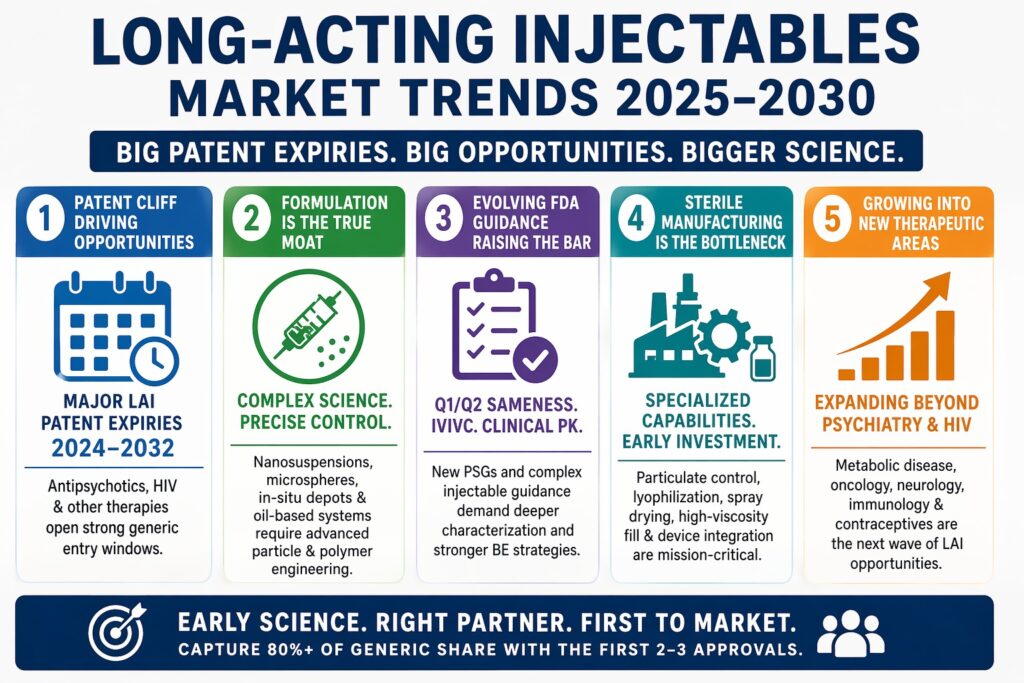
The Long Acting Injectables Market Trends observed over the last five years show one of the most important shifts in specialty pharmaceutical development. These changes are driven less by new indications and more by upcoming patent expiries. Several first-generation long-acting injectable (LAI) blockbusters — paliperidone palmitate, aripiprazole monohydrate, and cabotegravir/rilpivirine — are approaching or entering patent expiry windows. This creates a strong entry opportunity for generic and specialty pharmaceutical developers with advanced formulation capabilities. The market is also growing due to rising demand for therapies that improve patient adherence, especially in chronic psychiatric and infectious diseases. As healthcare systems focus on long-term disease control, LAIs are increasingly preferred over daily oral medications.
Learn more about the roadmap for complex generics: > Explore the Generic Drug Development Process for ANDA
At the same time, scientific and regulatory expectations for these products are much higher than those for traditional oral generics. LAIs combine sterile manufacturing, complex drug characterization, non-linear pharmacokinetics, and polymer or lipid science. Because of this complexity, simple chemistry-based replication is not practical. Developers must evaluate injection-site tolerability, release profile, and long-term stability during development. Companies that succeed in this space are those investing early in formulation science, analytical characterization, and strong bioequivalence strategies.
Compare your options for development: > CRO vs. In-House ANDA Development: Making the Right Choice
Share via:
Article Summary
- Long-acting injectable (LAI) market trends indicate growing movement toward generic development, especially across psychiatry, HIV, and oncology pipelines.
- Major patent expiries expected between 2025–2030 are creating a valuable opportunity window for generic LAIs, attracting CDMOs and specialty pharmaceutical companies.
- Product complexity in formulation — beyond regulatory requirements — continues to be the main factor protecting branded LAI therapies.
- Advances in polymer platforms, nanosuspension technologies, and in-situ forming depot systems are changing the competitive environment.
- Bioequivalence requirements specific to LAIs present both technical challenges and strategic opportunities for developers with strong expertise.
- CMC planning, particle engineering capabilities, and sterile manufacturing readiness play a critical role in successful market entry.
- Increasing alignment between FDA and EMA guidance for complex injectables is helping reduce regulatory uncertainty for global development programs.
- ResolveMass Laboratories combines formulation science experience with CDMO support to help sponsors navigate the technical and regulatory demands of this evolving market.
The Patent Cliff Landscape: Where Generic LAI Opportunities Are Materializing
Current Long Acting Injectables Market Trends show that immediate generic opportunities are concentrated in long-acting antipsychotics and HIV treatments. In these therapeutic areas, brand erosion has already started. Several leading products are moving toward patent expiry, opening the door for early ANDA filers. These products differ in formulation technology, which directly impacts development complexity and timelines. Developers must also evaluate device compatibility, dose strengths, and injection schedules when planning entry strategies.
Key Products and Patent Windows
| Product | Molecule | Technology | Patent Window |
|---|---|---|---|
| Invega Sustenna / Trinza | Paliperidone palmitate | Nanosuspension | 2026–2028 |
| Abilify Maintena | Aripiprazole monohydrate | Aqueous suspension | 2024–2026 |
| Risperdal Consta | Risperidone microspheres | PLGA microspheres | Already expired (generics pending) |
| Cabenuva (cabotegravir + rilpivirine) | CAB/RPV | Nanosuspension | 2030–2032 |
| Sublocade | Buprenorphine | In-situ forming depot | 2027–2029 |
Understand the specific hurdles of complex injectables: > Overcoming Leuprolide Depot Analytical Challenges
Beyond antipsychotics, oncology and hormonal therapy LAIs — such as leuprolide acetate microspheres and octreotide LAR — already show multi-generic competition. These categories provide a practical development roadmap for psychiatric and HIV LAIs. Early entrants often benefit from limited competition and stronger formulary positioning. Payer preference frequently shifts quickly toward the first approved generics, accelerating adoption.
A key takeaway for developers is that the first two to three ANDA approvals in an LAI category typically capture more than 80% of generic market share for 18–24 months. Late entry can significantly reduce commercial returns. Filing strategies should therefore be driven by formulation readiness and manufacturing capability, not just regulatory timelines. Early investment in process robustness and scale-up is essential to avoid approval delays.
Formulation Science as the True Competitive Moat in LAI Generics
One of the most important Long Acting Injectables Market Trends is that formulation reproducibility has become the main barrier for generic entry. Regulatory expectations are defined, but consistently reproducing a multi-month depot with precise particle size distribution, polymer molecular weight, and encapsulation efficiency across GMP batches is technically demanding. Small formulation changes can create clinically meaningful pharmacokinetic differences. This makes analytical control and process understanding critical.
Key Formulation Technologies Driving Market Differentiation
Nanosuspension platforms
Used in paliperidone palmitate and cabotegravir generics, nanosuspension performance depends heavily on particle engineering. The nanonization method, such as wet bead milling versus high-pressure homogenization, affects crystal morphology and stability. Stabilizer selection also impacts aggregation and shelf life. Sedimentation rate and syringeability must also be optimized. These factors directly influence in vivo performance and product quality.
PLGA microsphere systems
PLGA microspheres remain a gold standard for controlled release ranging from weeks to months. Critical variables include polymer molecular weight, end-group chemistry, solvent evaporation rate, and drug loading uniformity. Small changes can create large differences in release kinetics. Developers must also control burst release and residual solvents. These challenges often determine success in bioequivalence studies.
In-situ forming depots (ISFDs)
NMP-based systems such as Atrigel are sensitive to injection technique and physiological conditions. For generics, demonstrating Q1/Q2 sameness while managing the unique bioequivalence pathway is challenging. Depot formation kinetics must be studied under simulated physiological conditions. Syringe compatibility and viscosity behavior are also critical considerations.
Oil-based solutions and suspensions
Although simpler than microspheres, oil-based systems still require detailed characterization. Vehicle composition, viscosity, and syringeability must be evaluated under physiological conditions. Developers must also assess phase separation and injection force. Stability of the active ingredient in the oil matrix is another key parameter affecting performance.
Access expert support for peptide-based formulations: > Specialized Peptide CDMO Services for Complex Projects
For each platform, particle characterization data packages — including laser diffraction, dynamic light scattering, SEM/TEM, zeta potential, and rheology — are increasingly expected by FDA during ANDA submission. The characterization burden has increased significantly in recent years. Strong analytical packages now play a central role in demonstrating formulation sameness.
Navigating FDA’s Complex Injectable Framework — What Has Changed for LAI Developers
Recent Long Acting Injectables Market Trends also show that FDA expectations for complex injectables have become more detailed. Product-specific guidances (PSGs) for LAIs now emphasize Q1/Q2 sameness, matching release mechanisms, and population PK modelling. These requirements reflect FDA’s focus on therapeutic equivalence for complex injectables. Developers must integrate in vitro release testing with clinical PK strategies early.
Critical FDA Guidance Updates Relevant to LAI Generics
Paliperidone palmitate PSG (revised 2022)
FDA now expects particle size distribution matching across D10/D50/D90 metrics along with equivalent dissolution kinetics in biorelevant media. Extensive in vitro characterization is required. Developers must also demonstrate particle size stability over shelf life.
Aripiprazole monohydrate PSG
Waiver of in vivo bioequivalence is not available. A full clinical PK study in patients is required, increasing cost and timelines. However, this also creates higher barriers for late entrants.
In vitro-in vivo correlation (IVIVC) for microspheres
FDA’s Complex Drug Substances and Products guidance (2024 draft) introduces a clearer IVIVC pathway for PLGA microspheres. This may reduce reliance on large clinical trials. Predictive in vitro release methods become critical.
505(b)(2) pathway for next-generation LAI platforms
Developers creating improved formulations, such as longer dosing intervals or improved tolerability, may use the 505(b)(2) pathway. Referencing an approved LAI can accelerate development compared to a full NDA. This approach also supports lifecycle management strategies.
Stay compliant with the latest regulatory standards: > Comprehensive Analytical Requirements for ANDA Generic Drugs
On the EMA side, the Reflection Paper on Pharmaceutical Development of Injectables and updated complex generic guidance are aligning European expectations with FDA requirements. This alignment supports dual-jurisdiction strategies and reduces redundant development work.
Long Acting Injectables Market Trends in Emerging Therapeutic Areas
Beyond psychiatry and HIV, Long Acting Injectables Market Trends show expansion into metabolic disease, oncology, and neurology. These areas are attracting both innovator investment and early generic interest. Improved adherence and reduced dosing frequency are key drivers.
Emerging LAI Therapeutic Segments to Watch
GLP-1 receptor agonists (extended-release)
Semaglutide weekly injectables have shown strong commercial success. Development of monthly or quarterly formulations is ongoing. These long-duration therapies may reshape metabolic disease management. Generic interest is expected after patent maturity.
Long-acting antipsychotics for bipolar disorder
Second-generation atypical antipsychotics in LAI form remain underused in bipolar I maintenance. Long-acting formulations may improve relapse prevention and create commercial opportunities.
Subcutaneous immunologics
Subcutaneous depot formulations for autoimmune conditions are emerging. These include long-acting TNF inhibitors and IL-17 antagonists. Long-acting formats may improve patient convenience and adherence.
Contraceptive LAIs
While DMPA generics are mature, next-generation progestin-only LAIs with six-month to one-year duration are advancing. Longer duration reduces healthcare visits and creates mid-term generic opportunities.
Across these segments, the pattern remains consistent. Innovator products establish proof-of-concept and adherence benefits over several years. Patent expiries then create entry opportunities for technically capable generic developers.
Sterile Manufacturing Readiness — The Bottleneck Generic Developers Underestimate
Sterile LAI manufacturing requires capabilities beyond standard injectable facilities. This gap often determines whether a developer can enter the market. Complex particulate systems require specialized equipment and validated aseptic processes. Manufacturing readiness must be considered early.
Manufacturing Capability Requirements for LAI Generics
| Capability | Standard Injectable | LAI-Specific Requirement |
|---|---|---|
| Aseptic processing | Required | Required + specialized for viscous or particulate systems |
| Lyophilization | Sometimes | Often required for microsphere stability |
| Spray drying / microencapsulation | Not typical | Required for PLGA microsphere manufacturing |
| Particle size control during fill-finish | Not applicable | Critical — GSD must be maintained through process |
| High-viscosity fill systems | Not typical | Required for nanosuspensions and oil-based LAIs |
| Specialized device integration | Rare | Required for autoinjectors, prefilled syringes |
Accelerate your time-to-market with the right partner: > How a CDMO Accelerates Generic Drug Development in the US and Canada
Investment in manufacturing capability usually must occur two to four years before regulatory filing. Process validation and scale-up require significant time. CDMOs with sterile, lyophilization, and spray drying infrastructure become strategic partners. Early collaboration reduces commercialization risk.
How ResolveMass Laboratories Positions Sponsors for LAI Generic Success
ResolveMass Laboratories Inc. supports developers navigating evolving Long Acting Injectables Market Trends with an integrated approach combining formulation science and regulatory strategy. The organization supports nanosuspensions, microsphere systems, oil-based depots, and in-situ forming depots. Sponsors receive guidance from pre-formulation through technology transfer. Development programs align with ANDA and NDA requirements.
Capabilities include:
- Particle engineering and nanonization for nanosuspension-based LAIs
- Polymer selection and PLGA optimization for controlled-release microsphere development
- In vitro release method development aligned with FDA PSG expectations
- CMC documentation for 505(b)(2) and ANDA submissions targeting complex injectables
- Regulatory strategy consulting for dual FDA and EMA filings
Sponsors evaluating LAI generic entry or next-generation platform development benefit from structured feasibility assessments. These evaluations address formulation viability, patent risk, and regulatory pathway alignment. Early planning reduces development uncertainty.
Find the right CRO for your injectable program: > Strategic CRO for Complex Injectables Development
Conclusion: The Long Acting Injectables Market Trends Demand Technical Leadership
The Long Acting Injectables Market Trends for 2025–2030 reflect a convergence of patent expiries, rising demand for adherence-improving therapies, and evolving regulatory guidance. This creates a strong opportunity for generic and specialty pharmaceutical developers. However, the window is limited, and competition is increasing.
Success will not depend only on filing timing. It will rely on formulation accuracy, successful bioequivalence studies, and commercial-scale sterile manufacturing. These capabilities require early investment and technical expertise. Developers must build infrastructure before regulatory timelines begin.
For pharmaceutical developers aiming to capture value from Long Acting Injectables Market Trends, early investment in formulation science and CDMO partnerships is critical. Strong preparation improves approval probability and accelerates commercialization.
Ready to evaluate your LAI development opportunity?
Contact ResolveMass Laboratories Inc.
Frequently Asked Questions (FAQs)
Developing LAI generics is more complex because developers must match not only the active ingredient but also the entire drug delivery system. This includes particle size distribution, polymer composition, vehicle properties, and sometimes the delivery device. Unlike oral generics, which often rely on standardized dissolution and PK comparisons, LAIs usually require advanced characterization and sometimes full clinical PK studies. Small formulation differences can change drug release behavior, which may affect safety and efficacy. As a result, formulation precision becomes critical for successful development.
Most LAI generics are reviewed through the ANDA pathway using FDA product-specific guidances that outline expectations for Q1/Q2 sameness, particle characterization, and bioequivalence study design. In certain situations, FDA may consider alternative approaches when strong in vitro–in vivo relationships are established, although this is not common for complex LAIs. The 505(b)(2) pathway is another option for modified or next-generation formulations. This route allows partial reliance on existing safety and efficacy data while requiring bridging studies. Developers must carefully align formulation strategy with the appropriate regulatory pathway early in development.
Particle size plays a major role in determining how quickly the drug dissolves from the injection depot after administration. Smaller particles generally dissolve faster, while larger particles release the drug more slowly, affecting the overall pharmacokinetic profile. Regulatory agencies expect the generic product to closely match the reference product’s particle size distribution. Even minor differences can alter absorption rate and plasma exposure. If the release profile changes significantly, the product may fail bioequivalence requirements.
Short-term opportunities are mainly in long-acting antipsychotics, particularly paliperidone palmitate and aripiprazole monohydrate formulations approaching patent expiry. These products generate substantial annual revenue and currently face limited generic competition due to development complexity. Additional opportunities are expected in HIV long-acting combinations and hormonal LAI therapies. Future potential also exists in metabolic and specialty therapeutic segments. Companies with early technical readiness are better positioned to benefit from these openings.
Traditional injectable products often establish bioequivalence through relatively short PK studies comparing parameters like AUC and Cmax. LAIs, however, release drug over weeks or months, requiring longer clinical studies with extended sampling schedules. Researchers must capture absorption, plateau, and elimination phases from the depot. Some studies also require multiple dosing cycles to evaluate steady-state behavior. These factors increase cost, timeline, and statistical complexity compared to immediate-release injectables.
PLGA molecular weight strongly influences how quickly the polymer degrades and releases the drug. Higher molecular weight polymers generally slow degradation and extend release duration, while lower molecular weight materials produce faster release profiles. End-group chemistry also affects hydrolysis rate and overall performance. Maintaining consistent polymer characteristics across batches is essential for reproducible release behavior. Variability in polymer properties can lead to differences in in vitro release and in vivo pharmacokinetics.
Commercial LAI manufacturing requires specialized sterile processing capabilities beyond standard injectable production. Facilities must support aseptic filling for viscous or particulate formulations and technologies such as spray drying or solvent evaporation for microsphere preparation. Lyophilization may also be required for stability in certain products. High-viscosity filling systems and particle size monitoring are important to maintain batch consistency. Because many facilities lack this full capability set, developers often partner with experienced CDMOs.
EMA expectations for complex injectable generics are increasingly aligning with FDA guidance. Regulators now emphasize detailed physicochemical characterization and justification of formulation sameness. Developers must identify critical quality attributes that influence in vivo performance. Harmonizing development strategies for both regions helps reduce duplication of studies. A unified data package can support simultaneous or closely timed regulatory submissions.
Reference:
- U.S. Food and Drug Administration. Product-Specific Guidance for Paliperidone Palmitate Injectable Suspension, Extended-Release. FDA.gov (Revised 2022). Available at: https://www.fda.gov/drugs/guidances-drugs/product-specific-guidances-complex-products
- U.S. Food and Drug Administration. (2017). FDA Drug Competition Action Plan: Maximizing scientific and regulatory clarity with respect to complex generic drugs. U.S. Department of Health and Human Services. https://www.fda.gov/drugs/guidance-compliance-regulatory-information/fda-drug-competition-action-plan-maximizing-scientific-and-regulatory-clarity-respect-complex
- European Medicines Agency. (n.d.). Scientific publications. https://www.ema.europa.eu/en/news-and-events/publications/scientific-publications
- Drugs@FDA. ANDA approval database — paliperidone palmitate and aripiprazole long-acting injectable filings. https://www.accessdata.fda.gov/scripts/cder/daf/
- U.S. Food and Drug Administration. (n.d.). Drugs@FDA: FDA-approved drug products database. https://www.accessdata.fda.gov/scripts/cder/daf/
Get In Touch With Us
About The Author


