
Introduction
Nitrosamine limits apply both to individual impurities and to their cumulative total whenever two or more N-nitrosamines are detected or considered likely to form in the same drug product. Establishing a compliant Multiple Nitrosamines Total Acceptable Intake requires ensuring that no individual impurity exceeds its compound-specific Acceptable Intake (AI), while keeping the combined exposure to all specified nitrosamines within a theoretical excess cancer risk of 1 in 100,000, in accordance with ICH M7(R2) principles.
Understand the fundamentals of nitrosamine impurities and their potential risks in pharmaceutical products. Learn more about nitrosamines and their characteristics.
Although the U.S. FDA, European Medicines Agency (EMA), and Health Canada share the same lifetime excess cancer risk threshold of 1 in 100,000, their operational requirements differ in ways that directly influence batch disposition and regulatory submissions. Under EMA Q&A 10 (EMA/409815/2020, Revision 24, November 2026) and U.S. FDA Revision 2 (September 2024), sponsors can address substantial differences in impurity potency through risk-weighted proportional calculations rather than restricting every impurity to the lowest individual AI. However, the FDA limits the use of its algebraic formula to three or fewer nitrosamines. In contrast, Health Canada’s August 2025 guidance generally requires cumulative daily exposure to be capped at the lowest AI among the identified impurities. This guidance does not establish a 10% specification omission threshold, and it does not permit Less-Than-Lifetime (LTL) multipliers, which the FDA’s Center for Drug Evaluation and Research (CDER) formally introduced through its 2026 LTL update.
Share via:
Quick Summary:
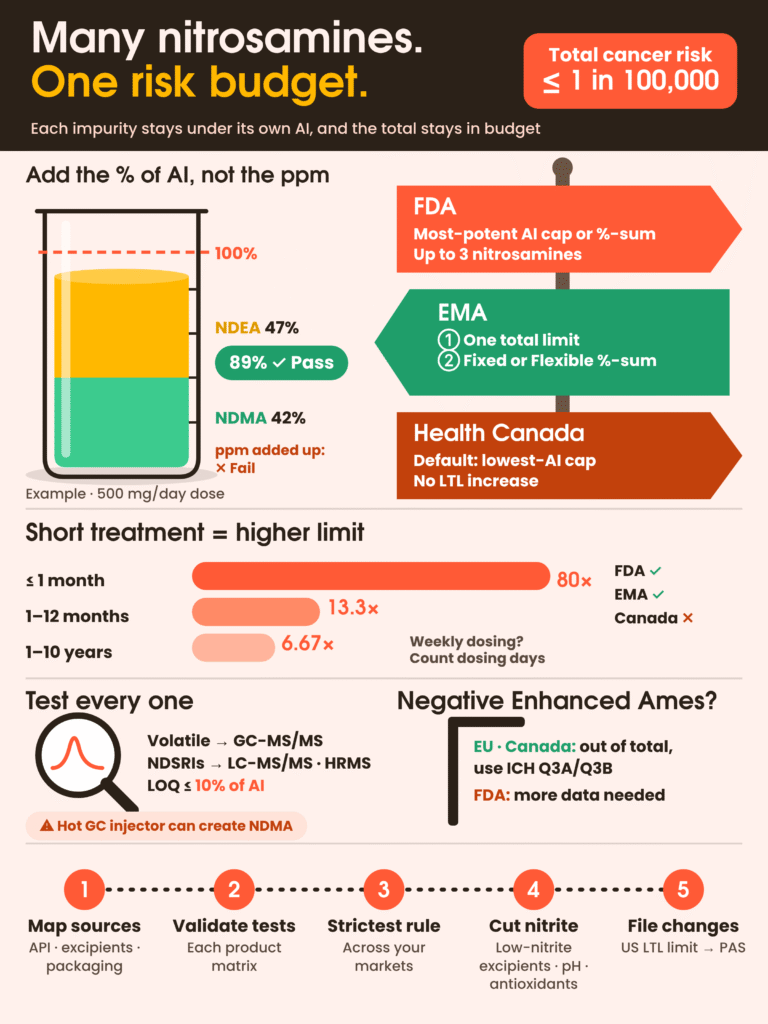
- One risk budget for all of them: When two or more nitrosamines are present or likely, each must stay under its own Acceptable Intake (AI), and their combined exposure must keep the theoretical excess cancer risk at or below 1 in 100,000 (ICH M7(R2)).
- Why stricter rules apply: Nitrosamines are in ICH M7’s “cohort of concern,” so they don’t get the general 1.5 µg/day allowance or the 5 µg/day total. Multiple nitrosamines can form at the same time from API synthesis, excipient nitrites and packaging. Their AIs range from about 18–26.5 to 1,500 ng/day, so simply adding up masses can misjudge the real risk.
- Three regulators, three approaches:
- The FDA caps the total at the most potent nitrosamine’s AI, or allows an Appendix C %-sum of 100% or less, limited to three nitrosamines.
- The EMA offers Option 1 (one total limit) or Option 2 (a Fixed or Flexible %-sum of 100% or less).
- Health Canada’s default caps the total at the lowest AI and assesses alternative methods case by case.
- Proportional math prevents needless failures: Converting each AI to ppm (AI ÷ maximum daily dose) and summing each impurity’s % of AI shows that some batches failing a simple mass-sum limit are still safe. In the article’s examples, 88.8% and 80% both pass.
- Less-than-lifetime (LTL) adjustments: The FDA’s 2026 update allows multipliers of 80× (up to 1 month), 13.3× (1–12 months) and 6.67× (1–10 years), based on total dosing days. In the US this usually needs a Prior Approval Supplement. The EMA also allows LTL adjustments, but Health Canada does not.
- Non-mutagenic nitrosamines: A negative Enhanced Ames Test lets a nitrosamine be left out of the total and controlled under ICH Q3A/Q3B in the EU and Canada. The FDA asks for more supporting data.
- Testing and control:
- Use GC-MS/MS for volatile nitrosamines and LC-MS/MS or HRMS for NDSRIs, with LOQs at or below 10% of the AI.
- Guard against artifacts such as NDMA formed in a hot GC injector.
- Reduce nitrite through excipient choice, pH and antioxidants.
- Choose the strictest strategy that applies across your target markets.
Why Co-Occurring Nitrosamines Require Stricter Controls Than Standard ICH M7(R2) Totals
Co-occurring nitrosamines require cumulative exposure limits as soon as two impurities are present. Their combined exposure must remain within the 1 in 100,000 risk threshold because N-nitrosamines belong to the ICH M7(R2) “cohort of concern” rather than the standard Class 2 or Class 3 categories of mutagenic impurities.
Understand how nitrosamines differ from other mutagenic impurities and why their toxicological classification matters. Explore the differences between NDSRIs and simple nitrosamines.
Under the standard ICH M7(R2) framework, DNA-reactive impurities without compound-specific carcinogenicity data are assigned a lifetime Threshold of Toxicological Concern (TTC) of 1.5 µg/day (1,500 ng/day). This value corresponds to a theoretical excess cancer risk of 1 in 100,000. When two Class 2 or Class 3 impurities are included in a drug substance specification, ICH M7(R2) applies the 1.5 µg/day limit separately to each impurity. A combined lifetime limit of 5 µg/day for “total mutagenic impurities” is introduced through ICH M7(R2) Table 2 only when three or more Class 2 or Class 3 impurities are specified. Class 1 impurities with compound-specific AIs are excluded from this aggregate limit.
However, N-nitrosamines, which are grouped with aflatoxin-like and alkyl-azoxy structures in the cohort of concern, are not assigned a general 1.5 µg/day allowance or an expanded 5 µg/day cumulative limit. Their carcinogenic potency can remain significant even at concentrations considerably below the TTC. Consequently, regulatory authorities require cumulative exposure assessment as soon as more than one nitrosamine is identified or anticipated in a drug product.
Multiple nitrosamines can arise when independent synthetic, formulation, and packaging-related pathways operate simultaneously within the same dosage form. During API synthesis, residual secondary, tertiary, or quaternary amines present in solvents, catalysts, or intermediates may react with residual nitrites. These contaminants may also enter the manufacturing process through contaminated vendor-sourced or recovered solvents, resulting in the formation of small-molecule nitrosamines such as N-nitrosodimethylamine (NDMA) and N-nitrosodiethylamine (NDEA).
Evaluate the manufacturing conditions and chemical reactions that can contribute to nitrosamine generation during pharmaceutical production. Explore nitrosamine formation pathways during API synthesis.
At the same time, trace nitrites in excipients can react with an amine-containing API during manufacturing or shelf-life storage, producing a Nitrosamine Drug Substance-Related Impurity (NDSRI). Reactive foil adhesives and packaging materials may also release nitrosating species after product release. Market surveillance demonstrates that these contamination pathways can overlap. For example, Health Canada recall notices document amitriptyline tablet batches affected by both NDMA and N-nitroso-nortriptyline (NNORT).
Review documented pharmaceutical contamination events to understand the implications of multiple nitrosamine impurities in marketed drug products. Read the analysis of nitrosamine-related drug recalls.
Since accepted AIs can vary by almost two orders of magnitude, ranging from 18–26.5 ng/day for highly potent structures to 1,500 ng/day for low-potency NDSRIs under the Carcinogenic Potency Categorization Approach (CPCA), simply adding the measured masses and comparing the result with the AI of the most potent compound can misrepresent the actual patient risk.
Global Regulatory Rules for Multiple Nitrosamines Total Acceptable Intake
Although the U.S. FDA, EMA, and Health Canada base Multiple Nitrosamines Total Acceptable Intake limits on the same theoretical excess cancer risk threshold of 1 in 100,000, their regulatory approaches differ considerably. These differences involve proportional summation, the permitted number of impurities, specification omission thresholds, LTL adjustments, and exclusions for non-mutagenic nitrosamines.
| Regulatory Parameter | U.S. FDA (Rev. 2, Sept 2024 and 2026 LTL Update) | EMA (Q&A 10, EMA/409815/2020 Rev. 24, Nov 2026) | Health Canada (Guidance Updated Aug 2025) |
|---|---|---|---|
| Default / Conservative Total Limit | Maintaining total nitrosamines below 26.5 ng/day requires no additional safety data. Industry reviews also indicate that the FDA permits total nitrosamines to be capped at the AI of the most potent impurity present. | The total daily intake of all identified N-nitrosamines must not exceed the AI of the most potent N-nitrosamine present at ≥10% of its AI under Option 1. | Cumulative daily exposure must be restricted to the nitrosamine with the lowest AI at the maximum daily dose. |
| Proportional / Risk-Weighted Formula | Appendix C: The sum of each impurity’s ratio to its respective AI must be ≤100%. | Option 2 (Fixed or Flexible): The sum of the percentage AI contributions of all specified nitrosamines must remain ≤100% for each batch. | Alternative methodologies are assessed individually. Applicants must demonstrate that the excess cancer risk remains ≤1 in 100,000. |
| Maximum Impurities in Formula | Explicitly restricted to n ≤3. Detection of more than three nitrosamines requires direct consultation with the FDA. | No numerical ceiling is specified under Option 1 or Option 2. The selected approach must be scientifically justified. | No numerical maximum is stated because the default approach limits the summed mass to the lowest individual AI. |
| 10% Specification Omission Threshold | Specification limits are required when confirmatory or expiry results exceed 10% of the AI. Levels below 10% still require testing of exhibit/validation batches and post-change batches. | The 10% threshold is used in determining which nitrosamines are considered under the applicable cumulative assessment approach. | The guidance does not establish a 10% specification omission threshold. |
| Less-Than-Lifetime (LTL) Adjustments | Permits duration-based LTL multipliers under the 2026 CDER update, subject to applicable requirements. | Permits LTL-related adjustments for eligible treatment durations under the applicable Q&A provisions. | Does not permit LTL scaling beyond the published Appendix 1 lifetime AIs. |
| Non-Mutagenic Nitrosamines | Additional supporting evidence beyond a negative Enhanced Ames Test may be required to justify a 1,500 ng/day AI. | Nitrosamines demonstrated to be non-mutagenic may be managed under ICH Q3A/Q3B principles. | Non-mutagenic nitrosamines may be excluded from cumulative calculations and managed under ICH Q3A/Q3B requirements. |
EMA Q&A 10 Option 1 vs. Option 2 for Multiple Nitrosamines Total Acceptable Intake
Under EMA Q&A 10 (EMA/409815/2020), applicants establishing a Multiple Nitrosamines Total Acceptable Intake can select either Option 1, which restricts the total nitrosamine mass according to the lowest applicable AI, or Option 2, which distributes the allowable exposure across individual impurities using proportional AI percentages that must collectively remain ≤100%. The selected approach must be supported by an appropriate scientific justification.
Option 1 establishes a single total N-nitrosamines limit, expressed in ppm or ppb, corresponding to the AI of the most potent N-nitrosamine present at ≥10% of its respective AI. Under this approach, separate individual specification limits for each nitrosamine are optional. However, the product specification must clearly identify the N-nitrosamines included in the cumulative total calculation. Option 1 can simplify quality control when co-occurring impurities have identical or relatively similar potency levels, or when manufacturing controls consistently maintain total nitrosamine concentrations well below the most restrictive AI.
When co-occurring impurities have substantially different potency levels, such as a small-molecule nitrosamine with an AI of 26.5 ng/day alongside an NDSRI with an AI of 400 ng/day or 1,500 ng/day, Option 2 offers a more proportionate approach. It provides two implementation methods.
Option 2 Fixed Approach
Under the Option 2 Fixed Approach, each specified nitrosamine receives a predetermined, reduced acceptance limit in ppm or ppb. Each limit represents an allocated fraction of the impurity’s individual AI, with the combined allocated percentages restricted to ≤100%. This approach eliminates the need for a separate total N-nitrosamines specification criterion.
Option 2 Flexible Approach
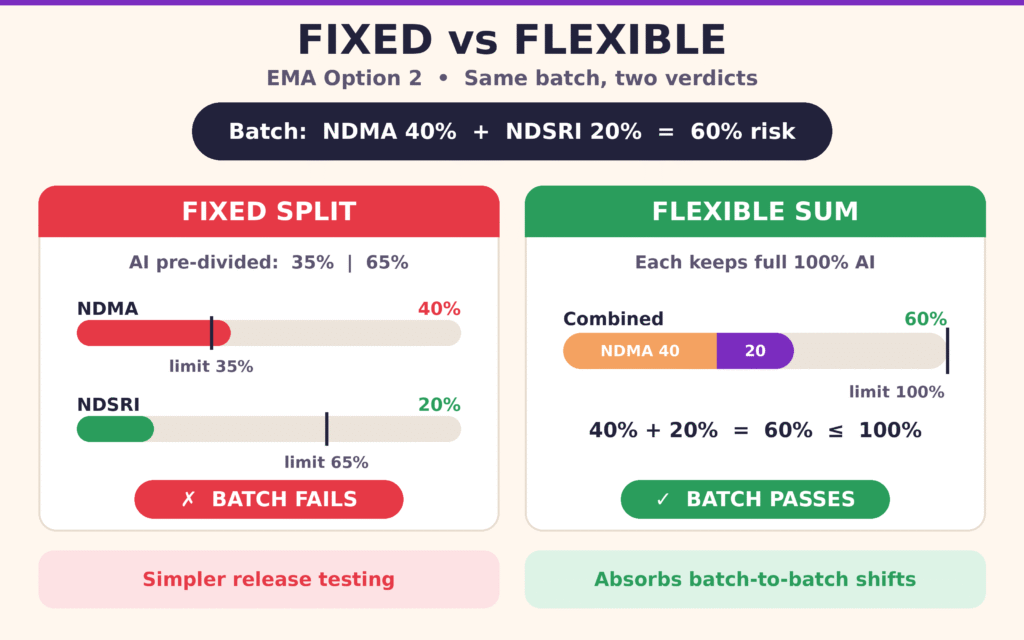
Under the Option 2 Flexible Approach, each specified nitrosamine retains its full individual 100% AI limit in ppm or ppb. An additional total N-nitrosamines specification criterion is introduced to confirm that the sum of the measured percentage contributions of all impurities relative to their respective AIs does not exceed 100% in each released batch.
The selection between Fixed and Flexible Option 2 depends on manufacturing variability and impurity behavior during stability studies. The Fixed Approach simplifies batch release testing because it eliminates the need for batch-specific weighted calculations. However, it can create unnecessary specification failures.
For example, if a fixed allocation assigns 35% of the AI to NDMA and 65% to an NDSRI, a batch containing 40% NDMA and 20% NDSRI would fail the individual fixed limits, even though its combined exposure represents only 60% of the allowable cancer risk.
In contrast, the Flexible Approach accommodates opposite batch-to-batch variations between synthesis-related impurities and NDSRI formation during shelf-life storage. This flexibility is acceptable provided that laboratory data systems accurately calculate, verify, and document the weighted sum at release and throughout stability testing.
FDA Appendix C and the Three-Impurity Boundary
In Revision 2 of Control of Nitrosamine Impurities in Human Drugs (September 2024), the U.S. FDA permits proportional risk allocation through Appendix C. However, it explicitly restricts the algebraic Multiple Nitrosamines Total Acceptable Intake formula to a maximum of three nitrosamines (n ≤3).
Under FDA Revision 2, sponsors can maintain total nitrosamines below the AI of the most potent impurity present, as described in regulatory analyses. Maintaining total nitrosamines below 26.5 ng/day does not require additional safety data, provided that the impurity levels are demonstrated to remain controlled below this threshold.
Alternatively, applicants can implement the weighted-sum criterion outlined in Appendix C. If confirmatory screening identifies more than three different nitrosamines in a single drug product, or if an applicant intends to use an alternative total-nitrosamine calculation methodology, the FDA advises manufacturers and applicants to consult the Agency directly.
Appropriate communication channels include Type C meetings, pre-ANDA meetings, and controlled correspondence. These discussions should take place before finalizing the proposed product specifications.
For a stronger scientific and regulatory foundation, evaluate how nitrosamine impurities are addressed within the broader framework for mutagenic impurity control. Explore genotoxic impurity testing under ICH M7 and nitrosamine requirements.
Health Canada Cumulative Exposure Rules and Post-NOC Filings
Among the major regulatory authorities, Health Canada follows one of the most conservative default approaches. Whenever a drug product has actual or potential contamination involving multiple nitrosamines, cumulative exposure is generally restricted to the lowest individual AI at the maximum daily dose.
Health Canada illustrates this cumulative exposure requirement through specific examples. A drug product containing both NDMA (96.0 ng/day) and NMBA (96.0 ng/day) must maintain combined daily exposure at or below 96.0 ng/day. However, when a product contains NDMA (96.0 ng/day) and NDEA (26.5 ng/day), the combined daily exposure must not exceed 26.5 ng/day.
Although Marketing Authorization Holders (MAHs) may submit alternative risk-weighted calculation methodologies, Health Canada assesses such proposals individually and requires evidence demonstrating that the excess cancer risk remains within 1 in 100,000. Furthermore, Health Canada accounts for potential additive biological effects by applying the published Appendix 1 AIs to both lifetime and LTL treatment durations.
For approved chemically synthesized or semi-synthetic products that already include nitrosamine limits in their specifications, revisions to individual or cumulative AI limits may be submitted as Level III changes (Annual Notifications) under Health Canada’s Post-Notice of Compliance (NOC) Quality Document.
Calculating Multiple Nitrosamines Total Acceptable Intake: Worked Regulatory Scenarios
Converting each mass-based AI (ng/day) into a concentration limit (ppm) using the Maximum Daily Dose (MDD, in mg/day) demonstrates why certain batches that fail under Option 1 can still meet the requirements of EMA Option 2 and FDA Appendix C.
Since 1 ppm equals 1 ng/mg, dividing the daily AI expressed in nanograms by the labeled MDD expressed in milligrams provides the concentration limit directly, without requiring additional conversion factors:
Formula 1: Individual Nitrosamine AI Concentration Limit
AI (ppm) = AI (ng/day) ÷ MDD (mg/day)
Under FDA Appendix C and the EMA Option 2 Flexible Approach, compliance with the combined risk limit requires verification that each batch satisfies the following proportional calculation, subject to the FDA’s maximum of three impurities under Appendix C:
Formula 2: Cumulative Risk-Weighted Nitrosamine Calculation
∑i=1n (Xi ÷ AIi) ≤ 100%
Here, Xi represents the measured concentration of individual nitrosamine i in ppm, while AIi represents the corresponding compound-specific AI concentration limit in ppm.
The following table compares Option 1 and Health Canada’s default cumulative exposure approach against Option 2 and FDA Appendix C across two representative commercial scenarios.
| Worked Scenario | Co-Occurring Impurities and Individual AIs | Product MDD and Individual AIs (ppm) | Measured Batch Concentrations | Option 1 / Health Canada Default Outcome | EMA Option 2 / FDA Appendix C Outcome |
|---|---|---|---|---|---|
| Scenario A: Two Potent Small-Molecule Nitrosamines | NDMA (96.0 ng/day) + NDEA (26.5 ng/day) | 500 mg/day. NDMA: 0.1920 ppm. NDEA: 0.0530 ppm. | NDMA: 0.080 ppm (41.67% AI). NDEA: 0.025 ppm (47.17% AI). | Total = 0.080 + 0.025 = 0.1050 ppm compared with the 0.0530 ppm limit. FAIL | 41.67% + 47.17% = 88.84% ≤100%. PASS |
| Scenario B: Small-Molecule Nitrosamine + CPCA Category 3 NDSRI | NDMA (96.0 ng/day) + Category 3 NDSRI (400.0 ng/day) | 200 mg/day. NDMA: 0.4800 ppm. Category 3: 2.0000 ppm. | NDMA: 0.120 ppm (25.00% AI). Category 3: 1.100 ppm (55.00% AI). | Total = 0.120 + 1.100 = 1.2200 ppm compared with the 0.4800 ppm limit. FAIL | 25.00% + 55.00% = 80.00% ≤100%. PASS |
Scenario A: Two Potent Small-Molecule Nitrosamines
In Scenario A, converting the individual AIs using an MDD of 500 mg/day gives 96.0 ÷ 500 = 0.1920 ppm for NDMA and 26.5 ÷ 500 = 0.0530 ppm for NDEA.
If batch analysis detects 0.080 ppm NDMA and 0.025 ppm NDEA, both impurities remain below half of their respective AIs, corresponding to 41.67% and 47.17%. Both values also exceed the 10% specification inclusion threshold.
However, directly adding their measured concentrations produces a total of 0.1050 ppm, which is nearly twice NDEA’s individual 0.0530 ppm limit. Consequently, the batch fails under Option 1 and Health Canada’s default cumulative limit.
When proportional summation is applied instead, the combined contribution is 41.67% + 47.17% = 88.84%. This result demonstrates that the combined lifetime excess cancer risk remains within the specified 1 in 100,000 threshold.
Scenario B: Small-Molecule Nitrosamine + CPCA Category 3 NDSRI
Scenario B demonstrates the disproportionate restrictions imposed by Option 1 when a low- or moderate-potency NDSRI occurs alongside NDMA. Using the FDA’s CPCA Category 3 limit of 400.0 ng/day, as summarized in testing guidance, together with the NDMA limit of 96.0 ng/day in a product with an MDD of 200 mg/day produces individual concentration limits of 2.0000 ppm (400.0 ÷ 200) and 0.4800 ppm (96.0 ÷ 200), respectively.
The measured batch concentrations are 0.120 ppm NDMA (25.00% AI) and 1.100 ppm Category 3 NDSRI (55.00% AI). Their combined concentration is 1.2200 ppm, exceeding the Option 1 limit of 0.4800 ppm by more than 2.5 times.
This occurs because Option 1 effectively applies the potency restriction of NDMA to the less potent Category 3 NDSRI. In contrast, proportional risk allocation establishes that the combined exposure is 80.00%, which remains comfortably within the regulatory threshold.
Applying the 10 Percent Omission Threshold, 2026 LTL Adjustments, and Negative EAT Exclusions
Regulatory authorities provide three potential pathways for managing multi-nitrosamine exposure: the 10% specification omission threshold, LTL duration-based adjustments, and the exclusion of non-mutagenic nitrosamines. These provisions can allow trace impurities to be excluded from cumulative calculations or permit higher acceptable exposure levels. However, their application depends on specific analytical, toxicological, and regulatory submission requirements.
The 10 Percent Specification Omission Threshold and LOQ Sensitivity
Source text requires completion: The supplied paragraph describing the EMA 10% specification omission threshold is truncated. The complete threshold conditions and corresponding analytical requirements should be verified against the applicable regulatory guidance before publication.
Understand the distinction between analytical screening and confirmatory testing when evaluating low-level nitrosamine contamination. Compare nitrosamine screening and confirmatory analytical methods.
FDA 2026 Less-Than-Lifetime (LTL) Adjustments for Multiple Nitrosamines
The FDA’s 2026 LTL update introduces treatment-duration-based adjustments to acceptable intake limits. These adjustments can increase the permitted daily intake of nitrosamines for eligible products with shorter treatment durations, provided that the applicable regulatory requirements are satisfied.
Consider Scenario D, an acute-care drug product with an MDD of 200 mg/day and an approved treatment duration of ≤1 month, qualifying for the 80× multiplier. The product contains both NDEA and NDMA.
Applying the multiplier increases the NDEA lifetime AI from 26.5 to 2,120.0 ng/day, corresponding to 10.60 ppm (2,120.0 ÷ 200). Similarly, the NDMA AI increases from 96.0 to 7,680.0 ng/day, corresponding to 38.40 ppm (7,680.0 ÷ 200).
If batch testing identifies 4.0 ppm NDEA (4.0 ÷ 10.60 = 37.74%) and 15.0 ppm NDMA (15.0 ÷ 38.40 = 39.06%), the combined Appendix C contribution is 76.80%. Therefore, the calculated exposure remains within the 1 in 100,000 excess cancer risk threshold.
Four important requirements govern multi-nitrosamine LTL proposals submitted to the FDA, highlighting the differences between regional regulatory approaches:
1. Intermittent Dosing Uses Cumulative Dosing Days
For recurring treatment schedules, the applicable Table 1 category is determined by the total number of lifetime dosing days rather than the overall calendar duration. For example, once-weekly administration over two years results in 104 cumulative dosing days. This falls within the >1–12 months treatment category and therefore qualifies for the 13.3× multiplier.
Under this approach, the NDEA LTL AI becomes 352.5 ng/day rather than being calculated using the 6.67× factor associated with longer treatment durations.
2. Long-Term Label Uses Override Short-Term Uses
When approved product labeling includes both short-term and chronic indications, CDER generally evaluates the applicable LTL limit based on the longer-term administration scenario.
3. Interim Limits Are Excluded
The LTL adjustment factors listed in Table 1 cannot be applied to temporary or interim AI limits.
4. Prior Approval Supplement (PAS) Requirement
Introducing an LTL-adjusted control strategy for an approved NDA or ANDA generally constitutes a major regulatory change requiring a PAS, as referenced in 21 CFR 314.70(b) and 314.97(a) in industry summaries.
The submission should include “LTL Request” in the subject line, along with supporting root-cause investigation and mitigation data. Manufacturers operating outside the NDA or ANDA framework, including applicable OTC monograph manufacturers, should contact CDER-OPQ-inquiries@fda.hhs.gov.
EMA Q&A 10 also permits LTL-related adjustments. Specifically, it refers to incorporating the LTL-corrected AI of the most potent nitrosamine for treatment durations below 10 years through Q&A 24. Health Canada, however, explicitly does not permit LTL scaling beyond the published Appendix 1 lifetime AI limits.
Excluding Non-Mutagenic Nitrosamines via the Enhanced Ames Test
Demonstrating that a co-occurring nitrosamine is non-mutagenic can remove it from cumulative nitrosamine calculations in the EU and Canada. The U.S. FDA, however, requires additional supporting evidence beyond a negative Enhanced Ames Test (EAT) to justify a 1,500 ng/day acceptable intake limit.
EMA Q&A 10 specifically states that its multi-nitrosamine calculation requirements do not apply to nitrosamines managed under ICH Q3A/Q3B principles. EMA guidance permits these impurities to be controlled according to ICH Q3A/Q3B qualification thresholds when an Enhanced Ames Test (EAT) produces negative results.
Health Canada follows a similar approach by excluding non-mutagenic nitrosamines from cumulative daily exposure calculations and managing them under ICH Q3A/Q3B requirements.
In contrast, FDA CDER’s Acceptable Intake guidance indicates that additional supporting evidence, including negative in vitro mutation tests, is requested alongside the EAT to justify a 1,500 ng/day limit. Furthermore, the extracted text of FDA Revision 2 does not establish an automatic ICH Q3A/Q3B exclusion from Appendix C cumulative calculations.
Analytical Validation and Control Execution for Multi-Nitrosamine Products
Implementing fractional specifications for multiple nitrosamines requires complementary LC-MS/MS, HRMS, and GC-MS/MS analytical methods validated to achieve single-digit ppb LOQs in the relevant drug product matrix. These methods must be supported by stringent controls addressing matrix suppression and potential in-situ nitrosation artifacts.
Small-molecule volatile nitrosamines, including NDMA, NDEA, and NDBA, frequently occur alongside non-volatile and thermally labile NDSRIs. Consequently, a single chromatographic configuration may not provide reliable separation and quantification of every target analyte.
Volatile small-molecule nitrosamines are commonly quantified using GC-MS/MS, whereas polar NDSRIs and heat-sensitive APIs generally require Triple Quadrupole LC-MS/MS or High-Resolution Mass Spectrometry (HRMS).
Industry summaries of the FDA’s October 2019 ranitidine findings emphasize that elevated injector temperatures in GC methods can cause artificial NDMA formation from susceptible APIs during analytical testing. Therefore, every GC analytical protocol must be evaluated for potential in-situ nitrosamine formation before the resulting data are reported.
Additionally, because Option 2 Flexible and FDA Appendix C calculations involve summing the fractional contributions of multiple analytes, even minor signal suppression affecting a single compound can influence the final batch disposition decision.
Laboratories address these analytical challenges through isotope-dilution mass spectrometry using deuterated internal standards, such as NDMA-d6, solid-phase extraction (SPE), matrix-matched calibration, neutral-pH low-temperature extraction, and comprehensive matrix-specific validation aligned with ICH Q2(R2), USP, and Ph. Eur. 2.5.42.
Reliable analytical results depend on appropriately developed and validated methods capable of detecting and quantifying multiple nitrosamine impurities at the required sensitivity. Explore nitrosamine method development and validation services.
A comprehensive Chemistry, Manufacturing, and Controls (CMC) program for multi-nitrosamine drug products should incorporate five essential operational steps:
1. Identify Potential Contamination Pathways
Map both synthetic amine/nitrite carryover and nitrosation pathways associated with formulation and packaging materials during the initial risk assessment.
2. Validate Sensitive Analytical Methods
Establish orthogonal LC-MS/MS, HRMS, or GC-MS/MS methods for each relevant drug product matrix, ensuring that validated LOQs are at or below the 10% AI threshold.
3. Select an Appropriate Regional Control Strategy
Choose the most restrictive calculation approach required across the intended markets, including the Health Canada default cumulative cap, EMA Option 2 Fixed or Flexible, or FDA Appendix C for n ≤3.
Develop a scientifically justified approach for managing individual and cumulative nitrosamine exposure across different regulatory markets. Explore nitrosamine control strategy development services.
4. Implement Formulation and Manufacturing Controls
Introduce appropriate risk-reduction measures, such as qualifying low-nitrite excipients, increasing microenvironmental pH, or incorporating antioxidants such as ascorbic acid and α-tocopherol when stability studies demonstrate increasing NDSRI concentrations.
5. Prepare Appropriate Regulatory Submissions
File region-specific regulatory changes according to the applicable requirements. Reserve Prior Approval Supplements for U.S. LTL-based control strategies and seek proactive Agency consultation when more than three nitrosamines are identified together.
Nitrosamine contamination can also originate from product-contact materials and packaging components, making extractables and leachables evaluation an important part of the overall control strategy. Learn more about nitrosamine leachables testing.
Multi-Nitrosamine Analytical Testing and CMC Support at ResolveMass Laboratories
Successful execution of multi-analyte validation and stability mitigation at single-digit ppb concentrations requires specialized mass-spectrometry infrastructure and experienced regulatory chemists.
At ResolveMass Laboratories Inc. in Laval, Québec, an ISO/IEC 17025-accredited laboratory staffed by scientists with more than 15 years of experience, multi-nitrosamine analytical programs integrate Triple Quadrupole LC-MS/MS, Q-Exactive Orbitrap HRMS, and GC-MS/MS technologies.
The laboratory also uses in-house custom synthesis of deuterated internal standards to support the simultaneous identification and quantification of co-eluting NDSRIs and volatile nitrosamines.
Direct consultation with analytical chemists enables sponsors to establish suitable method LOQs, implement controls against analytical artifacts, and develop Option 2 or Appendix C control strategies that align with FDA, EMA, and Health Canada submission requirements.
Manufacturers seeking specialized analytical capabilities can consider external laboratory support for complex multi-nitrosamine testing and validation programs. Explore the benefits of outsourcing nitrosamine testing to a CRO.
Conclusion
Establishing a scientifically defensible Multiple Nitrosamines Total Acceptable Intake requires the integration of toxicological risk calculations, regional regulatory requirements, and highly sensitive analytical testing within a unified regulatory and CMC strategy. Treating co-occurring small-molecule nitrosamines and NDSRIs solely as individual impurities, or indiscriminately adding their measured concentrations and comparing the result with the lowest AI, can create unnecessary compliance challenges, overlooked patient risks, and avoidable batch failures during FDA, EMA, and Health Canada reviews.
By integrating orthogonal mass-spectrometry validation, reliable analytical capabilities at the 10% AI threshold, formulation and manufacturing controls to minimize nitrite-related nitrosation, and region-specific justifications under EMA Option 2, FDA Appendix C, or applicable LTL provisions, sponsors can protect patient safety while maintaining a reliable product supply.
To collaborate with experienced analytical chemists on multi-nitrosamine method development, analytical validation, or regulatory control strategies, contact ResolveMass Laboratories Inc. through the contact page.
Frequently Asked Questions
N-nitrosamines are classified within the ICH M7(R2) cohort of concern because of their potentially high carcinogenic potency. Unlike ordinary Class 2 or Class 3 impurities, they cannot rely on the generic 1.5 µg/day TTC or the 5 µg/day cumulative allowance. Therefore, cumulative exposure restrictions apply as soon as two nitrosamines are identified.
EMA Option 1 restricts the combined nitrosamine concentration according to the AI of the most potent impurity present at or above 10% of its AI. Option 2 evaluates each impurity according to its individual potency by calculating its percentage contribution to the respective AI. The combined percentage must remain at or below 100%, allowing lower-potency NDSRIs to be assessed more proportionately.
The Fixed Approach is suitable when manufacturing conditions are consistent and predetermined impurity limits can be maintained across batches. The Flexible Approach is more appropriate when nitrosamine concentrations vary between batches or change during stability studies. It allows each impurity to retain its individual AI limit, provided the combined percentage contribution does not exceed 100%.
FDA Revision 2 restricts the Appendix C proportional calculation formula to a maximum of three nitrosamines. If confirmatory testing identifies more than three different nitrosamines in one drug product, manufacturers should consult the FDA before establishing an alternative cumulative control strategy. Type C meetings, pre-ANDA meetings, and controlled correspondence are appropriate communication channels.
Under EMA Q&A 10 and FDA Revision 2, nitrosamines consistently maintained below 10% of their respective AIs may generally be excluded from routine product specifications and cumulative calculations. However, manufacturers must establish reliable analytical methods and demonstrate effective process controls. The FDA also recommends testing exhibit batches, validation batches, and batches affected by relevant manufacturing changes.
Yes, both the FDA and EMA permit certain LTL adjustments when treatment duration is shorter than a lifetime. The FDA’s 2026 guidance provides adjustment factors of 80×, 13.3×, and 6.67×, depending on treatment duration, while requiring combined exposure to remain within the acceptable risk threshold. Health Canada does not permit these adjustments and continues to apply its published lifetime AIs.
Health Canada generally restricts the combined daily exposure of multiple nitrosamines to the lowest individual AI at the maximum daily dose. For example, when NDMA and NDEA are present together, their cumulative exposure must not exceed the lower NDEA limit of 26.5 ng/day. Alternative proportional calculations require case-specific regulatory assessment, and the August 2025 guidance does not establish a 10% omission threshold or permit LTL adjustments.
Under EMA and Health Canada requirements, nitrosamines demonstrated to be non-mutagenic through a negative Enhanced Ames Test (EAT) may be excluded from cumulative calculations when they meet the applicable ICH Q3A/Q3B qualification criteria. The FDA takes a more extensive approach and requests additional supporting evidence, including negative in vitro mutation testing, to justify an acceptable intake of 1,500 ng/day.
Reliable multi-nitrosamine testing requires highly sensitive analytical methods capable of detecting impurities at single-digit or low double-digit ppb concentrations. For example, a 500 mg/day drug product may require LOQs of approximately 5.3 ppb for NDEA and 19.2 ppb for NDMA to evaluate the 10% AI threshold. Laboratories commonly combine LC-MS/MS, HRMS, and GC-MS/MS with deuterated internal standards to minimize matrix interference, signal suppression, and thermal degradation artifacts.
Reference:
- U.S. Food and Drug Administration. (2024, September). Control of nitrosamine impurities in human drugs: Guidance for industry (Revision 2). U.S. Department of Health and Human Services. https://www.fda.gov/media/141720/download
- Health Canada. (2025, August). Guidance on nitrosamine impurities in medications: Evaluating and managing the risks of N-nitrosamine impurities in human pharmaceutical, biological and radiopharmaceutical products. Government of Canada. https://www.canada.ca/content/dam/hc-sc/documents/services/drugs-health-products/compliance-enforcement/information-health-product/drugs/nitrosamine-impurities/medications-guidance/medications-guidance.pdf
- European Medicines Agency. (2026, November 3). Questions and answers for marketing authorisation holders/applicants on the CHMP Opinion for the Article 5(3) of Regulation (EC) No 726/2004 referral on nitrosamine impurities in human medicinal products (Revision 24). https://www.ema.europa.eu/en/documents/opinion-any-scientific-matter/nitrosamines-emea-h-a53-1490-questions-answers-marketing-authorisation-holders-applicants-chmp-opinion-article-53-regulation-ec-no-726-2004-referral-nitrosamine-impurities-human-medicinal-products_en.pdf
- U.S. Food and Drug Administration. (2026, September 24). Application of less-than-lifetime adjustment to nitrosamine impurities: Guidance for industry. U.S. Department of Health and Human Services. https://www.fda.gov/media/195007/download?attachment
- International Council for Harmonisation of Technical Requirements for Pharmaceuticals for Human Use. (2023, July 18). ICH M7(R2) guideline on assessment and control of DNA reactive (mutagenic) impurities in pharmaceuticals to limit potential carcinogenic risk. European Medicines Agency. https://www.ema.europa.eu/en/documents/scientific-guideline/ich-m7r2-guideline-assessment-and-control-dna-reactive-mutagenic-impurities-pharmaceuticals-limit-potential-carcinogenic-risk-step-5_en.pdf
- U.S. Food and Drug Administration. (2023, July). M7(R2) assessment and control of DNA reactive (mutagenic) impurities in pharmaceuticals to limit potential carcinogenic risk: Guidance for industry. U.S. Department of Health and Human Services. https://www.fda.gov/media/170461/download
- Health Canada. (n.d.). Nitrosamine impurities in medications: Recalls. Government of Canada. https://www.canada.ca/en/health-canada/services/drugs-health-products/compliance-enforcement/information-health-product/drugs/nitrosamine-impurities/recalls.html
Get In Touch With Us
About The Author