

Introduction:
The global pharmaceutical industry is facing strict regulatory control for mutagenic impurities, especially nitrosamines. A strong understanding of NDA vs ANDA Nitrosamine Submission Requirements is now essential for sponsors who want smooth regulatory approval and continued patient safety. Since the discovery of N-nitrosodimethylamine (NDMA) in sartan products in 2018, agencies such as the FDA, EMA, and Health Canada have increased their expectations. What started as urgent testing has now become a well-defined and structured compliance framework that applies throughout the product lifecycle.
Today, submitting a New Drug Application (NDA) or an Abbreviated New Drug Application (ANDA) involves much more than basic impurity testing. Sponsors must provide structural risk assessments, forced degradation studies, highly sensitive confirmatory testing, and long-term stability data. These expectations apply to both traditional small-molecule nitrosamines and Nitrosamine Drug Substance-Related Impurities (NDSRIs). Regulatory authorities expect clear scientific justification supported by validated analytical data. Meeting these standards requires teamwork between analytical scientists, toxicologists, regulatory writers, and quality experts who understand eCTD structure and compliance timelines.
Expert Resource: Ensure your submission meets the latest regulatory standards with specialized Nitrosamine Analysis services.
Share via:
Key Takeaways
- Nitrosamine risk assessment is now mandatory for both NDA and ANDA submissions due to strict global regulatory requirements.
- Sponsors must provide structural risk evaluation, validated analytical testing, and stability data.
- Sensitive LC-MS/MS or GC-MS/MS methods are required to detect impurities at very low levels.
- Proper documentation in eCTD Module 3 is essential for regulatory approval.
- Incomplete nitrosamine data can lead to submission delays, rejection, or regulatory action.
Evolution of NDA vs ANDA Nitrosamine Submission Requirements
Regulatory expectations for nitrosamines have changed from reactive investigations to a proactive and preventive approach. In the early stages, attention was mainly on small nitrosamines like NDMA, NDEA, and NMBA. These were often linked to contaminated solvents or specific reagents used during manufacturing. Over time, regulators identified NDSRIs, which are directly related to the active pharmaceutical ingredient (API). This added a new level of complexity to risk assessments.
The FDA’s Revision 2 guidance, released in September 2024, formally included both classical nitrosamines and NDSRIs within the compliance scope. Sponsors must now review secondary and tertiary amines present in APIs, intermediates, and degradants. For NDAs involving a New Molecular Entity (NME), the full synthetic pathway must be assessed for nitrosation risk. For ANDAs, manufacturers must ensure their generic product does not introduce new nitrosamine risks beyond those in the Reference Listed Drug (RLD). This reinforces that generics must match the RLD not only in performance but also in impurity control.
Technical Guidance: Stay ahead of evolving guidelines by reviewing the Impact of ICH M7R2 Updates on Nitrosamine Risk Assessment.
| Milestone Date | Regulatory Action | Impact on Submission Requirements |
|---|---|---|
| July 2018 | Detection of NDMA in Valsartan | Initiated global recalls and regulatory investigations. |
| Feb 2021 | FDA Guidance: Control of Nitrosamine Impurities | Introduced the 3-step mitigation strategy. |
| Aug 2023 | FDA/EMA NDSRI Guidance | Implemented CPCA for structure-based AI limit derivation. |
| Sept 2024 | FDA Revision 2 Guidance | Expanded inclusion of NDSRIs and updated timelines. |
| June 2025 | Deadline Extension/Update | Shifted to mandatory progress reports (NDSRI Updates). |
| Aug 2025 | Health Canada Major Update | Removed LTL limits and added 17 new listed impurities. |
For generic companies operating under GDUFA III, the risk of non-compliance is serious. If nitrosamine data are incomplete, the FDA may issue a Refuse to Receive (RTR) letter. With an ANDA filing fee of $358,247 for FY 2026, the financial impact can be significant. This makes the quality of the nitrosamine data package a key factor for first-cycle approval success.
Compliance Check: Avoid submission delays by performing a comprehensive Nitrosamine Risk Assessment for ANDA Submission.
Structural Assessment Criteria in NDA vs ANDA Nitrosamine Submission Requirements
Under NDA vs ANDA Nitrosamine Submission Requirements, structural risk assessment plays a central role. Regulators rely on the Carcinogenic Potency Categorization Approach (CPCA) when compound-specific data are not available. The CPCA framework predicts carcinogenic risk based on molecular structure and assigns an Acceptable Intake (AI) limit. Sponsors must clearly explain how the compound was evaluated and how the final potency category was selected.
The assessment includes reviewing alpha-hydrogen counts and identifying activating or deactivating structural features. NDA applicants usually perform detailed retrosynthetic analysis to identify possible amine precursors in the NME pathway. ANDA applicants often review the Drug Master File (DMF) and excipient profiles to detect nitrosating agents such as nitrites. This stage requires close collaboration between chemistry, toxicology, and regulatory teams.
Learn More: Understand how structures influence regulatory limits in our guide on Nitrosamine AI Limit and CPCA.
The AI limit directly affects analytical sensitivity and specification limits. The evaluation starts by examining hydrogen atoms attached to alpha-carbons next to the N-nitroso group.
| Feature Type | Specific Feature | Feature Score / Adjustment |
|---|---|---|
| Alpha-Hydrogen Count | 0 hydrogens (Tertiary alpha-carbon) | PC 5 (1500 ng/day) |
| Deactivating Feature | Carboxylic acid group | +3 |
| Deactivating Feature | 5- or 6-membered ring | +2 |
| Deactivating Feature | Morpholine or 7-membered ring | +1 |
| Activating Feature | Methyl group on alpha-carbon | -1 |
| Activating Feature | Electronic withdrawing group (beta-position) | Variable |
A compound in Potency Category 1 may have an AI limit as low as 26.5 ng/day. In contrast, Category 5 compounds may allow up to 1500 ng/day. Sponsors must justify any deviation from CPCA guidance with strong toxicological data or read-across justification. Clear documentation in Module 2 summaries supports reviewer confidence and strengthens the overall submission.
Analytical Validation in NDA vs ANDA Nitrosamine Submission Requirements
Analytical testing under NDA vs ANDA Nitrosamine Submission Requirements must detect nitrosamines at extremely low levels. Agencies require validated LC-MS/MS or GC-MS/MS methods that can measure impurities at parts-per-billion levels. Validation must follow ICH Q2 (R1/R2) and USP expectations. The Limit of Quantitation (LOQ) is one of the most critical parameters.
Advanced Testing: Achieve required sensitivity with Ultra-Low Limit of Quantitation (LOQ) in Nitrosamine Testing.
If the LOQ is higher than 30% of the AI limit, regulators may question the method’s suitability. Sponsors should demonstrate consistent performance across batches and time points. Stability-indicating capability is also important, especially for products that may form nitrosamines during storage. Long-term and accelerated stability data add confidence to the control strategy.
Matrix effects from excipients can affect detection accuracy. Using isotope-labeled internal standards helps control variability and improve precision. Validation reports should include chromatograms, calibration data, recovery results, and inter-day precision findings.
| Validation Parameter | Standard Acceptance Criteria | Submission Requirement |
|---|---|---|
| Specificity | No interference at analyte retention time | Chromatograms of blank, LOQ, and sample |
| Linearity | r² ≥ 0.99 | Calibration from 50–150% of limit |
| Accuracy | 70%–130% recovery | LOQ, mid, and high levels |
| Precision | ≤20%–25% RSD at LOQ | Multi-day injections |
| LOQ | ≤30% of AI limit | S/N ≥ 10:1 |
| Robustness | Minimal impact from minor changes | Flow rate and temperature assessment |
For NDSRIs that are not commercially available, custom synthesis of reference standards may be required. High-Resolution Mass Spectrometry (HRMS) can support broader screening to confirm that no unexpected nitrosamines are present. Including forced degradation studies further demonstrates that the method is suitable and reliable.
Deep Dive: Explore the advantages of using HRMS for Nitrosamine Testing in complex matrices.
eCTD Module 3 Requirements in NDA vs ANDA Nitrosamine Submission Requirements
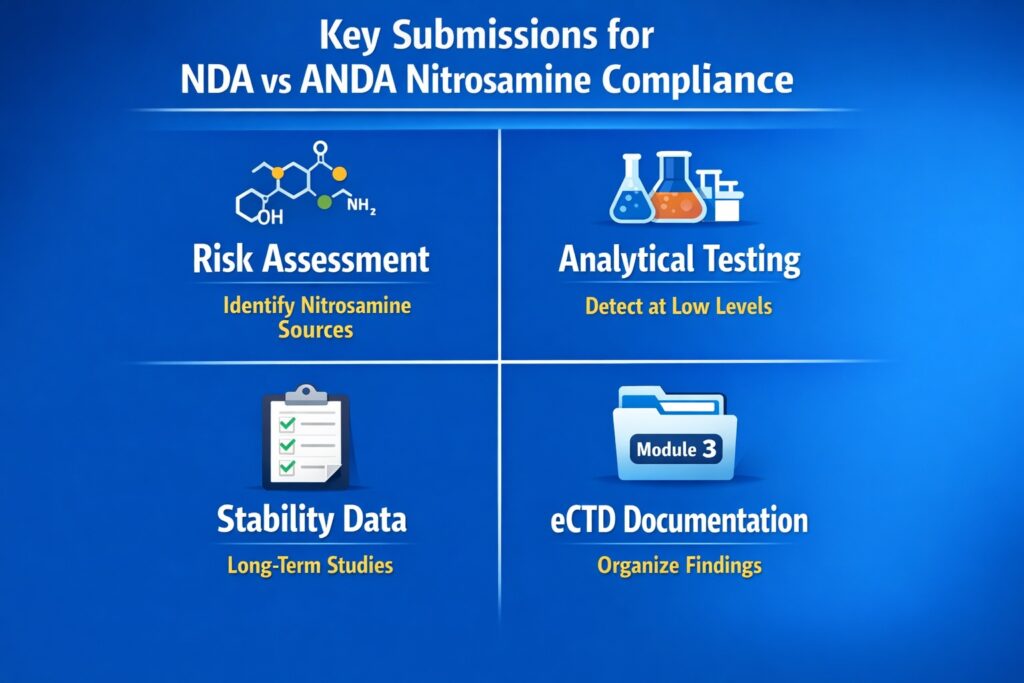
Nitrosamine data must be properly organized in eCTD Module 3 to allow efficient regulatory review. Both NDA and ANDA submissions must show alignment between Drug Substance (3.2.S) and Drug Product (3.2.P) sections. The control strategy should clearly connect the risk assessment results with specifications and testing plans. Consistency between Module 2 summaries and Module 3 detailed data improves clarity.
Section 3.2.S: Control of Drug Substance
In section 3.2.S.3, sponsors must identify all potential nitrosamines related to API synthesis. Risk assessments should review secondary and tertiary amines, nitrosating agents like sodium nitrite, and process steps that may increase risk. Fate and purge studies should explain how impurities are reduced during purification steps. If a risk is confirmed, justified specification limits must be included in 3.2.S.4.1. Supporting batch data strengthens the control approach.
Section 3.2.P: Control of Drug Product
Section 3.2.P.5 focuses on formulation and storage risks. Sponsors must assess excipients for nitrite or nitrate content and evaluate manufacturing conditions such as wet granulation and drying temperatures. For infusion products, testing for NDBA and other small nitrosamines is required. At least three months of accelerated stability data should show controlled nitrosamine levels. Trending data across multiple batches improves submission strength.
Regulatory Strategy: Learn the details of setting appropriate limits with our resource on Nitrosamine Specification Setting.
In 2025, companies must include an “NDSRI Update” in section 1.13.14 of the Annual Report if mitigation activities are ongoing. The update should be data-driven and aligned with previous CAPA commitments.
Stability Focus: Ensure long-term compliance by integrating Nitrosamine Testing in Stability Studies.
Bioequivalence Bridging and NDA vs ANDA Nitrosamine Submission Requirements
Reformulation to reduce nitrosamine risk may affect bioequivalence (BE). Adding suppressors such as ascorbic acid or alpha-tocopherol requires proof that drug absorption remains unchanged. For NDAs, this may involve clinical bridging studies. For ANDAs, alternative BE approaches may be allowed depending on formulation impact and BCS classification.
Alternative BE Approaches Under NDA vs ANDA Nitrosamine Submission Requirements
FDA Revision 2 guidance provides flexibility for Immediate Release products under defined conditions.
| Suppressor Type | Limit for Alternative BE | Bioequivalence Requirement |
|---|---|---|
| Antioxidants (Ascorbic acid, Cysteine) | ≤10 mg per dose | Possible in vivo BE waiver if dissolution matches RLD |
| pH Modifiers | Form-dependent | Solubility-pH testing and PBPK modeling |
| BCS Class III/IV | N/A | Extensive dissolution testing |
For BCS Class I and III drugs, permeability is usually not the limiting factor. This may simplify bridging requirements. For BCS Class II and IV drugs, additional solubility or permeability studies may be required. Early discussion with regulatory agencies can reduce delays and deficiency letters.
Mitigation Strategy: Discover how to prevent impurity formation using a Secondary Amine Scavenger for Nitrosamines.
Managing the August 1, 2025 Compliance Deadline
The August 1, 2025 deadline is a key milestone for NDSRI compliance. Although full mitigation was initially required, the June 2025 update allows progress reports in complex cases. This recognizes that reformulation, validation, and long-term stability studies require time. However, sponsors must clearly document progress.
An “NDSRI Update” should include:
- Forced Degradation Results
- Confirmatory Test Results
- Root Cause Analysis
- Mitigation Strategy and Timeline
Incomplete submissions may result in clinical holds, Refuse to File decisions, or recalls. Clear scientific justification and transparent communication help reduce enforcement risk. Planning ahead is essential for both NDA and ANDA holders.
Global Harmonization: Health Canada and EMA 2025 Requirements
While there is global alignment on nitrosamine control, regional differences remain. Health Canada’s August 2025 update removed Less-than-Lifetime (LTL) limits and applied stricter lifetime AI thresholds. Manufacturers must also complete CAPA actions within a defined three-year timeline for newly listed impurities.
Health Canada added 17 new nitrosamines in August 2025 and seven more in December 2025. The EMA continues to emphasize Marketing Authorization Holder responsibility under Article 5(3), including structured risk reporting. Companies marketing in multiple regions should align their strategies with the strictest requirements to avoid duplication and delays.
Strategies to Strengthen Regulatory Content and E-E-A-T
Clear structure and practical examples improve both regulatory review and online visibility. Using headings, tables, and concise explanations makes technical information easier to understand. Addressing common regulatory questions directly improves content clarity and trust.
Referencing official FDA, EMA, and Health Canada guidance increases credibility. Including real-world examples of NDSRI detection challenges demonstrates expertise. Structured formatting and schema-ready HTML also improve discoverability in AI-generated search summaries.
Conclusion: Achieving Compliance with NDA vs ANDA Nitrosamine Submission Requirements
NDA vs ANDA Nitrosamine Submission Requirements are now a central part of pharmaceutical regulatory strategy. Agencies expect detailed structural assessments, validated analytical methods, and clear documentation in Module 3. Ongoing updates, especially for NDSRIs, reflect a strong focus on prevention and transparency.
Companies that invest in scientific expertise, advanced analytical capability, and regulatory intelligence are better prepared for first-cycle approvals. Working with experienced laboratories and regulatory consultants can streamline compliance and protect product supply.
For more information or to request a consultation regarding your nitrosamine testing needs, please visit our contact pages:
Contact Us
FAQs on Nitrosamine Submission Requirements
An NDA (New Drug Application) is submitted when a company seeks approval for a new drug product that has not been previously approved. It must include full clinical, non-clinical, and manufacturing data to prove safety and effectiveness. An ANDA (Abbreviated New Drug Application) is filed for a generic version of an already approved drug. Instead of repeating clinical trials, the ANDA applicant must show that the product is bioequivalent to the reference listed drug (RLD).
The NDA process is primarily governed by 21 CFR Part 314, Subpart B, which outlines requirements for new drug approval. The ANDA process is also covered under 21 CFR Part 314, specifically Subpart C, which details abbreviated applications for generic drugs. These regulations describe submission content, review procedures, labeling requirements, and post-approval obligations. Together, they form the core regulatory framework for drug approval in the United States.
The main purpose of an NDA submission is to obtain regulatory approval to market a new pharmaceutical product in the United States. It provides comprehensive data demonstrating that the drug is safe and effective for its intended use. The application also includes detailed information on manufacturing processes, quality controls, and labeling. Regulatory authorities review this information to ensure that the benefits of the drug outweigh its risks.
An NDA requires significant time, financial investment, and extensive clinical research, which can limit accessibility for smaller companies. The review process can be lengthy, especially if additional data or clarification is requested by regulators. Post-approval commitments, such as Phase IV studies or risk management programs, may also apply. In addition, market exclusivity periods eventually expire, allowing generic competition to enter the market.
The CPCA framework evaluates the molecular structure of the nitrosamine, focusing on features such as alpha-hydrogen count and the presence of activating or deactivating groups. Based on these structural elements, the impurity is assigned to one of five potency categories. Each category has a default Acceptable Intake (AI) range, typically between 26.5 ng/day and 1500 ng/day. This AI value then guides specification limits and analytical sensitivity requirements.
Reference:
- U.S. Food and Drug Administration. (2023). CDER nitrosamine impurity acceptable intake limits. https://www.fda.gov/regulatory-information/search-fda-guidance-documents/cder-nitrosamine-impurity-acceptable-intake-limits
- U.S. Food and Drug Administration. (2024, September 4). Information about nitrosamine impurities in medications. https://www.fda.gov/drugs/drug-safety-and-availability/information-about-nitrosamine-impurities-medications
- European Medicines Agency. (2025, July 29). Nitrosamine impurities. https://www.ema.europa.eu/en/human-regulatory-overview/post-authorisation/referral-procedures-human-medicines/nitrosamine-impurities
- Manchuri, K. M., Shaik, M. A., Gopireddy, V. S. R., Sultana, N., & Gogineni, S. (2024). Analytical methodologies to detect N-nitrosamine impurities in active pharmaceutical ingredients, drug products and other matrices. Chemical Research in Toxicology, 37(9), 1456–1483. https://doi.org/10.1021/acs.chemrestox.4c00234
Get In Touch With Us
About The Author


