


Introduction
In this NDMA Root Cause Investigation Case Study, we examine a real-world scenario involving an unexpected spike of N-nitrosodimethylamine (NDMA) in stability samples of a commercially distributed finished product. The signal was identified during routine stability monitoring, not through a market complaint. Early detection allowed the company to act before broader distribution impact occurred.
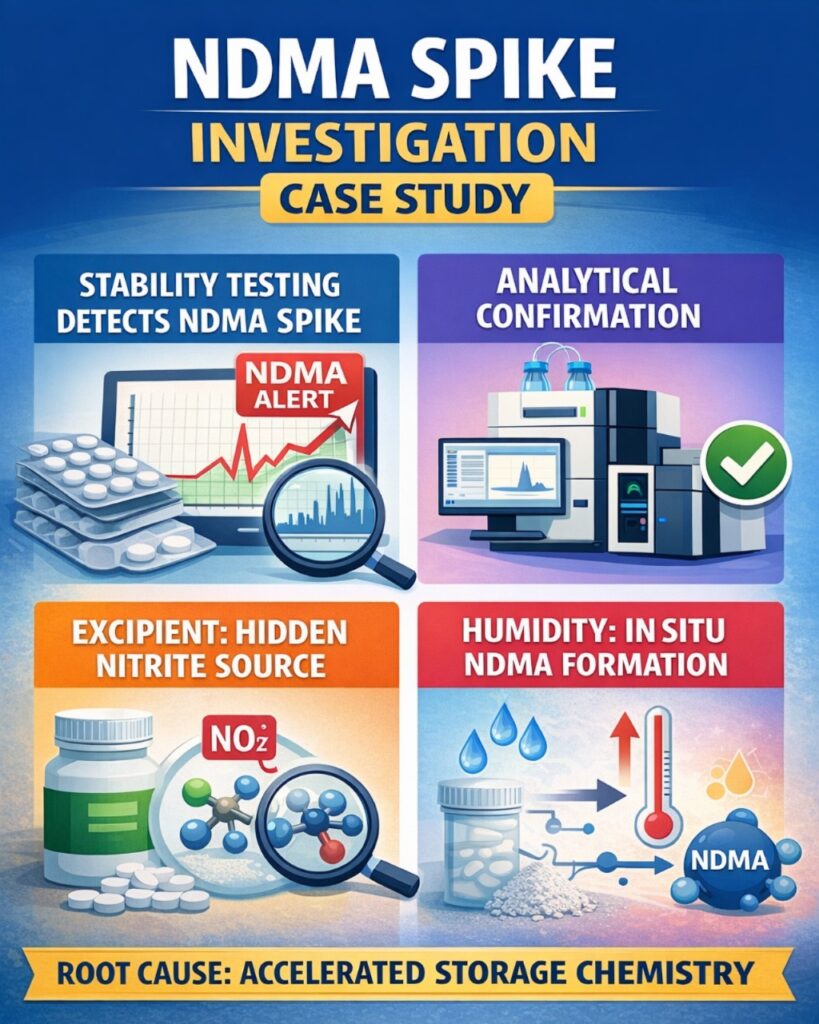
The investigation showed that the NDMA was not introduced during API manufacturing. Instead, it resulted from a complex interaction between excipient-derived nitrite and API degradation products under accelerated storage conditions. The reaction pathway was subtle and became visible only under stress testing.
This case demonstrates why modern nitrosamine risk assessments must evaluate formulation chemistry, packaging interaction, and long-term stability behavior. Regulatory expectations now demand a lifecycle approach. Focusing only on synthetic route review is no longer enough.
Ensure your testing partner meets global standards: Nitrosamine Testing CRO Selection
Executive Summary
- An unexpected NDMA spike in a finished pharmaceutical product requires an immediate, structured, and scientifically defensible investigation.
- This NDMA Root Cause Investigation Case Study examines how a sudden out-of-trend result was traced to in situ formation driven by nitrite–amine interactions during storage.
- Advanced LC-MS/MS confirmation, forced degradation studies, excipient testing, and packaging extractables analysis were critical.
- The true root cause was not API contamination but trace nitrite in an excipient combined with secondary amine degradation of the API.
- Corrective actions included excipient specification tightening, reformulation, nitrogen blanketing, and revised stability protocols.
- This case highlights why risk-based nitrosamine assessment must extend beyond API synthesis to finished product lifecycle management.
Share via:
NDMA Root Cause Investigation Case Study: Detection of the Spike
What Triggered the Investigation?
The investigation began when a 6-month accelerated stability sample exceeded the internal NDMA alert threshold. Release and 3-month data were within acceptable limits. The change between 3 and 6 months was statistically significant and unexpected.
Trend analysis showed a clear upward pattern rather than random variation. This indicated an active formation process occurring during storage.
Initial Observations
| Parameter | Release | 3 Months | 6 Months (40°C/75% RH) |
|---|---|---|---|
| NDMA Level | < LOQ | 28 ng/g | 162 ng/g |
| Spec Limit | 96 ng/day equivalent | 96 ng/day equivalent | 96 ng/day equivalent |
Key Findings:
- Batch passed all release specifications. Manufacturing conditions were compliant at the time of production.
- Spike occurred only in accelerated storage. Long-term samples showed much lower levels.
- No changes in API supplier or synthetic route. Audit records confirmed consistency.
- No nitrosating reagents were used in manufacturing. Batch records were thoroughly reviewed.
A cross-functional team from quality, analytical, formulation, and regulatory departments initiated a formal root cause investigation. A risk assessment was immediately performed to evaluate patient exposure.
NDMA Root Cause Investigation Case Study: Analytical Confirmation
Was the Spike an Analytical Artifact?
The first priority was to confirm whether the NDMA increase was real. Analytical false positives can result from matrix interference or instrument carryover. Eliminating this possibility was critical before moving forward.
Confirmation Steps
- Orthogonal LC-MS/MS method verification
- Alternative column chemistry confirmation
- Standard addition (spike-recovery) testing
- Blank placebo analysis
- Laboratory contamination assessment
Methods followed peer-reviewed approaches described in:
Charagondla et al. (2025). Pharmaceutical Research.
https://link.springer.com/article/10.1007/s11095-025-03875-7
Kartop et al. (2024). Journal of Pharmaceutical Sciences.
https://www.sciencedirect.com/science/article/pii/S0022354924000170
Grgičević (2023). LC-MS/MS validation.
https://repository.biotech.uniri.hr/object/biotechri:841
Analytical Conclusion
- Recovery: 94–103%
- LOQ confirmed at 10 ng/g
- No carryover detected
- No laboratory contamination identified
The NDMA spike was confirmed as genuine. Repeated injections produced consistent results. Independent review verified data integrity.
NDMA Root Cause Investigation Case Study: Manufacturing Process Review
Could API Synthesis Be the Source?
The API manufacturing process was re-evaluated in detail. No NDMA-forming reagents were identified. Raw material histories and solvent use were reviewed.
Literature indicates that NDMA formation in API synthesis often involves dimethylamine, sodium nitrite, or solvent reuse contamination (Cioc et al., 2023. Organic Process Research & Development. https://pubs.acs.org/doi/abs/10.1021/acs.oprd.3c00153).
However:
- No nitrite reagents were used
- No dimethylamine was part of the process
- No recovered solvents were incorporated
API Retest Results
- API NDMA: < LOQ
- Stress testing of API alone: No NDMA formation
The API process was ruled out. Attention shifted toward formulation and storage conditions.
NDMA Root Cause Investigation Case Study: Excipient Risk Assessment
Could Excipients Be the Source?
Yes. Scientific literature confirms that excipients can contain trace nitrite from agricultural or manufacturing origins.
Excipient Testing Results
| Excipient | Nitrite Level (ppm) | Secondary Amine Risk |
|---|---|---|
| MCC | < 0.1 | No |
| Crospovidone | 0.4 | No |
| Lactose | 1.2 | No |
| Magnesium stearate | < 0.1 | No |
| Coating polymer | 2.8 | Possible |
Key Discovery
The coating polymer showed elevated nitrite at 2.8 ppm. Supplier data revealed lot-to-lot variability. Under accelerated stability conditions, nitrite reacted with trace dimethylamine formed from API degradation.
Even low ppm nitrite can drive NDMA formation when reactive amines are present. This interaction explained the gradual, storage-dependent increase.
NDMA Root Cause Investigation Case Study: Forced Degradation Studies
Did Storage Promote In Situ Formation?
Yes. Controlled experiments reproduced the NDMA formation pathway.
Studies included:
- API plus nitrite spiking
- Full formulation stress testing
- High humidity exposure
- Nitrogen vs. ambient storage comparison
Observed Mechanism
- API degraded to trace dimethylamine
- Nitrite migrated from coating polymer
- Humidity accelerated nitrosation
- NDMA formed gradually during storage
Nitrogen blanketing reduced NDMA formation by 70%. This confirmed in situ nitrosation as the root cause.
NDMA Root Cause Investigation Case Study: Packaging Contribution Assessment
Could Packaging Be a Factor?
Extractables and leachables testing was performed on packaging materials. Both primary and secondary components were evaluated under stress conditions.
Results:
- No nitrosamines detected
- No nitrite leaching observed
Packaging was ruled out as a contributing factor.
NDMA Root Cause Investigation Case Study: Risk Quantification
Was Patient Exposure Above Limit?
Using ICH M7 guidance and industrial case studies (Urquhart et al., 2025), exposure was calculated conservatively.
- Maximum NDMA/day at 6 months: 112 ng/day
- Acceptable intake: 96 ng/day
Exposure exceeded regulatory thresholds. Regulatory notification and field actions were initiated following internal procedures.
NDMA Root Cause Investigation Case Study: Corrective and Preventive Actions (CAPA)
| Action | Impact |
|---|---|
| Tightened nitrite spec for coating polymer (<0.2 ppm) | Reduced formation risk |
| Reformulated with low-nitrite supplier | Eliminated spike |
| Nitrogen headspace packaging | Reduced oxygen-mediated degradation |
| Revised accelerated stability design | Early detection |
| Enhanced supplier audit | Upstream control |
Follow-up data showed:
- NDMA < 20 ng/g at 6 months
- No upward trend in long-term data
The CAPA plan effectively controlled the risk and improved process robustness.
Key Scientific Learnings from This NDMA Root Cause Investigation Case Study
NDMA can form after manufacturing. Storage chemistry is as important as synthesis control. Stability studies must be designed to reveal hidden risks.
Trace nitrite in excipients is a critical risk factor. Even small amounts can drive reactions. Routine nitrite screening may be necessary.
API degradation pathways must be evaluated carefully. Secondary amine formation plays a key role in nitrosation risk.
Root cause investigations must combine analytical chemistry, formulation science, and degradation kinetics. Cross-functional collaboration ensures defensible regulatory decisions.
Broader Industry Context
The global nitrosamine crisis showed similar patterns across multiple products. Many recalls were linked to secondary formation in finished dosage forms. Regulatory agencies now emphasize lifecycle risk management.
Industry data confirms that excipient quality and storage conditions are major contributors. Proactive control strategies reduce recall risk and protect patients.
Conclusion
This NDMA Root Cause Investigation Case Study demonstrates that unexpected NDMA spikes in finished products often result from storage-driven chemical reactions rather than API manufacturing defects. A narrow focus on synthesis would not have identified the true cause.
Trace nitrite in a coating excipient reacted with API degradation products under accelerated conditions. The reaction developed gradually and was strongly influenced by humidity and temperature.
The investigation required:
- Advanced LC-MS/MS confirmation
- Degradation pathway modeling
- Excipient nitrite testing
- Packaging interaction assessment
- Toxicological risk evaluation
Modern pharmaceutical quality systems must integrate lifecycle nitrosamine risk management into formulation design, excipient control, and stability planning. Scientific depth and structured investigation remain essential for regulatory compliance.
For expert support in complex nitrosamine investigations and regulatory strategy:
Most Asked FAQs on NDMA Spike Investigations
The most frequent cause is chemical formation during storage rather than direct contamination during manufacturing. Trace nitrite present in excipients can react with amines formed from API degradation. This reaction becomes faster under high heat and humidity. Over time, it can lead to measurable NDMA increases.
Confirmation requires a validated and highly sensitive LC-MS/MS method. Laboratories usually perform repeat testing, spike-recovery experiments, and orthogonal method verification. Blank samples are also checked to rule out contamination. These steps ensure the result reflects true product content.
Packaging is not a common source, but it must still be evaluated. Extractables and leachables studies help confirm whether packaging materials release nitrosating agents. Testing under stress conditions provides additional assurance. Clear documentation supports regulatory compliance.
API degradation can generate secondary amines under stress conditions. If nitrite is present in the formulation, these amines may react and form NDMA. Therefore, degradation pathways must be carefully studied. Risk assessment should consider both API stability and excipient quality.
A commonly referenced acceptable intake for NDMA is 96 ng per day. However, the exact limit may vary depending on region and product-specific risk assessment. Health authorities may require calculations based on daily dose. ICH M7 guidance is often used as the regulatory framework.
Prevention focuses on controlling nitrite levels and minimizing moisture exposure. Selecting low-nitrite excipients and qualifying reliable suppliers are key steps. Nitrogen blanketing and optimized packaging can also help. Stability studies should be designed to detect early warning signs.
Reformulation is not always necessary. In some cases, tightening excipient specifications or improving packaging controls is enough to manage the risk. The final decision depends on scientific data and exposure calculations. Any approach must be supported by a documented risk assessment.
Reference:
- U.S. Food and Drug Administration. (2024, September 4). Information about nitrosamine impurities in medications. https://www.fda.gov/drugs/drug-safety-and-availability/information-about-nitrosamine-impurities-medications
- European Medicines Agency. (2025, July 29). Nitrosamine impurities. https://www.ema.europa.eu/en/human-regulatory-overview/post-authorisation/referral-procedures-human-medicines/nitrosamine-impurities
Get In Touch With Us
About The Author


