

Introduction
The primary technical consideration when comparing NDSRIs with simple nitrosamines lies in understanding how differences in molecular complexity and their structural association with the active pharmaceutical ingredient (API) influence metabolic activation kinetics and determine regulatory Acceptable Intake (AI) limits. Simple nitrosamines are generally small, highly volatile process-related impurities with well-established toxicological data. In contrast, Nitrosamine Drug Substance-Related Impurities (NDSRIs) are structurally complex, non-volatile derivatives of the API that usually lack comprehensive long-term carcinogenicity data, making predictive toxicological assessment essential. To bridge this information gap, international regulatory authorities introduced the Carcinogenic Potency Categorization Approach (CPCA), a rule-based Structure-Activity Relationship (SAR) framework that evaluates defined molecular descriptors to assign appropriate human daily safety thresholds. Collaborating with an experienced contract research organization (CRO) such as ResolveMass Laboratories Inc. enables pharmaceutical developers to confidently address these regulatory expectations through advanced mass spectrometry capabilities and customized reference standard synthesis, facilitating successful global regulatory submissions.
Learn More: To understand the fundamental science behind these compounds, read our comprehensive guide on What Are Nitrosamines?
Share via:
Article Summary:
- NDSRIs and simple nitrosamines differ significantly in molecular structure and toxicological behavior. Simple nitrosamines are small, process-related impurities, whereas NDSRIs are larger, API-derived compounds that are generally formed during drug formulation or storage.
- Molecular structure determines carcinogenic potency. The ease of cytochrome P450-mediated α-hydroxylation largely controls DNA-reactive metabolite formation, making steric hindrance and electronic effects critical factors in assessing cancer risk.
- The Carcinogenic Potency Categorization Approach (CPCA) provides a science-based method for assigning Acceptable Intake (AI) limits. It evaluates α-hydrogen availability together with activating and deactivating structural features to classify nitrosamines into five potency categories.
- Many NDSRIs receive higher AI limits than simple nitrosamines. Their larger molecular size and more complex chemical environment often reduce metabolic activation, resulting in lower carcinogenic potential compared with highly reactive compounds such as NDMA and NDEA.
- When experimental carcinogenicity data are unavailable, predictive toxicology becomes essential. CPCA, supported by structure-activity relationship (SAR) analysis and scientifically justified read-across approaches, helps establish regulatory safety limits for newly identified NDSRIs.
- Accurate NDSRI analysis requires advanced analytical technologies. High-resolution LC-MS/MS, GC-MS/MS, isotope-labeled reference standards, and computational prediction tools enable reliable detection of trace impurities while minimizing analytical interference.
- Adopting structure-based risk assessment improves both regulatory compliance and patient safety. Using CPCA instead of applying a single conservative limit to all nitrosamines allows manufacturers to establish scientifically justified AI values without unnecessarily restricting pharmaceutical availability.
Structural Differentiation: NDSRI vs. Simple Nitrosamines
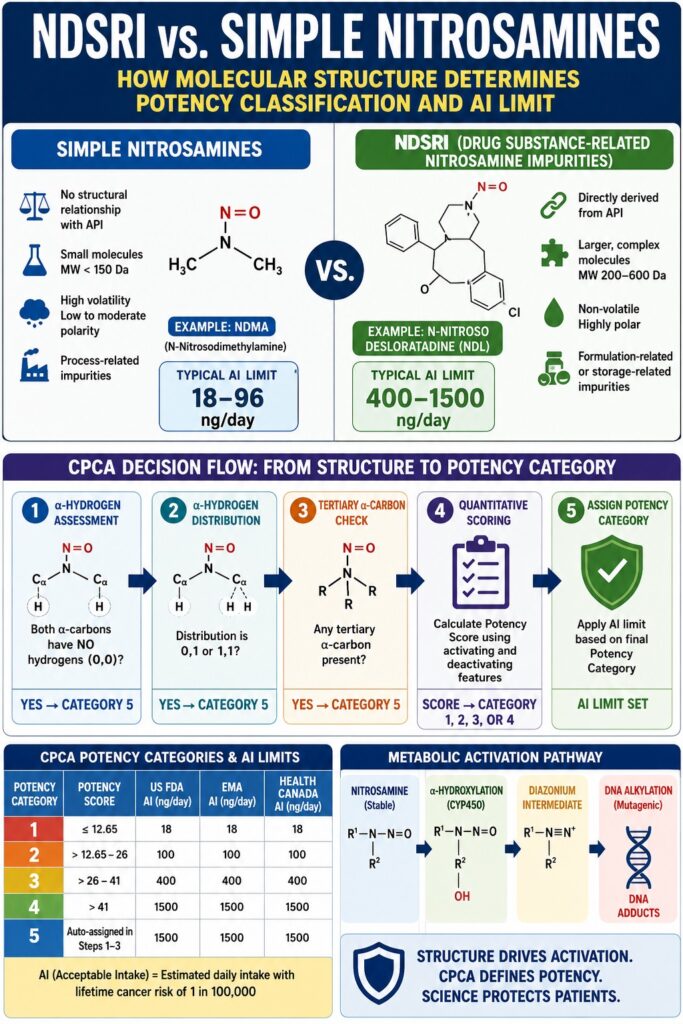
Simple nitrosamines are low-molecular-weight process-derived contaminants that have no structural resemblance to the active pharmaceutical ingredient. In comparison, NDSRIs are higher-molecular-weight, structurally intricate impurities that preserve the fundamental molecular framework of the API or its synthetic intermediates. These fundamental structural differences influence their physicochemical properties, mechanisms of formation, biological behavior, and the regulatory strategies required to establish acceptable daily exposure limits.
Discover how these differences affect regulatory compliance in our guide on Genotoxic Impurity Testing under ICH M7
Conventional or “simple” nitrosamines, including N-nitrosodimethylamine (NDMA), N-nitrosodiethylamine (NDEA), and N-nitrosodibutylamine (NDBA), generally possess molecular weights below 150 Da. These compounds are characterized by high volatility and relatively low to moderate polarity. They are typically generated as process-related impurities during API manufacturing when secondary or tertiary amines react with nitrosating agents under acidic reaction conditions. Additional sources include contaminated raw materials, recycled solvents, and other manufacturing-related contaminants.
Understand the precise chemical mechanisms involved by exploring Nitrosamine Formation Pathways in API Synthesis
By comparison, NDSRIs are substantially larger, non-volatile, highly polar molecules with molecular weights generally ranging between 200 and 600 Da. Their formation most commonly occurs during drug product formulation or throughout the product’s storage period. This process takes place when susceptible amine functionalities within the API react with trace concentrations of nitrite impurities, often present at parts-per-million levels in commonly used pharmaceutical excipients such as microcrystalline cellulose, lactose, and povidone.
See a real-world example of tracing these impurities in our NDMA Root Cause Investigation Case Study
The key physicochemical characteristics and regulatory distinctions between these two categories of impurities are summarized below.
| Parameter | Simple Nitrosamines | Nitrosamine Drug Substance-Related Impurities (NDSRIs) |
|---|---|---|
| Structural Relationship | No structural relationship with the API | Directly derived from the API or API degradation products |
| Molecular Weight | Typically < 150 Da | Typically 200 to 600 Da |
| Physical Properties | High volatility with low to moderate polarity | Non-volatile, highly polar, and structurally complex |
| Origin in Product | Process-related; introduced during API synthesis or through solvent reuse | Formulation-related; formed through reactions between the API and nitrite-containing excipients |
| In Vivo Bioassay Data | Extensively available (e.g., Lhasa and CPDB databases) | Extremely limited; most compounds lack experimentally determined in vivo carcinogenicity data |
| Regulatory Assessment | Compound-specific fixed limits (e.g., 96 ng/day for NDMA) | Determined using CPCA calculations, read-across approaches, or additional toxicological evaluation |
| Analytical Challenge | Compatible with established compendial methods and minimal matrix interference | Requires de novo analytical method development due to significant API matrix interference |
Enzymatic Activation and the Alpha-Hydroxylation Pathway
The primary metabolic mechanism responsible for nitrosamine-induced mutagenicity is cytochrome P450-mediated α-hydroxylation. This metabolic transformation converts a relatively stable nitrosamine molecule into an extremely reactive electrophilic diazonium intermediate capable of alkylating DNA. Since the efficiency of α-hydroxylation directly influences the mutagenic and carcinogenic potential of nitrosamines, understanding this pathway is fundamental to evaluating impurity-related risk.
Delve into the operational differences between types of impurities with our breakdown of Nitrosamine Impurity vs. Nitrosamine Leachable Differences
Nitrosamines are not inherently mutagenic and require metabolic activation following administration. This activation is predominantly catalyzed by cytochrome P450 monooxygenase enzymes, particularly the CYP2E1 isoform. These enzymes introduce an oxygen atom into the C-H bond located on the carbon atom immediately adjacent to the N-nitroso functional group, commonly referred to as the α-carbon. The reaction produces a highly unstable α-hydroxynitrosamine, also known as a nitrosocarbinolamine intermediate. Owing to the strong electron-withdrawing properties of the nitroso group, this intermediate rapidly undergoes spontaneous, non-enzymatic cleavage of the C-N bond, resulting in the formation of a carbonyl compound together with a monoalkylnitrosamine. A rapid prototropic rearrangement subsequently converts the monoalkylnitrosamine into a diazohydroxide intermediate, which then dissociates to release water while generating a highly reactive alkyldiazo ion or carbenium ion. These electrophilic intermediates readily react with nucleophilic sites within DNA, producing mutagenic DNA adducts such as O⁶-alkylguanine. The formation of these DNA adducts can ultimately induce transition mutations during DNA replication, contributing to carcinogenic risk.
Regulatory Acceptable Intake (AI) limits are quantitatively derived from lifetime rodent carcinogenicity studies that establish the TD₅₀ value. The TD₅₀ represents the daily dose rate (mg/kg body weight/day) capable of producing tumors in 50% of test animals over a standard two-year experimental period. To convert this experimental value into a human daily exposure level corresponding to an estimated excess lifetime cancer risk of 1 in 100,000 individuals, regulatory agencies apply a linear multistage extrapolation model:
Human Acceptable Intake (AI) =
(TD50 (mg/kg/day) × 50 kg (standard human body weight) ÷ 50,000) × 106 (ng/mg)
This relationship can be simplified to the following expression:
AI (ng/day) = TD50 (mg/kg/day) × 1,000
For the overwhelming majority of NDSRIs, experimentally determined TD₅₀ values are unavailable. Consequently, the steric and electronic characteristics surrounding the α-carbon atoms must be evaluated using the Carcinogenic Potency Categorization Approach (CPCA). This predictive framework assesses whether the molecular environment promotes or inhibits the α-hydroxylation pathway, thereby enabling estimation of carcinogenic potency and the establishment of scientifically justified Acceptable Intake limits.
Find out if your specific product portfolio is impacted by checking Do All Drugs Need a Nitrosamine Risk Assessment?
The CPCA Logic: Categorizing Potency by Structural Features
The Carcinogenic Potency Categorization Approach (CPCA) follows a structured, rule-based framework to assess the molecular environment surrounding the N-nitroso functional group and estimate carcinogenic potency based on the likelihood of metabolic activation. By examining the number of hydrogen atoms attached to each α-carbon and incorporating the influence of activating and deactivating structural features, the CPCA classifies nitrosamines into five distinct potency categories.
Understand how regulatory thresholds impact daily operations by reviewing Nitrosamine Alert Limit vs. Action Limit Definitions
This predictive framework is specifically applicable to N-nitroso compounds in which the nitroso nitrogen is bonded to sp³-hybridized carbon atoms on both sides, provided that neither of these carbon atoms is double-bonded to a heteroatom. As a result, compound classes including N-nitrosamides, N-nitrosoureas, and N-nitrosoguanidines fall outside the scope of the CPCA. Likewise, the model is not intended for structures in which the N-nitroso group is attached to a nitrogen atom within a heteroaromatic ring, such as nitrosated indole derivatives.
The Stepwise Decision Flowchart for Potency Classification
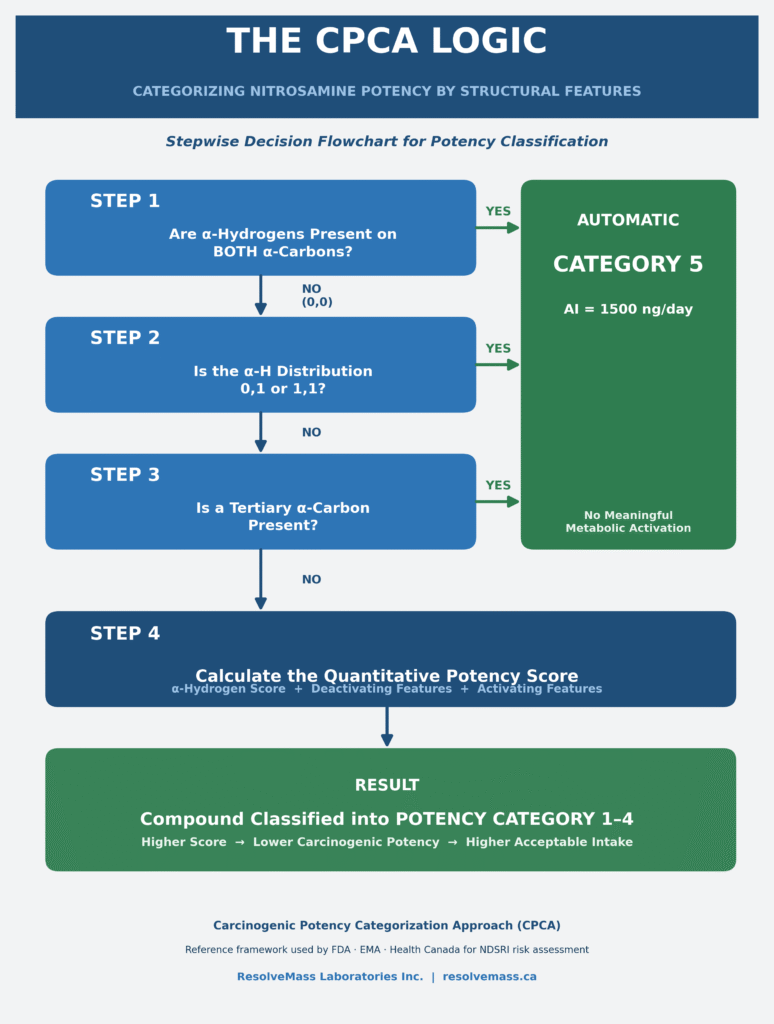
The CPCA decision framework evaluates nitrosamine structures through a sequence of qualitative screening steps before applying a quantitative scoring system. Structures meeting predefined low-risk criteria are automatically assigned to Potency Category 5, eliminating the need for further scoring. The classification process proceeds as follows.
Step 1: Assessment of α-Hydrogens
The first evaluation determines whether hydrogen atoms are present on either α-carbon adjacent to the N-nitroso group. When both α-carbons contain no hydrogen atoms (0,0 configuration), metabolic α-hydroxylation cannot occur. Since this metabolic activation pathway is unavailable, the compound is automatically assigned to Potency Category 5 with an AI of 1500 ng/day.
Step 2: Evaluation of α-Hydrogen Distribution
The next step examines the distribution of α-hydrogen atoms on both sides of the N-nitroso group. Molecules exhibiting either a 0,1 or 1,1 hydrogen distribution experience substantial steric restrictions that significantly reduce the probability of metabolic activation. Consequently, these structures are also automatically classified as Potency Category 5 with an AI of 1500 ng/day.
Step 3: Screening for a Tertiary α-Carbon
The algorithm then determines whether a tertiary α-carbon is present. A tertiary α-carbon is defined as an sp³-hybridized carbon atom bonded to three additional carbon atoms. When such a structural feature exists, the reactive intermediate generated during metabolism is preferentially detoxified through reaction with water rather than proceeding toward DNA alkylation. Accordingly, these compounds are automatically assigned to Potency Category 5 with an AI of 1500 ng/day.
Step 4: Quantitative Potency Assessment
If a compound does not satisfy any of the automatic low-potency criteria described in the previous steps, its carcinogenic potential is established by calculating a quantitative Potency Score. This numerical score determines whether the compound belongs to Potency Category 1, 2, 3, or 4.
Quantitative Scoring of Deactivating and Activating Features
The CPCA Potency Score is calculated by combining the base score associated with the α-hydrogen distribution and adjusting it according to the presence of activating and deactivating molecular features adjacent to the N-nitroso group.
Potency Score = α-Hydrogen Score + Σ(Deactivating Feature Scores) + Σ(Activating Feature Scores)
An increased Potency Score indicates that oxidative metabolic activation requires a higher activation energy, thereby reducing carcinogenic potency and allowing for a higher Acceptable Intake limit. The structural scoring criteria recognized by international regulatory authorities are summarized below.
| Feature Category | Molecular Substructure / Chemical Feature | Feature Score |
|---|---|---|
| Base α-Hydrogen Score | 0,2 Distribution (Methylene α-carbon is not part of an ethyl group) | +3 |
| 0,2 Distribution (Methylene α-carbon is part of an ethyl group) | +2 | |
| 0,3 Distribution | +2 | |
| 1,2 Distribution | +3 | |
| 1,3 Distribution | +3 | |
| 2,2 Distribution | +1 | |
| 2,3 Distribution | +1 | |
| Deactivating Features | Carboxylic acid group present anywhere within the molecule | +3 |
| N-nitroso group located within a pyrrolidine ring | +3 | |
| N-nitroso group present in a six-membered ring containing at least one sulfur atom | +3 | |
| N-nitroso group located within a five- or six-membered ring (excluding morpholine, pyrrolidine, and sulfur-containing rings) | +2 | |
| N-nitroso group located within a morpholine ring | +1 | |
| N-nitroso group located within a seven-membered ring | +1 | |
| Chains containing five or more consecutive non-hydrogen atoms extending from both sides of an acyclic N-nitroso group | +1 | |
| Electron-withdrawing group (EWG) attached to the α-carbon on one side only | +1 | |
| Electron-withdrawing groups (EWGs) attached to α-carbons on both sides | +2 | |
| Hydroxyl group attached to the β-carbon on one side only | +1 | |
| Hydroxyl groups attached to β-carbons on both sides | +2 | |
| Activating Features | Aryl group attached to the α-carbon (benzylic or pseudo-benzylic substituent) | −1 |
| Methyl group attached to the β-carbon in either cyclic or acyclic systems | −1 |
After calculating the cumulative Potency Score, the compound is assigned to its corresponding Potency Category along with the appropriate Acceptable Intake limits recommended by major international regulatory agencies.
| Potency Category | Calculated Potency Score | Recommended US FDA AI (ng/day) | Recommended EMA AI (ng/day) | Recommended Health Canada AI (ng/day) |
|---|---|---|---|---|
| Category 1 | ≤ 1 | 26.5 | 18 | 18 |
| Category 2 | 2 | 100 | 100 | 100 |
| Category 3 | 3 | 400 | 400 | 400 |
| Category 4 | ≥ 4 | 1500 | 1500 | 1500 |
| Category 5 | Automatically assigned during Steps 1–3 | 1500 | 1500 | 1500 |
How Steric and Electronic Environments Drive AI Limits in NDSRI vs. Simple Nitrosamines
The fundamental reason for the differences in Acceptable Intake limits between NDSRIs and simple nitrosamines is the influence of steric hindrance and electronic deactivation on metabolic activation. Larger, drug-related nitrosamine structures often possess steric and electronic characteristics that reduce the efficiency of cytochrome P450-mediated α-hydroxylation. As metabolic activation becomes less favorable, carcinogenic potency decreases, allowing for higher daily safety thresholds.
Simple alkyl nitrosamines, including NDMA and NDEA, contain relatively unhindered methyl or methylene groups that can be readily accommodated within the active site of cytochrome P450 enzymes. This structural accessibility enables efficient α-hydroxylation, resulting in rapid metabolic activation and placing these compounds among the highest-potency nitrosamines, typically within Potency Category 1.
Conversely, NDSRIs Occupy a Much More Complex Chemical Landscape
Unlike simple nitrosamines, NDSRIs exist within a considerably more complex chemical space. The presence of large, structurally intricate drug scaffolds surrounding the N-nitroso functional group creates substantial steric hindrance that limits enzymatic oxidation. A significant scientific proposal published by GSK R&D in 2024 reported that N-nitrosamines possessing molecular weights greater than 200 Da, a range encompassing nearly all NDSRIs, demonstrate markedly lower carcinogenic potency in animal studies than smaller, volatile nitrosamines. The increased molecular size restricts access to the cytochrome P450 (CYP) enzyme active site while simultaneously slowing transport across cellular membranes. These findings support the view that a default lifetime AI limit of 150 ng/day, which is ten times lower than the standard Threshold of Toxicological Concern established under ICH M7, provides a highly protective safety margin and is scientifically more appropriate than applying the extremely conservative class-specific limit of 18 ng/day.
To better illustrate the influence of molecular structure on potency classification, the following examples demonstrate how the CPCA scoring framework is applied in practice.
N-Nitroso Desloratadine (NDL)
N-Nitroso desloratadine (NDL) contains two α-hydrogen atoms on each side of the N-nitroso center, resulting in a 2,2 α-hydrogen distribution with a corresponding base score of 1. Because the N-nitroso functionality is incorporated within a six-membered piperidine ring, the molecule receives an additional deactivating feature score of +2. As no activating structural features are present, the final Potency Score is calculated as:
Potency Score = 1 (α-hydrogen score) + 2 (deactivating ring score) + 0 = 3
A final score of 3 places NDL in Potency Category 3, corresponding to an AI of 400 ng/day. However, NDL exhibits significant structural similarity to the extensively studied surrogate compound N-nitroso-piperidine (NPIP). Using a scientifically justified read-across approach, the CPCA-derived limit may therefore be superseded, supporting an AI value of 1300 ng/day. This example demonstrates the importance of expert toxicological interpretation when preparing regulatory submissions.
Learn how similar structural and regulatory challenges have impacted the market in our Nitrosamine Drug Recalls Analysis
N-Nitroso Flecainide
N-Nitroso flecainide possesses a 1,3 α-hydrogen distribution, resulting in a base Potency Score of 3. The molecular structure also contains a hydroxyl group attached to a β-carbon on one side of the N-nitroso group, contributing an additional deactivating score of +1. Since no activating structural features are present, the final Potency Score is determined as follows:
Potency Score = 3 (α-hydrogen score) + 1 (deactivating hydroxyl score) + 0 = 4
A cumulative Potency Score of 4 classifies N-nitroso flecainide within Potency Category 4, permitting the highest recommended Acceptable Intake limit of 1500 ng/day.
N-Nitroso Felodipine
The molecular architecture of N-nitroso-felodipine creates substantial steric hindrance around the N-nitroso center. Owing to this highly constrained structural environment, the CPCA decision framework automatically directs the compound to Potency Category 5 without requiring quantitative scoring. Consequently, the compound is assigned an AI of 1500 ng/day.
Analytical and Computational Testing Strategies
Developing reliable and reproducible analytical methods capable of detecting complex NDSRIs at sub-parts-per-billion concentrations presents considerable technical challenges. These methods must effectively resolve severe sample matrix interference while simultaneously preventing artificial de novo nitrosamine formation during sample preparation and analysis. Achieving such ultra-trace detection performance requires an integrated strategy that combines advanced computational risk prediction with high-resolution tandem mass spectrometry.
Explore how expert testing mitigates these challenges through our Nitrosamine Method Development and Validation Services
For simple nitrosamines, standardized compendial chromatographic methods can generally be implemented across multiple analytical laboratories with minimal modification. In contrast, every NDSRI possesses a molecular structure unique to its parent API, making de novo analytical method development and validation under ICH Q2 guidelines essential. Because commercially available reference standards for newly identified NDSRIs are seldom available, laboratories must have the capability to synthesize high-purity reference materials along with deuterium-labeled internal standards to support accurate isotope dilution quantification.
Learn what to look for when selecting an analytical partner by reading about Nitrosamine Testing CRO Selection Criteria
Matrix interference represents another major analytical challenge. Extremely high concentrations of the API can produce significant ion suppression during conventional liquid chromatography-mass spectrometry (LC-MS) analysis, reducing analytical sensitivity and accuracy. To address this issue, ResolveMass Laboratories Inc. utilizes high-resolution, high-mass-accuracy instrumentation, including High-Resolution LC-MS/MS (Q-Exactive Orbitrap), enabling highly sensitive detection with Limits of Detection (LOD) as low as 0.03 ng/mL. For the analysis of volatile nitrosamine impurities, gas chromatography-tandem mass spectrometry (GC-MS/MS) combined with automated headspace sampling is employed to minimize matrix effects while avoiding potential thermal degradation during sample introduction.
Maximize your operational efficiency by understanding the benefits of Outsourcing Nitrosamine Testing to a CRO
To improve efficiency before laboratory testing begins, pharmaceutical manufacturers increasingly rely on advanced computational tools for preliminary risk assessment. The U.S. Food and Drug Administration (FDA) co-developed and released an open-source Java-based command-line application, Featurize-Nitrosamines, through GitHub. This software automatically extracts relevant structural descriptors from SMILES chemical representations and predicts CPCA potency categories based on the molecular structure. Integrating these computational assessments with the specialized analytical capabilities of an FDA-registered and ISO 9001:2015-certified laboratory such as ResolveMass Laboratories Inc. (FEI No.: 3042696771) provides pharmaceutical developers with a comprehensive and compliant workflow that spans computational risk evaluation through high-sensitivity confirmatory analytical testing.
Conclusion
In summary, effectively addressing the toxicological distinctions between NDSRIs and simple nitrosamines requires a shift away from conservative default exposure limits toward scientifically supported Structure-Activity Relationship (SAR)-based assessment methods such as the Carcinogenic Potency Categorization Approach (CPCA). Applying identical exposure thresholds to structurally complex, sterically hindered NDSRIs and highly reactive simple nitrosamines does not accurately reflect their respective toxicological risks and may unnecessarily contribute to pharmaceutical supply shortages. By implementing the CPCA framework, manufacturers can establish scientifically justified Acceptable Intake limits based on the specific molecular characteristics of each compound, ensuring both patient safety and regulatory compliance.
ResolveMass Laboratories Inc. serves as a trusted North American Contract Research Organization (CRO), providing comprehensive analytical testing, regulatory-compliant toxicological evaluations, and custom reference standard synthesis to support pharmaceutical development programs. Organizations seeking to strengthen their drug development pipeline and obtain expert guidance from specialized mass spectrometry scientists are encouraged to contact ResolveMass Laboratories Inc. through the Contact Us page.
Frequently Asked Questions (FAQs)
A tertiary α-carbon significantly limits the metabolic activation process required for nitrosamine carcinogenicity. Because of its highly crowded molecular environment, enzymatic α-hydroxylation by cytochrome P450 enzymes becomes extremely unfavorable. As a result, the reactive DNA-alkylating intermediates are not efficiently generated, leading the CPCA framework to classify these compounds directly into Potency Category 5.
Featurize-Nitrosamines is an open-source computational application that simplifies the preliminary assessment of nitrosamine impurities. By interpreting SMILES chemical structures, the software automatically identifies relevant structural features, applies CPCA decision rules, and predicts the appropriate potency category and Acceptable Intake (AI) limit. This reduces manual evaluation and supports faster, more consistent regulatory risk assessments.
Many NDSRIs are structurally large and require more extensive metabolic activation than standard Ames test conditions can provide. Traditional Salmonella strains may not generate sufficient metabolic activity to convert these compounds into their reactive forms. Consequently, an Enhanced Ames Test (EAT), which incorporates increased S9 metabolic activation components, is often necessary to obtain a more reliable assessment of mutagenic potential.
The proposal is based on observations that N-nitrosamines with molecular weights greater than 200 Da generally exhibit lower carcinogenic potency than smaller nitrosamines. Their larger molecular size reduces transport across cell membranes and creates steric hindrance that limits interaction with cytochrome P450 enzymes. These characteristics support the use of a higher default Acceptable Intake limit of 150 ng/day for many NDSRIs.
When a molecule contains more than one N-nitroso functional group, each site is independently assessed using the CPCA methodology. The overall toxicological classification is determined by the N-nitroso group predicted to have the greatest carcinogenic potency. In practice, the lowest numerical potency category governs the Acceptable Intake limit assigned to the entire molecule, ensuring a conservative safety assessment.
Although pharmaceutical excipients are manufactured to high-quality standards, they may still contain trace levels of nitrite impurities originating from raw materials, processing water, or bleaching procedures. During formulation or storage, these residual nitrites can react with susceptible secondary or tertiary amine groups present in the API. Over time, these reactions may result in the formation of Nitrosamine Drug Substance-Related Impurities.
During LC-MS/MS analysis, the parent API is often present at concentrations much higher than the target impurity. This imbalance can produce ion suppression or ion enhancement within the mass spectrometer, negatively affecting analytical sensitivity and quantitative accuracy. Careful chromatographic separation together with high-resolution mass spectrometry is therefore essential to accurately detect trace-level NDSRIs.
A manufacturer may justify an alternative Acceptable Intake limit when robust scientific evidence demonstrates that the default CPCA prediction is overly conservative. This can be accomplished through well-supported structure-activity read-across using validated surrogate compounds or by generating additional experimental toxicological data, including studies such as the Transgenic Rodent (TGR) gene mutation assay, when appropriate.
Reference:
- U.S. Food and Drug Administration. (2025). CDER nitrosamine impurity acceptable intake limits. https://www.fda.gov/regulatory-information/search-fda-guidance-documents/cder-nitrosamine-impurity-acceptable-intake-limits
- U.S. Food and Drug Administration. (2024). Control of nitrosamine impurities in human drugs: Guidance for industry. https://www.fda.gov/regulatory-information/search-fda-guidance-documents/control-nitrosamine-impurities-human-drugs
- European Medicines Agency. (2020). Nitrosamines EMEA-H-A53-1490: Questions and answers for marketing authorisation holders/applicants on the CHMP Opinion for the Article 5(3) of Regulation (EC) No 726/2004 referral on nitrosamine impurities in human medicinal products. https://www.ema.europa.eu/en/documents/opinion-any-scientific-matter/nitrosamines-emea-h-a53-1490-questions-answers-marketing-authorisation-holders-applicants-chmp-opinion-article-53-regulation-ec-no-726-2004-referral-nitrosamine-impurities-human-medicinal-products_en.pdf
- Health Canada. (2026). Nitrosamine impurities in medications: Guidance. Government of Canada. https://www.canada.ca/en/health-canada/services/drugs-health-products/compliance-enforcement/information-health-product/drugs/nitrosamine-impurities/medications-guidance.html
- Yosukemino. (2023). Case studies for CPCA scoring. Nitrosamines Exchange (U.S. Pharmacopeia Forum). https://nitrosamines.usp.org/t/case-studies-for-cpca-scoring/6744
- European Medicines Agency. (2023). Nitrosamine Implementation Oversight Group (NIOG), fifth meeting with pharmaceutical industry: Presentation. https://www.ema.europa.eu/en/documents/presentation/presentation-nitrosamine-implementation-oversight-group-niog-fifth-meeting-pharmaceutical-industry_en.pdf
Get In Touch With Us
About The Author


