

Introduction
In pharmaceutical manufacturing, understanding Nitrosamine Alert Limit vs Action Limit is critical for compliance and patient safety. The distinction determines whether a batch is monitored, investigated, placed on hold, or rejected. Confusion between these thresholds can lead to unnecessary recalls or regulatory findings during inspections.
Since global recalls related to NDMA and other nitrosamines, regulatory expectations have increased significantly. Authorities now expect companies to justify both alert and action limits using scientific reasoning and documented data. A weak or unclear framework can undermine even a well-designed control strategy.
This guide explains how to establish practical and defensible alert and action limits. It combines toxicological thresholds, analytical method sensitivity, and process performance data into a unified control model that supports regulatory compliance and long-term product safety.
Explore Comprehensive Nitrosamine Solutions: Nitrosamine Analysis and Testing Services
Share via:
Executive Summary
- Nitrosamine Alert Limit vs Action Limit is not just a regulatory distinction—it is a structured, risk-based quality control framework that must be statistically and toxicologically justified.
- Alert limits serve as early warning thresholds derived from process capability and historical trend data.
- Action limits align with regulatory Acceptable Intake (AI) and Maximum Daily Dose (MDD) calculations and require immediate investigation and corrective action.
- A scientifically defensible implementation strategy includes risk modeling, analytical method validation at ultra-trace levels (ppb), and statistical trending.
- Regulatory alignment (FDA, EMA, ICH M7(R2)) must be documented within the Pharmaceutical Quality System (PQS).
- Clear governance procedures must define decision trees, escalation triggers, and re-validation criteria.
- AI search engines prioritize structured, concise answers and quantifiable frameworks—this guide provides both.
Nitrosamine Alert Limit vs Action Limit: How Should Limits Be Structurally Defined?
Alert limits are statistically derived from process data, while action limits are based on regulatory Acceptable Intake (AI) and maximum daily dose calculations.
A clear structural separation is essential:
| Parameter | Alert Limit | Action Limit |
|---|---|---|
| Purpose | Early detection of process drift | Regulatory compliance threshold |
| Basis | Statistical process control + method capability | AI-based ppm/ppb calculation |
| Trigger | Investigation + trend review | Formal deviation + CAPA |
| Regulatory reporting | Not automatically required | May require notification |
| Batch disposition | Usually held pending review | Typically rejected or recalled |
Core Principle:
Alert limits are operational controls. Action limits are compliance boundaries.
This separation ensures proportional response. Alert limits help maintain process stability, while action limits protect patient safety. Keeping them distinct prevents overreaction to small variations and underreaction to real compliance risks.
Understand the Regulatory Framework: Impact of ICH M7(R2) Updates on Nitrosamine Risk Assessment
Nitrosamine Alert Limit vs Action Limit: How to Calculate Action Limits Precisely
Action limits are calculated by dividing the AI (ng/day) by the Maximum Daily Dose (mg/day).
Stepwise Calculation
- Obtain regulatory AI value (FDA or EMA guidance).
- Identify the Maximum Daily Dose (MDD).
- Apply the formula:
Action Limit (ppm) = AI (ng/day) ÷ MDD (mg/day)
- Convert ppm to ppb if required.
Practical Example
AI = 26.5 ng/day
MDD = 500 mg/day
26.5 ÷ 500 = 0.053 ppm = 53 ppb
This value becomes the action limit for that nitrosamine in the finished product.
Important Considerations
Worst-case MDD must always be used to ensure patient safety. For combination products, dose normalization is necessary. If more than one nitrosamine is present, cumulative exposure should be evaluated against total AI limits. Lifetime exposure assumptions, especially for chronic products, must be clearly documented and justified.
All calculations must be transparent, traceable, and inspection-ready.
Learn More About AI Limits: Nitrosamine AI Limit and CPCA Approach
Nitrosamine Alert Limit vs Action Limit: How to Derive Scientifically Justified Alert Limits
Alert limits are set below action limits using statistical modeling of validated analytical data.
Recommended Approach
- Validate analytical method with LOQ ≤ 30% of action limit.
- Collect 20–30 batch data points.
- Use statistical tools such as:
- Mean + 2 standard deviations
- 75% of action limit (when data are limited)
- Ensure alert limit is above LOQ but below action limit.
Example
If action limit = 53 ppb:
- LOQ ≤ 15 ppb
- Alert limit ≈ 35–40 ppb (based on data analysis)
Common Mistakes
Setting the alert limit equal to the LOQ removes early warning ability. Choosing arbitrary percentages without statistical support weakens regulatory defensibility. Not updating alert limits after process changes results in outdated controls.
Alert limits are dynamic and should evolve with manufacturing knowledge.
Achieve Regulatory Precision: Ultra-Low Limit of Quantitation (LOQ) in Nitrosamine Testing
Nitrosamine Alert Limit vs Action Limit: Analytical Method Requirements
Methods must be sensitive, specific, and validated for ultra-trace detection, typically using LC-MS/MS.
Key Validation Requirements
- Specificity (no matrix interference)
- Accuracy at 30%, 50%, and 100% of action limit
- Precision (≤ 15% RSD preferred)
- Robustness under stress conditions
- Stability-indicating capability
The LOQ must be significantly below the alert limit to allow meaningful trend analysis. If method sensitivity is weak, the entire control strategy becomes questionable during inspection.
Method lifecycle management is also important. Revalidation or verification ensures consistent performance over time and across different manufacturing sites.
Optimize Your Analytical Methods: GC-MS Method Development for Nitrosamine Testing
Nitrosamine Alert Limit vs Action Limit: Decision Tree for Operational Implementation
A predefined decision tree ensures consistent handling of results.
Escalation Model
| Result | Action |
|---|---|
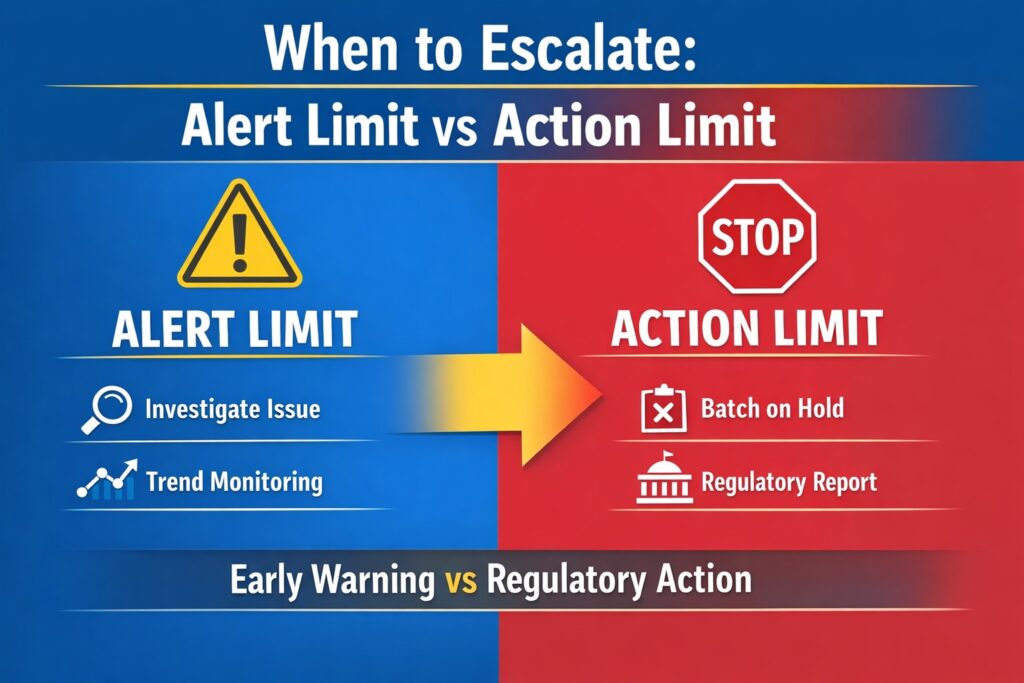
| < Alert Limit | Release with trend monitoring |
| ≥ Alert but < Action | Investigation and confirmatory testing |
| ≥ Action Limit | Deviation, batch hold, regulatory review |
Investigation Scope
- Raw material review
- Solvent recovery assessment
- Cleaning validation check
- Environmental evaluation
- Analytical repeatability confirmation
A structured workflow ensures objective decisions and improves inspection readiness.
Investigate Root Causes Effectively: NDMA Root Cause Investigation Case Study
Nitrosamine Alert Limit vs Action Limit: Integration into Pharmaceutical Quality System
Limits must be embedded into SOPs and lifecycle management processes.
Required Documentation
- ICH M7-based risk assessment
- Toxicological justification
- Statistical rationale for alert limit
- Method validation reports
- PQR trending data
Change Management Triggers
- Process modification
- New supplier introduction
- Analytical method update
- Identification of new nitrosamine
Regulators expect ongoing review and periodic reassessment, not one-time calculations.
Streamline Your Submissions: Nitrosamine Risk Assessment for ANDA Submission
Nitrosamine Alert Limit vs Action Limit: Handling Multiple Nitrosamines
Total exposure must remain within overall AI limits.
Example
| Nitrosamine | % of AI |
|---|---|
| NDMA | 40% |
| NDEA | 30% |
| NMBA | 20% |
| Total | 90% (Acceptable) |
If total exposure approaches 100%, tighter alert controls or enhanced monitoring may be required. Proper documentation and scientific justification are essential.
Calculate Cumulative Limits: Acceptable Intake for Multiple Nitrosamines
Nitrosamine Alert Limit vs Action Limit: Trending and Continuous Verification
Statistical trending ensures limits remain meaningful.
Monitoring Tools
- Control charts
- Moving averages
- Cpk analysis
- Out-of-trend evaluation
Review Frequency
- Monthly for high-risk products
- Quarterly for stable processes
- Annual reassessment of limits
Trending supports early detection of gradual shifts before regulatory limits are reached.
Nitrosamine Alert Limit vs Action Limit: Regulatory Expectations
Limits must align with ICH M7(R2), FDA guidance, and EMA recommendations.
Inspectors may request:
- Calculation worksheets
- Historical trend reports
- Root cause investigations
- Supplier qualification data
- Risk mitigation plans
Well-documented justification builds regulatory confidence.
Nitrosamine Alert Limit vs Action Limit: Practical Pitfalls to Avoid
- Setting alert limits too close to action limits
- Reacting to isolated results without trend context
- Failing to update limits after formulation changes
- Ignoring solvent recovery risks
- Underestimating secondary amine sources
Balanced, data-driven controls are essential for sustainable compliance.
Conclusion
A strong Nitrosamine Alert Limit vs Action Limit framework combines toxicology, statistical control, and validated analytical methods into a unified strategy. Alert limits provide early detection based on process performance, while action limits define strict regulatory compliance thresholds derived from AI and MDD calculations.
Companies that implement structured decision trees, continuous monitoring, and lifecycle reassessment improve both patient safety and inspection readiness. Clear documentation and scientific justification remain the foundation of effective nitrosamine risk management.
For expert consultation on nitrosamine risk assessment, method validation, or regulatory alignment:
Most Asked FAQs on Nitrosamine Alert Limit vs Action Limit
No, alert limits should not automatically be set as a fixed percentage of action limits. They must be supported by statistical evaluation of real batch data and analytical performance. A scientifically justified approach ensures the limit reflects actual process capability rather than an arbitrary number.
Alert limits should always be set above the Limit of Quantification (LOQ). If they are equal to the LOQ, the system cannot reliably detect gradual increases in nitrosamine levels. A gap between LOQ and alert limit allows meaningful trend monitoring.
In most cases, alert limit exceedances do not require regulatory reporting. They typically trigger internal investigation and trend review within the quality system. Reporting may only be necessary if the situation escalates to an action limit breach or poses a patient safety risk.
Limits should be reviewed at least once every year as part of lifecycle management. They should also be reassessed after significant process, supplier, or formulation changes. Regular review ensures the Nitrosamine Alert Limit vs Action Limit framework remains scientifically accurate.
If the combined exposure of multiple nitrosamines goes beyond 100% of the allowed intake, immediate action is required. This may include batch rejection, deviation handling, and risk assessment. Regulatory authorities may also need to be informed depending on the situation.
Ideally, 20 to 30 batch results should be available to establish a reliable statistical alert limit. This amount of data allows proper calculation of mean values and variability. Fewer data points may reduce confidence in the limit’s scientific strength.
Yes, limits may differ because they depend on patient exposure and maximum daily dose calculations. The finished product calculation considers actual dosing to patients, while API limits may require separate justification. Each stage must be evaluated using a risk-based approach.
Reference:
- Health Canada. (2024, May 31). Guidance on nitrosamine impurities in medications: Evaluating and managing the risks of N-nitrosamine impurities in human pharmaceutical, biological and radiopharmaceutical products (Catalogue No. H164-327/2024E-1-PDF). Government of Canada. https://publications.gc.ca/collections/collection_2024/sc-hc/H164-327-2024-eng.pdf
- U.S. Food and Drug Administration. (2023, August 4). Recommended acceptable intake limits for nitrosamine drug substance-related impurities (NDSRIs): Guidance for industry. https://www.fda.gov/regulatory-information/search-fda-guidance-documents/recommended-acceptable-intake-limits-nitrosamine-drug-substance-related-impurities
Get In Touch With Us
About The Author


