Introduction: Why Nitrosamine Analysis for Over-the-Counter Drug Products Is Crucial
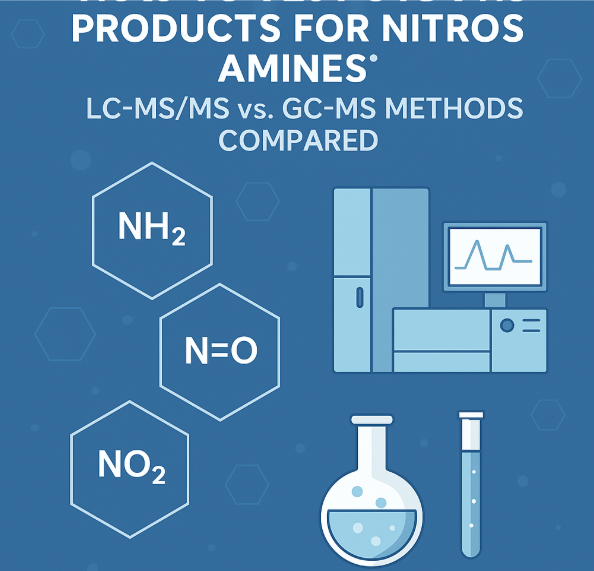
The presence of nitrosamines—classified as probable human carcinogens—has raised significant regulatory concerns, especially in Over-the-Counter (OTC) drug products. Ensuring nitrosamine analysis for Over-the-Counter drug products is now a mandatory requirement across various pharmacopoeias. At ResolveMass Laboratories Inc., we specialize in high-precision analytical testing using both LC-MS/MS and GC-MS methodologies, ensuring regulatory compliance and public safety.
Understanding Nitrosamines in OTC Drug Products
Nitrosamines can form during the synthesis, storage, or degradation of pharmaceutical ingredients. Commonly found nitrosamines include:
- NDMA (N-Nitrosodimethylamine)
- NDEA (N-Nitrosodiethylamine)
- NMBA (N-Nitroso-N-methyl-4-aminobutyric acid)
Even trace levels (in the range of ng/day intake) can be of toxicological concern. Thus, nitrosamine analysis for Over-the-Counter drug products is not only critical for regulatory compliance but also essential for consumer trust and safety.
Testing Methods for Nitrosamines: LC-MS/MS vs. GC-MS
1. Liquid Chromatography-Tandem Mass Spectrometry (LC-MS/MS)
✅ Advantages of LC-MS/MS for Nitrosamine Analysis
- High sensitivity: Detection limits in the low ppt (parts per trillion) range
- Versatility: Suitable for water-soluble and thermally labile nitrosamines
- Minimal derivatization: Reduces sample preparation errors
⚙️ ResolveMass Expertise
Our LC-MS/MS platforms are calibrated for multi-analyte screening and confirmatory quantification of nitrosamines in complex OTC formulations including tablets, gels, and syrups.
2. Gas Chromatography-Mass Spectrometry (GC-MS)
✅ Advantages of GC-MS for Nitrosamine Analysis
- High resolution: Ideal for volatile nitrosamines
- Cost-effective: Widely used and more affordable for simpler matrices
- Quick run times: Fast and efficient for high-throughput screening
⚙️ When GC-MS is Preferred
GC-MS is generally employed for volatile nitrosamines or where matrix interferences are low. ResolveMass employs automated headspace sampling and thermal desorption for enhanced accuracy.
Comparison Table: LC-MS/MS vs. GC-MS for OTC Nitrosamine Testing
| Feature | LC-MS/MS | GC-MS |
|---|---|---|
| Sensitivity | Very High (ppt) | Moderate to High (ppb) |
| Sample Prep | Less complicated | May require derivatization |
| Ideal for | Polar and non-volatile nitrosamines | Volatile nitrosamines |
| Detection Capability | Multi-residue | Single-residue (typically) |
| Cost | Higher | Moderate |
| Time Efficiency | Moderate | High |
| Matrix Compatibility | Complex drug matrices | Simpler matrices |
Regulatory Framework for Nitrosamine Analysis in OTC Drugs
Agencies like FDA, EMA, and Health Canada have set acceptable intake limits for nitrosamines. For instance:
- NDMA: 96 ng/day (FDA)
- NDEA: 26.5 ng/day (EMA)
Manufacturers are expected to perform nitrosamine analysis for Over-the-Counter drug products before release to ensure conformity.
Case Study: Testing Ranitidine OTC Tablets for Nitrosamines
Background: A client approached ResolveMass with concerns about nitrosamine content in their ranitidine OTC tablets.
Approach:
- LC-MS/MS used for NDMA and NDEA analysis.
- Sample preparation involved solid-phase extraction.
- Results: NDMA detected at 180 ng/tablet, well above the FDA threshold.
Outcome:
- Immediate product recall was advised.
- Reformulation suggested.
- Client received a complete report within 72 hours, allowing proactive regulatory engagement.
How ResolveMass Ensures Reliable Nitrosamine Analysis for OTC Drug Products
- ISO/IEC 17025 Accreditation
- Qualified Scientists with 15+ years of experience
- Advanced platforms including QqQ-LC-MS/MS and HRAM-GC-MS
- Fast turnaround time and detailed reports
- Custom NMR support for peptides and small molecules
Best Practices for Manufacturers
- Conduct risk assessments of APIs and excipients.
- Select appropriate analytical techniques based on compound volatility and matrix.
- Use qualified laboratories like ResolveMass Laboratories Inc. for validation studies.
- Ensure documentation and regulatory submissions follow international standards.
- Maintain open channels for technical consultation.
Conclusion
In a regulatory landscape where safety and compliance drive decisions, nitrosamine analysis for Over-the-Counter drug products is non-negotiable. Choosing the right technique—LC-MS/MS or GC-MS—depends on the nature of the formulation, type of nitrosamine, and matrix complexity. At ResolveMass Laboratories Inc., our combination of expertise, infrastructure, and turnaround capabilities makes us a trusted partner for nitrosamine testing.
We encourage manufacturers, R&D leaders, and QC specialists to leverage our deep domain experience and proven methodologies for effective nitrosamine testing.
REFERENCES
- Grgičević I. Development and validation of LC-MS/MS method for N-nitrosamines analysis in pharmaceutical products (Doctoral dissertation, University of Rijeka. Department of Biotechnology).
- Manchuri KM, Shaik MA, Gopireddy VS, Sultana N, Gogineni S. Analytical Methodologies to Detect N-Nitrosamine Impurities in Active Pharmaceutical Ingredients, Drug Products and Other Matrices. Chemical Research in Toxicology. 2024 Aug 19;37(9):1456-83.
- Dalkılıç O, Demircioğlu İH, Çelik S, Can H, Akman TC, Atila A, Kılıç H, Kandemir L. Method development and validation for determination of N-nitrosamines in pharmaceutical preparations by LC-MS/MS: Application to extractables and leachables studies. Journal of Chromatography A. 2025 Jan 29:465741.
CONTACT US
Partner with ResolveMass Laboratories Inc.—your trusted experts in advanced analytical testing, including nitrosamine analysis, LC-MS/MS method development, and impurity profiling. Our cutting-edge technology and regulatory expertise help accelerate your product journey from lab to market with confidence. Contact us today to discuss your testing needs, request a quote, or schedule a consultation with our scientific team. Let’s advance science, together.
Regulatory Starting Materials for Synthetic Peptides: How to Justify Them Under ICH Q11
Introduction Justifying Regulatory Starting Materials for Synthetic Peptides under the International Council for Harmonisation (ICH)…

Amino Acid Derivatives and Building Blocks: How Raw Material Quality Shapes Impurities in GMP Peptides
Introduction Establishing rigorous quality attributes for Amino Acid Derivatives and Building Blocks is one of…

Neutralizing Antibody (NAb) Assays for Biosimilars: Assay Format, Cut Points and Comparative Interpretation
Introduction Neutralizing Antibody (NAb) Assays for Biosimilars evaluate the functional ability of anti-drug antibodies (ADAs)…

Case Study: PCL Subcutaneous Implant Development for 12-Month Hormonal Drug Delivery
Introduction: PCL Subcutaneous Implant Development is an emerging approach for designing long-acting hormonal drug delivery…

From Research Reagent to Approved Drug: How Therapeutic Peptides Evolved Over 50 Years
Introduction The evolution of therapeutic peptides from research reagents to approved drugs over the past…

Pharmacodynamic Biomarkers in Biosimilar Development: How to Select, Validate and Use PD Markers
Introduction Pharmacodynamic Biomarkers in Biosimilar Development provide precise, quantitative measurements of a biological drug’s pharmacological…