

Introduction:
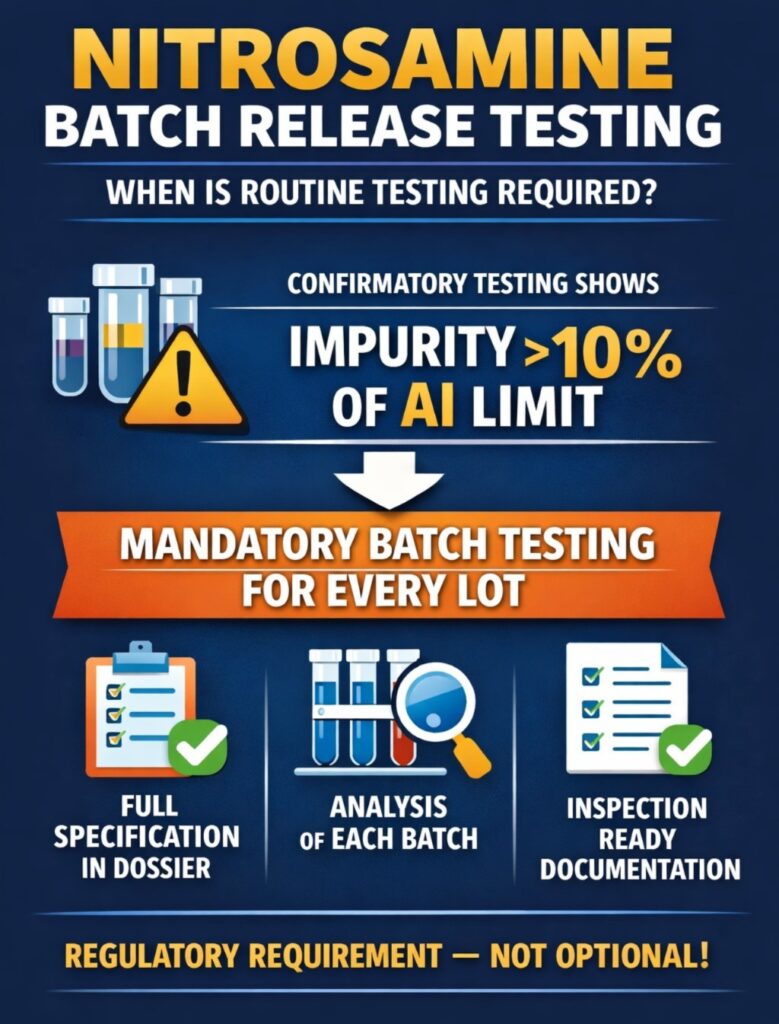
The Nitrosamine Batch Release Testing Requirement becomes mandatory when confirmatory testing shows nitrosamine impurity levels above 10% of the established Acceptable Intake (AI) limit. Regulatory authorities such as the FDA and EMA clearly state that if a drug product or active pharmaceutical ingredient (API) crosses this level, the impurity must be included in the official release specification. This means every manufactured batch must be tested before release to the market. The requirement is not optional; it is a formal regulatory obligation. Once triggered, testing must continue unless strong scientific data supports another approved control strategy.
Manufacturers are also expected to maintain proper documentation that explains their testing frequency and control approach. All data must be inspection-ready and supported by scientific justification. Regulatory agencies carefully review this information during audits and submissions. A weak explanation or missing data can lead to regulatory findings.
For a comprehensive overview of analytical requirements, visit Nitrosamine Analysis and Testing Services.
Share via:
Summary:
- Routine batch release testing is mandatory when nitrosamine levels exceed 10% of the Acceptable Intake (AI).
- If triggered, the impurity must be added to specifications and every batch must be tested before release.
- Very low ppb-level nitrosamines can trigger testing, requiring highly sensitive validated analytical methods.
- ICH M7 allows different control strategies, but strong scientific justification and data are essential.
- Regulators require complete documentation, ongoing monitoring, and validated methods to ensure compliance.
Watch the Full Video: Nitrosamine Batch Release Testing
Technical Thresholds Defining the Nitrosamine Batch Release Testing Requirement
The Nitrosamine Batch Release Testing Requirement is determined by comparing detected impurity levels with their toxicological limits. During Step 2 confirmatory testing, the measured concentration directly guides the long-term monitoring strategy. If results remain below 10% of the AI, routine batch testing is generally not required. However, once levels fall between 10% and 100% of the AI, routine batch-by-batch testing becomes mandatory.
The 10% AI level acts as a key regulatory decision point. If three consecutive commercial-scale batches consistently show levels below 10%, and the root cause is clearly identified and controlled, the impurity may not need to be added to the formal specification. This decision must be supported by strong process understanding and documented scientific evidence.
On the other hand, if impurity levels remain above 10%, the risk is considered confirmed. At that stage, the impurity must be actively controlled with validated analytical methods throughout the product’s shelf life. There is no flexibility once consistent levels exceed this threshold.
Learn how updated regulations affect your strategy at Impact of ICH M7(R2) Updates on Nitrosamine Risk Assessment.
For Nitrosamine Drug Substance-Related Impurities (NDSRIs), AI limits are often very low. They are assigned using the Carcinogenic Potency Categorization Approach (CPCA). Because of this, even very small concentrations in the parts-per-billion (ppb) range can trigger the Nitrosamine Batch Release Testing Requirement. Laboratories must use highly sensitive and validated analytical methods to detect these low levels.
For example, if a drug has an AI of 26.5 ng/day and a maximum daily dose of 1000 mg, the 10% trigger equals only 2.65 ppb. This means the laboratory’s Limit of Quantitation (LOQ) must reliably measure at or below that level.
Understand the categorization framework at Nitrosamine CPCA Approach for NDSRIs.
| Impurity Level (Relative to AI) | Regulatory Testing Frequency | Action Required in Dossier |
|---|---|---|
| < 10% AI | No routine testing required | Document in risk assessment; no specification needed |
| 10% – 30% AI | Routine testing required (initially) | Establish specification; potential for skip-testing |
| 30% – 100% AI | Mandatory routine testing | Establish specification; full batch release testing |
| ≥ 100% AI | Batch rejection | Immediate agency notification; recall if on market |
Strategic Implementation of the Nitrosamine Batch Release Testing Requirement Under ICH M7
The Nitrosamine Batch Release Testing Requirement can be implemented using four control options described in ICH M7. These options allow manufacturers to balance laboratory testing with scientific process knowledge. Each option represents a different level of reliance on analytical testing versus upstream process control.
Option selection must be supported by data and risk assessment. Regulatory authorities review these justifications carefully, especially when routine testing is reduced. The chosen approach must align with the product’s chemistry, manufacturing process, and impurity formation pathway.
A weak justification or incomplete data package may result in deficiency letters or regulatory delays. Therefore, a well-documented scientific strategy is essential.
Calculate your safety margins accurately using Nitrosamine Purge Factor Calculation.
Analysis of ICH M7 Control Options for Nitrosamines
Option 1 – Final Drug Substance Testing
ICH M7 Option 1 is the most commonly used approach to meet the Nitrosamine Batch Release Testing Requirement. Under this option, a specification limit is set for the nitrosamine, and every batch is tested before release. This method provides direct analytical confirmation of compliance.
Although it requires more laboratory resources, it offers the highest regulatory confidence. It is typically chosen when impurity formation cannot be completely eliminated.
Option 2 – Testing at Intermediate or Starting Material Stage
Option 2 shifts testing to an earlier manufacturing stage. This approach is acceptable only if the manufacturer proves that no nitrosamine formation or contamination can occur in later steps.
Detailed knowledge of chemistry, reagent quality, and contamination risks is required. Without strong evidence, regulators may not accept this strategy.
Option 3 – Upstream Control with Fate and Purge Study
Option 3 combines upstream control with purge studies. Manufacturers must show that purification steps such as recrystallization or chromatography consistently reduce nitrosamine levels below 30% of the AI.
Spike-and-purge studies significantly strengthen this justification. Reliable experimental data is critical for regulatory acceptance.
Option 4 – Complete Waiver of Routine Testing
Option 4 allows removal of routine testing but requires proof of negligible risk. Usually, this means demonstrating a purge ratio greater than 1000. In simple terms, the process must remove at least 1000 times the impurity amount required to reach the AI limit.
Regulators expect strong calculations, experimental confirmation, and ongoing monitoring. Without clear evidence, Option 4 submissions are often rejected.
| ICH M7 Option | Testing Strategy | Justification Requirement |
|---|---|---|
| Option 1 | Final Drug Substance | Analytical verification of every batch |
| Option 2 | Intermediate/Starting Material | Proof of no late-stage formation/contamination |
| Option 3 | Upstream Control + Fate/Purge | Analytical data showing consistent removal |
| Option 4 | No Analytical Testing | Calculated purge ratio > 1000; process knowledge |
Analytical Sensitivity and the Nitrosamine Batch Release Testing Requirement
Meeting the Nitrosamine Batch Release Testing Requirement depends heavily on analytical sensitivity. Laboratories must validate methods with an LOQ at or below 10% of the AI. If the method cannot measure at that level, it cannot support regulatory decisions.
Validation must follow ICH Q2 guidelines. Accuracy, precision, specificity, and robustness must be clearly demonstrated. All calculations should be traceable and scientifically justified.
The AI for nitrosamines is calculated using toxicological data. When sufficient carcinogenicity data exist, the AI is derived from the TD₅₀ value:
AI = (TD₅₀ × 50 kg) / 50,000
Here, 50 kg represents average body weight, and 50,000 is the safety factor used to limit cancer risk to 1 in 100,000 over a lifetime. If TD₅₀ data are not available, CPCA potency categories are used instead.
Explore high-sensitivity solutions at HRMS for Nitrosamine Testing.
CPCA Potency Categories and Their Impact on the Nitrosamine Batch Release Testing Requirement
The CPCA category assigned to an NDSRI directly affects the AI limit and therefore the Nitrosamine Batch Release Testing Requirement. Category 1 compounds have the lowest AI of 26.5 ng/day because of their high carcinogenic potential.
Even very small concentrations of Category 1 nitrosamines can trigger routine testing. These compounds usually require advanced LC-MS/MS or GC-MS/MS methods. Higher categories allow higher AI limits but still demand strict control and documentation.
| Potency Category | Structural Indicators | AI Limit (ng/day) | 10% Trigger for Routine Testing |
|---|---|---|---|
| Category 1 | No deactivating groups; high activation potential | 26.5 | 2.65 ng/day |
| Category 2 | Intermediate structural features | 100 | 10.0 ng/day |
| Category 3 | Moderate deactivating features | 400 | 40.0 ng/day |
| Category 4 | Significant deactivating groups | 1500 | 150.0 ng/day |
| Category 5 | Highly deactivating groups | 1500 | 150.0 ng/day |
Matrix Interference and Batch Release Reliability
Matrix interference can complicate routine nitrosamine analysis. Some excipients may suppress signals or reduce recovery. In extended-release products, polymers such as HPMC can form gels during extraction and trap nitrosamines.
To ensure reliable results, laboratories should use techniques such as solid-phase extraction (SPE) or liquid-liquid extraction (LLE). Recovery studies must be performed at different concentration levels. Stable isotope internal standards improve accuracy and compensate for matrix effects.
Without proper validation, reported results may not meet regulatory expectations.
Compare analytical approaches at Direct Injection vs. Headspace Techniques for Nitrosamines.
Preventing Artefactual Formation During Testing
Artefactual nitrosamine formation can occur during laboratory analysis. If secondary amines react with nitrites under acidic conditions, false positives may appear.
To reduce this risk, laboratories should control pH and use nitrite scavengers such as ammonium sulfamate. Sample preparation conditions must be carefully validated. Stress testing during method development helps confirm that laboratory procedures do not artificially create nitrosamines.
Regulators expect evidence that analytical results reflect the manufacturing process, not laboratory errors.
Discover how to prevent false positives at Secondary Amine Scavengers in Nitrosamine Mitigation.
Regulatory Deadlines and the August 2025 NDSRI Update
In June 2025, the FDA updated timelines for nitrosamine mitigation. Instead of requiring full compliance by August 1, 2025, companies must now submit a detailed NDSRI progress update if remediation is ongoing.
The update must be included in the Annual Report (eCTD section 1.13.14). Products without approved applications must maintain documentation on-site for inspection. Complete and accurate data submission is essential to avoid enforcement action.
Ensure your filings are compliant with Nitrosamine Risk Assessment for ANDA Submission.
Essential Components of the NDSRI Progress Update
Forced Degradation Studies: Evidence showing whether NDSRIs form under stress conditions.
Method Validation Status: Full validation details including LOQ, precision, and robustness.
Confirmatory Results: Data from at least three representative batches with statistical evaluation.
Root Cause Identification: Clear identification of nitrite sources, solvents, water, or excipients.
Mitigation Timelines: Realistic plans for process changes or supplier qualification.
Each section must include supporting data. Summary statements without evidence are not acceptable.
Transitioning from Routine to Skip Testing
Moving from full routine testing to skip-testing is possible when consistent low levels are demonstrated. Nitrosamine levels must remain below 30% of the AI, and root causes must be eliminated.
However, if any batch exceeds 30% of the AI, full routine testing must restart immediately. Strong change control and continuous monitoring systems are required to maintain compliance.
Case Study: Review real-world applications and root cause analysis at NDMA Root Cause Investigation Case Study.
Case Studies: Rejection of Option 4 Justifications
Regulators have rejected Option 4 submissions when scientific support was weak. Common issues include overestimated purge calculations and missing root cause analysis.
For example, some manufacturers failed to conduct spike-purge studies at levels 100 times above the AI. Others overlooked nitrite contamination from excipients or packaging materials.
| Reason for Rejection | Technical Deficiency | Regulatory Requirement |
|---|---|---|
| Overestimated Purge | No experimental confirmation | Spike-purge study at 100x AI |
| Missing Root Cause | Nitrite source not identified | Full risk assessment |
| Poor Sensitivity | LOQ above 10% AI | Validation per ICH Q2 |
| Late-Stage Formation | Ignored stability risks | Shelf-life stability data |
Emerging Global Trends in Nitrosamine Control (2026 and Beyond)
The Nitrosamine Batch Release Testing Requirement will continue to evolve as regulatory science advances. Authorities are refining CPCA categories and introducing new NDSRIs based on updated mutagenicity testing data.
Regulators are also investigating non-traditional sources, such as packaging materials and nitrogen oxides formed during drying processes. This means manufacturers must maintain continuous risk assessment and lifecycle monitoring.
In 2026 and beyond, compliance will depend on proactive risk management, strong analytical science, and well-documented quality systems. The focus is shifting from reactive correction to preventive control supported by reliable data.
Conclusion
The Nitrosamine Batch Release Testing Requirement represents a science-based and risk-focused approach to ensuring drug safety. By following the defined AI thresholds of 10%, 30%, and 100%, manufacturers can maintain product quality while managing testing resources effectively. These limits provide clear guidance on when routine testing, reduced monitoring, or batch rejection is required.
The growing focus on NDSRIs and highly sensitive LC-MS/MS methods highlights the need for strong analytical expertise and continuous oversight. Integrating the Nitrosamine Batch Release Testing Requirement into the core quality system is essential for long-term regulatory compliance and protection of patient health.
For more information on how to satisfy your testing mandates or to develop validated analytical protocols, please contact our experts:
FAQs: Navigating the Nitrosamine Batch Release Testing Requirement
Routine testing becomes compulsory when confirmatory analysis shows the nitrosamine level is higher than 10% of its Acceptable Intake (AI). Once this limit is crossed, the impurity must be added to the batch release specification. Every manufactured batch must then be tested before it can be released to the market. This forms part of the formal Nitrosamine Batch Release Testing Requirement.
Your analytical method must achieve a Limit of Quantitation (LOQ) at or below 10% of the AI. This ensures the method is sensitive enough to detect small amounts of nitrosamines. Without this level of sensitivity, the results cannot reliably support compliance decisions. Proper validation according to ICH Q2 guidelines is also required.
The 30% AI level is commonly used as a benchmark for moving from routine batch testing to periodic or skip-testing. If impurity levels consistently remain below this threshold and the root cause is controlled, reduced testing may be considered. However, strong process data and regulatory acceptance are necessary. Any increase above 30% may require returning to full routine testing.
Nitrosamines commonly form when nitrites present in excipients react with secondary or tertiary amines in the API. Other sources include contaminated solvents, recycled materials, and acidic conditions during manufacturing. Poor storage conditions can also contribute. A detailed root cause investigation is critical to prevent recurrence.
In limited cases, routine testing may be waived under ICH M7 Option 4. However, this requires very strong scientific proof that the manufacturing process consistently removes the impurity, typically with a purge ratio greater than 1000. The justification must be supported by solid experimental data. Regulatory approval is granted on a case-by-case basis.
Reference:
- Cantave, R. (2025, April 10). Nitrosamine related guidance. U.S. Food and Drug Administration, Center for Drug Evaluation and Research. https://www.fda.gov/media/187315/download
- Health Canada. (2024, May 31). Guidance on nitrosamine impurities in medications: Evaluating and managing the risks of N-nitrosamine impurities in human pharmaceutical, biological and radiopharmaceutical products (Catalogue No. H164-327/2024E-1-PDF). Government of Canada. https://publications.gc.ca/collections/collection_2024/sc-hc/H164-327-2024-eng.pdf
- U.S. Food and Drug Administration. (2023, August 4). Recommended acceptable intake limits for nitrosamine drug substance-related impurities (NDSRIs): Guidance for industry. https://www.fda.gov/regulatory-information/search-fda-guidance-documents/recommended-acceptable-intake-limits-nitrosamine-drug-substance-related-impurities
- Urquhart, M. W. J., Burns, M. J., Clark, H. F., Crochard, J.-P., Dirat, O., Hildbrand, S., Moessner, C., Pascoe, D. D., Roberts, A. J., Teasdale, A., & Thiel, O. R. (2024). Leveraging ICH M7 control options 3 and 4: Discussion and clarification using industrial case studies. Organic Process Research & Development, 28(8), 3295–3306. https://doi.org/10.1021/acs.oprd.4c00207
- U.S. Food and Drug Administration. (2025, May 2). CDER nitrosamine impurity acceptable intake limits. https://www.fda.gov/regulatory-information/search-fda-guidance-documents/cder-nitrosamine-impurity-acceptable-intake-limits
- United States Pharmacopeia. (2021, November 22). Nitrosamines formation as artefact: What are the challenges? Nitrosamines Exchange. https://nitrosamines.usp.org/t/nitrosamines-formation-as-artefact-what-are-the-challenges/1234
- Tarafder, A., Vega, E., Beck, H. P., Mundal, D., Tilala, M., & Wang, S. (2025). Nitrosamine control: From risk assessment to analytical testing with emphasis on sample preparation and phase-appropriate method validation. Organic Process Research & Development. Advance online publication. https://doi.org/10.1021/acs.oprd.5c00158
Get In Touch With Us
About The Author


