

Introduction:
In recent years, the pharmaceutical industry has faced several major product recalls linked to nitrosamine contamination. A detailed Nitrosamine Drug Recalls Analysis of global events—including the valsartan recalls in 2018, ranitidine withdrawals between 2019 and 2020, and metformin recalls in 2020—shows how regulatory expectations and manufacturing standards have rapidly evolved. These incidents triggered worldwide investigations into pharmaceutical production practices and impurity monitoring systems. As a result, regulators increased oversight and required companies to strengthen their quality assurance processes to better protect patient safety.
Unlike traditional recalls caused by labeling mistakes or formulation issues, nitrosamine-related recalls revealed deeper risks within manufacturing chemistry and API synthesis processes. These incidents demonstrated that certain chemical reactions or process conditions can unintentionally produce nitrosamines. Because of these discoveries, pharmaceutical companies began investing in improved analytical testing, stronger process design, and more proactive risk management systems. This shift toward preventive quality control has become a key focus in modern pharmaceutical manufacturing.
For a comprehensive overview of modern detection strategies, explore our guide on Nitrosamine Analysis and Testing Services.
Share via:
Summary of Key Insights
- Global regulatory actions since 2018 have reshaped pharmaceutical risk management, especially after the discovery of nitrosamine impurities such as NDMA and NDEA in drugs like valsartan, ranitidine, and metformin.
- Nitrosamine Drug Recalls Analysis shows that most recalls were linked to process changes, solvent reuse, and manufacturing impurities rather than formulation failures.
- Regulatory agencies including FDA, EMA, Health Canada, and WHO introduced mandatory risk assessments, acceptable intake limits, and new analytical requirements.
- The recalls highlighted the critical need for advanced analytical testing such as LC-MS/MS and GC-MS for trace nitrosamine detection at parts-per-billion levels.
- Manufacturers must now implement risk-based nitrosamine control strategies across API synthesis, excipient compatibility, packaging, and storage conditions.
- Regulatory agencies worldwide now require nitrosamine risk evaluation across the entire drug lifecycle, including post-approval manufacturing changes.
- The key lesson: proactive impurity surveillance and validated analytical methods are now essential for regulatory compliance and patient safety.
The Turning Point in Nitrosamine Drug Recalls Analysis: The 2018 Valsartan Crisis
The discovery of NDMA contamination in valsartan APIs in 2018 triggered worldwide recalls and led to the modern regulatory framework for nitrosamine impurity control.
In June 2018, regulators discovered the presence of N-nitrosodimethylamine (NDMA) in valsartan APIs manufactured by Zhejiang Huahai Pharmaceuticals. Investigations later revealed that changes made during tetrazole synthesis and solvent reuse practices created conditions that allowed nitrosamine formation. These process modifications had been implemented years earlier and were not initially recognized as impurity risks. Once contamination was detected, regulatory agencies initiated immediate investigations and product recalls worldwide. The event quickly became a major turning point for pharmaceutical quality oversight.
Regulatory analyses showed that the incident resulted in more than 100 global recalls involving angiotensin II receptor blockers (ARBs). The scale of the recalls demonstrated how interconnected global pharmaceutical supply chains can amplify manufacturing issues. Even trace levels of NDMA caused serious concern because nitrosamines are classified as probable human carcinogens. As a result, regulators required stricter monitoring of manufacturing processes and impurity formation mechanisms. This event significantly reshaped impurity risk management practices.
The valsartan crisis also highlighted how small changes in API manufacturing processes can unintentionally introduce genotoxic impurities. Adjustments to reagents, solvents, or reaction conditions may appear minor but can create chemical environments that promote nitrosamine formation. Because of this risk, regulatory agencies now require detailed documentation for manufacturing changes. Companies must also perform comprehensive impurity risk assessments before implementing process modifications. These measures aim to prevent similar incidents in future pharmaceutical production.
Assessing specific drug categories is now a regulatory priority. Learn more about Nitrosamine Testing for High-Risk Drug Classes.
Key Regulatory Actions Following the Valsartan Recall
| Regulatory Authority | Action Taken |
|---|---|
| US FDA | Issued guidance on nitrosamine risk assessment and testing requirements |
| European Medicines Agency (EMA) | Required mandatory risk evaluation for all chemically synthesized medicines |
| Health Canada | Implemented routine screening of ARBs and related APIs |
| WHO | Developed global regulatory coordination frameworks |
The Nitrosamine Drug Recalls Analysis of the valsartan case confirmed that contamination occurred when sodium nitrite reacted with secondary amines under acidic conditions during API manufacturing. This reaction can generate NDMA if process controls are not properly maintained. The discovery highlighted the importance of evaluating reagent compatibility and reaction pathways in pharmaceutical synthesis. As a result, regulators encouraged manufacturers to redesign processes that could potentially generate nitrosamines.
These regulatory responses also led to standardized risk assessment frameworks that pharmaceutical companies must follow today. Manufacturers are required to review historical manufacturing processes and identify potential nitrosamine-forming conditions. If risks are identified, companies must perform confirmatory analytical testing and implement mitigation strategies. These requirements significantly strengthened global pharmaceutical quality systems.
Stay compliant with the latest guidelines by reviewing the Impact of ICH M7(R2) Updates on Nitrosamine Risk Assessment.
Nitrosamine Drug Recalls Analysis of the Ranitidine Withdrawal
The ranitidine recall showed that nitrosamines can form not only during manufacturing but also during storage due to drug degradation.
In 2019, independent testing laboratories reported the presence of NDMA in ranitidine (Zantac) products. Unlike the valsartan case, where contamination occurred during API synthesis, the ranitidine issue revealed that the drug molecule itself could degrade and generate NDMA. This degradation occurred under certain storage conditions such as elevated temperatures. The findings raised serious concerns about the stability of ranitidine products during distribution and long-term storage. Regulatory agencies quickly began investigating the potential risks.
Scientific studies showed that ranitidine could form NDMA through several chemical pathways. These included thermal degradation during storage, reactions with nitrites under gastric conditions, and instability in environments with high humidity. These mechanisms demonstrated that nitrosamine formation can occur even after the drug has been manufactured and packaged. The discovery expanded the scope of nitrosamine risk management beyond manufacturing processes. Storage conditions and molecular stability became equally important considerations.
As more data became available, regulatory authorities decided to withdraw ranitidine products from markets around the world. This included the United States, Canada, and many European countries. The withdrawal became one of the most significant pharmaceutical safety actions in recent years. It also highlighted the need for stronger stability testing programs. Regulators began requiring pharmaceutical companies to evaluate impurity formation during long-term storage more carefully.
Ensure your product remains stable over its shelf life with Nitrosamine Testing in Stability Studies.
Lessons from Ranitidine Recalls
The Nitrosamine Drug Recalls Analysis of ranitidine revealed several important risk factors previously overlooked in pharmaceutical quality systems. One key finding was that the chemical structure of certain drug molecules can promote nitrosamine formation under specific conditions. Even long-established medicines may contain hidden impurity risks. This discovery emphasized the importance of evaluating molecular stability during drug development.
Another lesson involved the role of storage conditions in impurity formation. Temperature fluctuations and high humidity levels can accelerate degradation reactions that produce nitrosamines. Pharmaceutical manufacturers must therefore carefully evaluate packaging systems and storage requirements. Proper packaging helps protect products from environmental factors that may trigger impurity formation.
The ranitidine case also showed the importance of targeted analytical testing within stability programs. Traditional stability studies were not always designed to detect ultra-trace genotoxic impurities. By incorporating specific nitrosamine testing methods, companies can identify contamination risks earlier. This improvement has strengthened pharmaceutical quality assurance systems worldwide.
Expanding Scope: Metformin and Other Nitrosamine Drug Recalls
The metformin recalls showed that nitrosamine contamination risks can affect multiple drug classes and global supply chains.
In 2020, several extended-release metformin products were recalled after testing detected NDMA levels above acceptable intake limits. Investigations suggested that contamination could arise from several potential sources. These included impurities during API synthesis, interactions with packaging materials, or chemical changes during long-term storage. These findings highlighted the complexity of nitrosamine risk management. Even well-established medicines required renewed scrutiny.
The metformin recalls also illustrated the challenges of global pharmaceutical supply chains. APIs are often produced in one region, formulated in another, and distributed worldwide. Each stage of the process introduces variables that may influence impurity formation. Because of this complexity, manufacturers must implement strong quality control systems throughout the entire supply chain. Continuous monitoring helps reduce the risk of contamination.
Other medications affected by nitrosamine recalls include:
- Losartan
- Irbesartan
- Nizatidine
- Rifampin
- Varenicline
A broader Nitrosamine Drug Recalls Analysis of these recalls shows that contamination pathways are often complex and involve multiple factors. Interactions between raw materials, manufacturing chemistry, packaging materials, and environmental conditions can all contribute to impurity formation. Recognizing these factors is essential for building effective prevention strategies.
Complex structures require specialized approaches. Read about Isomeric Nitrosamines Analysis to understand these challenges.
Global Regulatory Actions After Nitrosamine Recalls
Regulatory agencies introduced mandatory risk assessment frameworks, strict intake limits, and advanced analytical testing requirements.
Following the global wave of recalls, regulatory agencies implemented comprehensive frameworks to control nitrosamine contamination. Pharmaceutical manufacturers must now systematically evaluate their products for potential nitrosamine risks. These frameworks help identify contamination sources early and allow companies to implement preventive measures. This proactive regulatory approach has become central to modern pharmaceutical safety.
Regulators also emphasized transparent documentation and reporting practices. Companies must maintain detailed records of risk assessments, analytical test results, and mitigation strategies. These records may be reviewed during inspections or product approval processes. Such transparency ensures accountability and supports consistent product quality.
Understand how limits differ across jurisdictions with our Nitrosamine AI Limits Comparison.
Key Regulatory Requirements
Three-Step Risk Assessment
Regulators introduced a structured three-step process:
- Risk evaluation
- Confirmatory testing
- Risk mitigation
This framework ensures that pharmaceutical manufacturers systematically identify potential contamination risks and implement appropriate control measures.
Acceptable Intake Limits
| Nitrosamine | Acceptable Intake Limit |
|---|---|
| NDMA | 96 ng/day |
| NDEA | 26.5 ng/day |
| NMBA | 96 ng/day |
These limits are based on toxicological studies designed to minimize long-term cancer risk from nitrosamine exposure.
Mandatory Analytical Testing
Pharmaceutical manufacturers must now implement highly sensitive analytical techniques capable of detecting trace impurities.
Common techniques include:
- LC-MS/MS
- GC-MS
- High-resolution mass spectrometry
- Headspace GC analysis
The Nitrosamine Drug Recalls Analysis clearly shows that modern analytical capabilities are essential for regulatory compliance and patient safety.
Root Causes Identified in Nitrosamine Drug Recalls Analysis
Most nitrosamine recalls originate from manufacturing chemistry, reagent interactions, or degradation reactions.
A comprehensive Nitrosamine Drug Recalls Analysis has identified several recurring sources of contamination across pharmaceutical products. These sources typically involve complex chemical reactions during manufacturing or storage. Understanding these mechanisms helps manufacturers design effective prevention strategies. Identifying root causes also supports stronger quality control systems.
Major Root Causes
1. API Synthesis Chemistry
- Secondary amines reacting with nitrosating agents
- Sodium nitrite contamination
- Incomplete purification steps
During API synthesis, certain chemical reactions can generate nitrosamines under acidic conditions. If purification steps are not sufficiently controlled, these impurities may remain in the final product.
2. Solvent Reuse and Recovery
- Recycling solvents containing amine impurities
- Process conditions enabling nitrosation
Solvent reuse is common in pharmaceutical manufacturing, but improper purification can introduce contaminants that promote nitrosamine formation.
3. Raw Material Impurities
- Contaminated reagents
- Nitrite-containing excipients
Impurities present in raw materials can act as precursors for nitrosamine formation during manufacturing or storage.
4. Drug Product Degradation
- High temperature storage
- Packaging interactions
- Long-term stability issues
Environmental conditions during storage can accelerate chemical reactions that generate nitrosamines.
Learn how to prevent formation during production with Nitrosamine Solvent and Catalyst Mitigation.
Lessons Learned for Pharmaceutical Manufacturers
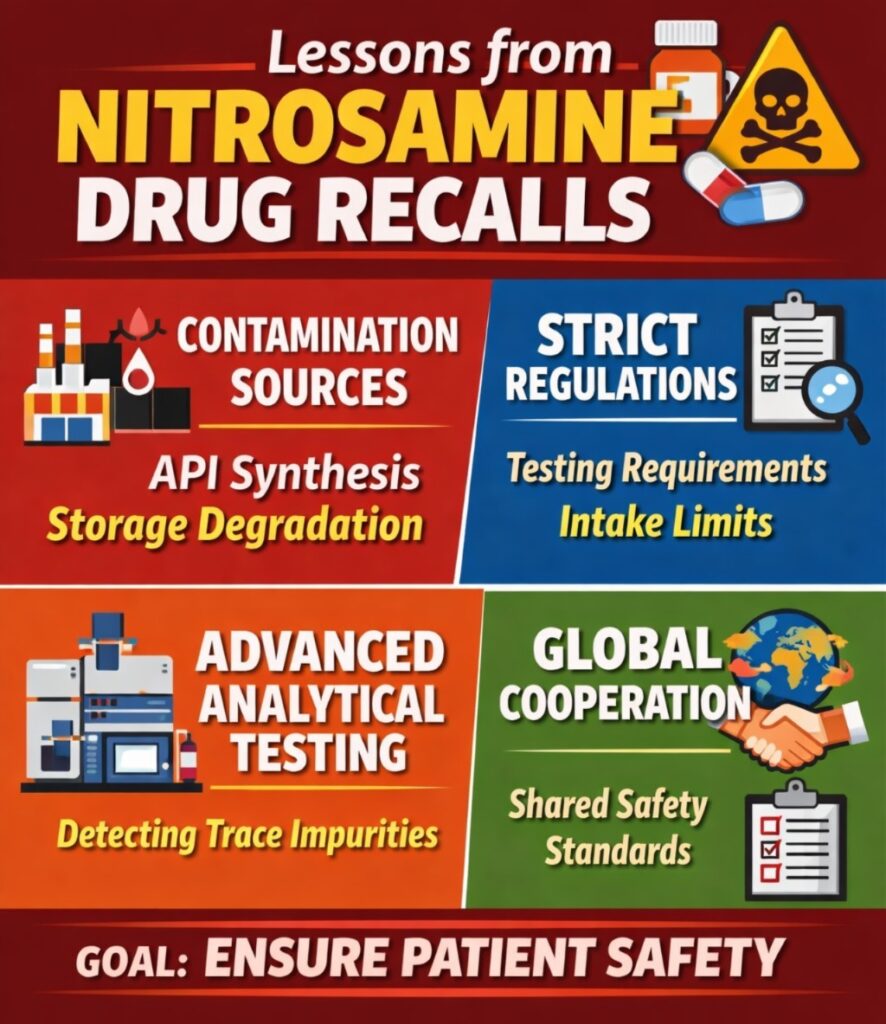
Preventing nitrosamine contamination requires integrated process design, strong analytical testing, and strict regulatory compliance.
Insights from global Nitrosamine Drug Recalls Analysis show that pharmaceutical companies must adopt proactive strategies to prevent contamination. This includes improved process design, stronger analytical capabilities, and comprehensive supplier qualification programs. Addressing risks early helps reduce the likelihood of costly product recalls.
Critical Risk Mitigation Strategies
1. Process Design Controls
- Avoid nitrosating agents where possible
- Reduce exposure to secondary amines
- Validate impurity control during API synthesis
Carefully optimized manufacturing processes significantly lower the risk of nitrosamine formation.
2. Advanced Analytical Testing
- Routine LC-MS/MS screening
- Monitoring trace-level impurities
Regular analytical testing helps detect contamination before products reach the market.
3. Raw Material Qualification
- Evaluate nitrite contamination
- Conduct supplier quality audits
Strong supplier management ensures that raw materials meet strict quality standards.
4. Lifecycle Risk Assessment
- Stability testing for nitrosamine formation
- Packaging compatibility studies
Continuous monitoring throughout the product lifecycle helps maintain product safety and quality.
Choosing the right partner is vital for long-term success. See our checklist for Nitrosamine Testing CRO Selection.
The Future of Nitrosamine Drug Recalls Analysis
Future control strategies will rely on predictive modeling, advanced analytics, and stronger global regulatory collaboration.
Several emerging developments are shaping the future of Nitrosamine Drug Recalls Analysis. One promising advancement is the use of predictive impurity modeling supported by artificial intelligence. These tools can analyze manufacturing data and identify potential contamination pathways before they occur. This allows manufacturers to address risks during process development rather than after product release.
Analytical technology is also advancing rapidly. Modern mass spectrometry systems can detect contaminants at extremely low concentrations. These improvements provide earlier warning signals for potential quality issues. As a result, pharmaceutical laboratories can maintain stronger monitoring across the entire drug lifecycle.
Another emerging trend is real-time monitoring within manufacturing processes. Continuous analytical measurements allow manufacturers to detect deviations immediately. Early detection enables corrective actions before impurities develop. This proactive approach improves product quality and reduces the risk of recalls.
Global regulatory collaboration will also play an important role. Increased data sharing between regulatory agencies allows faster identification of emerging safety risks. Collaborative oversight strengthens global pharmaceutical safety systems.
Conclusion
The global wave of pharmaceutical recalls since 2018 has significantly changed how the industry approaches impurity control. A detailed Nitrosamine Drug Recalls Analysis shows that contamination events involving drugs such as valsartan, ranitidine, and metformin exposed deeper challenges in pharmaceutical manufacturing and regulatory oversight.
In response, regulators introduced stricter nitrosamine risk assessment frameworks, mandatory analytical testing requirements, and clearly defined intake limits. These measures require pharmaceutical companies to strengthen their quality systems and adopt advanced analytical technologies. Companies must also evaluate supply chains carefully to ensure consistent product safety.
As regulatory expectations continue to evolve, organizations that invest in advanced testing, predictive risk tools, and proactive quality management will be better prepared for future challenges. Preventive impurity control is now a fundamental requirement for maintaining regulatory compliance and protecting patient health.
For expert guidance on Nitrosamine Drug Recalls Analysis, impurity detection, and regulatory compliance testing, consult specialized analytical laboratories with expertise in trace-level pharmaceutical analysis.
FAQs: Nitrosamine Drug Recalls Analysis
Several commonly used medications were affected by nitrosamine recalls, especially certain blood pressure and stomach acid drugs. Examples include valsartan, losartan, irbesartan, ranitidine, and some extended-release metformin products. These recalls occurred after testing detected nitrosamine levels above acceptable safety limits. Regulatory agencies acted to protect patient safety while manufacturers reviewed their production processes.
The most frequently reported nitrosamines in drug recalls include NDMA, NDEA, and NMBA. These compounds belong to a group of chemicals known to have potential carcinogenic properties when exposure occurs over long periods. Because of this risk, regulatory agencies set strict limits for their presence in medicines. Advanced analytical methods are used to detect even very small amounts.
Regulatory authorities use a structured approach to manage nitrosamine risks in pharmaceuticals. Companies are required to perform risk assessments, conduct confirmatory analytical testing, and implement control strategies if contamination risks are identified. These steps must be documented and reviewed during regulatory inspections. This system helps ensure consistent drug quality and patient safety.
Nitrosamine formation can occur when certain chemicals interact during pharmaceutical manufacturing. The presence of secondary amines, nitrosating agents, contaminated solvents, or impure raw materials may trigger these reactions. Inadequate purification steps can also allow impurities to remain in the final product. Careful process design and monitoring help prevent these issues.
Preventing nitrosamine contamination requires a combination of risk assessment, controlled manufacturing processes, and advanced analytical testing. Companies must carefully evaluate raw materials, solvents, and chemical reactions used during production. Regular impurity monitoring and supplier quality checks are also important. These preventive measures reduce the likelihood of contamination and future recalls.
Reference:
- U.S. Food and Drug Administration. (2023, August 4). Recommended acceptable intake limits for nitrosamine drug substance-related impurities (NDSRIs): Guidance for industry. https://www.fda.gov/regulatory-information/search-fda-guidance-documents/recommended-acceptable-intake-limits-nitrosamine-drug-substance-related-impurities
- Health Canada. (2024, May 31). Guidance on nitrosamine impurities in medications: Evaluating and managing the risks of N-nitrosamine impurities in human pharmaceutical, biological and radiopharmaceutical products (Catalogue No. H164-327/2024E-1-PDF). Government of Canada. https://publications.gc.ca/collections/collection_2024/sc-hc/H164-327-2024-eng.pdf
Get In Touch With Us
About The Author


