

Introduction:
Nitrosamine formation risk in drug products is an important quality and patient safety issue because certain nitrosamines are classified as probable or possible human carcinogens, depending on the compound and the available evidence. Formulation design, pH, excipient composition, manufacturing conditions, and storage environment can all influence whether nitrosamines form during development, production, or shelf life.
Nitrosamines contain a nitroso group attached to a nitrogen atom. In pharmaceutical products they may arise when susceptible amines meet nitrosating agents under favorable conditions. Potential sources include the active pharmaceutical ingredient (API), excipients, process-related impurities, contaminated materials, and packaging or manufacturing operations.
An amine-containing API is a structural concern, but it does not mean a product will automatically form nitrosamines. Actual risk depends on the reactive species present, their concentrations, the environmental conditions, and the duration of exposure.
At ResolveMass Laboratories Inc., a Canadian analytical CRO/CDMO, our scientists support nitrosamine investigations through mass spectrometry-based testing, impurity characterization, and formulation-aware risk assessment. This article explains how formulation and pH shape nitrosamine chemistry, what regulators expect, and how to build a defensible control strategy.
Summary:
- Formulation and pH can significantly influence nitrosamine formation risk in drug products by affecting how reactive nitrosating agents, amines, and other formulation components are.
- Acidic conditions can promote nitrosation when nitrite and susceptible secondary or tertiary amines are present. The effect depends on the specific chemical system, so no single pH is universally safe.
- Excipients, residual solvents, APIs, water content, manufacturing conditions, and packaging can all contribute to nitrosamine formation or change its likelihood.
- Nitrite impurities in excipients are a potential source of nitrosating species and belong in every risk assessment.
- Formulation changes such as lower-nitrite excipient grades or pH adjustment may reduce risk, but their effectiveness must be shown experimentally.
- LC-MS/MS and high-resolution mass spectrometry (HRMS) support detection, quantification, and investigation of formation pathways.
- A science-based control strategy combines formulation assessment, raw material qualification, process evaluation, stability testing, and validated analytical methods.
1. How Does Drug Product Formulation Affect Nitrosamine Formation Risk in Drug Products?
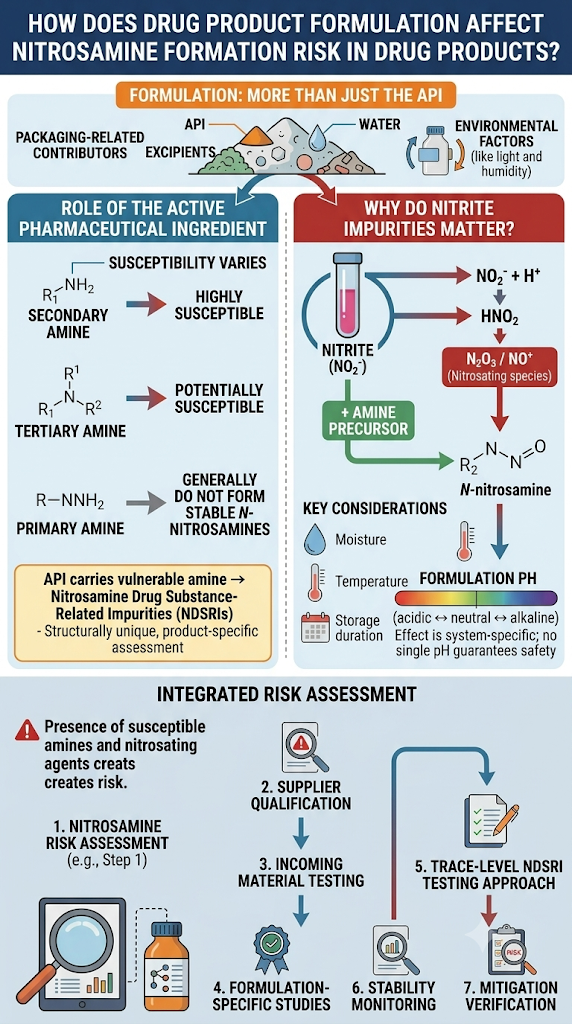
Formulation affects nitrosamine formation by determining which reactive compounds are present, how readily they interact, and whether the product creates conditions favorable to nitrosation. A finished product contains more than the API. Excipients, residual processing materials, water, and packaging-related substances all influence chemical stability and impurity formation.
1.1 Role of the Active Pharmaceutical Ingredient
The API’s chemical structure is a primary consideration, because susceptibility varies considerably by amine type and molecular environment.
- Secondary amines: often susceptible to nitrosation, potentially producing N-nitrosamines.
- Tertiary amines: may react through different pathways, including dealkylation or other transformations, depending on structure and conditions.
- Primary amines: generally do not form stable conventional N-nitrosamines by the same pathway, although other nitrogen-containing products may be possible.
- API impurities and degradants: may introduce additional reactive amines or other precursors.
When the API itself carries a vulnerable amine, the resulting products are called nitrosamine drug substance-related impurities (NDSRIs). Each NDSRI is structurally unique, so assessment must be product-specific. Our nitrosamine risk assessment and trace-level NDSRI testing approach addresses this directly.
1.2 How Do Excipients Influence Nitrosamine Formation?
Excipients can influence nitrosamine formation by introducing nitrite impurities, changing formulation pH, affecting moisture availability, or altering the chemical environment around the API.
Excipient classes worth reviewing include:
- Microcrystalline cellulose
- Lactose and other carbohydrate-based excipients
- Starches and modified starches
- Povidone and other polymeric excipients
- Magnesium stearate and other lubricants
- Disintegrants, binders, and coating materials
The concern is not that these excipients inherently produce nitrosamines. Individual grades may contain measurable nitrite or other relevant impurities, and the effect depends on the formulation and process. For example, if a formulation contains a susceptible amine and an excipient that contributes nitrite, the combination may create a plausible formation pathway. The extent of formation then depends on pH, moisture, temperature, reaction kinetics, and other formulation-specific factors.
An effective risk assessment should evaluate actual excipient sources and grades rather than relying on excipient names alone.
1.3 Why Do Nitrite Impurities Matter?
Nitrite can serve as a source of nitrosating species under suitable conditions, so even low levels may warrant investigation when a susceptible amine is present. A practical assessment considers:
- Nitrite concentrations in individual excipients
- Variability between suppliers, grades, and batches
- Total nitrite contribution from the complete formulation
- Potential changes during storage
- Availability of susceptible amines
- The effect of formulation pH and moisture
Supplier qualification, incoming material testing, and formulation-specific studies help determine whether nitrite control is necessary.
2. Does Formulation pH Affect Nitrosamine Formation Risk in Drug Products?
Yes. Formulation pH can substantially affect nitrosamine formation risk in drug products because it influences the chemical forms, reactivity, and availability of both amines and nitrosating species.
In many aqueous systems, acidic conditions facilitate conversion of nitrite into nitrous acid and related nitrosating species, which can react with susceptible amines to form N-nitrosamines. The relationship is not universally linear, however. The maximum formation rate depends on the specific amine, the nitrosating species, the solvent environment, temperature, and other conditions.
2.1 Why Can Acidic Conditions Increase Nitrosation?
In acidic aqueous environments, nitrite takes part in equilibria that generate nitrous acid and reactive nitrosating species. Risk is influenced by:
- The concentration of nitrite available
- The pH and buffering capacity of the formulation
- The identity and concentration of the amine
- The presence of water or other solvents
- Temperature and storage duration
An aqueous formulation containing a susceptible secondary amine and nitrite may show increased nitrosamine formation under conditions that favor nitrosating species. Whether this reaches a meaningful level must be established by product-specific testing.
2.2 Does Lowering pH Always Increase Nitrosamine Formation?
No. Lowering pH does not always increase nitrosamine formation, and raising pH does not automatically eliminate the risk. Competing effects determine the overall rate. pH changes both the availability of nitrosating species and the protonation state of the amine, and protonated amines may be less nucleophilic. Other pathways may also become favorable under different conditions.
| Formulation factor | Potential effect on nitrosamine risk | Key consideration |
|---|---|---|
| Acidic pH | May favor formation of nitrosating species | Depends on the specific chemical system |
| Near-neutral pH | May reduce certain acid-promoted pathways | Nitrosation may still occur through other mechanisms |
| Alkaline pH | Often suppresses acid-dependent pathways | Does not guarantee absence of nitrosamines |
| Buffer composition | Can influence local chemical conditions and stability | Assess buffer identity, concentration, and compatibility |
| Buffer capacity | Determines resistance to pH change | Consider changes during storage and dissolution |
| Moisture content | Enables molecular mobility and aqueous reactions | Depends on water activity and product matrix |
For solid dosage forms, the pH of an aqueous extract may not represent the local environment inside a stored tablet. Moisture uptake, microenvironmental acidity, and excipient interactions can all change the real reaction conditions. Certain carbonyl compounds, such as formaldehyde, can also promote nitrosation at neutral or basic pH, so bulk pH alone should never be the sole basis for a conclusion.
2.3 How Should Formulation pH Be Optimized?
Formulation pH should be optimized through controlled, comparative studies that evaluate both nitrosamine formation and product performance.
- Establish initial nitrosamine levels and potential precursor concentrations.
- Identify the API’s relevant functional groups and possible reaction pathways.
- Evaluate a justified range of formulation pH values.
- Monitor nitrosamine formation under relevant accelerated and long-term stability conditions.
- Assess API stability, solubility, dissolution, and excipient compatibility.
- Select a pH range that balances impurity control with product quality and performance.
Any pH adjustment needs experimental support rather than an assumption that a particular pH is inherently safe.
3. Which Formulation and Manufacturing Factors Increase Nitrosamine Risk?
Nitrosamine formation is influenced by interacting factors, including precursor availability, excipient impurities, moisture, temperature, processing conditions, and storage duration. A useful risk assessment examines the whole manufacturing and product lifecycle rather than pH alone.
3.1 Nitrite Levels in Raw Materials
Nitrite in excipients is a recognized potential source of nitrosating species. Risk may vary between suppliers, manufacturing sites, grades, and batches. Manufacturers should consider risk-based nitrite testing, supplier specifications, and material qualification where the formulation chemistry justifies it.
3.2 Water Content and Moisture Exposure
Water improves the mobility of reactive species and enables aqueous-phase chemistry, so moisture can make nitrosation more favorable. In solid formulations, absorbed moisture may create localized environments where reaction is easier. Relevant variables include:
- Initial water content
- Hygroscopicity of the API and excipients
- Relative humidity during storage
- Moisture-barrier properties of the packaging
- Changes in water activity over shelf life
3.3 Temperature and Storage Duration
Higher temperatures may accelerate some nitrosation pathways, and longer storage increases the cumulative opportunity for impurity formation. Accelerated stability results should not automatically be read as a direct prediction of real-time levels, because pathways and formulation behavior can change with temperature and humidity. Stability studies should assess nitrosamine levels at justified time points under conditions relevant to the proposed storage and distribution environment.
3.4 Manufacturing Process and Equipment
Precursors may enter a product through starting materials, processing aids, recovered solvents, recycled materials, or cross-contamination. Risk assessments should consider:
- Nitrite or amine sources in process materials
- Recovered solvents and reagents
- Equipment cleaning and cross-contamination controls
- Processing temperature and duration
- Water quality and process hold times
- Interactions between intermediates and formulation components
3.5 Dosage Form and Packaging
Dosage form changes the risk profile. Solid forms typically have lower molecular mobility, but long shelf lives and acidic microenvironments can still allow formation. Liquids and injectables have higher mobility and defined buffer systems, which makes pH selection an especially useful lever. Packaging can also contribute nitrosating agents, as nitrocellulose-containing blister lidding has shown in past findings, and moisture-barrier properties affect shelf-life behavior.
4. How Can Formulation Strategies Reduce Nitrosamine Formation Risk?
Risk can often be reduced by controlling precursors, selecting suitable excipient grades, optimizing formulation conditions, and verifying each mitigation through analytical testing. No single intervention suits every product.
4.1 Select Appropriate Excipient Grades
Where excipient-derived nitrite is a credible risk factor, evaluate alternative suppliers or grades with lower nitrite levels. Before making a change, assess its impact on:
- Nitrosamine formation
- API stability
- Dissolution and drug release
- Tablet hardness and other physical attributes
- Manufacturing process performance
- Long-term stability
A lower-nitrite excipient can reduce precursor availability, but its real benefit must be confirmed in the complete formulation.
4.2 Optimize Buffer and Microenvironmental pH
Buffer systems can maintain a suitable pH and limit undesirable drift during storage. In some products, controlling microenvironmental acidity reduces the likelihood of acid-promoted nitrosation. Buffer selection should still weigh chemical compatibility, API solubility, stability, and the risk of introducing new reactive impurities. Nitrite scavengers such as ascorbic acid are sometimes evaluated too, but their effectiveness must be demonstrated in the specific matrix.
4.3 Evaluate Moisture-Control Strategies
- Optimize drying and residual moisture limits.
- Use packaging with appropriate moisture-barrier properties.
- Evaluate desiccants when scientifically justified.
- Control humidity during manufacturing and storage.
- Monitor moisture-related changes during stability studies.
4.4 Assess Formulation Changes Through Comparative Studies
A mitigation strategy should be tested in a designed study that compares the original and proposed formulations.
| Study variable | Purpose |
|---|---|
| Nitrite content | Establishes the potential precursor contribution |
| Formulation pH | Evaluates the effect of acidity and buffering |
| Moisture content | Assesses water-related reaction potential |
| Nitrosamine concentration | Measures the actual impurity outcome |
| API assay and degradants | Confirms chemical stability |
| Accelerated and long-term stability | Evaluates changes during storage |
| Dissolution and physical properties | Ensures performance is maintained |
The preferred formulation is the one that shows acceptable performance and effective control of the relevant nitrosamine risks.
5. How Do You Detect and Quantify Nitrosamines in Drug Products?
Nitrosamines are investigated with sensitive, selective methods able to detect trace-level impurities in complex matrices. LC-MS/MS is widely used for targeted quantification, and HRMS supports identification of unexpected compounds. Method selection depends on the target nitrosamine, expected concentration, formulation composition, and the required reporting or acceptance limit.
5.1 LC-MS/MS for Targeted Analysis
A well-developed method typically includes:
- Chromatographic separation of the target analyte from matrix components
- Selective precursor and product ion monitoring
- Calibration with appropriate reference standards
- Assessment of matrix effects and extraction recovery
- Evaluation of specificity, accuracy, precision, and sensitivity
- Controls for contamination and analytical interference
The limit of quantification must suit the applicable limit and the intended purpose.
5.2 HRMS for Impurity Identification
HRMS provides accurate-mass data and fragmentation information that help investigate suspected nitrosamines or related impurities. It is particularly useful when a formulation change produces an unexpected impurity. Accurate mass alone does not prove identity, so assignments may require reference standards, diagnostic fragmentation, or orthogonal evidence.
5.3 Sample Preparation and Method Validation
Sample preparation can make or break nitrosamine data. If a sample is prepared under acidic conditions in the presence of nitrite, nitrosamines can form during analysis and produce a false positive. Careful design of nitrosamine sample preparation and extraction protects result reliability, including measures against artifactual formation and analyte loss.
Validation or other justified method qualification should address:
- Specificity and selectivity
- Accuracy and precision
- Linearity and calibration performance
- Limit of detection and quantification, where applicable
- Recovery and matrix effects
- Solution stability and sample preparation effects
- Robustness and potential interference
6. What Regulatory Expectations Apply to Nitrosamine Formation Risk in Drug Products?
Regulators expect a documented, science-based assessment that identifies plausible nitrosamine sources, evaluates the likelihood of formation or contamination, measures relevant impurities when warranted, and implements a control strategy. Exact requirements depend on the product, jurisdiction, and current guidance, so manufacturers should consult the latest guidance from FDA, Health Canada, EMA, and other relevant authorities.
A robust assessment documents:
- The API structure and potential nitrosamine precursors
- Sources and levels of nitrite or other relevant impurities
- The contribution of excipients, manufacturing processes, and packaging
- The influence of pH, moisture, temperature, and storage duration
- The analytical evidence supporting the assessment
- The proposed mitigation and control strategy
- Justification for specifications and ongoing monitoring, where applicable
ICH Q9(R1) provides a framework for quality risk management, ICH Q2(R2) for analytical procedure validation, and ICH Q1 stability guidance for evaluating product changes over time. These address different aspects of quality and should be applied within their scope rather than treated as nitrosamine-specific requirements.
For sponsors preparing filings, ResolveMass offers nitrosamine testing services for NDA and BLA submissions. Biologics developers can also review our nitrosamine compliance strategy for biosimilars.
7. Practical Case Example: Evaluating Nitrosamine Risk in a Tablet Formulation
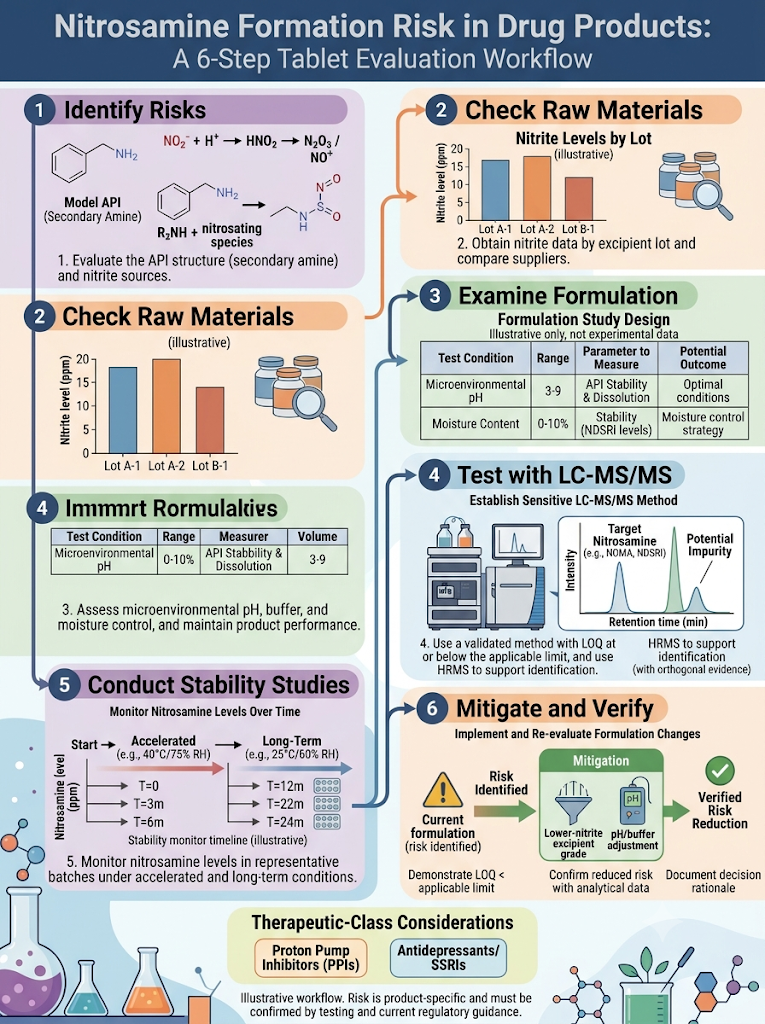
A hypothetical tablet shows how these factors are investigated together. Consider a tablet containing an amine-bearing API, a cellulose-based filler, a polymeric binder, and a moisture-sensitive coating. The initial assessment identifies a plausible pathway involving the API and nitrite in one or more excipients, with microenvironmental pH and moisture as additional factors.
- Step 1: Characterize precursors. Evaluate the API structure, relevant impurities, and potential pathways.
- Step 2: Assess raw materials. Obtain justified nitrite data for relevant excipients and evaluate supplier variability.
- Step 3: Investigate formulation conditions. Compare justified pH and moisture conditions while maintaining product performance.
- Step 4: Develop an analytical method. Establish an LC-MS/MS procedure for the target nitrosamine, with HRMS support for unexpected impurities.
- Step 5: Conduct stability studies. Compare nitrosamine levels at appropriate time points under relevant conditions.
- Step 6: Verify mitigation. Confirm that changes reduce measured risk without compromising quality.
Without actual analytical data, it would be inappropriate to claim that a specific pH or excipient change has eliminated nitrosamine formation.
Therapeutic-Class Considerations
Chemistry differs across drug classes, so assessments should be class-aware. Examples of how this plays out in practice include our work on a nitrosamine risk assessment for a proton pump inhibitor and nitrosamine testing for antidepressants and SSRIs, where amine structure and formulation environment shape the analytical approach.
8. How ResolveMass Laboratories Inc. Supports Nitrosamine Investigations
Resolving a nitrosamine concern requires connecting formulation chemistry, impurity identification, method performance, and stability data. ResolveMass Laboratories Inc. supports pharmaceutical development with analytical chemistry and mass spectrometry-based approaches suited to impurity characterization and quality investigations. Depending on scope, activities may include:
- Targeted impurity analysis by LC-MS/MS
- HRMS-based investigation of unexpected impurities
- Analytical method development and validation
- Evaluation of formulation-related impurity profiles
- Comparative analysis of stability samples
- Investigation of degradation products and reaction pathways
- Analytical support for development and quality documentation
Target nitrosamines, required sensitivity, sample matrix, and applicable limits should be defined before choosing an analytical strategy. A well-designed investigation helps manufacturers distinguish a theoretical risk, a plausible formation pathway, and a demonstrated impurity problem that needs further control.
Conclusion:
Nitrosamine formation risk in drug products is shaped by far more than the API alone. Formulation pH, microenvironmental acidity, excipient-derived nitrite, moisture, manufacturing conditions, packaging, and storage all play a part, and no single pH adjustment guarantees risk elimination. A comprehensive assessment evaluates all of them together, and formulation changes should be backed by comparative analytical studies that show effective mitigation while preserving product quality.
Sensitive techniques such as LC-MS/MS and HRMS, combined with risk-based raw material controls, stability testing, and a documented control strategy, help manufacturers manage nitrosamine concerns across the product lifecycle.
Frequently Asked Questions:
The main factors include the presence of susceptible amines, nitrite impurities, favorable pH conditions, moisture, temperature, and storage duration. Excipients, manufacturing processes, and packaging may also contribute to the risk. Nitrosamine formation depends on the interaction of these factors rather than any single variable. A product-specific risk assessment helps identify the most important sources and determine appropriate control measures.
Nitrite impurities can act as precursors to nitrosating species under suitable chemical conditions. When these species encounter susceptible amines in a drug formulation, nitrosamine formation may occur. Nitrite levels can vary among excipient suppliers, grades, and batches. Testing relevant raw materials and evaluating their contribution to the complete formulation can help manufacturers identify and manage potential risks.
Yes. Nitrosamines may form during storage if suitable precursors and favorable reaction conditions are present. Factors such as moisture, temperature, formulation pH, and storage duration can influence the rate of formation. Stability studies help determine whether nitrosamine concentrations increase over time and whether the product remains within applicable impurity limits throughout its shelf life.
Moisture can facilitate chemical reactions by increasing the mobility of reactive species and enabling aqueous-phase chemistry. In solid dosage forms, absorbed water may create localized environments that support nitrosation. The effect depends on the formulation’s composition, water activity, and storage conditions. Moisture control, appropriate packaging, and stability testing can help evaluate and reduce moisture-related risks.
Manufacturers can compare the original and modified formulations using appropriate analytical methods and stability studies. Relevant variables include nitrosamine concentrations, nitrite levels, pH, moisture content, and API degradation. The study should demonstrate that the proposed change reduces the identified risk without adversely affecting dissolution, stability, or other critical quality attributes. Conclusions should be based on measured results rather than theoretical assumptions alone.
Nitrosamine contamination occurs when a nitrosamine is introduced into a pharmaceutical product through raw materials, solvents, equipment, cross-contamination, or other external sources. Nitrosamine formation occurs when chemical reactions generate the compound within the manufacturing process or finished product. Distinguishing between these pathways helps manufacturers identify the source of the impurity and select appropriate preventive controls.
Reference
- Aishwarya D, Ramakant Dhampalwar V, Pallaprolu N, Peraman R. Nitrosamine drug substance-related impurities (NDSRIs) in pharmaceuticals: formation, mitigation strategies, and emphasis on mutagenicity risks. Pharmaceutical Research. 2025 Apr;42(4):547-78.https://link.springer.com/article/10.1007/s11095-025-03857-9
- Charoo NA, Dharani S, Khan MA, Rahman Z. Nitroso impurities in drug products: an overview of risk assessment, regulatory milieu, and control strategy. AAPS PharmSciTech. 2023 Feb 9;24(2):60.https://link.springer.com/article/10.1208/s12249-023-02523-w
- Dande A, Chandra Mouli HM, Nandy J, Shreya S, Pallaprolu N, Samanthula G, P R. Risk assessment, detection and control of mutagenic impurities in pharmaceuticals: Emphasis on nitrosamines. Critical Reviews in Analytical Chemistry. 2025 Jun 10:1-42.https://www.tandfonline.com/doi/abs/10.1080/10408347.2025.2517357
- Bhirud D, Agrawal G, Shah H, Patel A, Palkar MB, Bhattacharya S, Prajapati BG. Nitrosamine impurities in pharmaceuticals: An empirical review of their detection, mechanisms, and regulatory approaches. Current Topics in Medicinal Chemistry. 2024 Mar 1;24(6):503-22.https://www.benthamdirect.com/content/journals/ctmc/10.2174/0115680266278636240125113509
- Ashworth IW. N-nitrosamine formation in pharmaceutical drug products: Development and validation of a biased, conservative, predictive model. Journal of Pharmaceutical Sciences. 2025 Nov 15:104067.https://www.sciencedirect.com/science/article/pii/S0022354925005210
About the Author


