

Introduction:
Nitrosamine Impurities Testing is the analytical process used to detect and quantify nitrosamine compounds—potentially carcinogenic impurities—in pharmaceutical products and active pharmaceutical ingredients (APIs).
Nitrosamines gained global attention after their detection in several marketed drugs, prompting strict regulatory oversight. Today, manufacturers must perform risk assessments and confirmatory testing to ensure patient safety and regulatory compliance.
At ResolveMass Laboratories Inc., we specialize in ultra-trace analysis of nitrosamines using advanced LC-MS/MS and GC-MS technologies aligned with international regulatory expectations.
Summary:
- Nitrosamine Impurities Testing is essential to detect and quantify carcinogenic nitrosamines in APIs and drug products.
- Global regulators including the U.S. Food and Drug Administration (FDA), European Medicines Agency (EMA), and Health Canada require risk assessment and confirmatory testing.
- Highly sensitive LC-MS/MS and GC-MS/MS methods are needed to detect nitrosamines at ng/g (ppb) levels.
- Testing involves risk assessment, method development, validation, and regulatory documentation.
- ResolveMass Laboratories Inc. provides expert, compliance-driven nitrosamine testing solutions with advanced mass spectrometry platforms.
1: Why Is Nitrosamine Impurities Testing Required?
Nitrosamine Impurities Testing is required because nitrosamines are classified as probable human carcinogens and must be controlled at extremely low limits.
Regulatory bodies worldwide have issued guidance requiring manufacturers to:
- Conduct risk assessments for APIs and finished products
- Perform confirmatory testing where risk is identified
- Establish acceptable intake (AI) limits
- Implement mitigation strategies
Key Regulatory Authorities
- U.S. Food and Drug Administration
- European Medicines Agency
- Health Canada
These agencies mandate compliance with strict permissible daily intake limits—often in the nanogram range.
Read about AI Integration in Nitrosamine Testing for Efficiency
2: What Are Nitrosamines?
Nitrosamines are chemical compounds formed by the reaction of secondary or tertiary amines with nitrosating agents.
They can form during:
- API synthesis
- Recovered solvent reuse
- Storage conditions
- Packaging interactions
- Degradation processes
Common Nitrosamines Detected in Pharmaceuticals
| Nitrosamine | Full Name | Commonly Associated With |
|---|---|---|
| NDMA | N-Nitrosodimethylamine | Solvent reuse, amine contamination |
| NDEA | N-Nitrosodiethylamine | Amine-containing APIs |
| NMBA | N-Nitroso-N-methyl-4-aminobutyric acid | ARB drugs |
| DIPNA | N-Nitrosodiisopropylamine | Manufacturing impurities |
| EIPNA | N-Nitrosoethylisopropylamine | Synthetic process risks |
Because acceptable intake limits are extremely low (often < 100 ng/day), highly sensitive instrumentation is required.
Also explore: Comprehensive Nitrosamine Analysis Laboratory Services: What Pharmaceutical Companies Need to Know
3: How Is Nitrosamine Impurities Testing Performed?
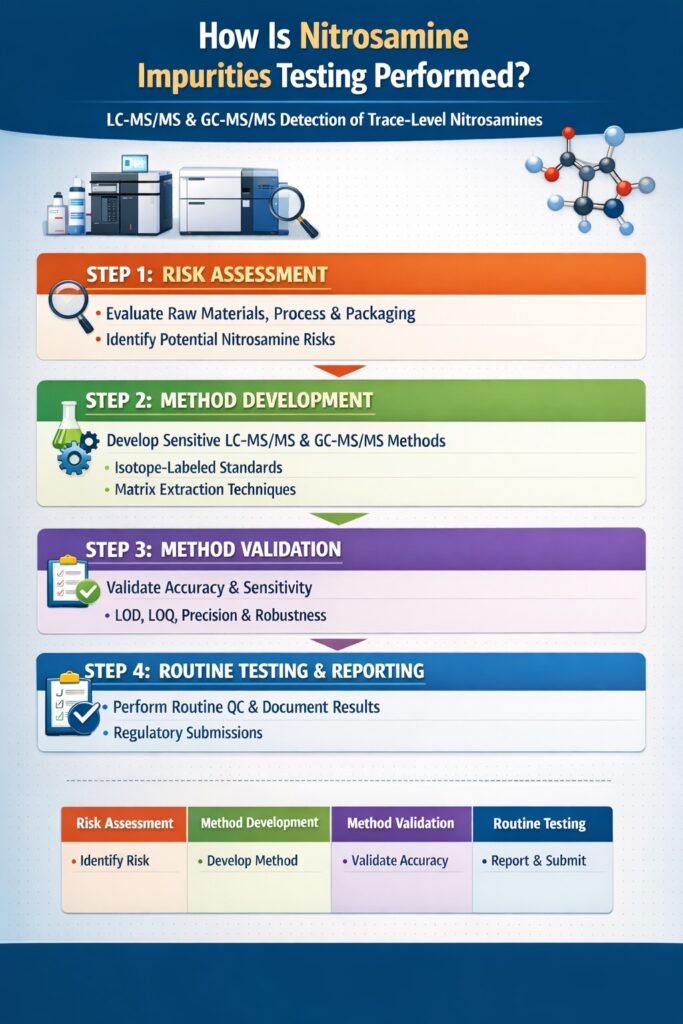
Nitrosamine Impurities Testing is performed using highly sensitive mass spectrometry techniques such as LC-MS/MS and GC-MS/MS capable of detecting trace-level impurities.
Step 1: Risk Assessment
Manufacturers evaluate:
- Raw materials
- Synthetic route
- Reagents and catalysts
- Solvent recovery practices
- Packaging interactions
Step 2: Method Development
ResolveMass develops compound-specific methods using:
- LC-MS/MS for polar nitrosamines
- GC-MS/MS for volatile nitrosamines
- Isotope-labeled internal standards
- Matrix-specific extraction techniques
Step 3: Method Validation
Validation typically includes:
- Specificity
- Accuracy and precision
- Linearity
- Limit of Detection (LOD)
- Limit of Quantification (LOQ)
- Robustness
Step 4: Routine Testing & Regulatory Documentation
Results are compiled into:
- Analytical reports
- Validation protocols
- Risk mitigation documentation
- Regulatory submission support
Explore our Nitrosamine Testing Services in Canada and the US
4: Nitrosamine Impurities Testing Regulatory Limits
Regulatory agencies set acceptable intake limits for nitrosamines based on carcinogenic risk assessment models.
Limits vary depending on:
- Type of nitrosamine
- Maximum daily dose of drug
- Treatment duration
Example Acceptable Intake (AI) Limits
| Nitrosamine | Approximate AI Limit (ng/day) |
|---|---|
| NDMA | 96 ng/day |
| NDEA | 26.5 ng/day |
| NMBA | 96 ng/day |
Manufacturers must ensure total nitrosamine levels remain below these limits throughout product shelf life.
Learn more about how to Avoid United States FDA Recalls with Routine Nitrosamine Impurity Testing for Your API and Drug Product
5: Challenges in Nitrosamine Impurities Testing
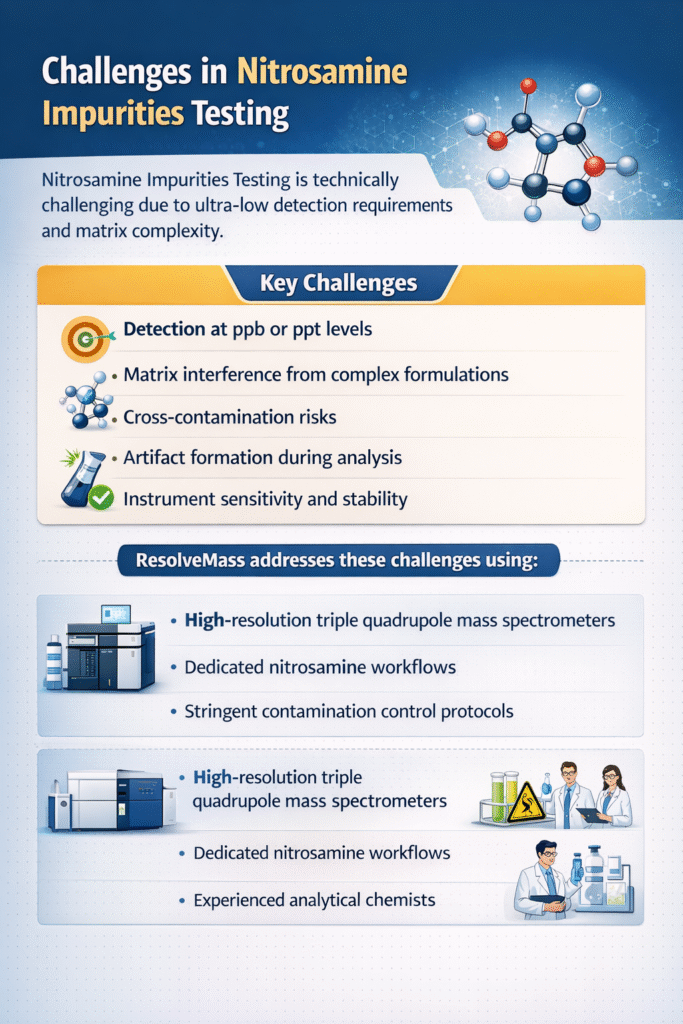
Nitrosamine Impurities Testing is technically challenging due to ultra-low detection requirements and matrix complexity.
Key Challenges
- Detection at ppb or ppt levels
- Matrix interference from complex formulations
- Cross-contamination risks
- Artifact formation during analysis
- Instrument sensitivity and stability
ResolveMass addresses these challenges using:
- High-resolution triple quadrupole mass spectrometers
- Dedicated nitrosamine workflows
- Stringent contamination control protocols
- Experienced analytical chemists
6: Case Study: Nitrosamine Impurities Testing for a Pharmaceutical Clients
A leading pharmaceutical company approached Resolvemass Laboratories for nitrosamine testing services for one of their drug products. The company needed to ensure compliance with the latest regulatory guidelines on nitrosamine impurities. Here’s how we addressed their needs:
Challenges
- Complex Matrix: The drug product had a complex formulation, making the extraction and analysis of nitrosamines challenging.
- Low Detection Limits: The required detection limits for nitrosamines were in the parts-per-billion (ppb) range, necessitating highly sensitive and specific analytical methods. If you want to know more about limits of Nitrosamine Impurities, you can read this article: Nitrosamine Impurity Limits and Acceptable Intake for Health Canada: How to Stay Compliant
- Regulatory Compliance: The company needed to comply with stringent regulatory guidelines from both the FDA and EMA.
Solution
- Optimized Sample Preparation: We developed a customized sample preparation method to effectively extract nitrosamines from the complex matrix. This involved using a combination of SPE and LLE techniques to achieve high recovery rates.
- Advanced Chromatography and MS Techniques: Our team employed high-resolution GC-MS/MS to achieve the required sensitivity and specificity for detecting nitrosamines at trace levels. The method was validated to ensure it met all regulatory requirements.
- Comprehensive Reporting and Guidance: We provided the client with detailed reports on the levels of nitrosamine impurities detected, along with expert guidance on regulatory compliance and recommendations for mitigating the presence of nitrosamines in their product.
Outcome
The successful detection and quantification of nitrosamine impurities enabled the pharmaceutical company to comply with regulatory guidelines and ensure the safety of their drug product. Our comprehensive testing and expert guidance helped them address potential risks and implement corrective measures in their manufacturing process.
7: Nitrosamine Impurities Testing for APIs vs Finished Products
Nitrosamine Impurities Testing differs for APIs and finished dosage forms due to matrix differences and formulation complexity.
API Testing
- Focus on process-related impurities
- Higher control over matrix
- Evaluation of synthetic route risk
Finished Product Testing
- Tablet, capsule, injectable matrix interference
- Stability-related formation assessment
- Packaging interaction studies
ResolveMass customizes testing strategies based on product type and regulatory pathway (ANDA, NDA, DMF, etc.).
8: When Should You Perform Nitrosamine Impurities Testing?
Nitrosamine Impurities Testing should be performed during development, before regulatory submission, and as part of lifecycle management.
Recommended Stages
- Early development risk assessment
- Pre-ANDA / NDA submission
- Post-approval changes
- Supplier change
- Process modification
- Stability studies
Proactive testing prevents regulatory delays, warning letters, and costly recalls.
9: How ResolveMass Laboratories Ensures Reliable Nitrosamine Impurities Testing
At ResolveMass Laboratories Inc., our approach is built on scientific rigor, regulatory understanding, and advanced analytical expertise.
Our Capabilities
- State-of-the-art LC-MS/MS & GC-MS/MS platforms
- Ultra-trace quantification at ng/g levels
- Method development & full validation
- Regulatory-compliant documentation
- Experienced mass spectrometry scientists
- Dedicated nitrosamine contamination control procedures
Why Clients Trust ResolveMass
- Proven expertise in complex impurity analysis
- Deep regulatory knowledge
- Transparent communication
- Fast turnaround times
- Data integrity and compliance focus
Our laboratory operates under strict quality systems to ensure reproducibility, accuracy, and defensible regulatory submissions.
Conclusion:
Nitrosamine Impurities Testing is no longer optional—it is a regulatory and patient safety necessity.
With global scrutiny from authorities like the FDA, EMA, and Health Canada, pharmaceutical manufacturers must ensure rigorous risk assessment, ultra-trace detection, and comprehensive documentation.
ResolveMass Laboratories Inc. combines advanced mass spectrometry capabilities with deep regulatory expertise to deliver reliable, compliant, and defensible nitrosamine testing solutions.
If you are developing APIs or finished drug products, proactive Nitrosamine Impurities Testing can protect your submission timelines, brand reputation, and most importantly, patient safety.
Also, we tried to cover many FAQs on Nitrosmine testing in this article: Your Nitrosamine Impurity Testing FAQ: Answers for Regulatory Readiness and Confirmatory Analysis
Contact Us
For more information about our mass spectrometry testing services and how we can assist with nitrosamine impurities testing, please visit Resolvemass laboratories & contact us
Frequently Asked Questions:
Nitrosamines are a class of carcinogenic compounds formed by the reaction of nitrites and secondary or tertiary amines. They are of concern in pharmaceuticals due to their potential presence as impurities, especially in APIs and drug formulations. Regulatory agencies now require stringent risk assessments and confirmatory testing to ensure patient safety.
Key guidelines include the FDA’s “Control of Nitrosamine Impurities in Human Drugs,” EMA’s Q&A on nitrosamines, Health Canada’s nitrosamine guidance, and ICH M7(R1) for mutagenic impurities. These documents outline acceptable intake limits (AIs), risk assessment procedures, and analytical validation requirements.
The AI limit for NDMA (N-nitrosodimethylamine) is typically 96 ng/day, as defined by the FDA and EMA. This threshold may vary slightly depending on jurisdiction and duration of exposure, but exceeding it requires immediate regulatory action.
Common nitrosamines include:
-NDMA (N-Nitrosodimethylamine)
-NDEA (N-Nitrosodiethylamine)
-NMBA (N-Nitroso-N-methyl-4-aminobutyric acid)
-NEIPA, NDIPA, NDBA, and NDSRIs (Drug Substance-Related Impurities)
Detection is typically performed using highly sensitive and selective methods such as:
-LC-MS/MS (Liquid Chromatography–Mass Spectrometry)
-GC-MS (Gas Chromatography–Mass Spectrometry)
-HRMS (High-Resolution Mass Spectrometry)
These platforms allow quantification down to parts-per-billion (ppb) levels.
Risk assessment involves:
-Evaluating the synthesis pathway and raw materials for nitrosating agents and secondary amines.
-Estimating potential nitrosamine formation.
-Testing at-risk products.
Implementing control strategies if nitrosamines are present.
ResolveMass uses validated LC-MS/MS and GC-MS/MS methods per ICH Q2 guidelines. Confirmatory testing includes method-specific quantification, matrix interference evaluation, and LOQ/LOD determination. Full regulatory submission support is provided with comprehensive data packages.
Detection limits typically range from 0.03–0.1 ppb depending on the compound and matrix. LC-MS/MS methods at ResolveMass are optimized to detect nitrosamines well below regulatory thresholds.
Yes. Some nitrosamines can form during storage due to degradation of excipients or interaction with packaging materials. Stability studies are essential to evaluate nitrosamine formation over time.
NDSRIs (Nitrosamine Drug Substance-Related Impurities) are nitrosamines structurally related to the API. Unlike common nitrosamines, they are compound-specific and harder to predict, often requiring custom synthesis of reference standards and tailored analytical methods.
At ResolveMass, NDSRIs are synthesized using controlled reactions between known API precursors and nitrosating agents. These standards are then purified and characterized using NMR, LC-MS, and HPLC to confirm identity and purity.
Forced degradation under acidic, basic, thermal, and oxidative conditions helps assess nitrosamine formation potential. These studies guide formulation changes and storage recommendations to minimize impurity risks.
Depending on matrix complexity and regulatory requirements, method development at ResolveMass typically takes 5–10 business days for standard nitrosamines, and up to 20 days for custom NDSRIs.
Method validation ensures accuracy, precision, specificity, and sensitivity. It is required for regulatory compliance and essential for building trust in analytical results used in NDA/ANDA submissions.
Yes. ResolveMass offers expedited services with priority method development, real-time communication, and rapid reporting to support tight NDA/ANDA timelines.
Reference
- Analytical Methodologies to Detect N-Nitrosamine Impurities in Active Pharmaceutical Ingredients, Drug Products and Other Matrices.https://pubs.acs.org/doi/full/10.1021/acs.chemrestox.4c00234
- Yunes M. M. A. Alsayadi ,Raghav Dogra. Innovations in the Detection of N-Nitrosamine Impurities in Pharmaceuticals: Analytical and Regulatory Challenges.https://www.tandfonline.com/doi/abs/10.1080/10408347.2025.2512443
- An update on latest regulatory guidelines and analytical methodologies for N-nitrosamine impurities in pharmaceutical products – 2024.https://journals.lww.com/mgar/fulltext/2025/12000/an_update_on_latest_regulatory_guidelines_and.10.aspx
- Nitrosamine Impurities in Drug Substances and Drug Products.https://papers.ssrn.com/sol3/papers.cfm?abstract_id=3958595
- Critical Analysis of Drug Product Recalls due to Nitrosamine Impurities.https://pubs.acs.org/doi/abs/10.1021/acs.jmedchem.0c02120
Threshold of Toxicological Concern (TTC) in E&L Safety Assessment: A Technical Deep Dive
Introduction: TTC in Extractables and Leachables (E&L) provides an exposure-based approach for evaluating potential toxicological…
Is Research-Grade Peptide the Same as GMP Peptide?
Introduction Research-grade peptides and Good Manufacturing Practice (GMP) peptides represent two distinct categories of materials…
Why Do Peptide Drugs Require Cold-Chain Storage and Shipping?
Introduction Peptide drugs require specialized cold-chain infrastructure because their dynamic amino acid structures and chemically…

How Do You Reduce Cost of Goods for a Commercial Peptide Drug?
Reducing the Peptide Cost of Goods for commercial therapeutic drugs requires a comprehensive optimization strategy…
Case Study: ADA and Immunogenicity Testing Strategy for a Biosimilar Monoclonal Antibody Program
Introduction: Immunogenicity testing determines whether a biosimilar monoclonal antibody triggers an unwanted immune response, and…

What Is the Minimum Batch Size for GMP Peptide Manufacturing?
Introduction The minimum batch size for GMP peptide manufacturing is primarily determined by equipment working…


