

Introduction
Nitrosamine Leachables Testing is a comprehensive analytical and regulatory process used to evaluate pharmaceutical packaging and drug delivery systems for the presence and migration of highly potent, mutagenic N-nitrosamine impurities into finished drug products. As regulatory agencies increasingly expand their focus beyond active pharmaceutical ingredient (API) manufacturing pathways and toward the interactions between formulations and container closure systems, this testing discipline has become a critical component of pharmaceutical quality and patient safety programs. Current global regulatory expectations require manufacturers to identify and quantify both nitrosamine drug substance-related impurities (NDSRIs) and low-molecular-weight nitrosamines at ultra-trace concentrations, often reaching parts-per-billion (ppb) levels. Achieving these stringent detection requirements necessitates a structured analytical strategy that begins with detailed structural risk assessments using the Carcinogenic Potency Categorization Approach (CPCA), progresses through carefully controlled sample preparation procedures designed to prevent artifact generation, and culminates in highly selective and sensitive quantitation using liquid chromatography-tandem mass spectrometry (LC-MS/MS) methods validated according to ICH Q2(R2) requirements. ResolveMass Laboratories Inc. applies these sophisticated analytical approaches to help pharmaceutical manufacturers meet evolving regulatory obligations while maintaining the highest standards of product quality and patient protection.
Curious about the fundamental chemistry and origins of these compounds? Explore our guide on what nitrosamines are.
Share via:
Article Summary:
- Nitrosamine Leachables Testing evaluates pharmaceutical packaging and drug delivery systems for carcinogenic nitrosamine impurities that may migrate into drug products, ensuring compliance with FDA, EMA, USP, and ICH regulatory expectations.
- Packaging materials such as blister packs, elastomeric closures, and printed IV overwraps can generate or release nitrosamines (e.g., NDMA, NDEA, NDBA) through thermal degradation, printing inks, rubber additives, and long-term storage conditions.
- The Carcinogenic Potency Categorization Approach (CPCA) enables risk-based assessment by assigning nitrosamines to potency categories and acceptable intake (AI) limits based on their molecular structure and predicted carcinogenic potential.
- Advanced sample preparation techniques—including chemical stabilization, Solid-Phase Extraction (SPE), Liquid-Liquid Extraction (LLE), MHE-SIFT-MS, and QuEChERS—help prevent artifact formation while improving recovery and analytical accuracy.
- Triple quadrupole LC-MS/MS is the preferred confirmatory method for ultra-trace nitrosamine analysis, using optimized ionization modes, stable isotope-labeled internal standards, delay columns, and MRM transitions for highly selective ppb-level detection.
- ICH Q2(R2) method validation requires demonstrated specificity, low limits of quantitation, acceptable recovery, precision, linearity, and robustness to ensure reliable quantification of nitrosamines in complex pharmaceutical matrices.
- A comprehensive risk assessment combined with validated LC-MS/MS testing enables pharmaceutical manufacturers to detect packaging-derived nitrosamines, meet evolving global regulatory requirements, reduce recall risks, and protect patient safety.
The Evolving Regulatory Landscape for Nitrosamine Leachables Testing
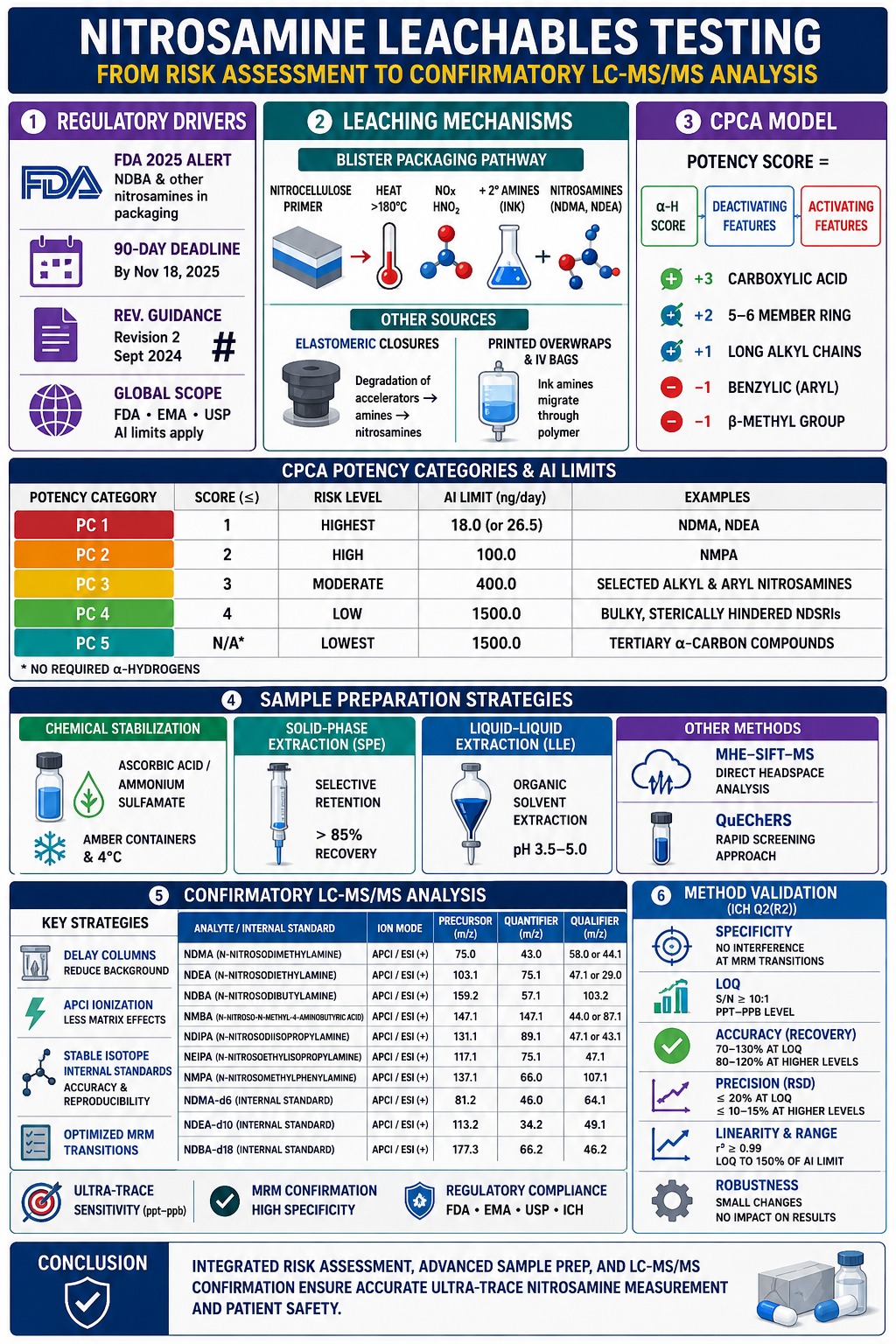
Regulatory expectations for Nitrosamine Leachables Testing now explicitly encompass primary and secondary packaging materials, introducing stringent acceptable intake (AI) thresholds and compliance timelines intended to reduce the risk of nitrosamine migration into pharmaceutical products. In the past, agencies such as the U.S. Food and Drug Administration (FDA) and the European Medicines Agency (EMA) concentrated primarily on impurities generated during API manufacturing processes, particularly following contamination events involving N-nitrosodimethylamine (NDMA) in the “sartan” class of antihypertensive drugs. However, emerging toxicological evidence has prompted a significant shift toward comprehensive extractables and leachables (E&L) evaluations conducted under the framework of USP and USP .
Concerns regarding packaging-associated nitrosamine contamination intensified on August 18, 2025, when the U.S. FDA announced a potential safety risk involving the migration of N-nitrosodibutylamine (NDBA) and other low-molecular-weight nitrosamines from printed overwrap materials and flexible pouches into saline solutions and intravenous (IV) infusion bags. In response, the agency required manufacturers to complete formal risk assessments and perform validated confirmatory testing within 90 days, establishing November 18, 2025, as the compliance deadline.
Understand the key distinctions between synthesis-derived contaminants and container-interaction issues in our detailed comparison of nitrosamine impurities vs. nitrosamine leachables.
The FDA’s revised guidance document, Control of Nitrosamine Impurities in Human Drugs (Revision 2, September 2024), formally recognizes packaging-derived nitrosamines through the use of a multiple-source identifier (represented by the symbol “#”). This designation reflects the understanding that packaging-related nitrosamines are not inherently linked to a specific API but instead represent a broader contamination source that may affect numerous dosage forms. For therapies involving chronic administration or continuous patient exposure, including parenteral nutrition and dialysis products, regulatory agencies maintain strict enforcement of established AI limits. In contrast, both the EMA and FDA may consider a Less-Than-Lifetime (LTL) regulatory approach for short-duration treatments, potentially permitting exposure levels ranging from four to ten times the standard AI value when justified by limited treatment duration and clinical need. Consequently, pharmaceutical manufacturers must implement robust nitrosamine testing programs in accordance with USP requirements to maintain regulatory compliance and minimize the risk of market withdrawals or product recalls.
Unsure about your drug product portfolio’s testing scope? Read our overview on whether all drugs need a nitrosamine risk assessment.
Mechanisms of Nitrosamine Leaching from Pharmaceutical Packaging
Nitrosamine leachables can originate within pharmaceutical packaging systems when nitrogen oxide species generated through the thermal degradation of nitrocellulose-based primers react with secondary amines present in printing inks, producing volatile nitrosamines that subsequently migrate into drug products during heat-sealing operations. A thorough understanding of these physicochemical processes is essential for conducting effective root-cause investigations and establishing scientifically justified control strategies within a Nitrosamine Leachables Testing program.
The Nitrocellulose and Printing Ink Pathway
One of the most extensively studied mechanisms associated with packaging-derived nitrosamine contamination involves blister packaging systems. A typical blister-pack lidding foil consists of several layers, including an aluminum substrate, a heat-seal coating, a print primer that promotes ink adhesion, and a protective over-lacquer. Nitrocellulose is commonly selected as the print primer because of its excellent adhesion properties and processing performance.
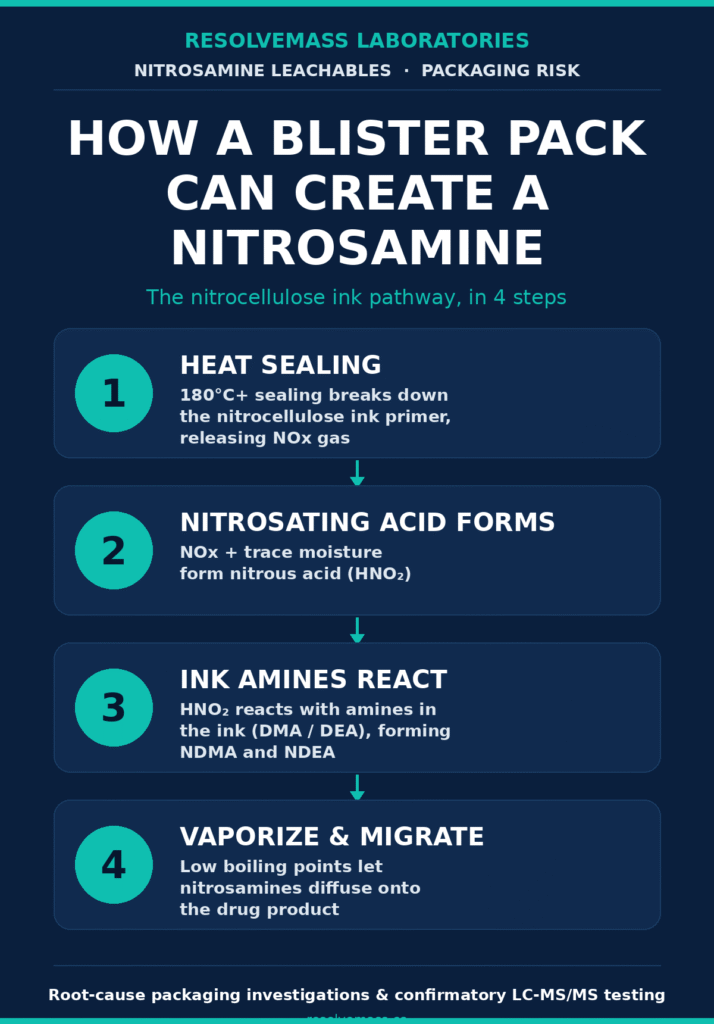
Thermal Decomposition: During blister-pack manufacturing, heated sealing plates or rollers are used to bond the lidding foil to the forming foil. Temperatures during this process frequently exceed 180°C. Exposure to such elevated temperatures causes degradation of the nitrocellulose primer, resulting in the release of nitrogen oxides (NOx), predominantly nitric oxide (NO) and nitrogen dioxide (NO₂).
Formation of Nitrosating Species: Following release, nitric oxide and related nitrogen oxide species interact with trace moisture present in the manufacturing environment to generate nitrous acid (HNO₂), a highly reactive nitrosating agent capable of initiating nitrosamine formation.
Reaction with Secondary Amines: At the same time, printing inks applied to the lidding foil may contain secondary amines or amine precursors such as dimethylamine (DMA) and diethylamine (DEA). These compounds may be present as non-intentionally added substances (NIAS) or residual solvent-related constituents. Nitrous acid rapidly reacts with these amines, generating nitrosamines such as NDMA and NDEA within the external packaging layers.
Vaporization and Migration: Small-molecule nitrosamines possess relatively low boiling points, with NDMA boiling between 151–154°C and NDEA between 172–177°C. The elevated temperatures encountered during sealing operations can therefore volatilize these compounds. Once vaporized, nitrosamines may diffuse through blister-pack layers or become trapped within blister cavities before ultimately condensing onto the drug product surface or interacting directly with the formulation.
Substituting nitrocellulose primers with alternative materials such as polyester- or vinyl-resin-based systems, or eliminating amine-containing ink components, can effectively interrupt this contamination pathway and significantly reduce the risk of packaging-related nitrosamine formation.
Elastomeric Closures and IV Overwraps
Packaging-related nitrosamine contamination is not limited to blister-pack systems. Elastomeric closures, including rubber stoppers used in vials and prefilled syringes, represent an additional source of potential nitrosamine migration. The vulcanization processes employed in some legacy elastomer formulations often utilize accelerators such as dithiocarbamates and thiurams. Over time, degradation of these compounds can generate secondary amines, including dibutylamine. In the presence of trace nitrites originating from the formulation matrix or surrounding environment, these amines may react to form leachable nitrosamines such as NDBA.
Similarly, the FDA’s 2025 investigation involving infusion bags demonstrated that dialkylamine-containing ink constituents present on printed secondary overwraps can migrate through semi-permeable polymeric primary packaging materials and subsequently enter aqueous pharmaceutical products during extended storage periods. These findings underscore the importance of evaluating all packaging components, including secondary packaging materials, during nitrosamine risk assessments.
Applying the CPCA Model in Nitrosamine Risk Assessments
The Carcinogenic Potency Categorization Approach (CPCA) enhances the efficiency of Nitrosamine Leachables Testing by applying a structured, rule-based methodology that evaluates molecular structural characteristics to predict mutagenic and carcinogenic potential. This approach enables the assignment of an Acceptable Intake (AI) limit without the need for extensive in vivo toxicological testing. Developed collaboratively by the FDA, the EMA, and the Nitrosamine International Technical Working Group (NITWG), the CPCA addresses critical data gaps associated with newly discovered NDSRIs and packaging-derived nitrosamine impurities.
The scientific basis of the CPCA lies in the understanding that nitrosamines generally exert carcinogenic effects through metabolic activation involving the α-hydroxylation pathway. Structural elements that introduce steric hindrance around the α-carbon or reduce its electronic reactivity can substantially decrease the likelihood of metabolic activation and, therefore, reduce carcinogenic potency. To account for these molecular characteristics, the CPCA generates a quantitative “Potency Score,” which is subsequently used to assign the impurity to one of five predefined Potency Categories (PCs). This categorization framework provides regulators and manufacturers with a scientifically justified basis for establishing risk-based AI limits and prioritizing control measures for nitrosamine impurities.
Explore structural categorization and potency differences in our breakdown of NDSRIs vs. simple nitrosamines.
Calculating the CPCA Potency Score
The CPCA scoring system is based on a structured algorithm that evaluates molecular characteristics associated with nitrosamine carcinogenicity. The calculation is represented by the following equation:
Potency Score = α-Hydrogen Score + Deactivating Feature Scores + Activating Feature Scores
α-Hydrogen Score
This component assesses the number of hydrogen atoms located on the carbon atoms directly adjacent to the N-nitroso functional group, commonly referred to as the alpha carbons. Molecules that lack α-hydrogens entirely (0,0) or possess only a single α-hydrogen on one side of the nitroso group (0,1 or 1,1) are generally unable to undergo the conventional α-hydroxylation pathway responsible for metabolic activation. As a result, these compounds are automatically assigned to Potency Category 5, representing the lowest carcinogenic concern. In contrast, molecules containing abundant α-hydrogens, such as configurations designated as 2,2 or 2,3, receive a lower numerical score, often around one point, reflecting a higher probability of metabolic activation and greater carcinogenic potential.
Deactivating Feature Scores (Risk-Reducing Factors)
Certain molecular features reduce the likelihood of metabolic activation and therefore contribute positively to the overall Potency Score. These structural elements increase the score and correspondingly lower the predicted carcinogenic risk. For instance, the presence of a carboxylic acid functionality anywhere within the molecular structure contributes +3 points. Likewise, an N-nitroso group incorporated into a five-membered or six-membered ring system contributes +2 points. Long aliphatic chains containing five or more consecutive non-hydrogen atoms on both sides of an acyclic N-nitroso group contribute +1 point, reflecting the reduced accessibility of the α-carbon for metabolic activation.
Activating Feature Scores (Risk-Increasing Factors)
Structural features that facilitate or accelerate α-hydroxylation decrease the Potency Score and thereby increase the predicted carcinogenic risk. An aryl substituent directly attached to the α-carbon, commonly referred to as a benzylic substituent, contributes −1 point. Similarly, the presence of a methyl group attached to the β-carbon also contributes −1 point. These features enhance metabolic activation pathways and are therefore considered risk-promoting characteristics within the CPCA framework.
Potency Categories and Regulatory AI Limits
Following calculation of the final Potency Score, the nitrosamine impurity is assigned to a specific Potency Category. This categorization directly determines the recommended Acceptable Intake (AI) limit expressed in nanograms per day (ng/day) and serves as the basis for regulatory risk management decisions.
| Potency Category (PC) | Calculated Potency Score | Relative Carcinogenic Risk | Recommended AI Limit (ng/day) | Examples of Associated Leachables / Impurities |
|---|---|---|---|---|
| PC 1 | ≤ 1 | Highest Risk | 18.0 (or 26.5) | NDMA, NDEA |
| PC 2 | 2 | High Risk | 100.0 | NMPA |
| PC 3 | 3 | Moderate Risk | 400.0 | Selected alkyl and aryl nitrosamines |
| PC 4 | 4 | Low Risk | 1500.0 | Bulky, sterically hindered NDSRIs |
| PC 5 | No required α-hydrogens | Lowest Risk | 1500.0 | Compounds containing tertiary α-carbons |
Data derived from FDA CPCA structural assessment guidelines.
The application of the CPCA model during the risk assessment stage of Nitrosamine Leachables Testing enables analytical laboratories to establish scientifically justified target Limits of Quantitation (LOQs) for confirmatory testing. This approach ensures that analytical methods are appropriately designed, technically fit for purpose, and aligned with current regulatory expectations.
Advanced Sample Preparation Strategies for Mitigating Artifact Formation
Effective sample preparation is one of the most critical aspects of Nitrosamine Leachables Testing because analytical procedures themselves can inadvertently generate nitrosamines if appropriate controls are not implemented. Advanced preparation strategies therefore require the immediate use of chemical stabilizers, such as ascorbic acid or ammonium sulfamate, in combination with selective solid-phase extraction (SPE) techniques to prevent artificial nitrosamine formation during laboratory analysis. Finished drug products and polymeric packaging materials frequently contain trace levels of nitrites and secondary amines. Under conditions involving heat, acidic environments, or mechanical stress during extraction, these compounds may react and generate nitrosamines within the sample vial itself. If such artifact formation is not carefully controlled, false-positive results may occur, potentially leading to unnecessary regulatory investigations, manufacturing disruptions, and costly product recalls.
Chemical Stabilization Techniques
Residual nitrite species must be neutralized before they can react with susceptible amines present in the sample matrix. Ascorbic acid functions as a highly effective stabilizing reagent because it rapidly reduces nitrosating species, thereby interrupting nitrosation pathways before nitrosamines can form. This protective effect makes ascorbic acid valuable both as a formulation excipient and as a laboratory sample preparation additive.
In addition to chemical stabilization, environmental controls play a significant role in preserving sample integrity. Conducting sample preparation in amber-colored containers protects analytes from light-induced degradation, while maintaining refrigerated conditions at approximately 4°C significantly slows chemical reaction rates and minimizes thermodynamically driven nitrosamine formation. Together, these measures help ensure that measured nitrosamine concentrations accurately reflect the original sample composition rather than artifacts generated during analysis.
Matrix-Specific Extraction Methodologies
The successful isolation and quantification of ultra-trace nitrosamines from complex pharmaceutical formulations and packaging materials require extraction techniques specifically optimized for each matrix type. Different extraction strategies offer distinct advantages depending on the physical and chemical characteristics of the sample.
Solid-Phase Extraction (SPE)
Solid-phase extraction is widely regarded as the preferred approach for recovering nitrosamine leachables from complex dosage forms and polymer-derived extracts. Mixed-mode ion-exchange sorbents and hydrophilic-lipophilic balanced (HLB) cartridges are frequently employed because they selectively retain nitrosamine analytes while allowing interfering substances such as APIs, lipophilic excipients, and polymer residues to be removed during wash steps. This highly effective cleanup process substantially reduces ion suppression during mass spectrometric analysis and routinely achieves analyte recoveries exceeding 85%. As a result, SPE remains one of the most reliable and widely adopted preparation techniques for regulatory nitrosamine testing programs.
Liquid-Liquid Extraction (LLE)
Liquid-liquid extraction is particularly suitable for volatile nitrosamines such as NDMA and NDEA when these compounds must be isolated from relatively simple aqueous matrices. During this procedure, nitrosamines partition into organic solvents such as dichloromethane or ethyl acetate, enabling concentration and purification prior to instrumental analysis. To maximize analyte stability and extraction efficiency, the aqueous phase is typically adjusted to a slightly acidic or near-neutral pH range between 3.5 and 5.0. Maintaining this pH range helps preserve nitrosamine integrity while minimizing the formation of problematic emulsions that can complicate phase separation.
Direct Headspace Analysis (MHE-SIFT-MS)
Multiple Headspace Extraction (MHE) combined with Selected Ion Flow Tube Mass Spectrometry (SIFT-MS) offers an alternative strategy that eliminates the need for liquid extraction altogether. This technique directly measures volatile nitrosamines released into the gas phase from solid drug products or packaging materials. By avoiding dissolution and extensive sample manipulation, MHE-SIFT-MS significantly reduces the possibility of in-situ nitrosamine formation during analysis. The method employs ultra-soft chemical ionization, enabling rapid and highly sensitive detection while supporting high-throughput screening applications without the need for chromatographic separation.
QuEChERS (Quick, Easy, Cheap, Effective, Rugged, and Safe)
QuEChERS methodologies are increasingly being adopted as efficient screening tools for semi-solid and multi-component pharmaceutical formulations. This approach utilizes magnesium sulfate (MgSO₄) to facilitate phase separation and primary secondary amine (PSA) sorbents to remove interfering matrix components. The resulting extract undergoes rapid cleanup prior to LC-MS/MS analysis, providing a streamlined workflow that balances speed, efficiency, and analytical performance. Because of its simplicity and versatility, QuEChERS has become an attractive option for preliminary nitrosamine screening and routine monitoring applications.
Evaluate method selection criteria in our comprehensive guide comparing nitrosamine screening vs. confirmatory methods.
Confirmatory LC-MS/MS Analysis for Nitrosamine Leachables Testing
Liquid Chromatography-Tandem Mass Spectrometry (LC-MS/MS) performed on a triple quadrupole platform is widely recognized as the benchmark analytical technique for confirmatory Nitrosamine Leachables Testing. Its exceptional sensitivity and specificity enable the accurate quantification of nitrosamine impurities at ultra-trace, parts-per-billion (ppb) concentrations. As regulatory agencies continue to lower acceptable intake limits, conventional analytical approaches such as high-performance liquid chromatography with ultraviolet detection (HPLC-UV) no longer provide the sensitivity or selectivity necessary to distinguish low-molecular-weight nitrosamines from complex pharmaceutical matrices. Consequently, LC-MS/MS has become the preferred technology for meeting modern regulatory expectations and ensuring reliable impurity quantification.
Triple Quadrupole Architecture and Specificity
The superior analytical performance of a triple quadrupole mass spectrometer is derived from its highly selective multi-stage filtering process. In the first quadrupole (Q1), the instrument isolates the precursor ion corresponding to the intact nitrosamine molecule according to its mass-to-charge ratio (m/z). This isolated ion is then transferred into the collision cell (Q2), where collision-induced dissociation (CID) is performed using an inert gas such as argon or nitrogen. During this process, the precursor ion fragments into characteristic product ions. The third quadrupole (Q3) subsequently filters these fragments and permits only a predefined product ion, commonly referred to as the quantifier ion, to reach the detector.
This Multiple Reaction Monitoring (MRM) approach provides an exceptionally high level of specificity by monitoring a unique precursor-to-product ion transition. As a result, matrix-derived interferences are effectively eliminated, leading to substantial improvements in signal-to-noise ratios and enabling reliable detection of nitrosamines at extremely low concentrations.
Overcoming Matrix Effects and Background Contamination
Although MRM significantly improves selectivity, matrix effects remain a major analytical challenge in Nitrosamine Leachables Testing. Co-eluting excipients, formulation components, and packaging-derived substances can suppress or enhance ionization, potentially affecting quantitative accuracy. To achieve ultra-low Limits of Quantitation (LOQs), ResolveMass Laboratories Inc. utilizes a combination of advanced analytical strategies specifically designed to minimize these effects.
Delay Columns for System Background Reduction
LC-MS/MS systems may contain trace nitrosamine contaminants originating from solvents, tubing, seals, and other internal components. These contaminants can contribute to persistent background signals that interfere with ultra-trace measurements. To address this issue, highly retentive delay columns, such as the Atlantis Premier BEH C18 AX column, are installed between the solvent delivery system and the autosampler. These columns retain background nitrosamines originating from the instrument, allowing them to be chromatographically separated from analytes present in the injected sample and thereby improving analytical reliability.
Ionization Mode Optimization (APCI versus ESI)
Although Electrospray Ionization (ESI) is one of the most commonly used ionization techniques in LC-MS/MS, Atmospheric Pressure Chemical Ionization (APCI) is frequently preferred for many mid-polar nitrosamines. APCI relies on gas-phase ion-molecule reactions rather than direct solution-phase ionization, making it less vulnerable to ion suppression caused by highly formulated pharmaceutical products, salts, and packaging-related leachates. Careful selection of the ionization mode is therefore critical for maximizing sensitivity and maintaining quantitative accuracy.
Stable Isotope-Labeled Internal Standards (SIL-IS)
The use of stable isotope-labeled internal standards is an essential component of modern nitrosamine analysis. Deuterated analogs such as NDMA-d6, NDEA-d10, and NDBA-d18 are added to samples before extraction and sample preparation. Because these compounds exhibit chromatographic behavior nearly identical to their corresponding analytes while remaining distinguishable by mass spectrometry, they effectively compensate for extraction losses, matrix-induced ion suppression, and instrumental variability. This approach substantially improves quantitative accuracy and data reproducibility.
Standardized MRM Transitions for Confirmatory Analysis
Regulatory compliance requires careful optimization of quantifier and qualifier MRM transitions, including collision energy and declustering potential parameters. The following table summarizes commonly used MRM transitions for packaging-derived nitrosamines and API-related nitrosamine impurities.
| Target Nitrosamine / Internal Standard | Ionization Mode | Precursor Ion (m/z) | Quantifier Ion (m/z) | Qualifier Ion (m/z) |
|---|---|---|---|---|
| NDMA (N-nitrosodimethylamine) | APCI / ESI (+) | 75.0 | 43.0 | 58.0 or 44.1 |
| NDEA (N-nitrosodiethylamine) | APCI / ESI (+) | 103.1 | 75.1 | 47.1 or 29.0 |
| NDBA (N-nitrosodibutylamine) | APCI / ESI (+) | 159.2 | 57.1 | 103.2 |
| NMBA (N-nitroso-N-methyl-4-aminobutyric acid) | APCI / ESI (+) | 147.1 | 117.1 | 44.0 or 87.1 |
| NDIPA (N-nitrosodiisopropylamine) | APCI / ESI (+) | 131.1 | 89.1 | 47.1 or 43.1 |
| NEIPA (N-nitrosoethylisopropylamine) | APCI / ESI (+) | 117.1 | 75.1 | 47.1 |
| NMPA (N-nitrosomethylphenylamine) | APCI / ESI (+) | 137.1 | 66.0 | 107.1 |
| NDMA-d6 (Internal Standard) | APCI / ESI (+) | 81.2 | 46.0 | 64.1 |
| NDEA-d10 (Internal Standard) | APCI / ESI (+) | 113.2 | 34.2 | 49.1 |
| NDBA-d18 (Internal Standard) | APCI / ESI (+) | 177.3 | 66.2 | 46.2 |
Note: Instrument-specific parameters, including source temperature, drying gas flow rate, nebulization conditions, and spray voltage, must be optimized for each analytical platform to achieve maximum sensitivity and method performance.
Requiring robust, trace-level analytical methods tailored to your product matrix? Discover ResolveMass’s dedicated nitrosamine method development and validation services.
Method Validation Requirements under ICH Q2(R2)
Analytical methods developed for Nitrosamine Leachables Testing must be validated according to the requirements outlined in ICH Q2(R2). These guidelines require methods to demonstrate the ability to accurately and precisely quantify nitrosamines at ultra-trace concentrations. Validation studies generally require recovery values between 70% and 130% at the limit of quantitation, while maintaining a relative standard deviation (RSD) of 20% or less. Because toxicologically derived acceptable intake limits are extremely low, regulatory agencies including the FDA, EMA, and USP require analytical methods to possess sufficient sensitivity to monitor nitrosamine concentrations at levels corresponding to 10% and 30% of the calculated specification limit.
Core Validation Parameters for Trace Analysis
Specificity and Selectivity
The LC-MS/MS method must unequivocally distinguish target nitrosamines from APIs, excipients, degradation products, and packaging-related extractables. Validation studies typically involve the analysis of blank matrices, unspiked product formulations, and samples fortified with known interfering compounds. Method selectivity is considered acceptable when no co-eluting peaks generate a response exceeding approximately 20–30% of the LOQ signal at the target MRM transitions.
Limit of Quantitation (LOQ)
Unlike conventional impurity methods where LOQs may be based on generic reporting thresholds, nitrosamine LOQs must be scientifically justified according to compound-specific AI limits. At the LOQ, the signal-to-noise ratio should be at least 10:1. Modern high-resolution and highly sensitive LC-MS/MS systems are often capable of achieving LOQs within the low parts-per-trillion (ppt) range, particularly for APIs administered at high maximum daily doses (MDDs).
Accuracy (Recovery)
Accuracy is evaluated by fortifying blank matrices or placebo formulations with known quantities of nitrosamine reference standards across multiple concentration levels within the validated range. Because measurement uncertainty increases at ultra-trace concentrations, ICH Q2(R2) permits broader acceptance criteria near the LOQ. Recovery values are generally expected to fall within 70% to 130% at the LOQ, while higher concentration levels typically require more stringent acceptance ranges of 80% to 120% or 85% to 115%.
Precision (Repeatability and Intermediate Precision)
Precision evaluates the consistency of analytical results obtained from repeated measurements, typically involving a minimum of six replicate determinations. Although conventional assay methods often require RSD values of 2.0% or less, Nitrosamine Leachables Testing involves substantially lower analyte concentrations. Consequently, RSD values of up to 20% or 25% may be considered acceptable at the LOQ. At concentrations closer to the specification limit, method precision should improve, with RSD values generally maintained at 10–15% or lower.
Linearity and Range
Method linearity is established using calibration curves constructed from at least five concentration levels spanning the validated analytical range, typically extending from the LOQ to approximately 150% of the AI-derived specification limit. Weighted linear regression models, frequently utilizing 1/x or 1/x² weighting factors, are commonly employed to maintain accuracy across low concentration levels. A correlation coefficient (r²) of at least 0.99 is generally required to demonstrate acceptable linearity.
Robustness
Robustness studies confirm that analytical performance remains consistent despite small, deliberate variations in method parameters. For LC-MS/MS procedures, variables such as mobile phase composition, column temperature (for example, ±2°C), flow rate, extraction conditions, and sample hold times are intentionally modified. Demonstrating robustness provides assurance that the method will perform reliably during routine quality control testing, across multiple laboratories, and throughout long-term implementation while preserving data quality and integrity.
Learn more about broader mutagenic testing requirements in our article on genotoxic impurity testing under ICH M7.
Conclusion
The evolution of Nitrosamine Leachables Testing from a discipline focused primarily on API manufacturing processes to one encompassing comprehensive assessments of primary and secondary packaging systems represents a significant advancement in pharmaceutical quality assurance and patient safety. Understanding the intricate physicochemical mechanisms responsible for contamination, including the thermal degradation of nitrocellulose-containing packaging materials and their interaction with amine-containing printing inks, requires sophisticated scientific evaluation supported by robust risk assessment methodologies such as the Carcinogenic Potency Categorization Approach (CPCA).
To comply with increasingly stringent acceptable intake limits established by regulatory agencies including the FDA and EMA, laboratories must implement advanced sample preparation strategies incorporating nitrite-scavenging agents and highly selective extraction techniques capable of preventing artifact formation. Furthermore, confirmatory analysis using LC-MS/MS triple quadrupole technology, validated in accordance with ICH Q2(R2), remains the most reliable approach for achieving accurate quantification of nitrosamines at ultra-trace, parts-per-billion concentrations.
As regulatory expectations continue to evolve, exemplified by recent requirements addressing NDBA contamination in infusion bag systems, pharmaceutical manufacturers must adopt proactive and scientifically rigorous testing strategies. ResolveMass Laboratories Inc. provides the technical expertise, advanced instrumentation, and commitment to data integrity necessary to support regulatory compliance, mitigate risk, and protect patient health.
Looking to streamline your testing workflows and regulatory compliance? Read our guide on outsourcing nitrosamine testing to a CRO to learn how ResolveMass Laboratories can support your team.
For expert assistance with nitrosamine risk assessments, CPCA implementation, ultra-low LOQ method development, and comprehensive packaging or product evaluations, visit our Contact Us page.
Frequently Asked Questions (FAQs)
Nitrocellulose is commonly used as a primer coating in printed pharmaceutical packaging because it improves ink adhesion and print durability. During high-temperature manufacturing operations such as blister sealing, nitrocellulose can decompose and release nitrogen oxide species. These reactive compounds may interact with secondary amines present in printing inks, leading to the formation of volatile nitrosamines that can migrate into the packaged drug product.
In 2025, the FDA highlighted concerns regarding the migration of N-nitrosodibutylamine (NDBA) and related nitrosamines from printed overwrap materials and flexible packaging into intravenous solutions and saline products. The agency instructed manufacturers to conduct comprehensive risk assessments and perform confirmatory analytical testing within a defined regulatory timeframe. This action reflected the FDA’s growing emphasis on packaging-related sources of nitrosamine contamination and patient safety.
The Carcinogenic Potency Categorization Approach (CPCA) provides a science-based method for estimating the carcinogenic potential of nitrosamines that lack extensive toxicological data. Instead of relying solely on long-term animal studies, the model evaluates molecular structural characteristics associated with carcinogenic activity. By assigning a potency category and corresponding Acceptable Intake (AI) limit, the CPCA enables faster and more consistent risk assessments for newly identified nitrosamine compounds.
During sample preparation, residual nitrites and amines present within pharmaceutical formulations may react under extraction conditions and generate nitrosamines that were not originally present in the product. Nitrite scavengers such as ascorbic acid and ammonium sulfamate neutralize reactive nitrite species before these reactions can occur. Their use helps preserve sample integrity and ensures that analytical results accurately represent the true nitrosamine content of the product.
Although GC-MS remains highly effective for analyzing volatile nitrosamines, LC-MS/MS offers broader applicability across a wider range of nitrosamine structures. It can accurately detect polar, non-volatile, and thermally sensitive nitrosamines, including complex nitrosamine drug substance-related impurities (NDSRIs), without requiring extensive sample derivatization. Additionally, Multiple Reaction Monitoring (MRM) provides exceptional selectivity and sensitivity, allowing reliable detection at extremely low concentration levels.
Trace nitrosamine contamination can sometimes originate from the analytical instrument itself, including solvents, tubing, seals, and other system components. A delay column is installed upstream of the sample injection pathway to retain and separate these background contaminants from the target analytes present in the sample. This additional chromatographic step helps minimize false-positive results and improves confidence in ultra-trace nitrosamine measurements.
Analytical methods used for Nitrosamine Leachables Testing must demonstrate acceptable accuracy and precision across the validated concentration range. At the Limit of Quantitation (LOQ), recovery values are generally expected to fall between 70% and 130%, while precision should typically remain within 20% relative standard deviation (RSD). At higher concentration levels, acceptance criteria become more stringent, requiring improved recovery performance and lower variability to ensure reliable quantitative results.
Matrix effects occur when co-extracted formulation components, excipients, APIs, or packaging-derived substances interfere with ionization inside the mass spectrometer. These effects can either suppress or enhance the analytical signal, leading to inaccurate quantification and reduced sensitivity. To minimize their impact, laboratories employ advanced cleanup procedures such as solid-phase extraction, optimize ionization techniques, and utilize stable isotope-labeled internal standards to compensate for ionization variability.
Yes. The absence of nitrosamine-forming agents during API synthesis does not eliminate the possibility of nitrosamine contamination in the final drug product. Nitrosamines may originate from packaging materials, excipient interactions, manufacturing equipment, water systems, or storage conditions. For this reason, regulatory agencies require manufacturers to perform comprehensive risk assessments and, where appropriate, conduct Nitrosamine Leachables Testing regardless of the API manufacturing pathway.
Reference:
- USP Staff. (2025, September 9). Nitrosamines and packaging leachables: Why vigilance and reliable testing matter. U.S. Pharmacopeia. USP Quality Matters Blog
- Kuzmič, S., Zlobec, T., Sollner Dolenc, M., Roškar, R., & Trdan Lušin, T. (2026). Extractables and leachables in pharmaceutical products: Potential adverse effects and toxicological risk assessment. Toxics, 14(1), 92. https://doi.org/10.3390/toxics14010092
- International Council for Harmonisation of Technical Requirements for Pharmaceuticals for Human Use (ICH). (2023). ICH Q2(R2) guideline: Validation of analytical procedures (Final version, adopted November 1, 2023). ICH. https://database.ich.org/sites/default/files/ICH_Q2%28R2%29_Guideline_2023_1130.pdf
- U.S. Food and Drug Administration. (n.d.). CDER nitrosamine impurity acceptable intake limits. U.S. Department of Health and Human Services. https://www.fda.gov/regulatory-information/search-fda-guidance-documents/cder-nitrosamine-impurity-acceptable-intake-limits
- U.S. Food and Drug Administration. (n.d.). CDER nitrosamine impurity acceptable intake limits. U.S. Department of Health and Human Services. Retrieved August 1, 2026, from https://www.fda.gov/regulatory-information/search-fda-guidance-documents/cder-nitrosamine-impurity-acceptable-intake-limits
- USP Nitrosamines Exchange. (2021, May 12). Risk of nitrosamine in packaging materials, risk or control? U.S. Pharmacopeia. https://nitrosamines.usp.org/t/risk-of-nitrosamine-in-packaging-materials-risk-or-control/147
- U.S. Food and Drug Administration. (2024). Determining recommended acceptable intake limits for N-nitrosamine impurities in pharmaceuticals: Development and application of the carcinogenic potency categorization approach. U.S. Department of Health and Human Services. https://www.fda.gov/drugs/spotlight-cder-science/determining-recommended-acceptable-intake-limits-n-nitrosamine-impurities-pharmaceuticals
Get In Touch With Us
About The Author


