


Introduction
Nitrosamine Reference Standard Qualification is an essential part of analytical testing used to detect and measure trace nitrosamine impurities in pharmaceutical products. Because these impurities may have mutagenic or carcinogenic potential, regulatory authorities worldwide require strict monitoring of nitrosamines in both drug substances and finished drug products.
The acceptable limits for many nitrosamines are extremely low, often in the nanogram range. For this reason, analytical methods must be highly sensitive and precise. The accuracy of these methods depends greatly on the quality and reliability of the reference standards used during method development, validation, and routine quality control testing.
Proper Nitrosamine Reference Standard Qualification ensures that reference materials are correctly identified, highly pure, stable, and suitable for calibration. This article explains the qualification process, key analytical techniques, regulatory expectations, and best practices for maintaining reliable reference standards in nitrosamine impurity testing programs.
Ensure your testing program meets global standards: Nitrosamine Analysis and Comprehensive Testing Services
Share via:
Why Nitrosamine Reference Standard Qualification is Critical for Analytical Testing
Nitrosamine Reference Standard Qualification is essential for accurate calibration and quantification of trace nitrosamine impurities during analytical testing. Analytical instruments determine impurity levels by comparing the response of a sample to a known reference standard. If the standard is not properly qualified, the calculated impurity levels may be inaccurate or misleading.
Most nitrosamines must be detected at parts-per-billion (ppb) levels or even lower. At such extremely low concentrations, even minor uncertainty in the reference material can create noticeable errors in analytical measurements. For this reason, laboratories must carefully evaluate and document all chemical and analytical properties of the reference standard before using it.
Qualified standards also help laboratories maintain consistent performance across multiple analytical runs. Analysts use these standards to verify system suitability and confirm that the analytical method continues to perform correctly. This consistency becomes particularly important when generating data for regulatory submissions or stability studies.
Reliable reference materials also support long-term analytical method performance. When laboratories use well-characterized standards, they can confidently compare analytical data generated over extended periods of time. This reliability is especially important in pharmaceutical quality control environments where data integrity is essential.
Key reasons qualification is essential
- Ensures traceable calibration curves for LC-MS/MS or GC-MS methods
- Confirms identity and structural integrity of the nitrosamine compound
- Verifies purity and impurity profile of the standard
- Supports method validation and regulatory submissions
- Minimizes false positives or inaccurate quantification
Regulatory reports and analytical investigations have shown that poorly characterized standards can introduce significant variability in test results. This problem becomes more serious when impurity levels are close to regulatory limits. Using qualified standards helps reduce this risk and improves data reliability.
Because of these risks, regulatory agencies expect laboratories to maintain full documentation for all reference materials used in nitrosamine testing. Such documentation confirms that the standards meet quality expectations and support reliable analytical outcomes.
Achieve the sensitivity required for regulatory compliance: Ultra-Low Limit of Quantitation (LOQ) in Nitrosamine Testing
Key Components of Nitrosamine Reference Standard Qualification
Nitrosamine Reference Standard Qualification requires thorough confirmation of identity, purity, stability, and traceability before the material can be used in analytical testing. Each of these parameters ensures that the reference material accurately represents the nitrosamine compound being measured in pharmaceutical samples.
During qualification, laboratories typically perform several analytical tests and documentation reviews to evaluate the quality of the reference material. These activities help determine whether the material is suitable for use as a calibration standard. The data generated during this process also become part of the official documentation supporting analytical testing programs.
The qualification process is designed to identify possible impurities, structural inconsistencies, or stability concerns that might influence analytical measurements. By using multiple analytical techniques, laboratories can gain a complete understanding of the chemical characteristics of the material. This approach helps ensure that the reference standard remains reliable throughout its intended use.
Many pharmaceutical laboratories incorporate these qualification procedures into their standard operating procedures. Doing so ensures consistent evaluation of reference materials across different analytical projects. Standardized workflows also improve traceability and simplify regulatory documentation.
Core qualification parameters
| Qualification Parameter | Purpose | Typical Analytical Techniques |
|---|---|---|
| Identity confirmation | Confirms chemical structure | NMR, HRMS, IR |
| Purity determination | Quantifies main component | HPLC/UPLC, qNMR |
| Impurity profiling | Detects residual impurities | LC-MS, GC-MS |
| Water content | Determines moisture impact | Karl Fischer |
| Residual solvents | Detects solvent contamination | GC |
| Stability assessment | Determines shelf life | Stability studies |
| Traceability | Links to certified reference material | Documentation review |
These qualification steps ensure that the reference standard used during analytical testing accurately represents the targeted nitrosamine compound. Properly qualified materials provide the reliability required for highly sensitive analytical measurements.
Navigate complex molecular structures with precision: Isomeric Nitrosamines Analysis and Characterization
Regulatory Expectations for Nitrosamine Reference Standard Qualification
Regulatory authorities expect laboratories to implement structured Nitrosamine Reference Standard Qualification procedures that align with international pharmaceutical quality standards. These procedures must clearly demonstrate that reference materials used in analytical testing meet strict scientific and regulatory requirements.
After several global nitrosamine contamination events in pharmaceutical products, regulators significantly increased oversight of nitrosamine testing programs. Pharmaceutical companies are now required to perform risk assessments and implement reliable analytical methods supported by qualified reference standards.
Laboratories must ensure that qualification activities follow recognized regulatory frameworks and pharmacopoeial guidance. Compliance with these expectations helps ensure that analytical data submitted in regulatory filings are scientifically reliable. Failure to meet these requirements may lead to additional regulatory questions or delays.
Regulatory inspectors often review documentation related to reference standard qualification during audits. Proper records show that laboratories maintain strong quality systems and follow validated analytical procedures.
Key regulatory frameworks
- FDA Nitrosamine Guidance for Industry
- EMA Nitrosamine Risk Assessment Guidelines
- USP Nitrosamine Control Chapters
- ICH M7 (Mutagenic Impurities)
- ICH Q2 Analytical Method Validation
Regulators typically expect laboratories to demonstrate:
- Qualification of primary reference standards
- Traceability of secondary working standards
- Documentation of analytical characterization
- Defined acceptance criteria for purity and identity
- Periodic requalification and stability monitoring
Meeting these expectations helps ensure that analytical data generated during pharmaceutical testing remain accurate, reliable, and suitable for regulatory review.
Align your strategy with the latest global mandates: Impact of ICH M7(R2) Updates on Nitrosamine Risk Assessment
Analytical Characterization Methods Used in Nitrosamine Reference Standard Qualification
Comprehensive Nitrosamine Reference Standard Qualification requires the use of multiple analytical techniques to confirm both identity and purity. Applying several complementary methods allows scientists to establish a high level of confidence in the chemical characteristics of the reference material.
Nitrosamines often have similar chemical structures and may appear at extremely low concentrations in pharmaceutical samples. Because of this complexity, relying on a single analytical technique is rarely sufficient. Using orthogonal analytical approaches provides a more complete evaluation of the reference standard.
Advanced analytical instrumentation plays a major role in this characterization process. High-resolution analytical tools allow scientists to detect trace impurities, verify molecular structures, and measure purity with excellent precision. These technologies are especially important when compounds must be quantified at nanogram levels.
Orthogonal testing also allows laboratories to cross-verify analytical results. When data from multiple techniques support the same conclusion, confidence in the qualification process increases significantly. This approach strengthens the overall reliability of the reference standard.
Common characterization techniques
1. Nuclear Magnetic Resonance (NMR)
- Confirms chemical structure
- Verifies functional groups
2. High-Resolution Mass Spectrometry (HRMS)
- Confirms molecular weight and fragmentation patterns
3. Quantitative NMR (qNMR)
- Provides highly accurate purity determination
4. Liquid Chromatography (HPLC/UPLC)
- Determines chromatographic purity
5. Gas Chromatography-Mass Spectrometry (GC-MS)
- Useful for volatile nitrosamines such as NDMA
6. Infrared Spectroscopy (FT-IR)
- Confirms structural fingerprints
By combining these analytical techniques, laboratories can confidently verify the identity, purity, and stability of nitrosamine reference standards.
Utilize high-resolution tools for structural confirmation: HRMS for Advanced Nitrosamine Testing
Primary vs Secondary Standards in Nitrosamine Reference Standard Qualification
Nitrosamine Reference Standard Qualification often involves the use of both primary and secondary reference materials. These two categories of standards play different roles in analytical testing but must both be carefully controlled and documented.
Primary reference standards are considered the highest quality materials available for analytical calibration. They undergo extensive analytical characterization and usually have certified purity values. Because of their reliability, they serve as the main source of traceability for other working standards used in laboratories.
In many analytical laboratories, primary standards are used only occasionally and are stored under tightly controlled conditions. Their primary purpose is to verify the accuracy and integrity of secondary standards. This approach helps preserve the quality and stability of the primary material.
Secondary standards, also known as working standards, are used more frequently during routine laboratory testing. These materials are typically prepared or verified against primary reference standards and must demonstrate equivalent analytical performance.
Primary Reference Standards
Primary standards are highly characterized materials with documented purity and traceability.
Characteristics include:
- Extensive analytical characterization
- Certified purity value
- Stability data
- Reference documentation
These standards may originate from:
- Pharmacopoeial sources (USP, EP)
- Accredited reference material providers
- Fully characterized in-house standards
Secondary (Working) Standards
Secondary standards are derived from primary materials and used routinely in laboratories.
They require:
- Comparison against the primary standard
- Verification of potency
- Controlled storage and handling
- Periodic requalification
Proper management of both primary and secondary standards is essential for maintaining analytical integrity and ensuring consistent testing results.
Set accurate thresholds for your analytical methods: Nitrosamine Specification Setting and Acceptance Criteria
Stability and Storage Considerations in Nitrosamine Reference Standard Qualification
Stability assessment is an important element of Nitrosamine Reference Standard Qualification because many nitrosamines may react with environmental factors over time. If a reference standard degrades during storage, the calibration used in analytical testing may no longer be accurate.
Environmental conditions such as temperature, light exposure, and humidity can influence the chemical stability of nitrosamine compounds. Even small changes in the composition of a reference standard may affect analytical measurements when working at very low impurity concentrations.
To prevent these issues, laboratories must establish validated storage conditions that protect the integrity of reference materials. These storage conditions should be supported by stability data and clearly defined in laboratory procedures.
Routine monitoring is also important. Periodic testing allows laboratories to identify early signs of degradation and replace reference standards when necessary. This process ensures that materials remain suitable for analytical use.
Stability factors affecting nitrosamine standards
- Light exposure
- Temperature variations
- Moisture sensitivity
- Oxidation potential
Typical storage practices
- Storage at controlled temperatures (often −20°C or below)
- Use of amber glass containers
- Protection from humidity
- Controlled handling during preparation
Stability studies may include
- Accelerated stability testing
- Long-term stability monitoring
- Periodic purity re-testing
These precautions help ensure that reference standards remain reliable throughout their intended lifecycle.
Understand how storage affects long-term compliance: Nitrosamine Testing in Stability Studies
Documentation Requirements for Nitrosamine Reference Standard Qualification
Complete documentation is essential to demonstrate Nitrosamine Reference Standard Qualification during regulatory inspections and internal quality audits. Detailed records provide evidence that the reference material has been properly characterized and approved for analytical use.
Accurate documentation also supports traceability throughout the analytical testing process. Laboratories must be able to track the origin, qualification history, and usage of each reference standard. This traceability becomes especially important when analytical data are submitted to regulatory agencies.
Qualification documentation should clearly describe the analytical methods used during characterization. Providing detailed analytical reports allows other scientists or regulators to understand how the qualification results were obtained.
Maintaining organized documentation improves transparency and strengthens long-term data reliability. Many laboratories store these records within validated electronic quality management systems.
Typical documentation includes
- Certificate of analysis (CoA)
- Structural confirmation reports
- Purity determination data
- Chromatograms and spectra
- Stability study reports
- Traceability records
- Standard preparation procedures
Maintaining complete documentation helps laboratories demonstrate regulatory compliance and maintain strong analytical quality systems.
Prepare your technical dossiers for regulatory review: Nitrosamine Risk Assessment for ANDA Submission
Common Challenges in Nitrosamine Reference Standard Qualification
Several scientific and operational challenges can affect Nitrosamine Reference Standard Qualification in analytical laboratories. These challenges often arise from the complex chemistry of nitrosamines and the extremely low detection limits required by regulatory agencies.
One major challenge is the limited availability of certified reference materials for newly identified nitrosamines. As research continues to identify additional nitrosamine impurities, laboratories may need to synthesize or characterize their own reference materials.
Another difficulty involves the potential degradation of nitrosamine standards during storage. Some nitrosamines are chemically unstable, so laboratories must carefully manage environmental conditions to preserve their integrity.
Analytical complexity also contributes to these challenges. Detecting trace impurities requires advanced instrumentation and experienced analytical scientists. Without appropriate equipment or expertise, accurate qualification may become difficult.
Major challenges
- Limited availability of certified standards for emerging nitrosamines
- Ultra-low detection limits required by regulators
- Potential degradation of nitrosamine standards during storage
- Complex impurity profiles in synthesized standards
- Need for high-resolution analytical instrumentation
To overcome these challenges, laboratories typically combine advanced analytical techniques with strict quality control procedures. Continuous monitoring and periodic reassessment of standards further help maintain analytical reliability.
Optimize your laboratory workflow for volatile impurities: GC-MS Method Development for Nitrosamine Testing
Best Practices for Nitrosamine Reference Standard Qualification
Following standardized procedures for Nitrosamine Reference Standard Qualification helps laboratories improve analytical accuracy and regulatory compliance. Clearly defined workflows reduce the risk of analytical variability and improve overall testing reliability.
Best practices also ensure that reference standards remain consistent across different laboratories and analytical methods. This consistency is especially important for pharmaceutical companies operating across multiple manufacturing sites.
In addition to analytical testing, proper documentation and quality control systems play an important role. Laboratories should maintain detailed audit trails that record each step of the qualification process.
Regular training of laboratory personnel also supports effective qualification practices. Skilled analysts can interpret complex data more accurately and identify potential issues early in the process.
Recommended best practices
- Use orthogonal analytical techniques for characterization
- Establish clear acceptance criteria for purity and identity
- Maintain traceability to certified reference materials
- Implement routine requalification schedules
- Store standards under validated stability conditions
- Maintain detailed documentation and audit trails
These practices help laboratories maintain consistent nitrosamine testing programs and meet global regulatory expectations.
Conclusion
Nitrosamine Reference Standard Qualification is a vital part of analytical testing for nitrosamine impurities in pharmaceutical products. Because regulatory limits for many nitrosamines are extremely low, even minor errors in reference standard characterization can significantly affect analytical measurements.
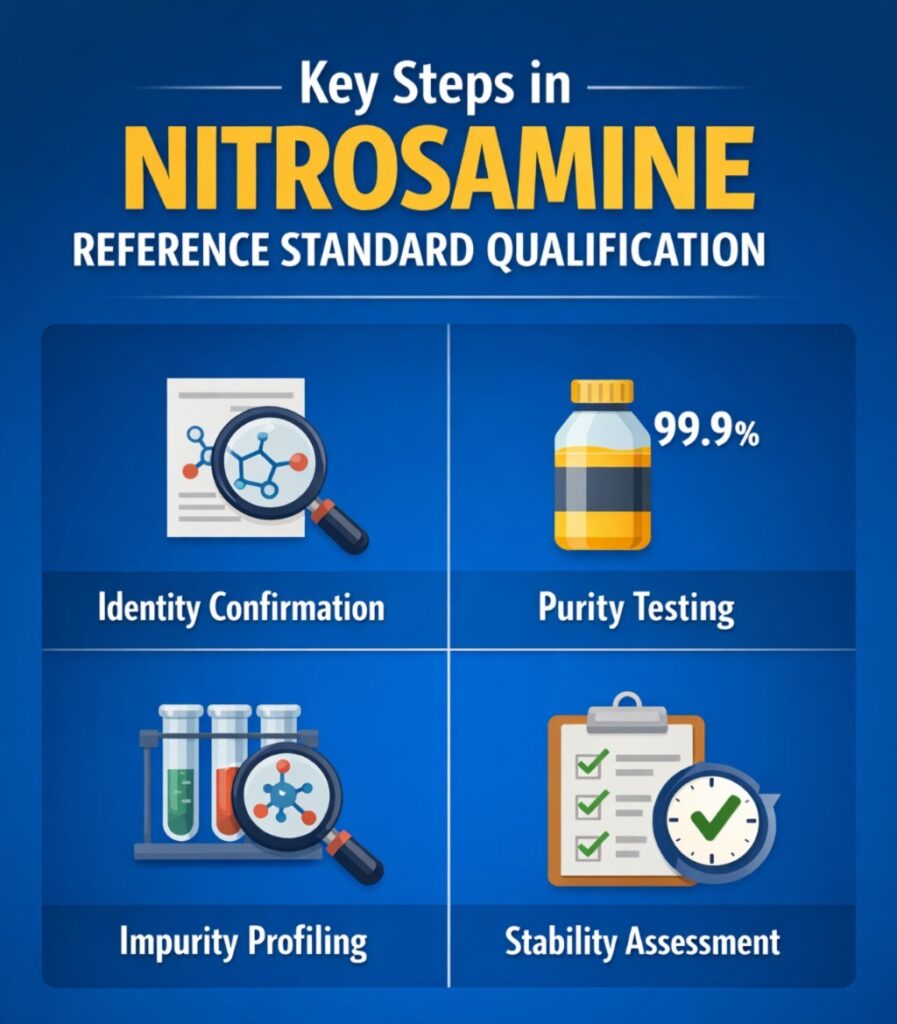
By performing detailed identity confirmation, purity determination, impurity profiling, and stability evaluation, laboratories can establish reliable reference materials that support validated analytical methods. These steps ensure that calibration standards accurately represent the compounds being measured.
Effective lifecycle management of reference standards is equally important. Stability monitoring, controlled storage conditions, and periodic requalification help maintain the integrity of reference materials over time. Without these controls, analytical data reliability may be compromised.
Comprehensive documentation and alignment with global regulatory guidelines further strengthen qualification programs. Laboratories that maintain organized records and strong quality systems demonstrate readiness during regulatory inspections.
Ultimately, robust Nitrosamine Reference Standard Qualification protects data integrity, supports regulatory compliance, and ensures that pharmaceutical products meet strict safety standards.
Maintain oversight across the entire product duration: Nitrosamine Lifecycle Management and Control Strategies
Frequently Asked Questions (FAQs)
Reference standards act as calibration materials for analytical instruments such as LC-MS/MS and GC-MS. They allow laboratories to measure extremely small amounts of nitrosamine impurities with high accuracy. If the standard is not reliable, the calculated impurity concentration may be incorrect. Therefore, well-qualified standards are essential for generating trustworthy analytical results.
Several orthogonal analytical techniques are commonly used during qualification. These include NMR, qNMR, LC-MS/MS, GC-MS, HRMS, and chromatographic purity analysis using HPLC or UPLC. Each technique provides different information about structure, purity, and impurity profiles. Using multiple techniques increases confidence in the qualification results.
Primary reference standards are highly characterized materials with certified purity values and full documentation. They serve as the main calibration reference for analytical testing. Secondary standards, also called working standards, are prepared or verified against primary materials and used more frequently in routine laboratory analysis. Both must be properly controlled and periodically verified.
Several international regulatory frameworks influence qualification requirements. These include guidance from the FDA, EMA, USP chapters, and ICH M7 related to mutagenic impurities. These guidelines define expectations for analytical testing, impurity control, and reference standard characterization. Laboratories must follow these frameworks to ensure regulatory acceptance of analytical data.
Purity is typically evaluated using multiple analytical techniques to improve reliability. Methods such as quantitative NMR (qNMR), chromatographic purity analysis, and mass spectrometry are commonly applied. Using several orthogonal approaches helps confirm that the purity result is accurate. This is important because even small purity errors can affect calibration accuracy.
Nitrosamine standards are typically stored at low temperatures to reduce chemical degradation. Laboratories often use controlled environments such as −20°C freezers and amber glass containers to protect the material from light. Moisture control is also important to maintain chemical stability. Proper storage conditions help extend the usable life of the reference material.
If reference standards are not properly qualified, analytical measurements may become inaccurate. This can lead to incorrect impurity levels being reported in pharmaceutical products. Such errors may create regulatory concerns, product recalls, or delays in approvals. Proper qualification helps prevent these risks and protects data integrity.
Reference:
- Manchuri, K. M., & colleagues. (2024). Analytical methodologies to detect N-nitrosamine impurities in pharmaceutical products: A comprehensive review. ACS Omega. https://pmc.ncbi.nlm.nih.gov/articles/PMC12135945/
- U.S. Food and Drug Administration. (2024). Control of nitrosamine impurities in human drugs: Guidance for industry. https://www.fda.gov/media/141720/download
- Badia, L., Camps, H., Lloveras, I., Handler, N., & others. (2024). Strategy to assess and control nitrosamine formation in API during storage: A sitagliptin case study. Organic Process Research & Development, 28(1). https://doi.org/10.1021/acs.oprd.4c00088
Get In Touch With Us
About The Author


