

Introduction
Conducting a comprehensive Nitrosamine Risk Assessment and Trace-Level NDSRI Testing program is an essential regulatory and quality requirement for identifying and evaluating potential N-nitroso impurities in complex parenteral peptide drug products. A systematic Nitrosamine Risk Assessment and Trace-Level NDSRI Testing strategy enables biopharmaceutical developers to identify chemical liabilities, assess potential carcinogenic potency categories, and establish high-sensitivity analytical methods capable of detecting these impurities at trace concentrations. These activities are critical for protecting patient safety and maintaining compliance with global regulatory expectations. Regulatory initiatives introduced by the U.S. Food and Drug Administration (FDA) and the European Medicines Agency (EMA) initially focused on small-molecule nitrosamines, including N-nitrosodimethylamine (NDMA) and N-nitrosodiethylamine (NDEA). Regulatory expectations have subsequently broadened to include complex active pharmaceutical ingredients (APIs), including synthetic peptides and other biopharmaceutical products.
Peptide injectables have distinctive chemical structures and sophisticated manufacturing processes that can create specific opportunities for nitrosamine formation or contamination. Synthetic peptides may contain secondary amine functional groups, including proline, hydroxyproline, or terminal alkylated amino acid residues, along with residual reagents originating from solid-phase peptide synthesis (SPPS), such as piperidine or morpholine. When these secondary amines encounter trace inorganic nitrites originating from formulation excipients, water for injection, or packaging components under acidic conditions, nitrosation reactions may occur and generate Nitrosamine Drug Substance-Related Impurities (NDSRIs). Because NDSRIs are structurally associated with the active therapeutic molecule and frequently lack extensive historical toxicological information, their evaluation requires structural potency categorization and highly sensitive analytical quantification capable of measuring concentrations down to sub-parts-per-million (ppm) levels.
Explore specialized Nitrosamine Risk Assessment for Peptide APIs to evaluate potential nitrosamine formation pathways and establish appropriate analytical controls.
Share via:
Quick Summary:
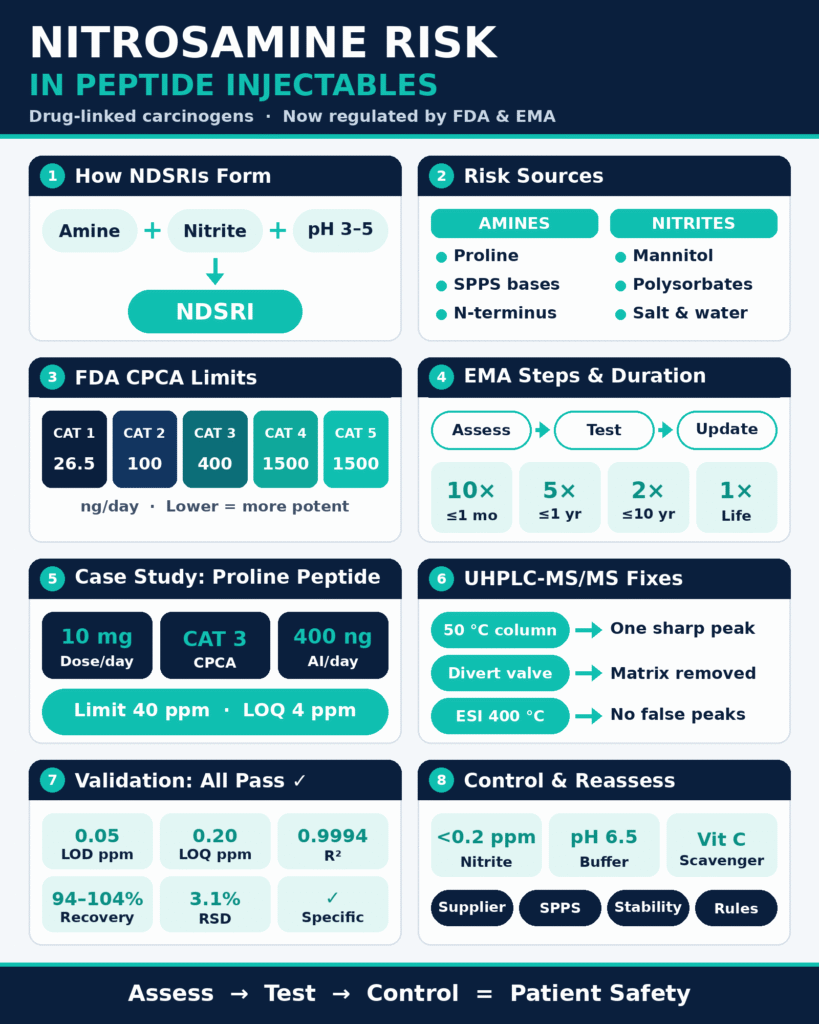
- Why it matters: Nitrosamine Drug Substance-Related Impurities (NDSRIs) are potentially carcinogenic. FDA and EMA expectations have expanded from small molecules like NDMA and NDEA to complex APIs, including synthetic peptide injectables.
- How they form: Secondary amines react with trace nitrites under acidic conditions (most readily at pH 3–5), and heat or long storage speeds this up. The amines come from proline residues, N-terminal amines, or leftover SPPS bases like piperidine. The nitrites come from excipients such as mannitol, polysorbates, and sodium chloride, typically at 0.1–5 ppm.
- FDA approach (CPCA): When compound-specific data is lacking, the FDA’s Carcinogenic Potency Categorization Approach sorts an NDSRI into one of five categories. Each category has an Acceptable Intake (AI) limit from 26.5 to 1500 ng/day, based on α-hydrogens, steric hindrance, and electron-withdrawing groups.
- EMA approach and short-term use: The EMA sets three steps: risk assessment, confirmatory testing, and marketing authorization changes. Under ICH M7(R2), short-term treatments can use Less-Than-Lifetime limits of up to 10× the lifetime AI.
- Case study: A proline-rich 10-mer peptide dosed at 10 mg/day was placed in CPCA Category 3 (400 ng/day). That gave a specification limit of 40 ppm and a target LOQ of 4 ppm.
- Analytical method: A UHPLC-MS/MS method solved three problems:
- A 50 °C column merged split rotamer peaks into one.
- A divert valve sent the peptide matrix to waste.
- ESI at 400 °C reduced false positives.
- Risk control: Mitigation includes vendor nitrite limits below 0.2 ppm, raising formulation pH from 4.5 to 6.5, and adding scavengers such as ascorbic acid or methionine. Under ICH Q9(R1), the assessment should be repeated after supplier changes, SPPS process changes, out-of-trend stability results, or regulatory updates.
Chemical Vulnerabilities and Reaction Pathways in Peptide Formulations
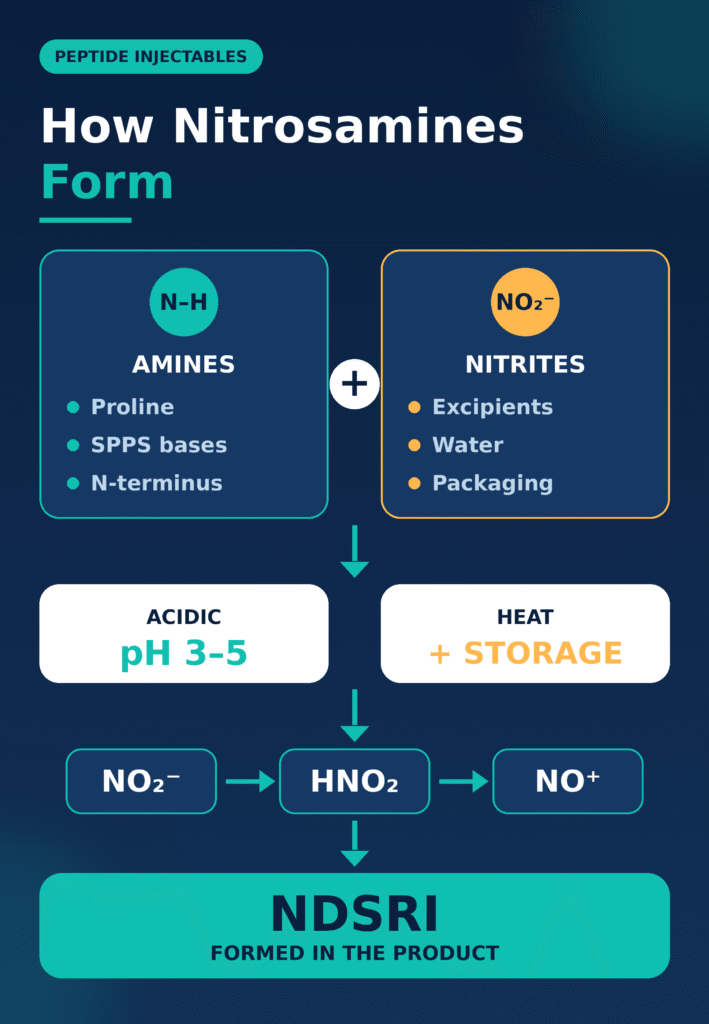
The chemical vulnerability of peptide injectables is primarily associated with reactions between secondary or tertiary amine precursor sites present within the peptide structure or introduced through synthesis reagents and reactive nitrosating species generated from trace nitrites in excipients. Within the acidic microenvironments that may occur in liquid parenteral formulations, these reaction pathways can facilitate the formation and accumulation of Nitrosamine Drug Substance-Related Impurities (NDSRIs) as well as small-molecule nitrosamines throughout the product shelf life.
Peptides contain several nitrogen-containing sites that may undergo nitrosation when appropriate kinetic conditions are present. Secondary amines are especially susceptible because they can react directly with nitrosating species to produce stable N-nitrosamines without requiring an initial dealkylation reaction. In synthetic peptides, important precursor sources include uncapped N-terminal amino acids containing secondary amine structures, such as N-alkylated glycines or proline residues, L-proline residues incorporated within the peptide sequence, and residual SPPS reagents. Fmoc-based SPPS commonly uses bases such as piperidine or diethylamine during deprotection. Inadequate washing or solvent contamination may allow trace quantities of these secondary amines to remain associated with the final API, potentially resulting in small-molecule nitrosamines such as N-nitrosopiperidine (NPIP). In addition, imidazole rings present in histidine and modified tertiary amine side chains may undergo N-dealkylation followed by nitrosation under elevated-temperature or oxidative conditions.
Review Custom Peptide Synthesis Services to support controlled peptide synthesis and characterization from early development through more advanced stages.
Inorganic nitrites (NO₂⁻) represent an important source of nitrosating agents in pharmaceutical drug products. Trace nitrite impurities may be present in parenteral excipients, including mannitol, sorbitol, polysorbate 20, polysorbate 80, and sodium chloride, at concentrations ranging from 0.1 to 5.0 ppm. In aqueous formulations, nitrites interact with hydronium ions (H₃O⁺) and establish an equilibrium with nitrous acid (HNO₂). Nitrous acid can subsequently generate reactive nitrosating species, including dinitrogen trioxide (N₂O₃) and the nitrosonium ion (NO⁺). Nitrosation rates are generally highest under weakly acidic conditions, particularly within the pH range of 3.0–5.0, which may also be selected during peptide formulation to support physical and chemical stability. Thermal stress associated with processes such as autoclaving or long-term stability studies can further accelerate these reaction pathways, increasing the potential accumulation of trace-level NDSRIs during the drug product shelf life.
| Precursor Source | Chemical Description | Typical Nitrosating Source | Resulting Impurity Class |
|---|---|---|---|
| Proline / Pyrrolidine Residues | Cyclic secondary amine within peptide sequence | Trace nitrites in bulking agents (e.g., Mannitol) | Peptide-Specific NDSRI |
| Residual SPPS Bases | Piperidine, Diethylamine used in Fmoc deprotection | Nitrites in process water or cleavage reagents | Small-Molecule Nitrosamine (e.g., NPIP, NDEA) |
| N-Terminal Amino Acids | Uncapped N-alkylated secondary amine terminals | Acidic reconstitution buffers containing nitrites | N-Terminal NDSRI Derivative |
| Degraded Excipient Auxiliaries | Oxidation products of polysorbates or polyols | Atmospheric NOx or trace peroxides | Secondary nitrosamines via secondary amine degradants |
Regulatory Frameworks Governing Nitrosamine Risk Assessment and Trace-Level NDSRI Testing
Global regulatory frameworks established by the FDA, EMA, and ICH require a structured, risk-based strategy for nitrosamine evaluation that integrates molecular structural assessment with defined Acceptable Intake (AI) limits. These regulatory approaches require systematic risk ranking, structure-activity relationship modeling, and appropriately validated analytical methods capable of detecting nitrosamines at sub-parts-per-million concentrations.
Because many complex NDSRIs do not have compound-specific long-term carcinogenicity datasets, the FDA’s updated regulatory guidance incorporates the Carcinogenic Potency Categorization Approach (CPCA). The CPCA classifies NDSRIs into one of five potency categories according to relevant structural characteristics and assigns daily Acceptable Intake (AI) limits ranging from 26.5 ng/day to 1500 ng/day. CPCA evaluation involves consideration of structural characteristics such as the number of hydrogen atoms attached to the α-carbons (α-hydrogens) in relation to the N-nitroso group, electron-withdrawing or electron-donating substituents surrounding the relevant structural environment, and steric hindrance around the nitrosamine functional group. These factors can influence cytochrome P450-mediated α-hydroxylation pathways and, consequently, the potential metabolic activation of the nitrosamine.
Learn more about Impurity Control Strategies Under ICH Q3A for a broader framework for identifying, monitoring, and controlling impurities during pharmaceutical development.
The EMA framework, established through the CHMP Article 5(3) opinion, organizes nitrosamine control into three sequential stages: Step 1 (Risk Assessment), Step 2 (Confirmatory Testing), and Step 3 (Changes to Marketing Authorization). For peptide injectables intended for defined short-term treatment periods, acceptable exposure limits may also be determined using Less-Than-Lifetime (LTL) principles described in ICH M7(R2).
| Potency Category | Recommended AI Limit (ng/day) | Structural Criteria & Activation Factors | Example Structural Context |
|---|---|---|---|
| Category 1 | 26.5 | Unhindered α-hydrogens; no electron-withdrawing groups | Simple, unbranched secondary N-nitrosamines |
| Category 2 | 100 | Two α-hydrogens with moderate steric availability | Mono-β-substituted cyclic N-nitroso structures |
| Category 3 | 400 | Sterically hindered α-hydrogens or electron-withdrawing groups | β-hydroxy or carboxyl-substituted nitrosamines |
| Category 4 | 1500 | Highly sterically hindered or carboxylic acid substituent | Heavily substituted piperidine/proline derivatives |
| Category 5 | 1500 | Multiple deactivating groups (e.g., adjacent carboxylates) | Deactivated, steric-heavy peptide-bound NDSRIs |
For acute or short-term therapeutic applications, Less-Than-Lifetime (LTL) exposure adjustments modify the daily threshold according to the intended clinical treatment duration:
| Treatment Duration | LTL Adjustment Factor | Example Adjusted AI for Category 1 NDSRI (26.5 ng/day) |
|---|---|---|
| ≤ 1 Month | 10× | 265 ng/day |
| > 1 Month to ≤ 1 Year | 5× | 132.5 ng/day |
| > 1 Year to ≤ 10 Years | 2× | 53 ng/day |
| > 10 Years (Lifetime) | 1× | 26.5 ng/day |
Case Study: Executing Nitrosamine Risk Assessment and Trace-Level NDSRI Testing for a Peptide Injectable
An evaluation of a commercial proline-rich synthetic 10-mer peptide injectable identified secondary amine vulnerabilities associated with a proline residue. These sites were capable of reacting with trace nitrites originating from excipients during liquid storage and forming a structurally related NDSRI. An end-to-end Nitrosamine Risk Assessment and Trace-Level NDSRI Testing workflow was subsequently applied to establish the compound’s CPCA potency category and determine stringent analytical specification limits for finished product release.
The assessment focused on a commercial synthetic 10-mer peptide injectable supplied as a lyophilized powder for reconstitution and administered at a maximum daily dose (MDD) of 10 mg/day for chronic metabolic management. Hazard identification demonstrated that the peptide sequence contained an L-proline residue at position 3 and a modified pyrrolidine moiety at the C-terminus. Analysis of the excipients identified trace inorganic nitrites across multiple raw material batches, including 0.80 ppm in mannitol and 1.45 ppm in polysorbate 80. In addition, reconstitution using a weakly acidic buffer at pH 4.5 generated conditions that could favor secondary amine nitrosation during post-reconstitution storage.
Application of the FDA CPCA framework to the target NDSRI, identified as N-nitroso-prolyl-peptide fragment, demonstrated that the α-carbon of the pyrrolidine ring contained two α-hydrogens. However, steric hindrance associated with the adjacent amide backbone reduced the accessibility of metabolic activation pathways. The neighboring carbonyl group also functioned as an electron-withdrawing feature, further reducing the predicted carcinogenic potency. Based on these structural characteristics, the compound received a CPCA score corresponding to Category 3, resulting in a lifetime Acceptable Intake (AI) limit of 400 ng/day.
Using the maximum daily dose of 10 mg/day, the finished drug product specification limit was calculated by dividing the 400 ng/day AI by the 10 mg/day maximum daily dose. This calculation resulted in a specification limit of 40 ppm, equivalent to 40 μg/g. In accordance with USP and FDA guidance, analytical method validation should achieve a Limit of Quantitation (LOQ) at or below 10% of the applicable specification threshold. Therefore, the target method LOQ was established at 4.0 ppm relative to the API matrix.
Explore Peptide Analytical Testing Services for analytical characterization and testing strategies designed for complex peptide APIs and drug products.
Analytical Method Development and UHPLC-MS/MS Validation for Trace-Level NDSRI Testing
Development of a validated UHPLC-MS/MS analytical method for trace-level NDSRI quantification requires careful management of API matrix suppression and resolution of cis/trans amide rotamers through high-temperature chromatography and divert valve-based matrix elimination. High-sensitivity mass spectrometry provides the detection capability necessary for sub-ppm measurements while minimizing the potential for in-source thermal degradation of the intact peptide backbone.
Measurement of trace-level NDSRIs within complex peptide formulations presents substantial analytical difficulties. High concentrations of intact peptide APIs can produce pronounced matrix ion suppression during mass spectrometric analysis. At the same time, in-source thermal fragmentation of the peptide backbone may generate false-positive signal transitions. In addition, N-acyl proline structures can exist as cis/trans amide rotamers in solution, potentially producing peak splitting during liquid chromatography and complicating quantitative analysis.
See Peptide Analytical Testing Services to evaluate analytical approaches for impurity profiling, characterization, and quantitative peptide testing.
To overcome these analytical challenges, an Ultra-High-Performance Liquid Chromatography coupled with Tandem Mass Spectrometry (UHPLC-MS/MS) method was optimized using an Agilent Poroshell 120 EC-C18 column (2.1 × 100 mm, 1.9 μm) maintained at 50 °C. The elevated column temperature promoted collapse of the cis/trans rotamers into a single sharp chromatographic peak, thereby improving signal-to-noise ratios. Electrospray Ionization (ESI) using an elevated desolvation gas temperature of 400 °C provided improved ionization efficiency for the high-molecular-weight NDSRI fragment while minimizing in-source cleavage. The mobile phase consisted of 0.1% formic acid in water and acetonitrile/methanol (50:50 v/v). A divert valve was incorporated to direct the heavy intact peptide API matrix to waste during the first 4 minutes of the chromatographic run.
The UHPLC-MS/MS method underwent full validation in accordance with ICH Q2(R2) and USP guidelines.
| Validation Parameter | Target Acceptance Criteria | Experimental Outcome | Compliance Status |
|---|---|---|---|
| Limit of Detection (LOD) | S/N ≥ 3:1 | 0.05 ppm (0.5 ng/mL) | Compliant |
| Limit of Quantitation (LOQ) | S/N ≥ 10:1; ≤ 10% of AI (4.0 ppm) | 0.20 ppm (2.0 ng/mL) | Compliant (5% of AI) |
| Linearity Range | R² ≥ 0.995 from LOQ to 150% limit | R² = 0.9994 (0.20–60.0 ppm) | Compliant |
| Accuracy / Spike Recovery | 80%–120% recovery across 3 levels | 94.2%–103.8% mean recovery | Compliant |
| Precision (Repeatability) | %RSD ≤ 10.0% (n=6 preparations) | %RSD = 3.1% at 1.0 ppm level | Compliant |
| Specificity | No interfering peaks >10% LOQ window | Baseline separation from matrix | Compliant |
Risk Mitigation Strategies and Lifecycle Management
Successful risk mitigation for peptide injectables requires coordinated control of raw material nitrite concentrations, optimization of the formulation microenvironment pH, and establishment of lifecycle management triggers consistent with quality risk management principles. Implementing defined vendor nitrite specifications and using appropriate antioxidant scavengers can reduce the potential for nitrosation reactions throughout the product’s shelf life.
Explore Peptide Stability Testing Services to support stability monitoring and evaluation of potential degradation-related changes throughout the product lifecycle.
When confirmatory testing identifies NDSRI concentrations approaching or exceeding established target thresholds, biopharmaceutical manufacturers should implement a multi-tiered control strategy consistent with Step 3 of applicable global regulatory frameworks. Establishing raw material specifications that require vendors to screen for nitrite content below 0.2 ppm using validated ion chromatography can reduce the overall nitrosating potential introduced into the drug product formulation. In addition, increasing the post-reconstitution formulation pH from 4.5 to 6.5 shifts the nitrous acid equilibrium away from reactive N₂O₃ species and thereby decreases the rate of nitrosation reactions. Incorporating parenteral-grade scavengers, including ascorbic acid at 0.1%–0.5% w/v or methionine, can provide preferential reaction targets that consume trace nitrites before they can react with secondary amines.
Learn about Extractables and Leachables Testing for Peptide Injectables to assess potential packaging-related sources of chemical contamination in injectable products.
Consistent with the principles outlined in ICH Q9(R1) Quality Risk Management frameworks, nitrosamine risk assessments should be reassessed whenever predefined lifecycle triggers occur. Such triggers may include changes to SPPS cleavage cocktails, qualification of new raw material suppliers, out-of-trend stability findings, or regulatory updates affecting CPCA categories and nitrosamine control expectations.
Conclusion: Elevating Compliance through Nitrosamine Risk Assessment and Trace-Level NDSRI Testing
A comprehensive Nitrosamine Risk Assessment and Trace-Level NDSRI Testing workflow provides biopharmaceutical manufacturers with a systematic scientific framework for evaluating nitrosamine-related risks, protecting patient safety, and addressing regulatory requirements. Integrating structural potency assessment with highly sensitive UHPLC-MS/MS method validation enables analytical laboratories to establish reliable controls for complex peptide parenterals and support the detection and quantification of trace-level NDSRIs.
Explore GMP Peptide API Manufacturing Services for GMP-focused peptide API development, manufacturing, and quality control support.
Through systematic risk assessment, structural CPCA evaluation, and high-sensitivity LC-MS/MS method validation, biopharmaceutical companies can establish scientifically supported approaches for managing nitrosamine risks while maintaining drug quality and regulatory compliance. For support with custom analytical method development, specialized testing protocols, or expert regulatory consultation, contact the technical specialists at ResolveMass directly through ResolveMass Contact Us.
Frequently Asked Questions
NDSRIs are structurally associated with the active pharmaceutical ingredient and can have molecular characteristics that differ substantially from conventional small-molecule nitrosamines. Their analysis may require compound-specific reference standards, highly sensitive mass spectrometry, and optimized chromatographic conditions to address API matrix effects and structural complexity. Rotamer formation can further complicate chromatographic separation and quantitative measurement.
The Carcinogenic Potency Categorization Approach (CPCA) evaluates structural characteristics that can influence the carcinogenic potency of an NDSRI, including α-hydrogens, electron-withdrawing groups, and steric effects around the nitrosamine functionality. These structural attributes are used to place the compound into one of five potency categories. Each category is associated with a corresponding daily Acceptable Intake (AI) limit ranging from 26.5 ng/day to 1500 ng/day.
Trace-level NDSRI analysis generally requires highly sensitive chromatographic and mass spectrometric instrumentation, such as Ultra-High-Performance Liquid Chromatography coupled with Tandem Mass Spectrometry (UHPLC-MS/MS) or High-Resolution Mass Spectrometry (HRMS). These platforms can provide the sensitivity and selectivity required for very low concentration measurements. The analytical method must also demonstrate suitable specificity, accuracy, precision, and Limit of Quantitation (LOQ).
Parenteral excipients, including mannitol, sorbitol, polysorbates, and buffer salts, may contain trace quantities of inorganic nitrites originating from their manufacturing processes. Under suitable formulation conditions, particularly acidic environments, nitrites can generate reactive nitrosating species such as N₂O₃ and NO⁺. These species may react with susceptible secondary amine precursor sites present in the API or residual synthesis-related components.
N-acyl proline and pyrrolidine-containing structures can undergo cis/trans amide rotamer formation in solution, resulting in multiple chromatographic signals or broadened peaks. This behavior can make peak identification and quantitative integration more difficult during liquid chromatography. Increasing the column temperature to approximately 50 °C can accelerate rotamer interconversion and may promote formation of a more consolidated chromatographic peak.
For nitrosamine analysis, the analytical method should be sufficiently sensitive to quantify the impurity well below the applicable specification or Acceptable Intake-derived limit. In the context described here, the target is an LOQ at or below 10% of the applicable AI-based specification threshold. Establishing this sensitivity provides analytical margin for reliable quantification during finished product release and stability testing.
Less-Than-Lifetime (LTL) principles may be applicable when a medicinal product is intended for a treatment duration shorter than a lifetime exposure scenario. Under ICH M7(R2), exposure adjustments can account for the duration of clinical administration, with applicable adjustment factors depending on the treatment period. The appropriate factor should therefore be determined according to the intended duration of patient exposure and the applicable regulatory framework.
NDSRI formation can be controlled through a combination of raw material qualification, formulation optimization, and appropriate impurity-control strategies. Using low-nitrite excipient grades, controlling the formulation pH to reduce nitrosation kinetics, and incorporating suitable parenteral antioxidants such as ascorbic acid or methionine may reduce nitrosating potential. These measures should be evaluated for compatibility with the overall formulation and product stability profile.
A nitrosamine risk assessment should be revisited when manufacturing or material changes could alter the potential for nitrosamine formation. Relevant triggers may include changes in raw material suppliers, synthesis routes, SPPS cleavage reagents, container closure systems, or formulation components. Unexpected stability degradants, new process-related impurities, and significant changes in regulatory expectations should also prompt reassessment under ICH Q9(R1) Quality Risk Management principles.
Reference:
- U.S. Food and Drug Administration. (2026). CDER nitrosamine impurity acceptable intake limits. https://www.fda.gov/regulatory-information/search-fda-guidance-documents/cder-nitrosamine-impurity-acceptable-intake-limits
- European Medicines Agency. (2025). Nitrosamine impurities. https://www.ema.europa.eu/en/human-regulatory-overview/post-authorisation/referral-procedures-human-medicines/nitrosamine-impurities
- Singh, S. K., Manne, N., & Pal, M. (2008). Synthesis of (S)-1-(2-chloroacetyl)pyrrolidine-2-carbonitrile: A key intermediate for dipeptidyl peptidase IV inhibitors. Beilstein Journal of Organic Chemistry, 4, Article 20. https://doi.org/10.3762/bjoc.4.20
- Thornberry, N. A., & Weber, A. E. (2007). Discovery of JANUVIA™ (sitagliptin), a selective dipeptidyl peptidase IV inhibitor for the treatment of type 2 diabetes. Current Topics in Medicinal Chemistry, 7(6), 557–568. https://doi.org/10.2174/156802607780091028
- U.S. Food and Drug Administration. (2024). Control of nitrosamine impurities in human drugs: Guidance for industry (Revision 2). U.S. Department of Health and Human Services. FDA guidance PDF
Get In Touch With Us
About The Author


