

Introduction
A comprehensive Nitrosamine Risk Assessment for ANDA Submission requires a structured and scientific evaluation of potential nitrosamine formation pathways. The assessment must cover every stage of the product lifecycle, including API synthesis, excipient quality, manufacturing process, packaging materials, storage conditions, and lifecycle monitoring.
Regulators expect applicants to identify possible nitrosamine sources, evaluate their likelihood, and demonstrate control through data. This includes impurity fate tracking, purge studies, analytical validation, and confirmatory batch testing. Unsupported claims or general statements are not acceptable.
This guide focuses on preparing a regulator-ready document that aligns with current FDA and global expectations. It outlines how to organize content clearly, present data effectively, and avoid common technical gaps that lead to deficiency letters.
Ensure your submission meets all regulatory benchmarks: Comprehensive Nitrosamine Analysis Services
🔎 Quick Summary: What This Guide Covers
- A step-by-step structure for preparing a Nitrosamine Risk Assessment for ANDA Submission
- How to document API, excipient, manufacturing, packaging, and storage risk factors
- What regulators expect in Module 3 (Quality) of CTD
- How to justify analytical method selection and LOQ relative to AI limits
- How to present confirmatory testing data and worst-case calculations
- Common technical deficiencies observed in ANDA reviews
- A practical checklist to avoid deficiency letters
- 10 expert FAQs for regulatory and CMC teams
Watch the Video Guide: Complete Nitrosamine Risk Assessment Report for ANDA Submission
1️⃣ What Should Be Included in a Nitrosamine Risk Assessment for ANDA Submission?
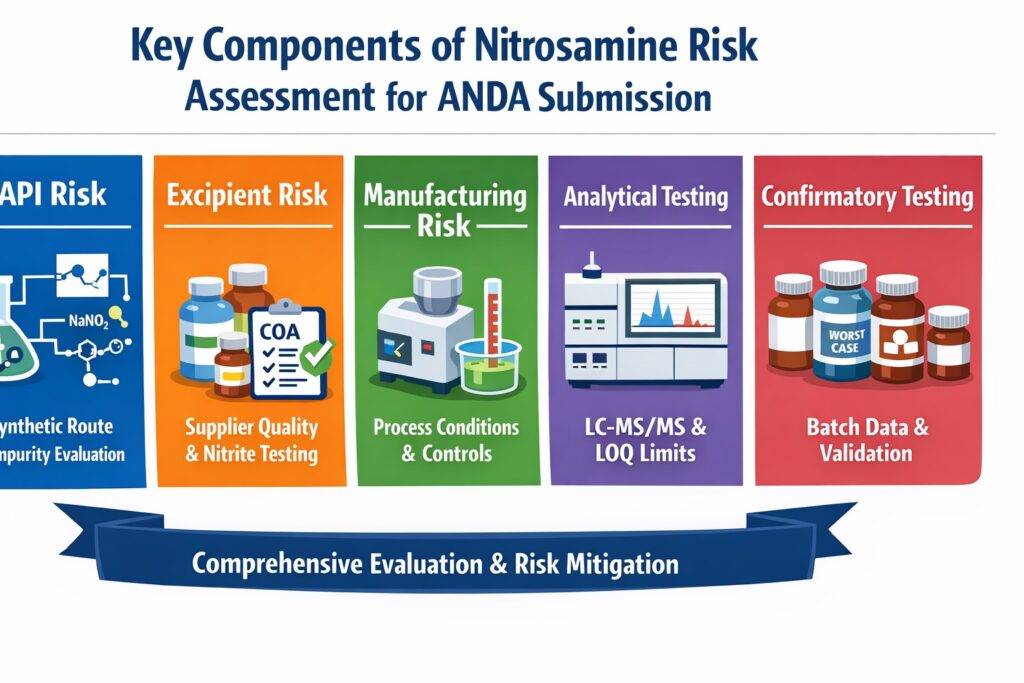
A complete Nitrosamine Risk Assessment for ANDA Submission must contain a detailed and structured evaluation of API risk, excipient risk, manufacturing risk, packaging risk, analytical assessment, and confirmatory testing data. Each section should logically connect risk identification with risk mitigation measures.
Regulators prefer a clear format that allows quick navigation between sections. Cross-references to Module 3.2.S (Drug Substance) and 3.2.P (Drug Product) should be clearly mentioned. Every conclusion must be supported by scientific justification or data.
Recommended Report Structure
| Section | Required Content |
|---|---|
| 1. Product Overview | API, dosage form, strength, route |
| 2. API Risk Assessment | Synthetic route, amine sources, nitrosating agents |
| 3. Excipient Risk Assessment | Supplier controls, secondary amine presence |
| 4. Manufacturing Risk | Solvents, water, rework, hold times |
| 5. Packaging Risk | Nitrosating impurities in packaging |
| 6. Analytical Assessment | Methods, LOQ vs AI limits |
| 7. Confirmatory Testing | Batch data, worst-case scenario |
| 8. Control Strategy | Specifications, supplier qualification |
| 9. Conclusion & Risk Statement | Overall risk category & mitigation |
Proper indexing and structured presentation improve review efficiency and reduce follow-up questions from regulatory agencies.
2️⃣ API Risk Evaluation in Nitrosamine Risk Assessment for ANDA Submission
API evaluation is one of the most critical parts of the Nitrosamine Risk Assessment for ANDA Submission. The synthetic route must be carefully reviewed to identify secondary or tertiary amines, nitrosating agents, solvents, reagents, and possible contamination pathways.
A clear flow diagram of the manufacturing process should be included. Each reaction step must be assessed for possible nitrosation, especially under acidic conditions or in the presence of nitrite salts. Even trace levels of amines can become significant under certain process conditions.
Quantify the removal of impurities during synthesis: Nitrosamine Purge Factor Calculation Guide
Critical API Risk Evaluation Steps
✔ Step 1: Map Synthetic Route
- Identify secondary, tertiary, or quaternary amines
- Evaluate nitrite salts such as NaNO₂ or KNO₂
- Review acidic reaction steps
✔ Step 2: Assess Recovered Materials
- Check recovered solvents for nitrosamine contamination
- Evaluate reused catalysts and reagents
✔ Step 3: Review Starting Material Controls
- Obtain nitrosamine risk statements from API suppliers
- Request batch-level confirmatory data
✔ Step 4: Conduct Fate and Purge Study
Document:
- Reaction purge factors
- Thermal degradation impact
- Crystallization removal efficiency
Quantitative purge calculations are increasingly expected by regulators. Including experimental data strengthens the scientific basis of the submission.
3️⃣ Excipient Risk in Nitrosamine Risk Assessment for ANDA Submission
Excipient risk should be evaluated using supplier questionnaires, Certificates of Analysis (COA), nitrosamine declaration letters, and nitrite testing reports. Some excipients may contain trace nitrites or residual amines that can contribute to nitrosamine formation.
Special attention should be given to excipients processed using amine-containing materials. Storage and transport conditions can also influence impurity levels. Periodic verification testing adds an extra layer of assurance.
Focus Areas
- Microcrystalline cellulose (possible nitrite contamination)
- Crospovidone (secondary amine residues)
- Magnesium stearate (amine processing aids)
Required Documentation
- Supplier nitrosamine declaration letters
- Nitrite testing reports
- Change notification commitments
Excipient Risk Summary Table
| Excipient | Nitrosamine Risk | Control Strategy |
|---|---|---|
| MCC | Nitrite trace risk | Supplier testing |
| Crospovidone | Secondary amine | COA + periodic testing |
| Mg Stearate | Low | Vendor qualification |
Including a clear summary table improves transparency and simplifies regulatory review.
Learn how to prevent nitrosation in your formulation: Using Secondary Amine Scavengers for Nitrosamine Mitigation
4️⃣ Manufacturing Process Risk Assessment
Manufacturing operations can influence nitrosamine formation even when raw materials present low risk. Process conditions such as moisture, elevated temperature, acidic pH, and extended hold times must be evaluated carefully.
Each processing step should be assessed individually and collectively. Wet granulation, drying, blending, compression, coating, and rework operations require detailed review.
Key Risk Variables
- Granulation water quality
- Drying temperature
- Compression heat
- Rework procedures
- Bulk hold time
Regulatory Expectations
- Written risk evaluation narrative
- Worst-case batch simulation
- Hold-time study data
- Cleaning validation assessment
The Nitrosamine Risk Assessment for ANDA Submission must clearly explain why the manufacturing process does or does not increase nitrosamine risk, supported by data or scientific reasoning.
Mitigate risks through process chemistry adjustments: Nitrosamine Solvent and Catalyst Mitigation Strategies
5️⃣ Analytical Requirements in Nitrosamine Risk Assessment for ANDA Submission
Sensitive and validated LC-MS/MS or GC-MS methods are required to detect nitrosamines at very low levels. The Limit of Quantification (LOQ) must be below the acceptable intake (AI) limit to ensure compliance.
Method validation should follow ICH guidelines and demonstrate specificity, accuracy, precision, linearity, and robustness. Stability-indicating capability must also be confirmed.
Analytical Requirements
- LOQ ≤ 30% of AI limit
- Specificity confirmation
- Matrix interference study
- Recovery study (70–130%)
- Stability-indicating capability
Required Data Presentation
| Parameter | Acceptance Criteria |
|---|---|
| LOQ | Below regulatory limit |
| Accuracy | 70–130% |
| Precision | ≤ 20% RSD |
| Linearity | r² ≥ 0.99 |
Attach:
- Chromatograms
- Full validation report
- Data from 3–6 commercial batches
Clear and organized data presentation improves transparency and supports faster regulatory review.
Compare analytical techniques for your submission: Direct Injection vs. Headspace Techniques for Nitrosamines
6️⃣ Presenting Confirmatory Testing Data
Confirmatory testing must include at least three representative commercial-scale batches. One batch should represent the worst-case scenario based on formulation or processing conditions.
Testing should also include one stability batch where possible. Justification for batch selection must be clearly documented in the report.
Example Data Table
| Batch No | NDMA | NDEA | NMBA | Result |
|---|---|---|---|---|
| 001 | <LOQ | <LOQ | <LOQ | Pass |
| 002 | <LOQ | <LOQ | <LOQ | Pass |
Regulators review worst-case justification, statistical consistency, and long-term monitoring plans. Including chromatograms and brief data interpretation strengthens the submission.
Determine AI limits for complex drug-related impurities: Nitrosamine CPCA Approach for NDSRIs
7️⃣ Writing the Final Risk Conclusion
The conclusion section of the Nitrosamine Risk Assessment for ANDA Submission should clearly categorize the product as Low, Medium, or High risk. The statement must be based on the data presented in earlier sections.
Summarize findings from API evaluation, excipient assessment, manufacturing review, packaging risk, and analytical testing. Confirm that testing supports the assigned risk category.
Example structure:
Based on comprehensive evaluation of API synthesis, excipients, manufacturing process, packaging materials, and confirmatory analytical testing, the product is categorized as Low Risk for nitrosamine formation. Validated LC-MS/MS testing confirms levels below AI limits. Ongoing monitoring will be maintained through lifecycle management.
Design effective long-term monitoring programs: Nitrosamine Testing in Stability Studies
8️⃣ Common Deficiencies in Nitrosamine Risk Assessment for ANDA Submission
Many deficiency letters result from incomplete documentation or weak analytical justification. Regulators expect quantitative data and proper supplier documentation.
Common Issues
- Missing purge calculations
- No supplier declaration letters
- LOQ higher than AI limit
- Lack of worst-case batch justification
- Limited batch testing
- Incomplete packaging assessment
Proactively addressing these areas reduces approval delays.
Ensure your primary packaging is not a source of risk: Packaging Leachables and Nitrosamine E&L Assessment
9️⃣ Lifecycle Management Strategy
Nitrosamine control continues after product approval. A lifecycle strategy ensures ongoing compliance and patient safety.
Include:
- Annual product quality review
- Change control triggers
- Supplier requalification
- Stability program monitoring
The Nitrosamine Risk Assessment for ANDA Submission should demonstrate continuous oversight and long-term risk management.
🔟 Complete Submission Checklist
✔ Synthetic route risk documented
✔ Excipient risk assessed
✔ Supplier letters attached
✔ Analytical validation report included
✔ 3–6 batch data attached
✔ Worst-case batch identified
✔ Packaging evaluated
✔ Control strategy defined
✔ Stability commitment included
Using this checklist before submission improves completeness and regulatory readiness.
Conclusion
A well-prepared Nitrosamine Risk Assessment for ANDA Submission is a scientific and data-driven document that evaluates every possible source of nitrosamine formation. It combines API analysis, excipient review, manufacturing evaluation, packaging assessment, analytical validation, and confirmatory testing into one structured report.
When supported by strong data and clear justification, the assessment reduces regulatory questions and improves approval timelines. A clear and organized submission reflects strong quality systems and regulatory preparedness.
Frequently Asked Questions (FAQs)
Regulatory agencies generally expect testing on at least three full-scale commercial batches. These batches should represent normal manufacturing conditions. Including a worst-case batch is highly recommended because it provides stronger scientific justification and demonstrates consistent nitrosamine control.
Yes, stability batches should be part of the evaluation whenever possible. This helps demonstrate that nitrosamine levels remain within acceptable limits throughout the product’s shelf life. Stability data gives regulators confidence in long-term product safety and control.
Although not always described as strictly mandatory, quantitative purge calculations are strongly expected by regulators. They help demonstrate how impurities are reduced or eliminated during processing. Providing scientific purge data significantly strengthens the Nitrosamine Risk Assessment for ANDA Submission.
If the Limit of Quantification (LOQ) is higher than the acceptable intake (AI) limit, the analytical method must be improved. Regulators require sensitive detection to ensure patient safety. Failure to meet this requirement can result in regulatory questions or deficiencies.
Packaging assessment is an important part of the overall risk evaluation. Some packaging materials may contain nitrite-related substances that could contribute to nitrosamine formation. A documented review ensures that packaging does not introduce additional risk.
The Nitrosamine Risk Assessment for ANDA Submission should be included within Module 3, specifically sections 3.2.S for Drug Substance and 3.2.P for Drug Product. Proper cross-referencing improves review efficiency and avoids unnecessary clarification requests.
Post-approval monitoring is typically conducted on an annual basis as part of the product quality review. However, the frequency may vary depending on the assigned risk level. Ongoing monitoring confirms that the control strategy remains effective over time.
Reference:
- lucas10mauriz. (2023, December 12). Nitrosamines: A new systematic review. Nitrosamines Exchange. https://nitrosamines.usp.org/t/nitrosamines-a-new-systematic-review/8615
- Akkaraju, H., Tatia, R., Mane, S. S., & Dengale, S. J. (2023). A comprehensive review of sources of nitrosamine contamination of pharmaceutical substances and products. Regulatory Toxicology and Pharmacology, 136, Article 105355. https://doi.org/10.1016/j.yrtph.2023.105355
- Xu, H., Zhang, Y., Li, F., & Wang, X. (2024). Advanced analytical strategies for nitrosamine impurity profiling in pharmaceuticals. Molecular Pharmaceutics, 21(3), 655–669. https://doi.org/10.1021/acs.molpharmaceut.4c01173
Get In Touch With Us
About The Author


