

Introduction
The Nitrosamine Risk in Solid vs Liquid Dosage forms has become a critical topic in pharmaceutical quality and regulatory compliance. Nitrosamines are potentially harmful impurities that can form during manufacturing, formulation development, or long-term storage of drug products. Because even very small amounts may pose safety concerns, global regulatory agencies have increased their focus on identifying and controlling these compounds.
Recent investigations into drug product recalls have shown that formulation type plays an important role in nitrosamine formation. Solid oral dosage forms and liquid formulations create different chemical environments, which can influence reaction kinetics, precursor availability, and impurity development over time. Understanding these differences helps pharmaceutical scientists design safer and more stable formulations.
This article presents a comparative overview of Nitrosamine Risk in Solid vs Liquid Dosage, focusing on reaction environments, excipient-related nitrite sources, stability factors, manufacturing influences, and risk mitigation strategies. The goal is to help researchers and manufacturers better understand how formulation design affects nitrosamine formation and how these risks can be effectively controlled.
For a comprehensive overview of detection strategies across all dosage forms, explore our Nitrosamine Analysis and Testing Services.
Share via:
Summary of Key Insights
- Nitrosamine risk in solid vs liquid dosage forms differs significantly due to reaction environments, excipient composition, and moisture content.
- Solid oral dosage forms primarily generate nitrosamines through nitrite-containing excipients and amine-functional APIs during storage or compression processes.
- Liquid formulations present higher kinetic reaction potential due to dissolved reactants but may be controlled through pH and antioxidant stabilization.
- Moisture migration, excipient nitrite levels, and manufacturing conditions are dominant drivers of nitrosamine formation in tablets and capsules.
- Solution-phase reactions in liquid dosage forms accelerate nitrosation reactions when secondary amines and nitrites coexist.
- Regulatory risk assessment frameworks (FDA, EMA, ICH M7) require formulation-specific evaluation because solid and liquid dosage forms exhibit distinct nitrosamine formation pathways.
- Advanced analytical techniques such as LC–MS/MS and GC–HRMS are required to detect trace-level nitrosamines across dosage formats.
- Mitigation strategies differ: excipient selection and packaging controls for solids, whereas pH control, antioxidants, and oxygen exclusion are critical in liquids.
Key Drivers of Nitrosamine Risk in Solid vs Liquid Dosage
The major drivers of Nitrosamine Risk in Solid vs Liquid Dosage are the availability of nitrosating agents, the presence of amine precursors, and the surrounding reaction environment. For nitrosamines to form, these elements must interact under suitable chemical conditions. By controlling any of these factors, pharmaceutical manufacturers can significantly reduce the overall risk.
Nitrosamines are typically formed when secondary or tertiary amines react with nitrosating agents derived from nitrites, especially under acidic or catalytic conditions. This reaction mechanism has been widely studied in pharmaceutical chemistry as well as environmental science. When both nitrites and reactive amines are present in a formulation, the potential for impurity formation increases.
In pharmaceutical products, amine sources may originate from active pharmaceutical ingredients, degradation products, or certain excipients. Nitrosating agents are usually linked to nitrite impurities present in raw materials or water used during manufacturing. When these components coexist under favorable conditions, nitrosamine formation may occur.
Environmental factors such as temperature, moisture, and pH can also affect the speed of these reactions. Depending on the formulation design and storage conditions, these factors may either accelerate or slow down nitrosation reactions.
Certain medications require more rigorous scrutiny due to their chemical nature. Learn more about Nitrosamine Testing for High-Risk Drug Classes.
Major Risk Factors Across Dosage Forms
| Risk Factor | Solid Oral Dosage | Liquid Formulations |
|---|---|---|
| Reaction Medium | Limited molecular mobility | High mobility in solution |
| Nitrite Source | Excipients (e.g., MCC, crospovidone) | Water, preservatives, raw materials |
| Moisture | Influences localized reaction | Already in solution |
| Storage Conditions | Humidity and temperature accelerate reactions | pH and oxidation state influence kinetics |
| Reaction Kinetics | Slower, diffusion-limited | Faster due to dissolved reactants |
Research has shown that trace nitrite impurities in excipients are among the most important contributors to nitrosamine formation in tablets and capsules (Boetzel et al., 2023). Even extremely small nitrite concentrations can initiate reactions if suitable amine sources are present. Therefore, continuous monitoring of excipient quality is critical.
Nitrosamine Risk in Solid vs Liquid Dosage: Reaction Environment Differences
The reaction environment is one of the most important factors affecting Nitrosamine Risk in Solid vs Liquid Dosage. Each formulation type creates unique physical and chemical conditions that influence how reactants interact with each other. These differences strongly impact the likelihood and rate of nitrosamine formation.
During pharmaceutical development, scientists must carefully study the microenvironment within the formulation. Solid and liquid dosage forms behave very differently at the molecular level, which means risk assessments must consider these unique characteristics.
Solid Dosage Forms
In tablets and capsules, nitrosamine formation often occurs through solid-state reactions or localized microenvironments within the formulation. Because molecules cannot move freely inside a solid matrix, these reactions usually occur slowly. However, when moisture is present, small reaction zones can form and allow chemicals to interact.
Key characteristics include:
- Restricted molecular mobility
- Localized moisture pockets
- Interaction between API and excipients
Studies have shown that solid formulations containing secondary amine APIs and nitrite-containing excipients may generate nitrosamines during long-term storage (Moser et al., 2023). Although the reaction rate may be slow initially, it can increase over time as stability conditions change.
Common excipients associated with nitrite presence include:
- Microcrystalline cellulose
- Crospovidone
- Sodium starch glycolate
- Magnesium stearate
Even trace nitrite levels in these materials can gradually accumulate under humid conditions. Because of this, manufacturers carefully evaluate excipient suppliers and perform impurity testing before selecting raw materials.
Liquid Dosage Forms
Liquid formulations provide a homogeneous chemical environment where reactants are dissolved and can interact more easily. Since molecules move freely in solution, the probability of chemical interactions increases significantly. This makes liquid systems more sensitive to certain reaction pathways.
Important characteristics include:
- Higher molecular diffusion
- Faster nitrosation reaction rates
- Greater sensitivity to pH conditions
Kinetic studies show that nitrosamine formation occurs much faster when amine precursors and nitrite ions coexist in aqueous solutions (Ashworth, 2025). Reaction rates may increase further in acidic conditions, which promote nitrosating reactions.
To control this risk, formulation scientists often use buffer systems, antioxidants, and stabilizing additives. These strategies help limit chemical reactions and maintain product stability during storage.
Complex liquid or solid matrices may contain hidden challenges. Read about Isomeric Nitrosamines Analysis to understand these structural hurdles.
Excipient Contribution to Nitrosamine Risk in Solid vs Liquid Dosage
Excipients are one of the key contributors to Nitrosamine Risk in Solid vs Liquid Dosage, particularly for solid formulations. Although excipients are generally considered inactive ingredients, they may contain trace impurities that participate in chemical reactions. Nitrite contamination has become a major focus in recent research.
A large nitrite excipient database has shown that several commonly used excipients consistently contain measurable levels of nitrites. These impurities may originate from raw material processing, environmental exposure, or manufacturing steps. Monitoring excipient quality is therefore essential for minimizing potential risk.
High-Risk Excipients
- Crospovidone
- Sodium starch glycolate
- Croscarmellose sodium
- Lactose
(Boetzel et al., 2023)
In solid dosage forms, the nitrite content of excipients can vary depending on supplier differences, production methods, and storage conditions. Because of this variability, pharmaceutical manufacturers often perform detailed supplier qualification programs to ensure consistent material quality.
For liquid formulations, excipients such as preservatives and buffering agents can indirectly influence nitrosamine formation. Even if they do not contain nitrites themselves, they may change the chemical environment by altering pH levels or introducing nitrate impurities.
These interactions highlight the importance of excipient compatibility studies during formulation development. Careful excipient selection can significantly reduce the likelihood of nitrosamine formation.
Understanding how these impurities impact your submission is vital. Review the Nitrosamine Risk Assessment for ANDA Submission.
Moisture and Storage Conditions in Nitrosamine Risk in Solid vs Liquid Dosage
Moisture affects Nitrosamine Risk in Solid vs Liquid Dosage in different ways. In solid formulations, moisture can activate chemical reactions by increasing molecular mobility. In liquid formulations, water is already present, so other parameters become more important.
Solid Dosage Forms
In solid dosage forms, moisture can dissolve nitrite impurities and allow them to react with amine compounds. This increases the chance of nitrosation reactions inside the formulation. Even small amounts of absorbed moisture can trigger localized chemical activity.
Moisture enables:
- Dissolution of nitrite impurities
- Increased API mobility
- Enhanced nitrosation reactions
Humidity-driven nitrosamine formation has been reported during long-term stability testing of oral tablets (Shakleya et al., 2024). Because of this risk, manufacturers often use protective packaging such as blister packs or desiccant containers to reduce moisture exposure.
Liquid Formulations
In liquid dosage forms, water is already part of the formulation. Therefore, parameters such as pH, dissolved oxygen, and antioxidant content play a larger role in controlling nitrosamine formation.
Key parameters include:
- pH
- Dissolved oxygen
- Presence of antioxidants
Maintaining slightly alkaline pH conditions and incorporating oxygen scavengers can reduce the potential for nitrosamine formation. Proper container systems and inert gas environments can also help protect sensitive liquid products.
Ensure your products remain compliant throughout their lifecycle with Nitrosamine Testing in Stability Studies.
Manufacturing Process Influence on Nitrosamine Risk in Solid vs Liquid Dosage
Manufacturing processes can significantly influence Nitrosamine Risk in Solid vs Liquid Dosage. Factors such as heat, moisture, and mechanical stress may create chemical changes that increase impurity formation. Understanding these risks is important during process development and scale-up.
Solid Dosage Manufacturing Risks
Critical manufacturing stages include:
- Wet granulation
- Compression
- Drying
These steps may cause:
- Changes in nitrite concentration
- API degradation
- Formation of secondary amines
Mechanical compression and heat may also create small microenvironments where APIs and excipients interact more closely. Over time, these interactions may promote impurity formation during product storage.
Liquid Formulation Manufacturing Risks
Liquid formulations present different manufacturing challenges. Water quality, raw material purity, and thermal processing must all be carefully controlled. Even trace contamination from equipment or utilities can introduce nitrite impurities.
Important considerations include:
- Water quality
- Nitrite contamination in raw materials
- Thermal processing
Research indicates that solution-based nitrosation reactions may occur rapidly when nitrites and amines coexist in acidic environments (Tarafder et al., 2025). Therefore, strict control of raw materials and process parameters is essential for liquid products.
Analytical Challenges in Assessing Nitrosamine Risk in Solid vs Liquid Dosage
Detecting nitrosamines in pharmaceutical products requires highly sensitive analytical techniques. These impurities often occur at extremely low concentrations, sometimes at the parts-per-billion (ppb) level. Accurate detection is necessary for regulatory compliance and patient safety.
Common Analytical Techniques
| Analytical Technique | Application |
|---|---|
| LC–MS/MS | Drug product nitrosamine detection |
| GC–MS | Volatile nitrosamines |
| HRMS | Structural confirmation |
| Headspace GC | Trace-level screening |
Each analytical method offers unique advantages depending on the chemical characteristics of the target nitrosamine. For example, volatile nitrosamines are typically analyzed using gas chromatography, while non-volatile compounds may require liquid chromatography methods.
Detection limits must reach extremely low levels to meet regulatory expectations. Achieving this sensitivity requires optimized sample preparation and validated analytical workflows.
Modern analytical approaches combine improved extraction techniques with high-resolution detection systems. These advancements allow scientists to identify nitrosamines accurately in both solid and liquid formulations (Tarafder et al., 2025).
For the most challenging detection limits, discover the benefits of HRMS for Nitrosamine Testing.
Risk Mitigation Strategies for Nitrosamine Risk in Solid vs Liquid Dosage
Effective management of Nitrosamine Risk in Solid vs Liquid Dosage requires targeted strategies for each formulation type. Because the mechanisms of impurity formation differ, prevention approaches must also be different.
Solid Dosage Mitigation
Key strategies include:
- Selection of low-nitrite excipients
- Supplier qualification programs
- Moisture-resistant packaging
- Nitrite scavengers
Compounds such as ascorbic acid and sulfamic acid can act as nitrite scavengers and significantly reduce nitrosamine formation (Bayne et al., 2023). These compounds react with nitrosating agents before they interact with amine precursors.
Manufacturers also implement stricter raw material testing and improved environmental control systems. These measures help reduce nitrosamine risk throughout the product lifecycle.
Learn how to manage risks during the synthesis phase with Nitrosamine Solvent and Catalyst Mitigation.
Liquid Formulation Mitigation
Important strategies include:
- pH optimization
- Use of antioxidants
- Oxygen exclusion techniques
- Removal of nitrites from raw materials
These strategies work by eliminating one of the components required for nitrosamine formation. Removing nitrite sources or controlling reaction conditions can significantly lower impurity formation.
Combining good formulation design with strong analytical monitoring provides the most effective control strategy for liquid pharmaceutical products.
Stay updated on global standards with our Nitrosamine AI Limits Comparison.
Comparative Overview of Nitrosamine Risk in Solid vs Liquid Dosage
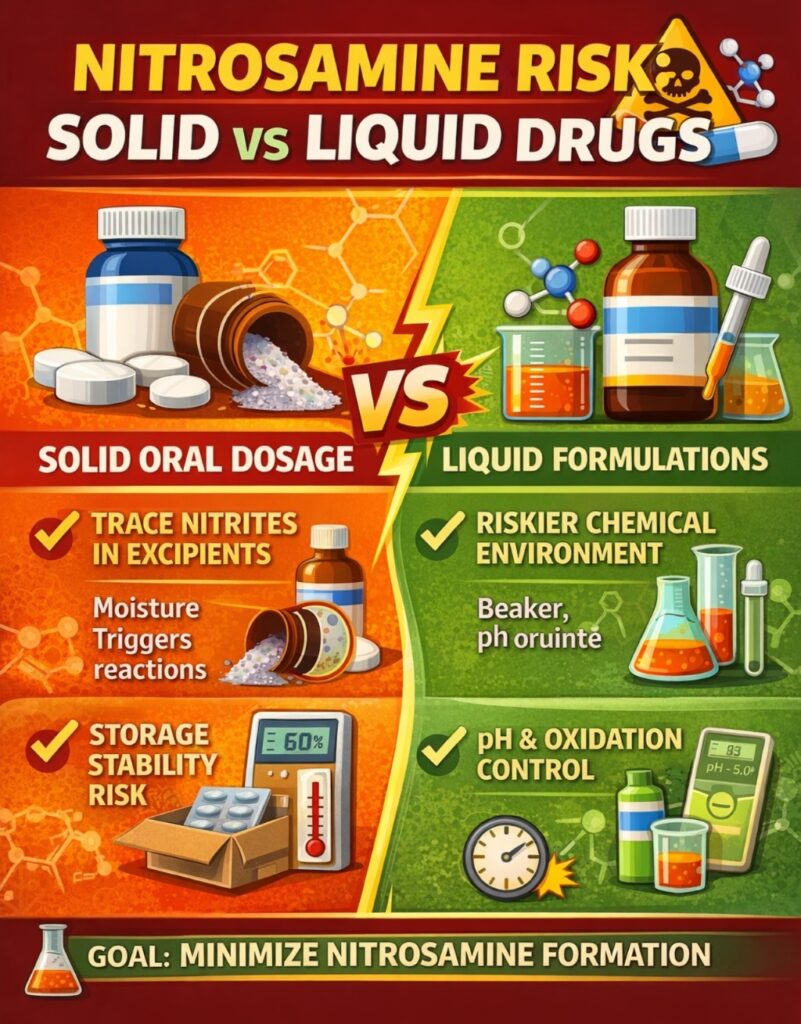
| Parameter | Solid Oral Dosage | Liquid Formulations |
|---|---|---|
| Reaction kinetics | Slow | Fast |
| Nitrite sources | Excipients | Water, preservatives |
| Moisture influence | Critical trigger | Already present |
| Stability risk | Long-term storage | Immediate reaction potential |
| Control strategies | Excipient control | pH and oxidation control |
This comparison shows why dosage-form-specific risk assessments are required under global regulatory guidance. Different pharmaceutical formulations create unique chemical environments that influence impurity formation pathways.
Conclusion
The Nitrosamine Risk in Solid vs Liquid Dosage forms differs due to variations in reaction environments, excipient composition, and formulation stability. Solid dosage forms often develop nitrosamines slowly during storage through interactions between nitrite-containing excipients and amine-containing APIs, especially in the presence of moisture. Proper excipient selection, moisture control, and protective packaging are therefore important for minimizing this risk.
Liquid formulations, on the other hand, allow faster chemical interactions because the reactants are already dissolved in solution. Factors such as pH, oxygen exposure, and formulation additives strongly influence nitrosamine formation in these systems. Effective control strategies, including pH optimization and the use of antioxidants, help reduce this risk.
Overall, understanding the Nitrosamine Risk in Solid vs Liquid Dosage is essential for developing safe pharmaceutical products. Formulation-specific risk assessment, careful material selection, and advanced analytical testing are key steps for maintaining product quality and regulatory compliance.
Finding a specialized partner is crucial for navigating these complexities. See our guide on Nitrosamine Testing CRO Selection.
If you require expert nitrosamine risk assessment, analytical testing, or regulatory support, connect with our specialists:
Frequently Asked Questions (FAQs)
The Nitrosamine Risk in Solid vs Liquid Dosage forms differs mainly because the reaction conditions are not the same. In liquid formulations, ingredients are dissolved and can move freely, which allows chemical reactions to occur faster. In solid dosage forms, molecules move more slowly, so reactions usually depend on factors such as moisture, temperature, and long-term storage conditions.
Both dosage forms can develop nitrosamines, but the risk appears in different ways. Liquid formulations may allow faster reactions because the reactants are already in solution. However, solid dosage forms can develop nitrosamines gradually during storage, especially when nitrite impurities in excipients interact with amine-containing APIs over time.
Some commonly used pharmaceutical excipients may contain trace levels of nitrite impurities. Materials such as crospovidone, sodium starch glycolate, lactose, and microcrystalline cellulose have been studied in relation to nitrosamine formation. The impurity levels may vary depending on manufacturing processes, supplier quality, and storage conditions.
Nitrites are considered problematic because they can act as chemical agents that trigger nitrosation reactions. When nitrites react with amines present in APIs or degradation products, nitrosamines may form as byproducts. Even very small amounts of nitrites can contribute to this reaction if the right conditions are present.
Moisture can play an important role in tablets because it helps dissolve certain impurities like nitrites. When these impurities become mobile, they can react with amine-containing compounds in the formulation. Over time, this interaction may lead to the formation of nitrosamines, especially under humid storage conditions.
Manufacturers can lower nitrosamine risk by carefully selecting excipients, monitoring nitrite levels in raw materials, and optimizing formulation conditions. Additional strategies include controlling pH, using antioxidants, and improving packaging to limit moisture exposure. These preventive steps help reduce the chances of unwanted chemical reactions.
Reference:
- U.S. Food and Drug Administration. (2023, August 4). Recommended acceptable intake limits for nitrosamine drug substance-related impurities (NDSRIs): Guidance for industry. https://www.fda.gov/regulatory-information/search-fda-guidance-documents/recommended-acceptable-intake-limits-nitrosamine-drug-substance-related-impurities
- Manchuri, K. M., Shaik, M. A., Gopireddy, V. S. R., Sultana, N., & Gogineni, S. (2024). Analytical methodologies to detect N-nitrosamine impurities in active pharmaceutical ingredients, drug products and other matrices. Chemical Research in Toxicology, 37(9), 1456–1483. https://doi.org/10.1021/acs.chemrestox.4c00234
- Tarafder, A., Vega, E., Beck, H. P., Mundal, D., Tilala, M., & Wang, S. (2025). Nitrosamine control: From risk assessment to analytical testing with emphasis on sample preparation and phase-appropriate method validation. Organic Process Research & Development. Advance online publication. https://doi.org/10.1021/acs.oprd.5c00158
Get In Touch With Us
About The Author


