Introduction:
Nitrosamine root cause investigation for injectable drugs is a critical analytical and pharmaceutical-development activity whenever a nitrosamine impurity is detected — or a formulation presents a credible risk of nitrosamine formation. Because injectable products are administered parenterally, identifying and controlling potentially mutagenic impurities requires a scientifically justified strategy supported by sensitive analytical testing and documented process understanding, distinct from the approach used for oral dosage forms.
Nitrosamines can originate from the API manufacturing process, API degradation, excipient-related nitrite sources, secondary or tertiary amine precursors, manufacturing conditions, or interactions occurring during storage. FDA’s September 2024 Control of Nitrosamine Impurities in Human Drugs guidance recommends risk assessment, confirmatory testing where risk is identified, and appropriate controls or mitigation strategies, building on principles first codified for mutagenic impurities more broadly — a distinction explored further in our comparison of ICH M7 versus FDA nitrosamine guidance.
The following case study illustrates how a pharmaceutical development team could investigate an elevated nitrosamine result in an injectable drug product and develop a scientifically defensible reformulation strategy.
Note: This is a representative case study constructed to demonstrate an investigation workflow. Product names, analytical results, and batch data are illustrative rather than claims about a specific marketed product.
Summary:
- Nitrosamine root cause investigation for injectable drugs requires evaluating the API, excipients, manufacturing process, packaging, storage conditions, and potential nitrosation pathways — not just re-testing the finished product.
- A positive nitrosamine result should trigger a science-based investigation, not simply a specification-setting exercise.
- For injectable products specifically, the investigation must weigh low-dose administration, parenteral exposure, excipient nitrite contribution, API-related precursors, process conditions, and product-contact materials.
- Current FDA and EMA expectations emphasize risk assessment, sensitive confirmatory testing, identification of formation mechanisms, and effective mitigation; FDA’s framework addresses both small-molecule nitrosamines and nitrosamine drug substance-related impurities (NDSRIs).
- Reformulation may involve excipient replacement or requalification, reduction of nitrite sources, pH/process optimization, changes to manufacturing conditions, or other scientifically justified controls.
- A successful investigation demonstrates not only that nitrosamine levels decrease, but also why the change works and whether the control strategy remains effective throughout shelf life.
- ResolveMass Laboratories Inc. supports analytical investigations involving trace-level impurity characterization, method development/validation, forced degradation, root-cause studies, and reformulation-support testing.
1: What Is the Root Cause of Nitrosamine Formation in an Injectable Drug Product?
The root cause is typically an interaction between a nitrosatable amine or API-related precursor and a nitrosating source, potentially influenced by formulation composition, manufacturing conditions, or storage. Therefore, the investigation must evaluate the entire product lifecycle rather than focusing exclusively on the API.
| Potential source | Investigation focus |
|---|---|
| API | Nitrosatable functional groups, process impurities, degradation pathways |
| API manufacturing | Nitrite/nitrosating reagents, solvents, process conditions |
| Excipients | Nitrite content, supplier variability, lot-to-lot variation |
| Water | Nitrite/nitrate contribution and process-water quality |
| Formulation pH | Conditions favorable to nitrosation |
| Manufacturing process | Mixing, hold times, temperature, and processing sequence |
| Container closure | Potential contribution from product-contact materials |
| Storage | Time, temperature, and degradation-related formation |
| Packaging | Extractables/leachables or reactive components where relevant |
FDA specifically notes that NDSRIs can form through nitrosation of APIs or API fragments containing susceptible amine functionality, and that residual nitrites in excipients can contribute to formation under suitable conditions. These same formation mechanisms have driven findings across a wide range of drug classes — from sartan APIs to proton pump inhibitors, SSRIs and antidepressants, and antibiotic and beta-lactam APIs — underscoring that no dosage form or API class is inherently exempt.
2: Case Study: Nitrosamine Root Cause Investigation for Injectable Drugs
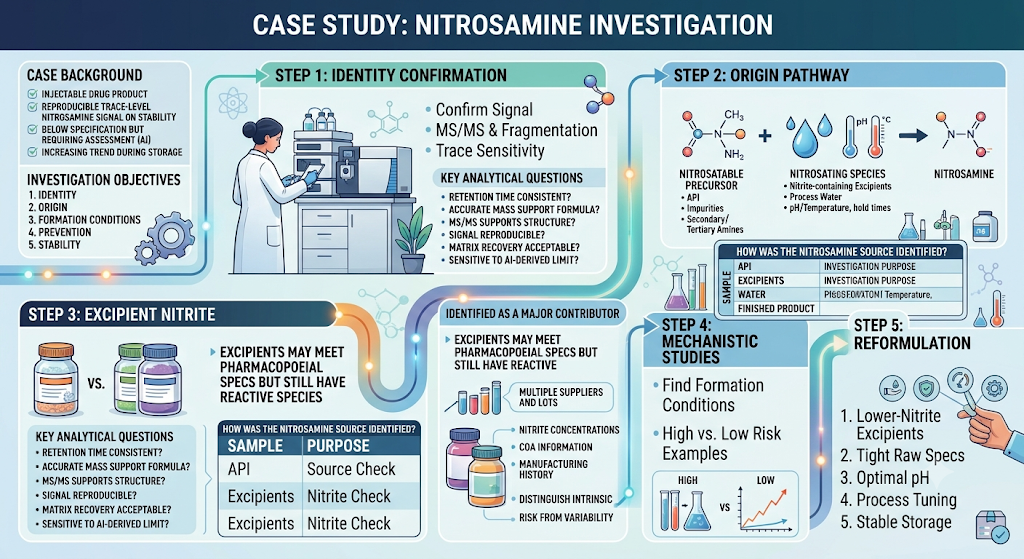
Case Background
An injectable drug product showed a reproducible trace-level nitrosamine signal during stability testing. Initial testing indicated that the impurity was below the product’s established specification but sufficiently significant to require a formal assessment against the applicable acceptable intake (AI). The development team initiated an investigation because the impurity concentration showed an increasing trend during storage — a pattern consistent with findings we’ve documented in dedicated nitrosamine testing programs for injectable drug products.
Initial Investigation Objectives
The investigation was designed to answer five questions:
- What nitrosamine is present?
- Where does it originate?
- Under what conditions does it form?
- Can formulation or process changes prevent formation?
- Does the revised product remain chemically and physically stable?
This approach is consistent with the regulatory emphasis on understanding potential formation pathways and implementing controls rather than relying solely on end-product testing.
Step 1: Confirm the Nitrosamine Identity
The first step in any nitrosamine root cause investigation for injectable drugs is confirming that the analytical signal represents a genuine nitrosamine rather than a matrix-related interference. A suitable analytical strategy may include:
- LC-MS/MS
- LC-HRMS
- High-resolution accurate-mass confirmation
- Retention-time comparison with an authentic reference standard, where available
- MS/MS fragmentation assessment
- Matrix-spike recovery
- Orthogonal confirmation where appropriate
For trace-level impurities, analytical specificity is particularly important because injectable formulations may contain multiple excipients and degradation products that can interfere with low-level measurements.
Key analytical questions:
- Is the retention time consistent with the suspected impurity?
- Does accurate mass support the proposed molecular formula?
- Does the fragmentation pattern support structural identity?
- Is the signal reproducible?
- Does matrix spiking demonstrate acceptable recovery?
- Is the method sufficiently sensitive for the applicable AI-derived limit?
FDA’s current framework includes specific recommendations concerning analytical methods for confirmatory testing of nitrosamine impurities.
Step 2: Map the Potential Nitrosation Pathway
Once the impurity was confirmed, the investigation moved from “What is present?” to “Why is it forming?” A pathway assessment follows a simple underlying logic: a nitrosatable precursor plus a nitrosating species plus a favorable chemical environment produces a nitrosamine.
For an injectable formulation, the team evaluated:
- API structure and API-related impurities
- Secondary amine or tertiary amine functionality
- Nitrite-containing excipients
- Water quality
- Formulation pH and temperature
- Manufacturing hold times and order of ingredient addition
- Sterilization-related conditions
- Container-closure interaction
- Stability storage conditions
This is important because nitrosamine formation can occur after API synthesis, including during drug-product manufacturing or storage. FDA recommends evaluating degradation pathways and nitrosamine precursor impurities as part of the drug-product risk assessment. Container-closure and packaging contribution is a particularly relevant line of inquiry for parenterals, echoing findings from our investigations into nitrosamine leachables in infusion bags and, for solid dose comparison, nitrosamine leachables in blister packaging.
How Was the Nitrosamine Source Identified?
The investigation used a component-by-component and process-stage comparison to identify the most probable source. Representative samples were tested from the API, individual excipients, excipient blends, purified water/process water, bulk formulation, finished product, stability samples, and packaging/contact components where scientifically justified. The purpose was to determine whether the nitrosamine entered with a raw material, formed during manufacturing, or increased during storage.
| Sample | Investigation purpose |
|---|---|
| API | Determine whether impurity originates upstream |
| Individual excipients | Identify potential nitrite contributors |
| Formulation before processing | Establish initial concentration |
| Post-manufacturing bulk | Assess process contribution |
| Finished injectable | Establish final level |
| Stability samples | Determine formation during storage |
| Packaging/contact materials | Evaluate secondary contribution where appropriate |
Step 3: Investigate Excipient-Related Nitrite
The investigation identified excipient nitrite variability as a major potential contributor. This is an important consideration because an excipient may meet its pharmacopoeial specification while still contributing a low-level reactive species relevant to nitrosamine formation.
FDA has specifically highlighted nitrite impurities in excipients as a potential source of NDSRI formation and has recommended consideration of supplier qualification and excipient-lot variability as part of mitigation strategies. The investigation compared:
- Multiple excipient suppliers and lots
- Nitrite concentrations across those lots
- Supplier specifications and Certificate of Analysis information
- Manufacturing history
- Formulation compatibility
This helped distinguish intrinsic formulation risk from supplier- or lot-dependent variability — the same kind of raw-material scrutiny applied in our nitrosamine leachables testing work and in risk assessments for other dosage forms, including proton pump inhibitor products.
Step 4: Forced Degradation and Mechanistic Studies
Forced degradation was then used to determine whether the nitrosamine could form under specific chemical conditions. The study evaluated controlled changes in pH, temperature, nitrite exposure, oxidative conditions, other relevant degradation conditions, storage duration, and API/excipient combinations.
The objective was not simply to produce degradation, but to establish a mechanistic relationship between formulation variables and nitrosamine formation. For example, higher nitrite combined with a susceptible API and a favorable pH increased nitrosamine formation, whereas reduced nitrite combined with optimized formulation conditions reduced it. Such experiments can provide stronger evidence for root-cause determination than relying solely on finished-product testing.
Step 5: Reformulation Strategy
The reformulation strategy focused on removing or reducing the factors required for nitrosamine formation while preserving product quality and performance.
1. Excipient selection — the formulation team evaluated alternative excipient grades and suppliers with lower and more consistent nitrite contribution.
2. Nitrite control — a tighter raw-material control strategy was evaluated to reduce variability in potential nitrosating species.
3. pH optimization — formulation pH was optimized to reduce the chemical conditions favorable to nitrosamine formation while maintaining API stability, solubility, compatibility, and injectable product performance.
4. Process optimization — manufacturing parameters were evaluated, including mixing time, temperature, hold time, ingredient addition sequence, bulk storage duration, and sterilization conditions.
5. Storage optimization — stability studies were used to determine whether revised storage conditions or packaging controls were necessary.
3: What Did the Reformulation Achieve?
In the representative case, the optimized formulation demonstrated a substantial reduction in nitrosamine formation compared with the original formulation, while maintaining the required critical quality attributes. The investigation showed that controlling nitrite contribution and optimizing formulation/process conditions could significantly reduce the formation pathway.
Importantly, the development team did not treat a lower analytical result as the sole endpoint — the revised formulation was evaluated for broader product quality, including:
- Assay
- Related substances
- Nitrosamine concentration
- Degradation products
- pH and appearance
- Particulate matter
- Sterility-related quality attributes, as applicable
- Stability
- Container-closure compatibility, where relevant
This demonstrates why nitrosamine mitigation should be treated as a product-development and control-strategy exercise, rather than an isolated analytical test.
4: Regulatory Expectations for Nitrosamine Risk Management
FDA’s September 2024 final guidance distinguishes between small-molecule nitrosamines and NDSRIs, and discusses risk assessment, testing, mitigation, and controls. FDA also maintains updated recommended AI limits and analytical-testing information, providing a framework for determining AI limits — including carcinogenic potency categorization when suitable compound-specific information is unavailable.
EMA’s current nitrosamine framework similarly addresses risk assessment, confirmatory testing, acceptable intakes, carcinogenic potency categorization, read-across, and enhanced Ames testing. Its Q&A was updated in October 2025, while its acceptable-intake appendix was updated in June 2026. For sponsors weighing mutagenic-impurity strategy more broadly, it’s also worth understanding how these nitrosamine-specific expectations relate to the general ICH M7 framework — see our comparison of ICH M7 versus FDA nitrosamine guidance.
A regulatory-ready investigation should document:
- Nitrosamine identification and risk assessment
- Potential formation pathways
- Confirmatory analytical testing
- AI determination
- Root-cause evidence and reformulation rationale
- Process changes and control strategy
- Stability data and batch-to-batch consistency
- Regulatory impact assessment
5: Why Analytical Expertise Matters in Nitrosamine Investigations
Nitrosamine investigations are challenging because target concentrations can be extremely low while pharmaceutical matrices can be analytically complex. A robust investigation requires alignment between analytical chemistry, formulation science, process understanding, toxicological assessment, and regulatory strategy.
At ResolveMass Laboratories Inc., an analytical investigation can be structured around:
- Trace-level nitrosamine analysis
- LC-MS/MS and high-resolution mass spectrometry
- Method development and optimization
- Method validation/verification
- Forced degradation studies
- Impurity profiling
- Excipient and raw-material investigations
- Stability testing
- Root-cause investigations
- Reformulation-support studies
- Regulatory-ready analytical documentation
The objective is to generate scientifically defensible evidence that can support pharmaceutical development and regulatory decision-making across dosage forms — a capability we’ve applied consistently, from combination oral solid dosage forms to sterile injectables.
6: Nitrosamine Root Cause Investigation Checklist
Before closing an investigation, teams should verify:
- Nitrosamine identity confirmed
- Analytical specificity demonstrated
- Appropriate sensitivity established
- API evaluated
- API manufacturing pathway reviewed
- Excipient nitrite risk assessed
- Supplier/lot variability investigated
- Water/process-water contribution assessed
- Formulation pH evaluated
- Manufacturing conditions assessed
- Storage-related formation evaluated
- Packaging/contact-material risk considered where relevant
- Forced degradation/mechanistic studies completed where justified
- Root cause scientifically supported
- Reformulation or mitigation strategy evaluated
- Revised formulation confirmed for critical quality attributes
- Stability demonstrated
- AI/control limits assessed
- Regulatory documentation prepared
7: Key Lessons for Nitrosamine Root Cause Investigation for Injectable Drugs
- Trend stability data specifically for nitrosamines rather than relying solely on release testing, since formation can be a slow, shelf-life-dependent process
- Investigate API, formulation/process, and packaging sources in parallel rather than sequentially, to avoid missing a contributing secondary source
- Treat excipient and preservative raw material specifications as a nitrosamine risk point, not just the API synthesis route
- Use forced degradation to build mechanistic evidence, not just confirmatory testing on finished product
- Validate corrective actions with orthogonal analytical methods across multiple batches before filing a permanent control strategy
Conclusion:
Nitrosamine root cause investigation for injectable drugs requires more than detecting and quantifying an impurity. A scientifically robust investigation connects the analytical result to a credible formation mechanism, identifies the contributing materials or process conditions, and demonstrates that the selected mitigation strategy consistently reduces risk. For injectable products, the strongest approach combines high-sensitivity analytical testing, API and excipient risk assessment, formulation/process investigation, forced degradation where appropriate, reformulation studies, and stability monitoring.
Current FDA and EMA expectations reinforce the importance of risk-based assessment, confirmatory testing, acceptable-intake evaluation, and effective mitigation of nitrosamine impurities.
Frequently Asked Questions:
Confirmation generally involves multiple lines of analytical evidence rather than relying on a single signal.
Retention time can be compared with an authentic reference standard when available.
Accurate mass and MS/MS fragmentation can provide additional structural confirmation.
Matrix-spike experiments help demonstrate that the detected signal corresponds to the target impurity.
Orthogonal confirmation may also be considered when the result or matrix presents analytical uncertainty.
Yes, nitrosamine formation can occur during manufacturing when the necessary chemical precursors and conditions are present.
Potential factors include nitrite sources, susceptible amines, pH, temperature, processing time, and ingredient sequence.
Manufacturing hold times and processing conditions should therefore be included in the investigation.
Comparing samples before and after critical manufacturing steps can help identify process-related formation.
Process optimization can then be evaluated as part of the mitigation strategy.
Yes, nitrosamine concentrations can potentially increase during storage if formation pathways remain active.
Temperature, time, pH, moisture, and degradation of the API or formulation components may influence formation.
Testing stability samples at multiple time points helps establish the impurity trend.
Comparing initial and stability results can distinguish an introduced impurity from one formed during storage.
Long-term stability data can help confirm whether the mitigation strategy remains effective.
Formulation changes should target the specific mechanism identified during the root cause investigation.
Potential strategies include selecting lower-nitrite excipients or alternative excipient grades.
pH and other formulation conditions may be optimized to reduce favorable nitrosation conditions.
Manufacturing hold times, temperature, or ingredient addition sequences may also be modified.
The revised formulation must still meet all relevant quality, stability, safety, and performance requirements.
Reference
- Dirat O, Urquhart MW, Akehurst H, Burns MJ, Dobo KL, Harvey J, Kuhl N, Schlingemann J, Tomlin P, Wetter C. Drug substance and drug product workflows for quality risk management for the presence of nitrosamines in medicines. Organic Process Research & Development. 2025 May 23;29(6):1538-53.https://pubs.acs.org/doi/abs/10.1021/acs.oprd.5c00097
- Rahangdale GD, Gupta KR, Umekar MJ. A Review of Nitrosamine Management in Pharmaceuticals: From Source to Solution. Current Analytical Chemistry. 2026 Jul;22(6):986-1011.https://www.benthamdirect.com/content/journals/cac/10.2174/0115734110388388250925134154
- Yerram S, Muhammad Nizam VP, Srivastava S, Nanduri S. Nitrosamine Contamination in Pharmaceuticals: A Retrospective Regulatory Analysis of USFDA Recalls and Risk Mitigation Strategies (2018–2025). Therapeutic Innovation & Regulatory Science. 2026 Mar;60(2):519-33.https://link.springer.com/article/10.1007/s43441-025-00891-y
- Bhirud D, Agrawal G, Shah H, Patel A, Palkar MB, Bhattacharya S, Prajapati BG. Nitrosamine impurities in pharmaceuticals: An empirical review of their detection, mechanisms, and regulatory approaches. Current Topics in Medicinal Chemistry. 2024 Mar 1;24(6):503-22.https://www.benthamdirect.com/content/journals/ctmc/10.2174/0115680266278636240125113509
About the Author