

Introduction
Nitrosamine Testing CRO Selection requires detailed scientific evaluation and regulatory awareness. Global authorities continue to update nitrosamine guidance, and acceptable intake limits are frequently revised. Testing methods must detect impurities at extremely low levels, often in the ppb or ppt range.
In many cases, risk assessments involve unknown impurities or Nitrosamine Drug Substance-Related Impurities (NDSRIs). These impurities require advanced structural analysis and toxicological understanding. Traditional impurity testing methods are not sufficient for this category.
Sponsors must evaluate more than just equipment. They must assess scientific expertise, validation quality, data integrity systems, and regulatory experience. This guide provides a practical and audit-ready checklist to support a strong and compliant Nitrosamine Testing CRO Selection process.
Executive Summary
Selecting the right partner for Nitrosamine Testing CRO Selection is a high-stakes technical and regulatory decision—not a procurement exercise. A structured due diligence process must verify:
- ✔ Regulatory inspection history (FDA, EMA, MHRA, TGA)
- ✔ Proven ultra-trace detection capability (ppt-level LOQs)
- ✔ Validated LC-MS/MS and GC-MS/MS platforms with orthogonal confirmation
- ✔ Expertise in NDSRIs risk assessment and structural elucidation
- ✔ Robust method validation aligned with ICH Q2(R2) & M7(R2)
- ✔ Demonstrated experience handling complex matrices (APIs, drug products, biologics)
- ✔ Strong data integrity systems (ALCOA+, Part 11 compliance)
- ✔ Transparent turnaround times and surge capacity
- ✔ Clear deviation/OOS investigation procedures
- ✔ Proactive regulatory intelligence and evolving guidance alignment
This technical checklist is designed to support quality, regulatory, and CMC leaders making defensible decisions in Nitrosamine Testing CRO Selection.
Share via:
1. Regulatory Inspection & Compliance History in Nitrosamine Testing CRO Selection
The first step is reviewing the CRO’s regulatory inspection history. Past inspections provide insight into quality systems, technical controls, and compliance culture. A CRO with a stable inspection record demonstrates operational maturity and regulatory readiness.
Careful review of past audit outcomes helps sponsors reduce downstream risk. Even small data integrity findings can create challenges during submission review. Therefore, inspection history must be evaluated in detail.
A technically capable CRO should demonstrate:
| Evaluation Parameter | What to Verify | Why It Matters |
|---|---|---|
| Regulatory inspections | FDA, EMA, MHRA, Health Canada audit outcomes | Indicates operational maturity |
| 483 observations | Nitrosamine-related citations? | Signals system gaps |
| Warning letters | Any data integrity or analytical deficiencies? | High regulatory risk |
| GMP certification | Current and applicable to testing scope | Legal compliance |
Key Due Diligence Questions
- Have they supported regulatory submissions involving nitrosamines?
- Have their methods been included in ANDA/NDA/MAA filings?
- Have regulators questioned their nitrosamine data?
Health authorities expect strong scientific justification, especially for NDSRIs. A CRO without inspection stability increases regulatory uncertainty.
Learn more about navigating regulatory shifts: Impact of ICH M7(R2) Updates on Nitrosamine Risk Assessment
2. Analytical Platform Capability for Ultra-Trace Detection
The CRO must prove that it can detect nitrosamines at or below regulatory acceptable intake limits. Sensitivity alone is not enough. Results must also be reproducible and scientifically justified.
Instrumentation should be modern, well-maintained, and properly qualified. Calibration records and performance checks should be readily available for review.
Required Instrumentation
- Triple Quadrupole LC-MS/MS (high sensitivity MRM transitions)
- GC-MS/MS for volatile nitrosamines
- High-Resolution Mass Spectrometry (HRMS) for unknown NDSRIs
- Stable isotope-labeled internal standards
- Orthogonal confirmation techniques
Technical Validation Evidence to Request
- Achieved LOQ values relative to FDA/EMA acceptable intake limits
- Signal-to-noise ratio at LOQ
- Matrix effect studies
- Recovery studies in complex formulations
- Carryover assessment data
If chromatograms at LOQ levels are not available, sensitivity claims should be reviewed carefully. Consistency across different matrices increases confidence in analytical reliability.
Explore specialized testing for sensitive compounds: Nitrosamine Testing for High-Risk Drug Classes
3. Method Validation Standards in Nitrosamine Testing CRO Selection
Method validation must align with ICH Q2(R2), ICH M7(R2), and current regulatory guidance. Because nitrosamine limits are extremely low, validation requirements are more demanding than for standard impurities. Documentation should be complete, traceable, and ready for audit review.
Critical Validation Parameters
- Specificity (including structural isomers)
- Accuracy (recovery 70–130% at trace levels)
- Precision (RSD ≤ 15% at LOQ)
- Robustness testing
- Linearity across regulatory thresholds
- Stability of standards and sample extracts
Red Flags
- Partial validation without robustness testing
- No stress or forced degradation data
- Missing system suitability criteria at ultra-trace levels
A disciplined validation approach ensures data reliability. Weak validation increases the risk of regulatory rejection.
See how ultra-low detection limits are achieved: Ultra-Low Limit of Quantitation (LOQ) in Nitrosamine Testing
4. Expertise in NDSRIs: A Critical Factor in Nitrosamine Testing CRO Selection
NDSRIs are among the most complex challenges in nitrosamine assessment. These impurities may form during manufacturing or degradation and often lack commercial reference standards.
A CRO should demonstrate strong analytical and toxicological expertise. Instrumentation alone is not enough; experienced scientists must lead these investigations.
Assess Whether the CRO Can:
- Conduct root cause investigations
- Perform in silico toxicological assessments
- Generate structure-activity relationship (SAR) data
- Support acceptable intake calculations
- Synthesize reference standards if needed
Technical Competency Checklist
- HRMS fragmentation interpretation expertise
- Experience in degradation pathway mapping
- Capability to prepare toxicology justification reports
Strong NDSRI expertise significantly strengthens the overall Nitrosamine Testing CRO Selection process.
Understand the regulatory approach for NDSRIs: Nitrosamine CPCA Approach for NDSRIs
5. Matrix Experience: APIs vs Finished Dosage Forms
Nitrosamine extraction differs between APIs and finished products. Each formulation presents unique challenges related to excipients, coatings, and packaging materials.
An experienced CRO should understand how matrix components affect recovery and detection. Poor extraction design may produce false positives or inaccurate quantitation.
Evaluate Experience With:
- High-dose APIs
- Low-dose potent APIs
- Extended-release tablets
- Biologics (where applicable)
- Complex excipient systems
- Blister-packaged products
Request anonymized case studies to confirm successful matrix-specific problem solving. Practical experience reduces unexpected analytical issues.
Compare analytical techniques for different matrices: Direct Injection vs. Headspace Techniques for Nitrosamines
6. Data Integrity & Digital Compliance in Nitrosamine Testing CRO Selection
Data integrity is critical because nitrosamine results may directly impact recall decisions. Even small errors can lead to regulatory enforcement or product withdrawal. Strong digital controls ensure defensible results.
Verify:
- 21 CFR Part 11 compliance
- Audit trail review procedures
- Controlled system access
- Secure data archiving
- Backup redundancy
- ALCOA+ adherence
Essential Documentation
- Data integrity SOPs
- OOS/OOT investigation workflows
- Change control logs
Transparent data governance reduces compliance risk and strengthens trust.
Prepare your regulatory package with confidence: Nitrosamine Risk Assessment for ANDA Submission
7. Turnaround Time, Capacity & Surge Readiness
Nitrosamine testing often becomes urgent due to regulatory deadlines or supply chain pressures. A CRO must balance scientific quality with operational efficiency.
Capacity limitations can delay submissions and impact commercial timelines. Therefore, sponsors should review operational readiness carefully.
Assess:
- Standard vs expedited turnaround times
- Instrument redundancy
- Analyst availability
- Global shipping logistics
- Sample stability controls
Strong planning and contingency systems prevent bottlenecks during critical phases.
Ensure long-term product quality: Nitrosamine Testing in Stability Studies
8. Risk Assessment & Regulatory Strategy Support
A high-quality CRO provides more than laboratory testing. It acts as a scientific partner during risk assessments and regulatory discussions.
Nitrosamine control strategies often require coordination between analytical chemistry, toxicology, and regulatory teams. Early collaboration reduces submission risk and improves clarity.
Look for:
- Participation in formal risk assessments
- Guidance on control strategy design
- Trending data interpretation
- Support during regulatory authority questions
Strategic collaboration strengthens long-term compliance and submission success.
Master complex impurity calculations: Nitrosamine Purge Factor Calculation
9. Transparent Communication & Reporting Standards
Reports must be clear, detailed, and easy to review. Regulators should be able to independently evaluate the data without confusion.
Incomplete or unclear reports may trigger additional information requests. Structured and transparent reporting reduces review delays.
Reports should include:
- Full chromatograms
- Integration parameters
- LOQ justification
- Method references
- Deviation summaries
- Stability study interpretation
Clear communication builds confidence between sponsor and laboratory.
10. Commercial & Contractual Risk Controls
Technical capability must be supported by strong legal agreements. Clear contracts prevent misunderstandings and protect confidential information.
Long-term partnerships require well-defined responsibilities and data ownership terms. Early legal review avoids future disputes.
Review:
- Confidentiality agreements
- Intellectual property ownership terms
- Liability clauses
- Data retention timelines
- Subcontracting disclosures
Clear contractual structure supports stable collaboration.
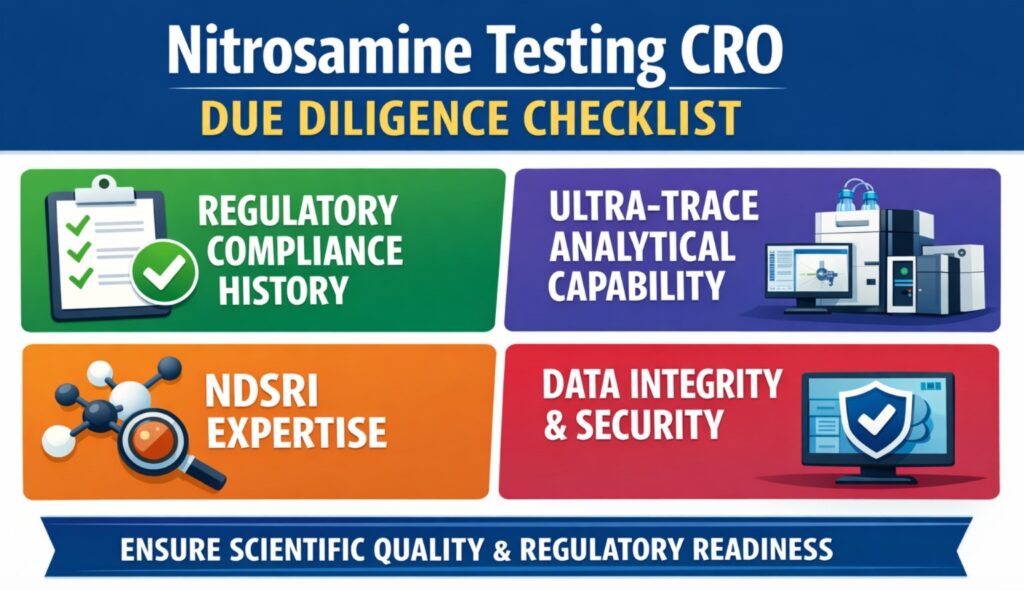
Comprehensive Nitrosamine Testing CRO Selection Checklist
| Category | Verification Status |
|---|---|
| Regulatory inspection clean history | ☐ |
| Validated ppt-level LOQ | ☐ |
| HRMS capability for NDSRIs | ☐ |
| ICH-compliant validation reports | ☐ |
| Data integrity audit passed | ☐ |
| Surge testing capacity | ☐ |
| Regulatory submission experience | ☐ |
| Root cause investigation expertise | ☐ |
| Toxicological support available | ☐ |
| Transparent reporting standards | ☐ |
Conclusion: Making a Defensible Nitrosamine Testing CRO Selection
A structured and scientifically sound Nitrosamine Testing CRO Selection process protects regulatory approvals, company reputation, and patient safety. Ultra-trace analysis and NDSRI investigations require advanced instrumentation and deep scientific knowledge.
Cost should never be the only deciding factor. Regulatory resilience, validated analytical methods, structural expertise, and strong data integrity systems must take priority.
By following this checklist, pharmaceutical companies can confidently complete their Nitrosamine Testing CRO Selection with reduced regulatory risk. Thorough documentation also strengthens inspection readiness and internal quality systems.
Partner With Confidence
If you require technical consultation or would like to discuss nitrosamine risk assessment strategies:
👉 Contact our scientific team:
Contact ResolveMass Today
Frequently Asked Questions (FAQs)
The most important factor is the ability to detect nitrosamines at extremely low levels that meet current regulatory limits. The CRO must show validated LOQs supported by accuracy, precision, and reproducibility data. Without proven ultra-trace capability, the reliability of results can be questioned during regulatory review.
You can request case studies, sample reports, and evidence of past regulatory submissions involving nitrosamines. Reviewing inspection outcomes and anonymized chromatograms at LOQ levels also helps confirm hands-on expertise. Practical experience is just as important as technical capability.
Nitrosamine results often influence major regulatory and commercial decisions, including recalls. Even small documentation gaps can raise compliance concerns. Strong audit trails, secure systems, and ALCOA+ practices ensure the data can withstand inspection scrutiny.
Most nitrosamine methods require LOQs in the low parts-per-billion or even parts-per-trillion range. The required level depends on the acceptable intake and maximum daily dose of the product. The CRO must clearly demonstrate that the LOQ is validated and consistently achievable.
Validation should be reviewed whenever regulatory guidance changes or when there are process or formulation updates. Periodic reassessment ensures continued compliance with evolving global expectations. Keeping validation current reduces regulatory risk.
Sponsors should review validation reports, SOPs, inspection history, data integrity procedures, and representative test reports. These documents provide insight into quality systems and technical rigor. Thorough review helps ensure a defensible Nitrosamine Testing CRO Selection.
Reference:
- U.S. Food and Drug Administration. (2023). CDER nitrosamine impurity acceptable intake limits. https://www.fda.gov/regulatory-information/search-fda-guidance-documents/cder-nitrosamine-impurity-acceptable-intake-limits
- U.S. Food and Drug Administration. (2024, September 4). Information about nitrosamine impurities in medications. https://www.fda.gov/drugs/drug-safety-and-availability/information-about-nitrosamine-impurities-medications
- European Medicines Agency. (2025, July 29). Nitrosamine impurities. https://www.ema.europa.eu/en/human-regulatory-overview/post-authorisation/referral-procedures-human-medicines/nitrosamine-impurities
Get In Touch With Us
About The Author


