

The Critical Role of Nitrosamine Testing for a Metformin Generic
Nitrosamine Testing for a Metformin Generic is a critical regulatory and public health requirement aimed at detecting and quantifying trace concentrations of carcinogenic impurities, such as N-nitrosodimethylamine (NDMA), before pharmaceutical products reach patients. This comprehensive analytical process helps protect patients from long-term mutagenic and carcinogenic risks while also shielding pharmaceutical manufacturers from costly product recalls, regulatory enforcement actions, and reputational damage. Following the widespread global recalls of extended-release (ER) metformin products in 2020, health authorities worldwide transitioned from voluntary testing recommendations to mandatory life-cycle risk assessment and testing programs.
┌────────────────────────────────────────────────────────┐
│   Nitrosamine Testing for a Metformin Generic          │
└───────────────────────────┬────────────────────────────┘
                            │
              ┌─────────────┴─────────────┐
              ▼                           ▼
┌───────────────────────────┐┌───────────────────────────┐
│   Trace-Level Detection   ││  Regulatory Compliance    │
│   (LOQ down to 0.1 ng/mL) ││  (FDA/EMA limits of       │
│                           ││   96 ng/day)              │
└───────────────────────────┘└───────────────────────────┘
To learn more about the fundamental concepts and safety implications, visit our guide on what are nitrosamines.
The occurrence of mutagenic impurities in essential medications used to manage type 2 diabetes presents a significant challenge because patients cannot abruptly discontinue treatment without risking serious disruptions in glycemic control. As a result, Contract Research Organizations (CROs) such as ResolveMass Laboratories Inc. utilize highly sensitive mass spectrometry technologies to verify product purity with a high degree of confidence. Through customized analytical method development and validation performed under cGMP, ISO/IEC 17025, and internationally recognized regulatory guidelines, scientists generate the critical data necessary to support Abbreviated New Drug Application (ANDA) submissions and routine commercial batch release testing.
Are you evaluating potential partners for your testing needs? Learn how to optimize your outsourcing-nitrosamine-testing-to-a-cro/.
Share via:
Article Summary:
Regulatory Limits Demanding Nitrosamine Testing for a Metformin Generic
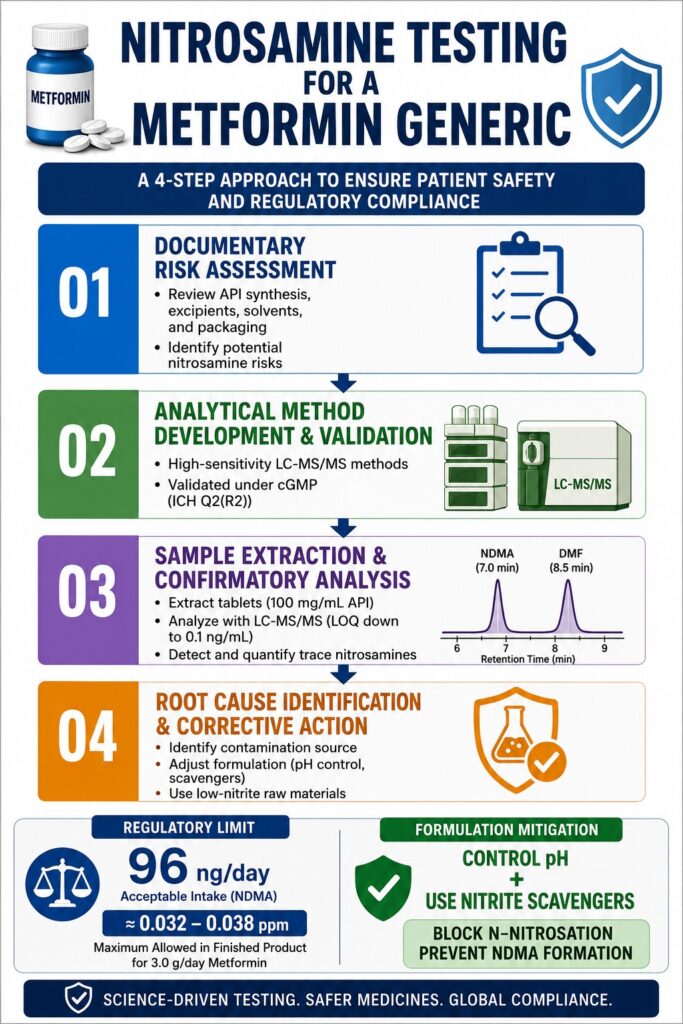
The regulatory requirements governing Nitrosamine Testing for a Metformin Generic are internationally aligned around an acceptable intake (AI) limit of 96 nanograms of NDMA per day. This threshold corresponds to an estimated lifetime cancer risk of one additional case per 100,000 individuals exposed continuously over a 70-year period. To establish a permissible concentration limit within a specific drug product, this daily exposure limit must be adjusted according to the maximum daily dose (MDD) of the formulation.
For clarity on specific regulatory requirements, check our article: do-all-drugs-need-nitrosamine-risk-assessment/.
For both immediate-release (IR) and extended-release (ER) metformin products, the maximum daily dose may reach as high as 3.0 grams per day. Based on this dosage, regulatory agencies including the European Medicines Agency (EMA) and the United States Food and Drug Administration (FDA) have translated the 96 ng/day acceptable intake into a finished product concentration limit ranging approximately from 0.032 ppm to 0.038 ppm. Regulatory frameworks established by the FDA, EMA, and Health Canada require that any metformin batch exceeding this limit be withheld from distribution or voluntarily recalled from the market.
Regulatory Limits and Carcinogenic Potency Categorization
The table below summarizes recommended acceptable intake (AI) limits for several common small-molecule nitrosamines and drug substance-related impurities (NDSRIs) according to current FDA and EMA guidance.
| Nitrosamine Impurity Name | Primary Source / Associated API | Potency Category | Recommended AI Limit (ng/day) |
|---|---|---|---|
| N-nitrosodimethylamine (NDMA) | Metformin, Ranitidine, Sartans | Compound-Specific | 96 |
| N-nitrosodiethylamine (NDEA) | Multiple APIs (e.g., Sartans) | Compound-Specific | 26.5 |
| N-nitroso-vonoprazan | Vonoprazan API | NDMA Surrogate | 96 |
| N-nitroso-desmethyl-almotriptan | Almotriptan API | 1 | 26.5 |
| N-nitroso-amoxapine | Amoxapine API | 3 | 400 |
| N-nitroso-abacavir | Abacavir API | 5 | 1500 |
Precursor Pathways Assessed During Nitrosamine Testing for a Metformin Generic
The precursor pathways evaluated during Nitrosamine Testing for a Metformin Generic primarily involve the interaction between secondary amines, particularly residual dimethylamine (DMA), and nitrosating agents that may be present in manufacturing environments or formulation excipients. Understanding these pathways requires a detailed assessment of the API synthesis process and the physicochemical properties of the final dosage form.
To understand the chemical origins of these impurities, read about nitrosamine-formation-pathways-api-synthesis/.
During the synthesis of metformin hydrochloride, dimethylamine (DMA) reacts with cyanoguanidine to produce the characteristic biguanide structure. Although purification procedures are employed extensively, trace amounts of DMA can remain within the API. Standard manufacturing specifications often allow residual amine concentrations of up to 500 ppm. In addition, under conditions involving elevated temperature, high humidity, or extreme pH, metformin itself may degrade and release free DMA into the formulation matrix.
[
\text{Metformin HCl Degradation} \xrightarrow{\Delta, \text{ Moisture}} \text{Dimethylamine (DMA)} + \text{Degradation Products}
]
When the product is exposed to trace levels of nitrosating species such as nitrous acid ((HNO_2)) or nitrous anhydride ((N_2O_3)), rapid N-nitrosation can occur, producing NDMA.
[
\text{Dimethylamine (DMA)} + \text{Nitrosating Agent } (N_2O_3)
\rightarrow
\text{N-nitrosodimethylamine (NDMA)} + HNO_2
]
Raw Material Risks Mitigated by Nitrosamine Testing for a Metformin Generic
The raw material risks addressed through Nitrosamine Testing for a Metformin Generic include trace nitrite and nitrate contamination in excipients, along with degradation products originating from solvents used during API manufacturing. Comprehensive risk assessments must evaluate each of these factors because even minor variations in raw material quality can result in finished products exceeding acceptable nitrosamine limits.
If you are managing complex supply chains, see our advice on nitrosamine-testing-cro-selection/.
Excipients are recognized as a significant source of trace nitrite ((NO_2^-)) contamination in solid oral dosage forms. Common excipients such as microcrystalline cellulose (MCC), starch, and lactose may contain low concentrations of nitrites resulting from agricultural processing, water contamination, or industrial bleaching operations. Although these impurities often exist only at parts-per-billion levels, their chemical reactivity makes them important contributors to nitrosamine formation.
Furthermore, industrial solvents including N,N-dimethylformamide (DMF), N,N-dimethylacetamide (DMAc), and N-methyl-2-pyrrolidone (NMP) present additional concerns. These solvents may undergo hydrolysis or thermal degradation, releasing free DMA that can subsequently serve as a precursor for NDMA formation. Advanced mass spectrometry screening of raw materials allows manufacturers to identify and reject high-risk excipient lots while transitioning to low-nitrite alternatives containing less than 100 ppb nitrite.
Step-by-Step Protocols in Nitrosamine Testing for a Metformin Generic
The procedures used in Nitrosamine Testing for a Metformin Generic follow a structured framework that begins with documentary risk assessment and progresses through highly sensitive laboratory analysis using validated instrumentation. This multi-level approach is required by regulatory agencies including the FDA, EMA, and Health Canada to identify, quantify, and mitigate mutagenic impurities throughout the entire product life cycle.
┌──────────────────────────────────────────────────────────────────┐
│  STEP 1: Documentary Risk Assessment                             │
│  - Audit API synthesis, excipient nitrites, and solvent decay    │
│  - Conduct packaging and blister-pack adhesive E&L studies       │
└────────────────────────────────┬─────────────────────────────────┘
                                 │
                                 ▼
┌──────────────────────────────────────────────────────────────────┐
│  STEP 2: Analytical Method Development and Validation            │
│  - Select high-sensitivity columns (e.g., Evosphere AQUA)        │
│  - Validate under cGMP in accordance with ICH Q2(R2)             │
└────────────────────────────────┬─────────────────────────────────┘
                                 │
                                 ▼
┌──────────────────────────────────────────────────────────────────┐
│  STEP 3: Sample Extraction and Confirmatory Analysis             │
│  - Standardize tablet extraction protocols (100 mg/mL API)       │
│  - Execute high-resolution Orbitrap or Triple Quad LC-MS/MS      │
└────────────────────────────────┬─────────────────────────────────┘
                                 │
                                 ▼
┌──────────────────────────────────────────────────────────────────┐
│  STEP 4: Root Cause Identification and Corrective Action         │
│  - Formulate with pH modifiers (Na2CO3) and nitrite scavengers   │
│  - Transition to low-nitrite excipient grades (<100 ppb)         │
└──────────────────────────────────────────────────────────────────┘
Ensure your methodology is compliant by exploring our nitrosamine-method-development-and-validation-services/.
Documentary Risk Assessment
Manufacturers perform comprehensive reviews of API synthetic pathways, raw material sources, excipient compositions, and water quality systems. Assessments also include evaluation of container closure systems for potential leachables and extractables, including secondary amines and nitrites that may migrate from blister-pack adhesives, polymer coatings, inks, and packaging materials.
Analytical Method Development and Validation
When nitrosamine risk is identified, a customized analytical method is developed specifically for the product under investigation. The method must be validated according to ICH Q2(R2) requirements to demonstrate specificity, linearity, precision, accuracy, robustness, and reproducibility.
Sample Extraction and Confirmatory Analysis
Validated extraction procedures are employed to efficiently recover trace nitrosamines from the complex metformin formulation matrix. Following extraction, samples are analyzed using high-resolution Orbitrap systems or triple quadrupole LC-MS/MS platforms to generate accurate quantitative impurity profiles.
Root Cause Identification and Corrective Action (CAPA)
When nitrosamines are detected above established limits, investigators conduct comprehensive root cause analyses to identify the contamination source. Corrective and preventive actions often include formulation modifications involving pH modifiers, nitrite scavengers, or replacement of high-risk excipients with low-nitrite alternatives.
Resolving Analytical Interferences During Nitrosamine Testing for a Metformin Generic
Addressing analytical interferences during Nitrosamine Testing for a Metformin Generic requires achieving sufficient chromatographic separation between NDMA and co-eluting N,N-dimethylformamide (DMF). This separation is essential because DMF is both a commonly used synthetic solvent and a degradation precursor that may exist in metformin products at concentrations up to one million times greater than NDMA.
                 CHROMATOGRAPHIC RESOLUTION BARRIER

         Standard C18 Column             Evosphere AQUA Column
         ┌───────────────────┐           ┌───────────────────┐
         │  NDMA + DMF       │           │  NDMA   │   DMF   │
         │  Co-elution       │           │  Peak   │   Peak  │
         │                   │           │  (7.0m) │  (8.5m) │
         └─────────┬─────────┘           └─────────┬─────────┘
                   │                               │
                   ▼                               ▼
       Mass Spectrometry Overlap         Clean Quantitation at
       & Overestimated NDMA              m/z = 75.0553
When metformin extracts are analyzed using traditional reversed-phase (C_{18}) columns, NDMA exhibits poor retention due to its highly polar nature. Consequently, NDMA may co-elute with residual DMF. As DMF concentration increases, column overload effects can further decrease retention time. The (^{15}N) and (^{13}C) isotopes of DMF possess the same nominal mass as the protonated molecular ion of NDMA (([M+H]^+), (m/z \approx 75.0553)). Low-resolution mass spectrometers are unable to distinguish these ions effectively, resulting in spectral overlap and historically contributing to false-positive NDMA findings.
To eliminate this analytical challenge, scientists at ResolveMass Laboratories Inc. utilize advanced Monodisperse Fully Porous Particle (MFPP) technologies such as the Evosphere® AQUA column. This polar-endcapped stationary phase delivers enhanced selectivity for highly polar analytes, enabling complete separation of NDMA and DMF under gradient conditions using a simple mobile phase consisting of 0.05% trifluoroacetic acid (TFA) in water and acetonitrile.
For deep insights into how to handle these challenges under ICH M7 guidelines, refer to genotoxic-impurity-testing-ich-m7-nitrosamines/.
High-Sensitivity LC-MS/MS Confirmatory Nitrosamine Testing for a Metformin Generic
High-sensitivity LC-MS/MS confirmatory Nitrosamine Testing for a Metformin Generic employs liquid chromatography-tandem mass spectrometry systems operating in positive Atmospheric Pressure Chemical Ionization (APCI) or Electrospray Ionization (ESI) modes. These systems provide highly selective Selected Reaction Monitoring (SRM) and Parallel Reaction Monitoring (PRM) transitions, enabling simultaneous detection and quantification of multiple nitrosamines at trace levels.
For analysis of finished tablet products, samples are prepared at a target concentration of (100 \text{ mg/mL}) API. Tablets are crushed and dissolved in methanol, vortex-mixed for five minutes, and sonicated for ten minutes. Following extraction, samples are centrifuged at 13,000 rpm at (6^\circ C) to separate insoluble excipient components. The resulting supernatant is filtered through a (0.2\ \mu m) PVDF syringe filter. The first (0.2\text{ mL}) of filtrate is discarded to minimize the possibility of filter-derived contaminants before transfer into HPLC vials for analysis.
Chromatographic Parameters for Confirmatory Testing (Evosphere AQUA vs. FDA Methods)
| Chromatographic Parameter | Evosphere® AQUA MFPP Method | FDA Validated LC-HRMS Method |
| Column Phase | Polar-endcapped alkyl chain | Reversed-phase ((C_{18}) or HSS T3) |
| Column Dimensions | (150 \times 4.6\text{ mm}), (3\ \mu m) | (100 \times 3.0\text{ mm}), (1.8\ \mu m) |
| Mobile Phase A | 0.05% TFA in water | 0.1% Formic acid in water |
| Mobile Phase B | 100% Acetonitrile (MeCN) | 100% Methanol or MeCN |
| Flow Rate | (1.0\text{ mL/min}) | (0.4\text{ mL/min}) |
| Column Temperature | (25^\circ C) | (35^\circ C) to (40^\circ C) |
| Injection Volume | (50\ \mu L) | (20\ \mu L) to (40\ \mu L) |
| Ionization Source | ESI Positive Mode | APCI or HESI Positive Mode |
| Resolution Target | Baseline NDMA/DMF Separation | Resolution >35,000 FWHM |
Mass Spectrometry Parameter Settings for APCI and ESI Modes
| Parameter | TSQ Quantis APCI Mode | Q-Exactive Orbitrap ESI Mode |
| Scan Type | SRM | PRM |
| Polarity | Positive Ion Mode | Positive Ion Mode |
| Sheath Gas Flow Rate | 45 arbitrary units | 50 arbitrary units |
| Auxiliary Gas Flow | 5 arbitrary units | 15 arbitrary units |
| Corona Discharge Current | (4\ \mu A) | N/A (Spray Voltage: (3.5\ kV)) |
| Capillary Temperature | (275^\circ C) | (350^\circ C) |
| Auxiliary Gas Heater Temperature | (350^\circ C) | (350^\circ C) |
| Isolation Window | Unit Resolution Q1/Q3 | (1.5\ m/z) |
Method Validation and System Suitability for Nitrosamine Testing for a Metformin Generic
Method validation and system suitability evaluations for Nitrosamine Testing for a Metformin Generic are conducted in accordance with stringent ICH Q2(R2) requirements. These studies establish assay specificity, sensitivity, precision, accuracy, and robustness within the challenging matrix of metformin drug products. Such validation data are essential for regulatory submissions, batch release decisions, and inspection readiness.
Validation Metrics for a Panel of Nitrosamines
| Nitrosamine Impurity | Linearity Range (ng/mL) | Correlation (R², n=8) | LOD (ng/mL) | LOQ (ng/mL) | Recovery (%) | Precision (%RSD) |
| NDMA | 0.5–9.5 | 0.9990 | 0.33 | 1.00 | 99.52–100.21 | 3.42–4.85 |
| NMEA | 0.5–9.5 | 0.9997 | 0.16 | 0.49 | 100.03–104.08 | 4.76–5.48 |
| NDEA | 0.5–9.5 | 0.9970 | 0.32 | 0.97 | 103.69–106.13 | 3.17–5.58 |
| NDPA | 0.5–9.5 | 0.9992 | 0.26 | 0.79 | 98.99–103.09 | 3.23–5.92 |
| NDBA | 0.5–9.5 | 0.9960 | 0.48 | 1.46 | 92.61–96.31 | 2.50–8.10 |
| NPip | 0.5–9.5 | 0.9976 | 0.45 | 1.36 | 98.39–102.99 | 4.73–8.89 |
| NPyr | 0.5–9.5 | 0.9958 | 0.49 | 1.48 | 97.53–103.22 | 5.53–5.94 |
| NMor | 0.5–9.5 | 0.9981 | 0.39 | 1.20 | 98.96–101.76 | 5.78–10.55 |
To maintain system suitability during routine testing, laboratories typically inject a (3.0\text{ ng/mL}) working standard six consecutive times before initiating sample analysis. The resulting peak area %RSD must not exceed 10%.
The same working standard is subsequently injected after every six sample injections and again at the end of the analytical sequence. The cumulative %RSD for all standard injections must remain below 15%. Any detected peak exhibiting a signal-to-noise ratio of at least 3 is reported in ppm using three significant figures when above the LOD. Results below the LOD are reported as “not detected.”
Developing Formulation Mitigation Strategies Linked to Nitrosamine Testing for a Metformin Generic
Developing formulation mitigation strategies linked to Nitrosamine Testing for a Metformin Generic focuses on interrupting N-nitrosation pathways through pH control and the incorporation of active nitrite scavengers. These approaches enable manufacturers to proactively manage nitrosamine risk during formulation development and maintain compliance throughout the product shelf life.
                 FORMULATION MITIGATION MECHANISMS

      Acidic Micro-pH                      Weakly Basic Micro-pH
┌──────────────────────────┐             ┌──────────────────────────┐
│ Active Nitrosating Agent │             │  Unreactive Nitrite      │
│ (Nitrous Acid, HNO2)     │             │  (Deprotonated, NO2-)    │
└────────────┬─────────────┘             └────────────┬─────────────┘
             │                                        │
             ▼                                        ▼
┌──────────────────────────┐             ┌──────────────────────────┐
│  Rapid N-nitrosation of  │             │  Reaction Blocked;       │
│  Secondary Amines        │             │  Zero NDMA Formation     │
│  (High NDMA Risk)        │             │  (Safe Generic Product)  │
└──────────────────────────┘             └──────────────────────────┘
The rate of nitrosamine formation depends heavily on the protonation states of both nitrite species and amine precursors. Nitrosation reactions occur when deprotonated secondary amines interact with nitrous acid ((HNO_2)) or nitrous anhydride ((N_2O_3)), both of which are generated more readily under acidic conditions. Incorporating 0.1% to 1.0% sodium carbonate ((Na_2CO_3)) into the formulation shifts the microenvironmental pH toward a weakly basic range, thereby reducing active nitrous acid concentrations and suppressing nitrosation reactions.
In addition, antioxidants such as ascorbic acid, caffeic acid, and ferulic acid may be incorporated at concentrations ranging from 0.5% to 1.0%. These compounds function as sacrificial nitrite scavengers, rapidly consuming trace nitrites before they can react with secondary amines. This strategy has proven highly effective in preventing NDMA formation during long-term stability studies conducted under stressed storage conditions of (40^\circ C) and 75% relative humidity.
If your initial tests show concerning levels, explore our nitrosamine-reformulation-strategy/.
Conclusion: Future Compliance via Nitrosamine Testing for a Metformin Generic
Achieving long-term compliance through Nitrosamine Testing for a Metformin Generic requires a comprehensive, science-driven strategy that integrates rigorous documentary risk assessments with highly sensitive confirmatory LC-MS/MS analysis. By identifying nitrosamine precursor pathways and overcoming analytical challenges such as DMF co-elution, manufacturers of generic medicines can maintain product quality, ensure patient safety, and satisfy evolving global regulatory expectations.
Collaborating with an experienced analytical testing laboratory such as ResolveMass Laboratories Inc. provides access to specialized expertise, validated methodologies, advanced instrumentation, and complete cGMP-compliant documentation. Located in Laval, QC, our facility is equipped with state-of-the-art Orbitrap HRMS and triple quadrupole LC-MS/MS platforms that enable PhD-level scientists to perform rapid and highly reliable trace impurity profiling at ppt-level sensitivity. By combining advanced analytical capabilities with proactive formulation design, pharmaceutical developers can minimize recall risks, protect public health, and accelerate successful regulatory approvals.
Need to plan your roadmap? See our nitrosamine-testing-timeline/ to ensure your project stays on track.
Frequently Asked Questions (FAQs)
Nitrosamine Testing for a Metformin Generic is required because certain nitrosamine compounds, particularly N-nitrosodimethylamine (NDMA), are recognized as probable human carcinogens. Regulatory agencies introduced stringent testing requirements after elevated NDMA concentrations were identified in several metformin products worldwide. The objective is to ensure that patients are not exposed to unsafe levels of these impurities during long-term therapy. Manufacturers must therefore perform risk assessments and analytical testing to demonstrate that NDMA concentrations remain within acceptable regulatory limits throughout the product lifecycle.
Global regulatory authorities have established an acceptable daily intake (AI) limit of 96 nanograms of NDMA per day for metformin-containing products. This limit is designed to minimize potential carcinogenic risk associated with long-term exposure. Depending on the maximum daily dose of the formulation, the allowable concentration in the finished product generally ranges from approximately 0.032 ppm to 0.038 ppm. Any product exceeding these limits may require further investigation, corrective action, or market withdrawal.
N,N-dimethylformamide (DMF) can interfere with NDMA analysis because both compounds exhibit similar chromatographic behavior under certain testing conditions. On conventional chromatographic columns, DMF may co-elute with NDMA, making accurate separation difficult. Additionally, naturally occurring isotopic forms of DMF possess the same nominal mass as protonated NDMA, creating overlapping signals in low-resolution mass spectrometers. This analytical interference can result in overestimation of NDMA concentrations and the reporting of false-positive results.
The Evosphere® AQUA column is widely recognized as an effective solution for separating NDMA from DMF during nitrosamine analysis. Its polar-endcapped alkyl chain chemistry and Monodisperse Fully Porous Particle (MFPP) technology provide improved retention and selectivity for highly polar compounds. This enhanced chromatographic performance allows clear baseline separation between NDMA and DMF, even when DMF is present at significantly higher concentrations. As a result, laboratories can achieve more accurate quantification and improved confidence in analytical results.
The formation of NDMA in metformin products is generally associated with the presence of dimethylamine (DMA) and nitrosating agents such as nitrites. DMA may originate from residual materials used during API synthesis or from the degradation of metformin and certain processing solvents. At the same time, trace nitrite impurities can be introduced through excipients, water systems, or manufacturing materials. When these components interact under favorable conditions, nitrosation reactions may occur, leading to NDMA formation.
Although both formulations require evaluation, extended-release (ER) metformin products generally present a higher nitrosamine formation risk than immediate-release (IR) formulations. ER products often contain complex polymer matrices and may undergo manufacturing processes involving elevated temperatures and moisture exposure. These conditions can promote the degradation of precursor compounds and increase opportunities for nitrosation reactions during storage. Consequently, ER formulations frequently receive greater regulatory scrutiny regarding nitrosamine control strategies.
Sample preparation for nitrosamine analysis begins with crushing tablets and preparing an extract at a target API concentration of approximately 100 mg/mL. Methanol is commonly used as the extraction solvent to recover trace nitrosamines from the formulation matrix. Following extraction, the sample is mechanically mixed, centrifuged to remove insoluble materials, and filtered through a 0.2 µm or 0.22 µm PVDF syringe filter. The initial portion of the filtrate is typically discarded to minimize potential contamination from the filtration process.
Generic manufacturers can reduce nitrosamine formation by modifying formulation characteristics that contribute to nitrosation reactions. Weakly basic pH modifiers, such as sodium carbonate (Na₂CO₃), can help maintain a microenvironment that discourages the formation of active nitrosating species. In addition, antioxidants including ascorbic acid, caffeic acid, and ferulic acid may be incorporated as nitrite scavengers. These ingredients react preferentially with nitrites, reducing the likelihood of NDMA generation during storage and stability studies.
Reference:
- Mir, M., Ahmed, N., & Rehman, A. U. (2018). Recent applications of PLGA based nanostructures in drug delivery. Colloids and Surfaces B: Biointerfaces, 159, 217–231. https://doi.org/10.1016/j.colsurfb.2017.07.038
- Lamichhane, S., Bal Krishna, K. C., & Sarukkalige, R. (2020). Polycaprolactone (PCL), polylactic acid (PLA), and their copolymers in biomedical applications: A review. Polymers, 12(5), 1186. https://doi.org/10.3390/polym12051186
- U.S. Food and Drug Administration. (2020). Liquid chromatography-high resolution mass spectrometry (LC-HRMS) method for the determination of N-nitrosodimethylamine (NDMA) in metformin drug substance and drug product. U.S. Department of Health and Human Services. https://www.fda.gov/media/134914/download
- Pallio, G., Bitto, A., Pizzino, G., Galfo, F., Irrera, N., Interdonato, M., Squadrito, F., & Altavilla, D. (2024). Advances in biodegradable polymers: Degradation mechanisms, biomedical applications, and future perspectives. International Journal of Molecular Sciences, 25(20), 10989. https://doi.org/10.3390/ijms252010989
- U.S. Food and Drug Administration. (n.d.). FDA updates and press announcements on NDMA in metformin. U.S. Department of Health and Human Services. Retrieved June 11, 2026, from https://www.fda.gov/drugs/drug-safety-and-availability/fda-updates-and-press-announcements-ndma-metformin
- U.S. Food and Drug Administration. (n.d.). Questions and answers: NDMA impurities in metformin products. U.S. Department of Health and Human Services. Retrieved June 11, 2026, from https://www.fda.gov/drugs/drug-safety-and-availability/questions-and-answers-ndma-impurities-metformin-products
- U.S. Food and Drug Administration. (n.d.). Information about nitrosamine impurities in medications. U.S. Department of Health and Human Services. Retrieved June 11, 2026, from https://www.fda.gov/drugs/drug-safety-and-availability/information-about-nitrosamine-impurities-medications
Get In Touch With Us
About The Author


